Design & Build
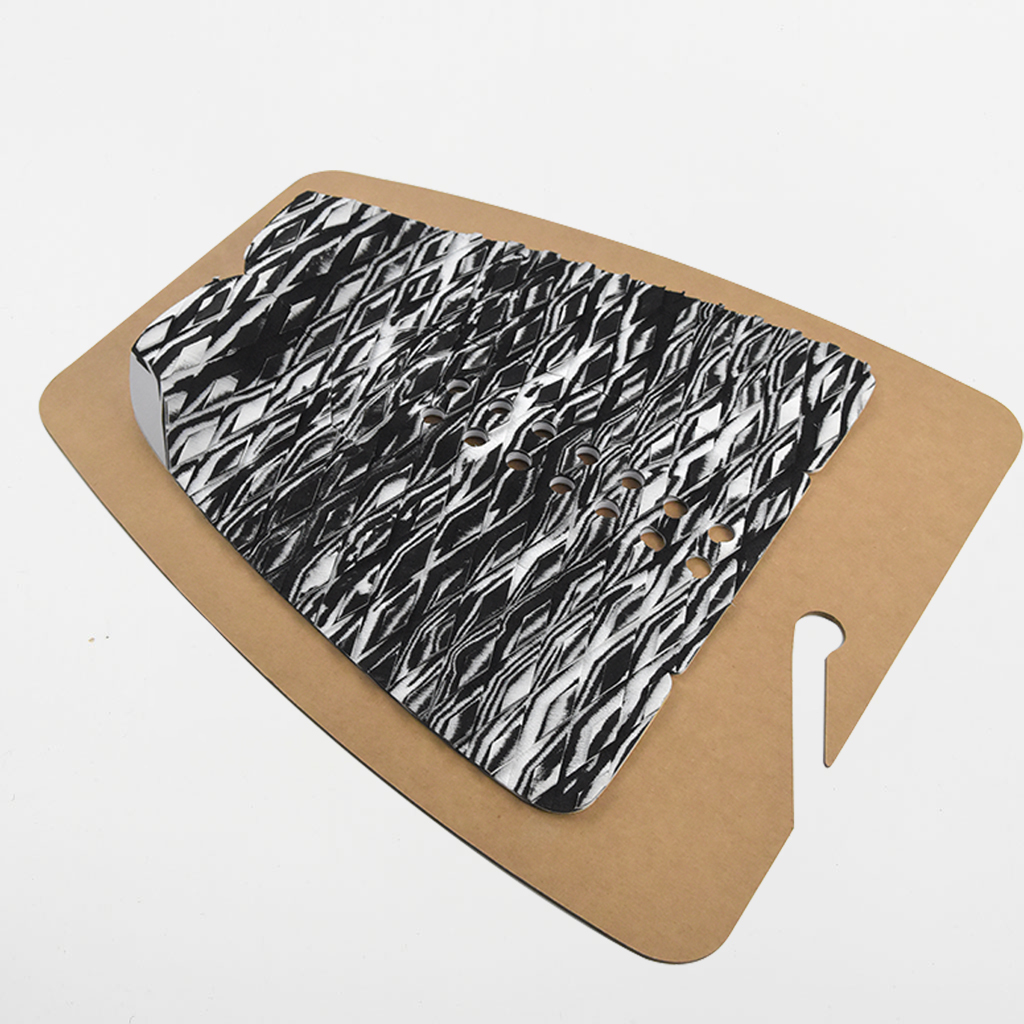
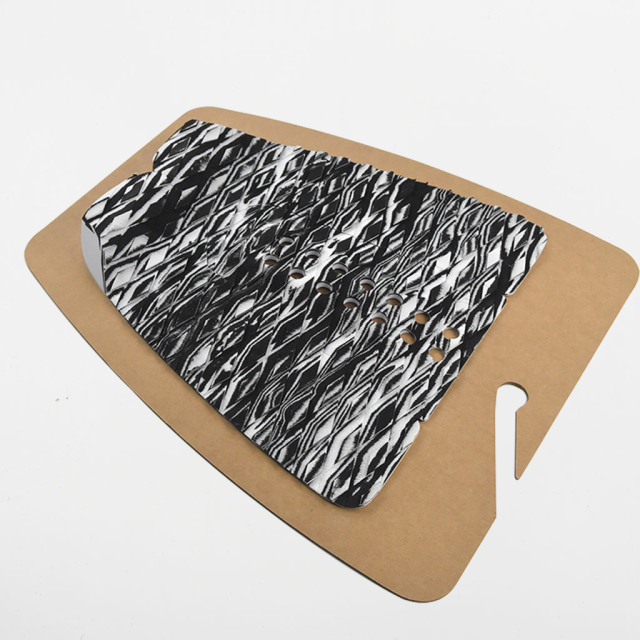
- Wave graphic across the plate. The black-and-white wave runs the length of the plate, so the design reads from the beach, from a shelf and in a product photograph. On a surfboard tail pad the graphic is usually what a rider picks first and what a buyer ranges first, which is why it gets the full plate here rather than a small logo.
- One-piece construction with rounded corners. The pad is a single flat plate, so there is no arch or kick piece to line up and nothing to stack on the deck. Rounded corners give the edge less to catch going in and out of a bag or a board stack, which is where lifting usually begins.
- Round-hole contact cluster. A tight group of small round holes sits in the middle of the plate, exactly where the back foot presses hardest. The holes break that contact area up and give water and sand somewhere to escape instead of sheeting under the foot — useful when a board comes out of choppy water with the deck still wet.
- A footprint that suits more than a shortboard. The same plate sits well on a wide square tail, where a rider is often looking for a longboard traction pad rather than a short, narrow one. Do a dry fit against the tail outline before the backing comes off; it tells you more than any drawing can.
- Edge and finish. The plate has a visible, even edge and a smooth gloss surface over the pattern. That gloss is what makes the graphic look sharp when the pad is new, and it is also the part that rewards the cleaning routine set out further down this product.
- Shelf-ready hanger card. Pads leave us on a kraft card, ready to peg or stand on a shelf. If the pad is going straight onto a board instead, the card lifts away before fitting.
- A bold black-and-white wave runs across a single flat plate, broken by a tight cluster of small round holes where the back foot sits. That is the whole idea of this surf traction pad: a piece of deck grip that goes on the tail so the back foot stays planted through a turn instead of skating across worn or waxed foam. The plate is cut in one piece with rounded corners, so there is no arch or kick section to line up and nothing stacked up on the deck. Once the old grip is off, fitting is a peel-and-stick job, which suits a shop refitting a customer's board, a rental operation working through a season of tired decks, and a buying team that wants a design reading clearly from a peg or a shelf edge. Reference No.00565 identifies this design. The wave graphic and the round-hole cluster are what tell it apart from the other tail pads in the family, so a board that comes back for a replacement can be matched to the right plate. Fit it where a pad has glazed over or lifted at the edge, or add it to a range that already carries our plainer grips.
Fitting to the Deck
- Strip the old surfboard traction pad back to the deck. Warm the old adhesive, lift a corner with a plastic scraper and work it away slowly, then clear the residue. Let the deck dry completely before going any further.
- Mark the position with tape. Set the pad where the back foot actually lands, check that both sides of the tail look even, and run a strip of tape along the front edge as a guide. Sight that guide against the stringer before the backing comes off — on a longboard traction pad, a line slightly out of square shows clearly once you reach the tail.
- Check the leash plug. The plate should finish clear of the plug so a surfboard leash still threads and swivels without rubbing against the edge of the pad.
- Look at the tail from underneath. Note where the surfboard fins are fitted and how the tail outline runs, so you know the deck area you are working on is flat and free of repairs.
- Clean and dry the deck. Wipe the area with a clean cloth and a solvent that flashes off completely, leaving no wax, dust, oil or fingerprints behind.
- Peel and set. Lift a short strip of backing at the front of the pad, align it to the tape guide, press it down, then peel the rest as you work towards the tail, pressing the plate flat as you go.
- Work the edges and let it settle. Press the rounded corners firmly with your thumb, run along the whole edge once more, and leave the board flat while the adhesive takes hold. If your workshop works to a fixed turnaround, ask us for the settling time we recommend.
Grip Care & Storage
Rinse it after every session. Salt water dries into a fine film that settles into the pattern and dulls the surface. A quick rinse under the tap, a shake and a wipe with a towel is enough to keep the plate working the way it did on its first surf, and it takes less time than rinsing a wetsuit.
Wash out sunscreen and wax. Sunscreen, wax crumbs and sand collect in the holes and along the edge. Mild soap, a soft brush and lukewarm water lift them out; solvent-heavy cleaners, acetone and abrasive pads do the opposite and take the finish off the plate along with the dirt.
Keep heat off the deck. A board left face-up in strong sun, or shut in a hot car, builds heat in the deck and in the adhesive under the pad. Store it face-down or in shade, and keep wax irons and hot wax tools well away from the edge of the plate.
Store it on a surfboard rack or in a bag. Boards stacked flat on top of one another press the pad against whatever is above it, and a pad held compressed for months can stay flattened. A surfboard rack, a wall position or a cover keeps the deck clear, and a cover also keeps UV off the graphic between sessions.
Know when the surface has gone. When the pattern starts to look polished flat where the back foot sits, and water stops breaking up across it, the texture has worn out rather than got dirty. Scrubbing harder will not bring it back — that is the point to fit a new plate, and it is worth telling a customer the same thing before they try three different cleaners on it.
Companion Range
- Surfboard leash. Hypalon leashes in 6 ft 6 mm, 7 ft 7 mm, 8 ft 7 mm and 9 ft 8 mm cover small days through to a longer board. - Surfboard fins. Honeycomb fins made by resin transfer moulding, supplied in single tab and double tab, with timber, G10 glass and nylon fins further along the range. - Traction. Tail pads, centre pads, skimboard pads and waxless pads make up the family this design belongs to.
Specifications
| Product type | Surfboard traction pad (tail pad) |
| Design reference | No.00565 |
| Pattern | Black-and-white wave graphic with a round-hole contact cluster |
| Form | Single flat plate with rounded corners |
| Deck position | Tail of the board, under the back foot |
| Fixings | Peel-and-stick adhesive backing, no separate glue |
| Surface | Smooth gloss finish over the printed pattern |
| Edge | Visible, even plate thickness with rounded corners |
| Boards | Surfboards, longboards and similar decked boards with a tail area |
| Packing | Kraft hanger card for peg or shelf display |
| Companion ranges | Leash, fins, traction, cover, surfboard rack |
| Care | Fresh water rinse, mild soap, soft brush, air dry out of direct sun |
| To confirm | Design match, quantity, packing and lead time with our sales team |
Ordering & Confirmation
- Tell us the design, the quantity and the market it is going to. We work as surf board manufacturers, so pads can be built to your artwork, packed for your shelf and scheduled around your season.
- Confirm the packing. Pads leave us on a kraft hanger card; if your chain needs something different for the surfboard tail pad — a sleeve, a barcode label, a different hole — say so and we will tell you what is possible.
- Raise your own branding early. If the plate should carry your logo or your own card, mention it before the order is fixed so the design work is planned in rather than added at the end.
- Ask about samples. If you need to feel the surface and the edge before committing, ask your sales contact about sample availability.
- Plan the mixed order. Pads, covers and a surfboard leash can go on one list so the shipment arrives together and the reorder list stays short.
- Add storage and display if you need it. A surfboard rack, travel rax or display fittings can be planned with the pad order rather than bought in separately later.
- Confirm lead time, payment and shipping. These are set per order, so check the current position with your sales contact before you plan a launch or a shelf reset.
Scale & Supply Capability
CIMI is a factory-based supplier with 16 years in surf and watersports hardgoods, manufacturing at our own facility rather than sourcing through traders. Chain stores, supermarkets and surf-brand stores buy from us because one supplier covers a full accessory assortment, so a season's order and its reorders can be planned together. We take on OEM and private-label work, adapting designs, colourways and branding to your programme, and we schedule production against your agreed range plan. Send us your buy list and target dates, and we will confirm what we can make and when.
FAQ
Will this pad fit my board's tail?
Do a dry fit against the tail outline before the backing comes off — that answers most of it. On a narrow, pulled-in tail there may be more pad than deck, and a shorter design from the range is the better answer; on a wide square tail this surfboard tail pad sits comfortably. If you are unsure, send us the tail width and a photo of the deck and we will point you to the right plate.
What does the round-hole cluster actually do?
It breaks up the contact area under the back foot. Instead of one large smooth surface, the holes give water and sand somewhere to escape when the deck is wet, and the raised pattern around them is what the foot presses against. On a surf traction pad that cluster also marks the design from a distance, so a customer can pick the same one off a shelf without reading the label.
Does it work on a longboard?
It can, provided the tail is wide and square enough to take the plate. A rider moving onto a wider board is often looking for a longboard traction pad with a longer footprint, so check the tail area first and ask us about the other designs in the family if this one looks short on the deck.
Can I fit it over an old pad, or straight onto a repair?
Never over an old pad — the surface underneath has to be the deck itself, or the new surfboard traction pad will lift at the edge within a few weeks of use. A cured and sanded repair is fine as long as it is flat, sound and completely dry before the backing comes off.
How do I make sure a repeat order matches?
Send a photo of the pad on the board, or of the card it came on, and describe the graphic. As surf board manufacturers we keep design references on file, so a repeat order is matched against the pattern itself rather than against a name someone half remembers.
Do the fins need to come off to fit a pad?
No. The plate goes on the deck and the surfboard fins sit on the underside, so one has nothing to do with the other. It is still worth looking at the tail from both sides before you start, so you know exactly where the fin box and the leash plug sit.