Product Overview
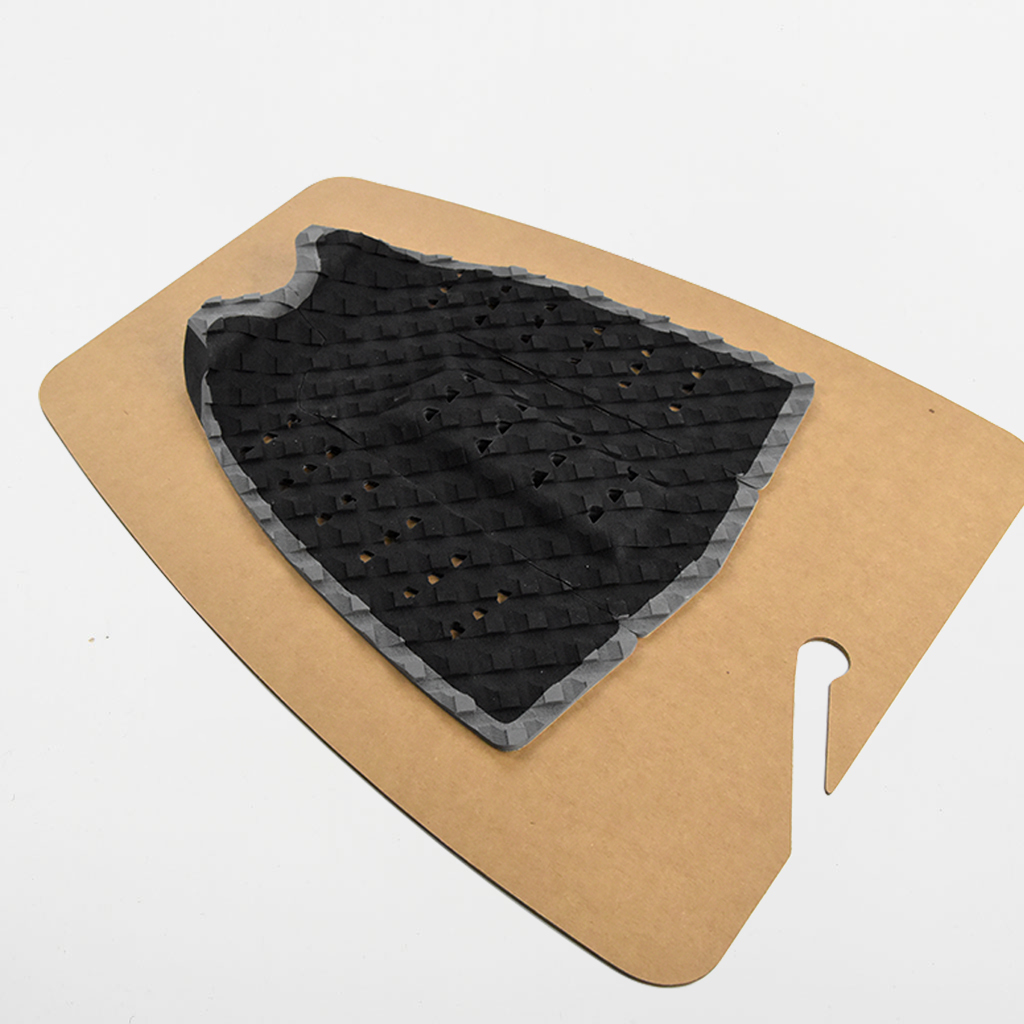
This is a peel-and-stick surfing traction pad for the back-foot area of a board, cut with a raised square grid across the deck side and finished with a grey trim around the edge. It sits on the tail, so your back foot lands on texture instead of bare glass or worn wax, and it stays registered through turns, cutbacks and the walk back up the beach after a set. The pattern is one of the uncoded designs in the tail-pad family — the pad itself carries no printed code, so on a peg wall it is the look rather than a number that identifies it. No.00566 is the reference we quote for it. On a longer board this pad covers the back-foot zone while a longboard traction pad section covers the deck further forward; the two are cut for different parts of the board and are meant to be stocked together rather than one replacing the other. Most buyers who take this design are running a deck-grip section rather than a single hook: surf shops, board-rental fleets and the accessory buyers at outdoor chains. Shops that already carry surfboard fins and leashes usually add traction to the same reorder, because all three sell to the same customer who walks in with a board under an arm. This grid is a quiet pattern that holds the middle of a range — not a novelty — so it can stay on the shelf across seasons while louder designs rotate around it.
Key Features
- Raised square grid: rows of raised blocks give the back foot something to read through the arch and heel, so you can feel where the tail is even through a wetsuit boot.
- Cut as a surfboard tail pad, not a deck sheet: the shape follows the back-foot zone, so the grip sits where the pressure actually goes instead of spreading thin across the whole board.
- Perforations between the squares: small holes break the surface up so water does not sit in one sheet under the sole, and the deck keeps a little breathing room beneath the pad.
- Peel-and-stick backing: the adhesive is already on the pad, so there are no clamps, jigs or resin, and a shop can fit one between customers.
- Grey edge trim: a finished border that keeps the outline clean against the rail and stops the pattern reading as a raw cut.
- Cushioned body: softens the landing on the tail without turning the deck vague underfoot.
- Works from a first board to a quiver: the pattern is neutral enough for a beginner's deck and specific enough that an experienced surfer will pick it for the tail. As a surfing traction pad it never asks the rider to change how they stand.
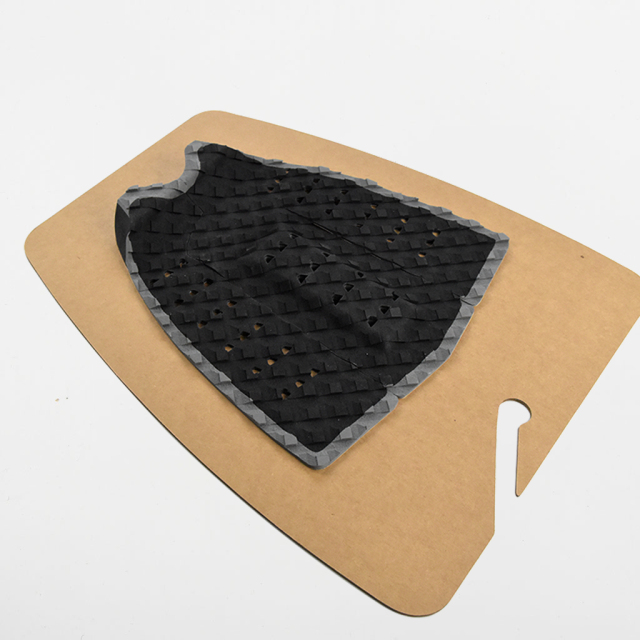
- The deck side is a raised square grid in a matte black finish, with a narrow grey trim running the full perimeter. That trim is a fabric-backed edge, and it is what gives the outline a clean line instead of a raw cut that catches on a bag or a wetsuit sleeve. Every surfboard traction pad we make follows the same logic: a cushioned body that sits flat on the tail curve, an adhesive applied at the factory, and a texture dense enough to hold a foot without being abrasive against bare skin. The grid here is fine rather than chunky, so it reads as texture at arm's length and as grip underfoot. We do not publish a thickness or weight figure, because the number that matters is how the pad feels on your own deck. If you need dimensions for a shelf plan or a product listing, send us the board width you are fitting and we will measure the pad you would actually receive.
Coverage & Board Fit
- Tail zone only: this surfboard tail pad is cut for the area under the back foot, from the top of the tail kick up to where the arch of the foot lands. Everything forward of that stays bare glass or wax.
- Full-deck grip is a different product, not a bigger version of this one: the T00443 HEXA Traction Board Grip is our all-over option — one continuous hex sheet that replaces wax across the whole standing area. Same family, different coverage, so choose by how much of the deck you want covered rather than by pattern.
- Take the tail pad when you wax forward of the tail, want to keep the deck feel under your front foot, are patching a worn back-foot zone on a board that is otherwise sound, or ride a board where wax belongs on the front half.
- Take the full grip when the deck is being re-gripped from scratch — a new build, a school or rental fleet that should look and feel uniform board to board, or a rider moving off wax altogether.
- Do not stack the two: laying a tail pad over an existing full-deck grip doubles the thickness under the back foot and lets water sit between the layers. Strip the old sheet completely first.
- On longer boards, run this pad at the tail and add a longboard traction pad section forward of it, keeping both aligned to the stringer. A surf front traction pad is a separate cut for the centre of the deck and is not a substitute for either.
- Confirming the fit: tell us the tail width where your back foot lands and whether you wax forward of the pad, and we will say whether the tail cut or the hex full grip suits the board. A soft or delaminated deck needs repairing before either goes on.
Fitting Guide
- Strip the old grip completely, including the adhesive line around the edge. A new pad can only sit as flat as the surface underneath it.
- Wipe the tail down with fresh water and let it dry fully. Wax, oil, sunscreen and old release agent all sit on the deck and will find the adhesive before the water does.
- Set the surfboard tail pad in place with the backing still on and stand over the board to check where your back foot actually lands. Move it before you peel, not after.
- Mark the outline with a strip of tape if you are fitting several boards the same way, so every deck in a rental set ends up looking identical.
- Peel a short section of backing at the nose end, anchor that edge, then work the rest down from the centre outwards, pressing air out ahead of the pad as you go.
- Run a thumb firmly around the trim and over the perforations, then leave the board to settle before it goes back in the water.
- Check the edges after the first session. A corner pressed back down early stays down; one left to curl will lift again.
Care & Longevity
- Rinse after every saltwater session: salt dries into the grid and leaves a crust that blunts the texture long before the pad itself wears out.
- Keep solvents away: wax remover, acetone and harsh cleaners attack the adhesive at the edge and dull the trim. A lifted edge is the beginning of the end for any surf traction pad.
- Scrape wax, do not cut it: if wax builds up in the squares, lift it with a plastic scraper and warm water rather than a blade.
- Do not bake the board: leave it deck-up in full sun for hours and the adhesive softens under any pad. A tail pad that slides is worse than one that has worn smooth.
- Walk the edges once a month on a fleet: press down anything that has started to lift and note which boards need replacing before the season starts.
- Replace when the squares flatten: once the raised blocks have worn into a smooth sheet, no amount of cleaning will bring the grip back.
Shelf Presentation
This design earns its place by contrast. On a peg run of bold, high-contrast graphics, a fine square grid in black with grey trim reads as the calm option, and that calm is what makes the louder pads beside it sell — a customer needs something to compare against. Put it between two visually different patterns rather than next to a near-identical one; two fine grids side by side simply look like a printing error.
Keep the cuts grouped the same way. A surf front traction pad covers the area forward of the back foot, so it belongs on the same shelf as the tail pads but on its own hook with its own signage, rather than mixed into the tail-pad run where the shapes blur together.
Where a shop also carries a longboard traction pad, put the wider cut on the lower hook so the difference in size is obvious at a glance and a customer can choose by board type without opening a pack.
The pack does some of the work for you. The pad leaves the factory on a kraft hang card with a die-cut hole, so it sits on the same peg wall as the surfboard leash line without needing a shelf slot or a box. One fitted board at the end of the run, with this grid under the back foot, will sell the texture faster than any copy printed on the card.
The Wider Accessory Range
| Category | What it covers |
| Leash | Regular, non-slip and Hypalon surfboard leash styles, from shortboard lengths up to 9 ft |
| Fins | Honeycomb, timber, G10 glass and nylon surfboard fins, in single tab and double tab |
| Traction | Our surfboard traction pad range: tail pads, skimboard pads and waxless pads |
| Centre pads | A surf front traction pad for the area forward of the back foot, in matching patterns |
| Covers | Basic bags, regular bags, stretch covers and bodyboard bags |
| Racks | Travel tie-downs, storage racks, display racks and bike racks |
Ordering & Delivery
- Send the design you are matching — a photo of the pad already on your shelf, or the pattern reference — so we can confirm which design in the range it corresponds to.
- Tell us the quantity split across designs and the in-store date you are working to, and we will confirm availability and the production slot that fits.
- Confirm how the pad should be packed.
- Say whether the order needs a surfboard leash alongside the pads, so it is picked and documented on the same order.
- Sets of surfboard fins, covers and racks can travel with the same buy; mention them at enquiry so they are included in one quotation.
- Ask your sales contact about sample availability and current terms if your team needs to feel the texture before committing.
- Tell us who the order is for — chain stores, distributors and surf board manufacturers all buy this range, and it changes what we quote and how we schedule it.
Scale & Supply Capability
CIMI is a factory-based supplier with 16 years in surf and watersports hardgoods, manufacturing at our own facility rather than sourcing through traders. Chain stores, supermarkets and surf-brand stores buy from us because one supplier covers a full accessory assortment, so a season's order and its reorders can be planned together. We take on OEM and private-label work, adapting designs, colourways and branding to your programme, and we schedule production against your agreed range plan. Send us your buy list and target dates, and we will confirm what we can make and when.
FAQ
Where exactly should the pad sit on the tail?
Directly under the back foot, not at the very tip of the tail. Stand on the board in your normal stance and mark where the ball of your back foot lands; the pad should cover that spot with a little margin behind it, so the foot never rolls off the end of the grip. A surfboard traction pad fitted too far forward interferes with the arch of the foot, and one fitted too far back hangs over the tail curve and lifts.
Will it work on a longboard or a wide-tailed board?
Yes, with a note on coverage. The pad is cut for the back-foot zone, so on a longer board it covers the area you actually stand on and leaves the rest of the deck bare, which many longboarders prefer because it keeps the glide feel under the front foot. If you want grip further forward as well, run a longboard traction pad section alongside it and keep the two aligned to the stringer.
How do I stop the edges lifting after fitting?
Almost every lifted edge starts with something under the pad. Strip all the old adhesive, wipe the deck with fresh water and let it dry completely before the backing comes off — no wax, no oil, no dust. Then press the trim down hard with a thumb rather than a flat palm, working right around the perimeter, and leave the board alone before it goes back in the water. Check the corners after the first session and press down anything that has started to move.
Does the grid still grip with wet or waxy feet?
That is what the raised squares are for. The texture stands proud of the deck, so a wet foot presses into the gaps instead of sliding across a flat surface, and the perforations stop water sitting in one sheet under the sole. Wax on the foot reduces grip on any surf traction pad, so wipe your feet before you paddle out and keep wax on the deck rather than on the grip.
Can I trim the pad to fit a narrower tail?
We would not recommend it. This is supplied as a finished surfboard tail pad with a trimmed edge, and cutting into it leaves an open border that will lift sooner than a factory edge. If your tail is unusually narrow, tell us the width you are working with and we will point you to the closest shape in the range instead.
How is this different from a full-deck grip?
A full-deck grip covers most of the board; this covers only the back-foot zone. That matters if you want to keep the feel of the deck under your front foot, if you still wax the board forward of the tail, or if you are replacing a worn patch rather than re-gripping the whole deck. As a surfing traction pad it does the same job as a full grip in the one place most of the pressure goes.
Which other pads sit in the same range?
Tail pads in several patterns form the core of it, with centre pads, skimboard pads and waxless pads around them, plus a surf front traction pad for the area forward of the back foot. The designs are meant to be stocked together rather than picked one at a time — the contrast between patterns is what makes the shelf work.