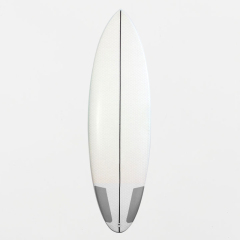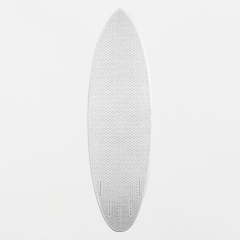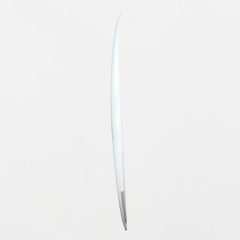
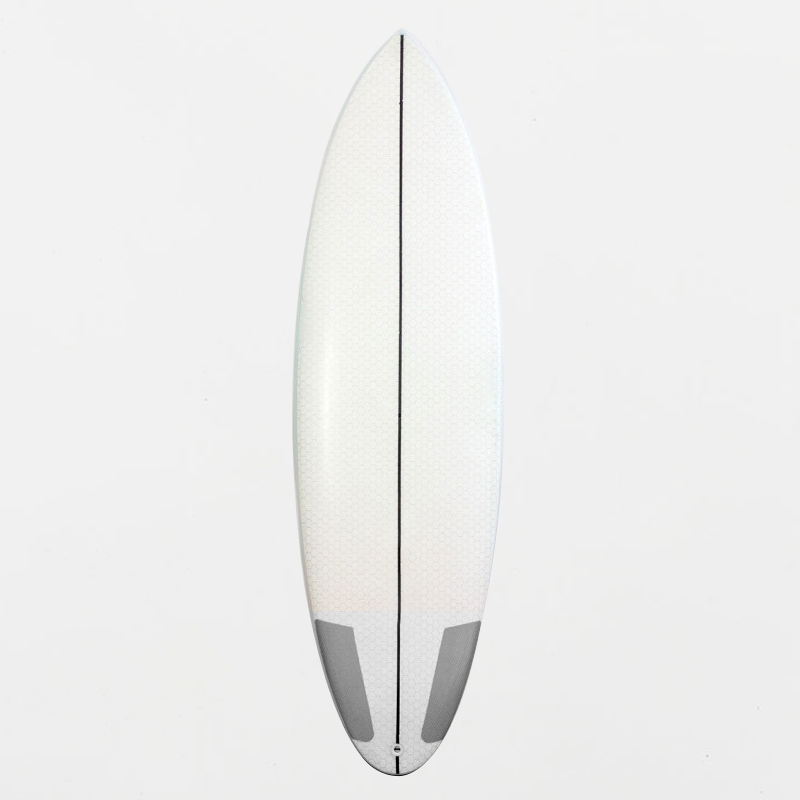
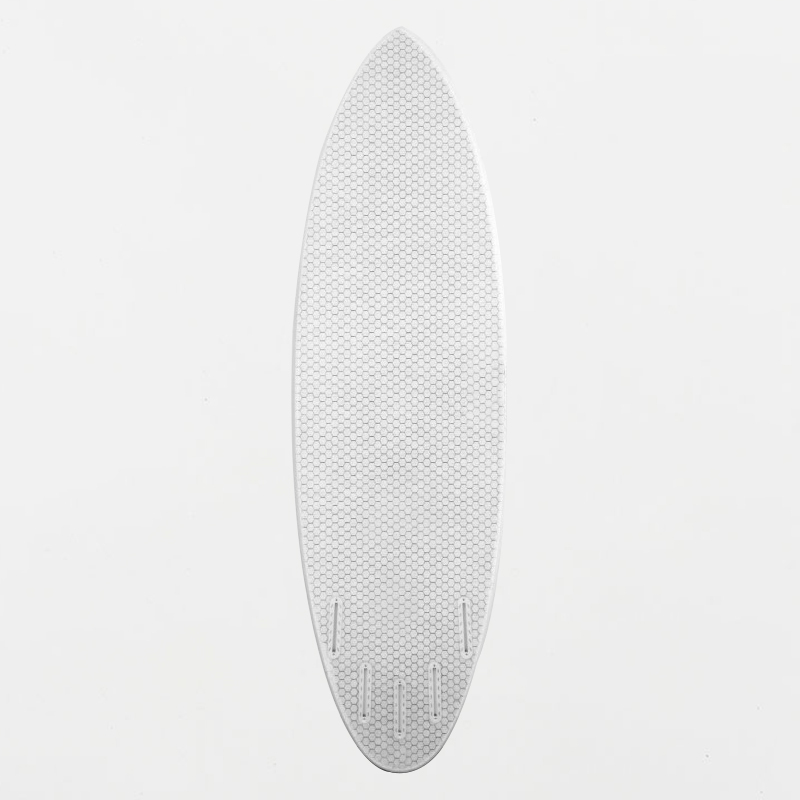
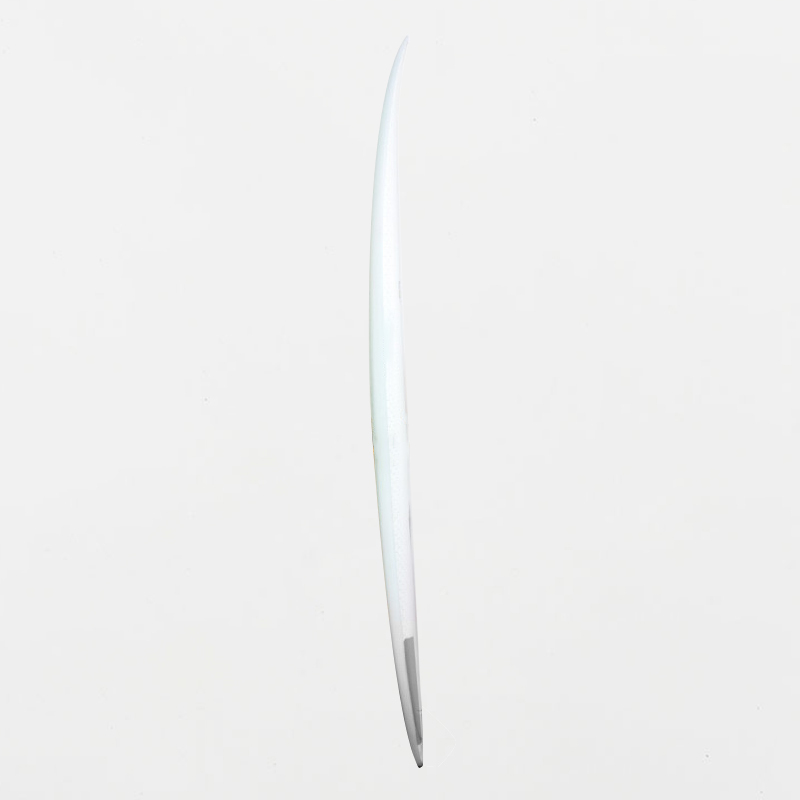
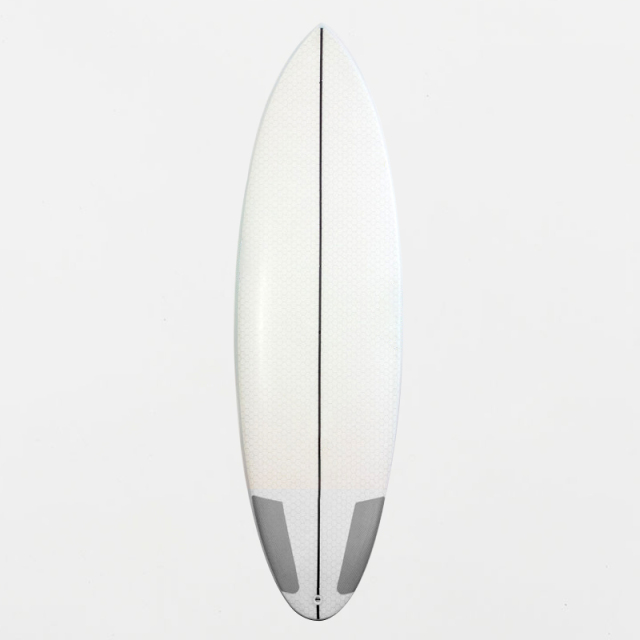
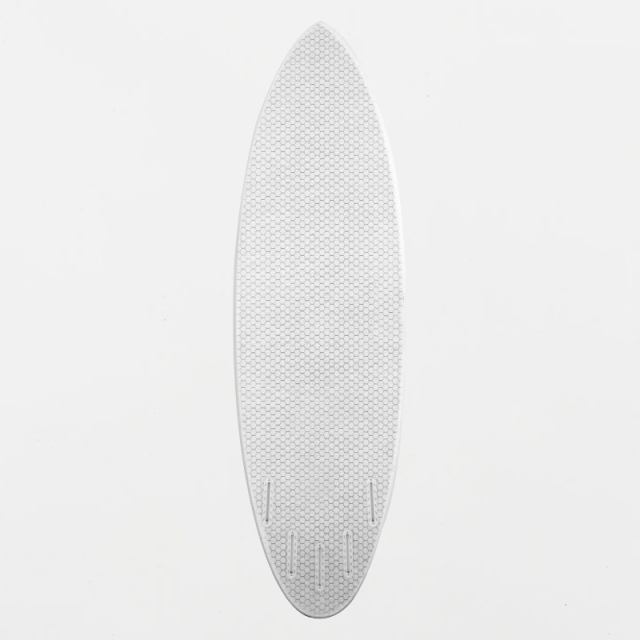
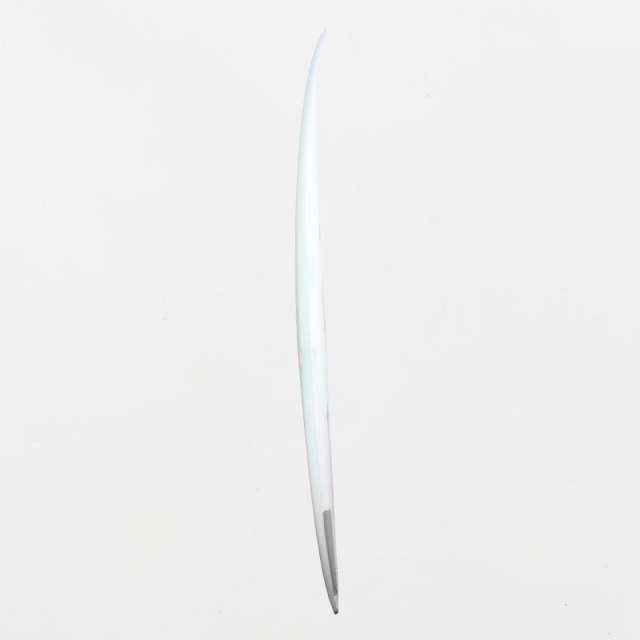
The epoxy surfboard 5ft8 Futures is the shortest performance shape we build: a compact shortboard with a pointed nose, a tapered tail and a continuous rocker, made for riders who generate their own speed and want a board that answers the moment they push through the back foot. It is glassed clean and finished white with grey tail accents, and it reads on a rack the way a competition board should, because that is what it is.
Nothing about the outline is softened for comfort. The template is narrow, the rails are fine and the volume sits under a committed rider rather than around a cautious one, so the board rewards someone who already surfs rail to rail and feels flat under anyone who does not. That is deliberate: this model exists to give shops and distributors a genuine high-performance option at the short end of a wholesale epoxy surfboard range, not another all-rounder that does a little of everything.
As an epoxy surfboard manufacturer we lay this shape up on our own line rather than buying it in, which is what holds the template, the glassing and the fin-box placement steady from one production run to the next. Sixteen years of building surf hardware sits behind that consistency, and it is the part a buyer notices last and relies on longest. Rental shops and suppliers use this epoxy board as a durable, high-turnover product for frequent customer use. Its resistance to dings and abrasion keeps maintenance demands low, which is essential for cost-effective rental operations. The lightweight epoxy surfboard build makes transport and handling easy without giving up the performance that suits a wide range of renter skill levels. Standardized fin compatibility lets a rental fleet keep inventory uniform while still offering a customizable ride.
Every eps foam epoxy surfboard in this size lives or dies on its core, and this one starts with a shaped EPS foam blank. EPS is light and holds its shape under load, which lets the finished board carry less weight in the tail without going soft under the back foot — the difference an advanced rider feels first when they drive through a turn.
The blank is then wrapped in fibreglass cloth and laminated with epoxy resin. Epoxy cures tougher and bonds more tightly to the core than the polyester resin used on traditional boards, so the shell resists pressure dents and the rail cracking that usually starts a board's decline. The lay-up is chosen to keep the board lively rather than over-built; where a programme needs a heavier glassing or a reinforced deck for rougher conditions, that is specified before the run is scheduled.
On this futures fin epoxy surfboard, the boxes are set into the tail and glassed in place, so the load from the fins travels into the laminate rather than into a plug sitting proud of it. Deck and bottom are sanded and finished smooth, with the white deck and grey tail accents giving the shape a clean, modern look on a shop wall.
Two details are worth settling before you commit a run: the glassing weight you want, and the finish standard your market expects. Send a sample or a clear photograph of the finish you are matching and we will build to it.
The obvious advantage of the lay-up is weight, but the one that pays back over a season is toughness. An epoxy surfboard manufacturer works with a resin that cures harder and bonds to the EPS core more aggressively than polyester, and the result is a shell that takes knocks along the rail and under the heel without the spider cracking that ends a board's working life early. For a shop, that means fewer warranty conversations. For a distributor, it means fewer returns from a market that will not accept a board that dents in its first month. A lightweight epoxy surfboard also changes what the rider can do with it. Less mass in the tail means less swing weight, so the board comes around faster under the back foot and recovers more quickly out of a turn. Carrying four of them from the van to the water is a different job too, which matters on a trip where boards are moved twice a day. Because we work as a custom epoxy surfboard supplier as well as a stock supplier, the build is not fixed. Graphics, colourways and deck branding can be produced to your range, and where a programme needs a different glassing weight or a heavier deck for a rougher market, that can be specified before the run is scheduled. What we will not change casually is the template: the shape only performs the way it does because the rocker and rails stay where they are.
In a wholesale epoxy surfboard range, this model does a specific job: it gives the wall a credible top end. Most shops and sporting-goods buyers already carry 6 ft 0 to 7 ft 6 shapes, and the customers who buy above that point are the repeat customers. Riders at club and regional level want a board that holds its line through a steep section and still releases when they want to pivot, and they want the replacement to feel like the one they broke. Because the shape is produced on the same line to the same template, a team can standardise on it and stop chasing small differences between boards. Commercially, the argument to the buyer is maintenance. An epoxy shortboard for advanced surfers gets ridden hard, and every ding is either a repair or a write-off. A board that resists the everyday knocks holds its value on the floor and in the water longer, which is the part of the price a category manager can defend at review time. For distributors working across several markets, the model also packs well: it is short, stacks easily with longer shapes and does not consume the shipping space a longboard does, so it fits a mixed order without distorting it. Responsiveness and durability are the qualities professional surfers and discerning buyers notice first. The lightweight build supports quick maneuvers, reduces fatigue and extends what a rider can do in complex waves. Resistance to dings and wear translates into longer service life and fewer repairs, which matters to distributors as much as to riders. Fin configuration is simple to adjust, so the ride can be tailored to the surfer and the conditions. - Own-brand programmes. Specialist shops and small brands that want their own graphics, colourways or deck branding on a proven shape work with us as a custom epoxy surfboard supplier. - Competitive teams and coaches. One model a whole squad can ride keeps the coaching conversation about technique instead of about a different board every session. - Buyers filling a gap at the short end. Most ranges run from 6 ft 0 to 7 ft 6; this shape gives the wall a top end and gives experienced customers somewhere to go next. - Not a first board. This is for surfers who already stand, turn and paddle out through the inside. Anyone earlier in the curve belongs on a longer, fuller shape, and we will say so rather than take the order.
Between sessions the routine is short. Rinse the board with fresh water after salt exposure, dry it with a towel and let it stand before it goes into a bag. Wax that has gone gritty should be scraped back and re-applied rather than left to trap sand, which is what slowly wears a deck and a rail. Heat is a bigger risk than water. A board left in a closed car or lying dark-side-up on hot sand gets far hotter than it ever does in the sea, and that is where delamination starts on any epoxy board. A day bag or a reflective cover prevents it for a fraction of the cost of a repair. Two straps, padded where they cross the rails, and just enough tension to stop movement is all that is needed; a ratchet pulled down hard on a warm day will dent a rail. Small chips should be dried and sealed before the next session. An open ding on an EPS core takes on water and spreads under the glass, so treat a chip as a same-week job rather than an end-of-season one, and keep a basic repair kit with the boards. 1. Agree the fin set before the board leaves the desk. This is a performance shape, so it belongs with experienced customers and guided-trip guests rather than in the entry-level fleet; confirm the fins with the rider so the board returns with the set it went out with. 2. Inspect the tail and the fin boxes at handover. Look for lifted glass around the boxes and for missing grub screws — both are a two-minute fix at the desk and an expensive one after a week of water ingress. 3. Rinse with fresh water at the end of the day. Salt and sand left in the boxes and around the plugs are the main cause of seized fins on a working fleet. 4. Let the board dry before it goes into a bag or a rack cover. An eps foam epoxy surfboard stored damp keeps that moisture in the laminate, and damp is what dulls a finish and turns a new board into a tired one. 5. Rotate the fleet rather than issuing the same three boards. Spreading sessions keeps wear even, which makes the replacement cycle predictable instead of a surprise. 6. Retire on condition, not on age. A board with compressed deck foam under the back foot has lost the response the model is bought for, even if the glass is still intact.
| Model | B70140 |
|---|---|
| Length | 5 ft 8 in |
| Construction | EPS foam core, fibreglass, epoxy resin |
| Fin system | Futures fin boxes |
| Outline | Pointed nose, tapered tail |
| Profile | Thin, performance rail line |
| Deck finish | White with grey tail accents |
| Rider level | Advanced to expert |
| Customisation | Graphics, colourways and deck branding to order |
| Inspection | Checked in-house before packing |
CIMI is a factory-based supplier with 16 years in surf and watersports hardgoods, manufacturing at our own facility rather than sourcing through traders. Chain stores, supermarkets and surf-brand stores buy from us because one supplier covers a full accessory assortment, so a season's order and its reorders can be planned together. We take on OEM and private-label work, adapting designs, colourways and branding to your programme, and we schedule production against your agreed range plan. Send us your buy list and target dates, and we will confirm what we can make and when.