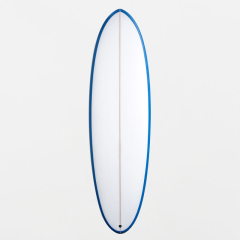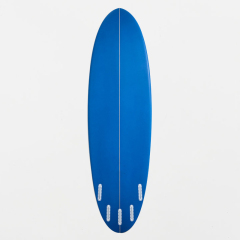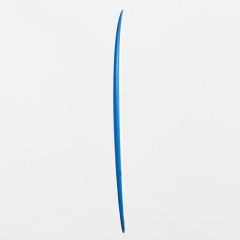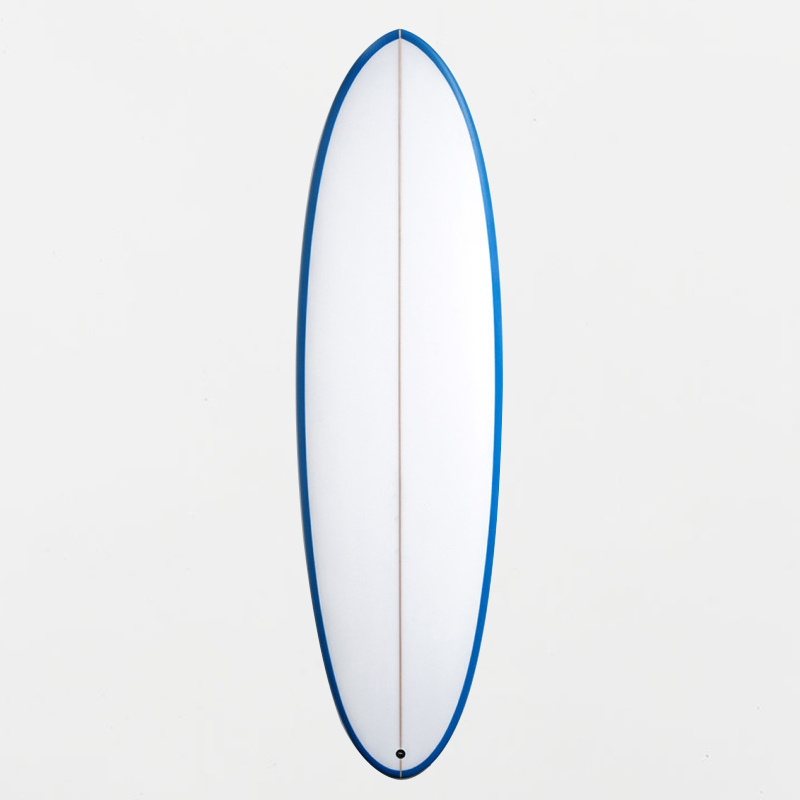
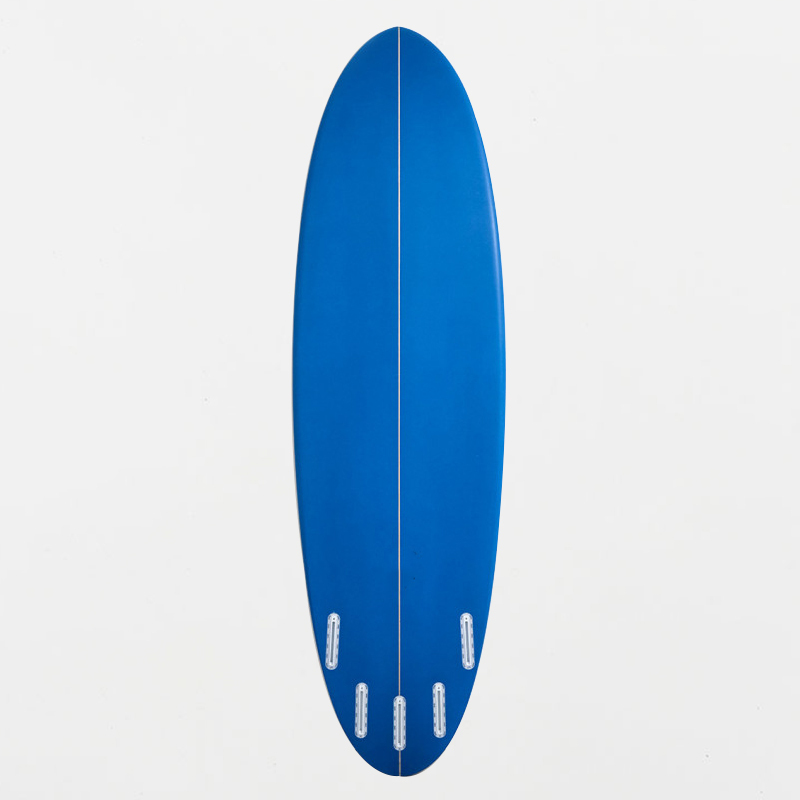
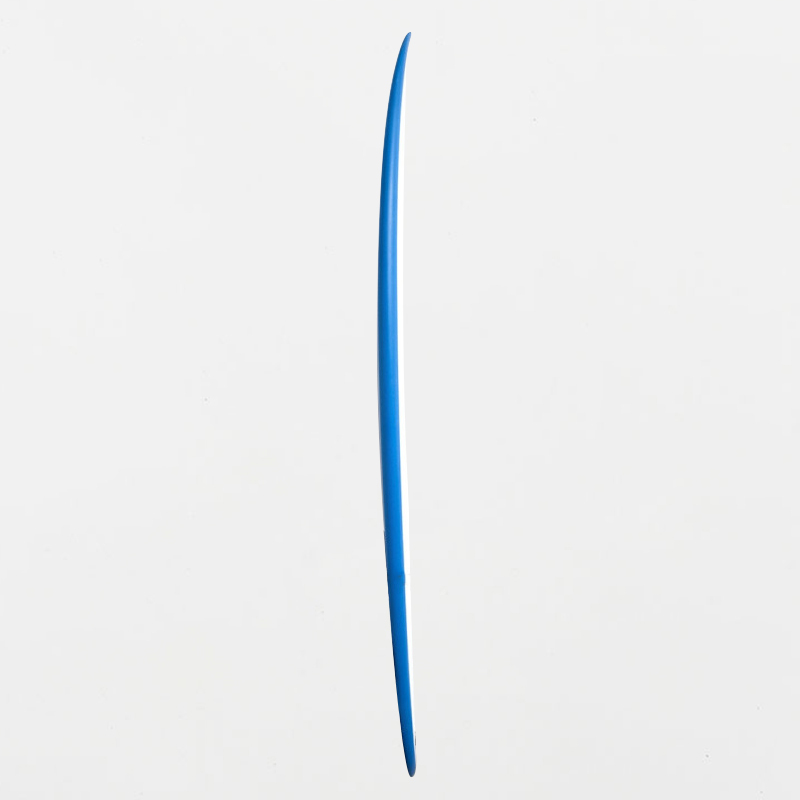
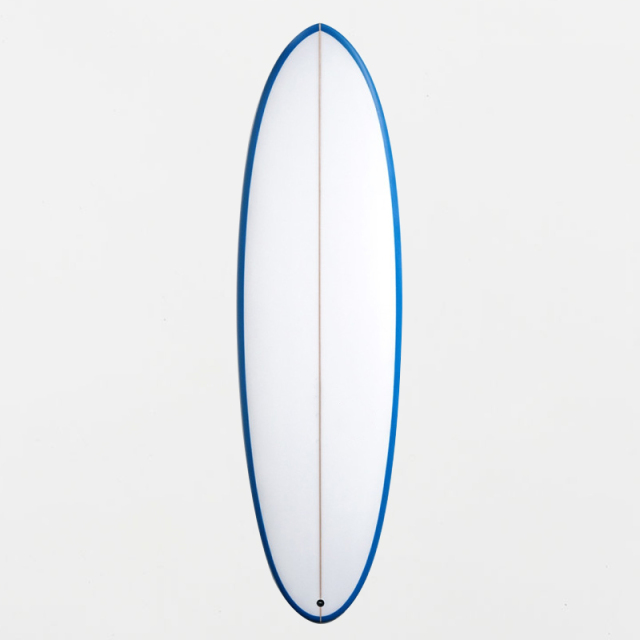
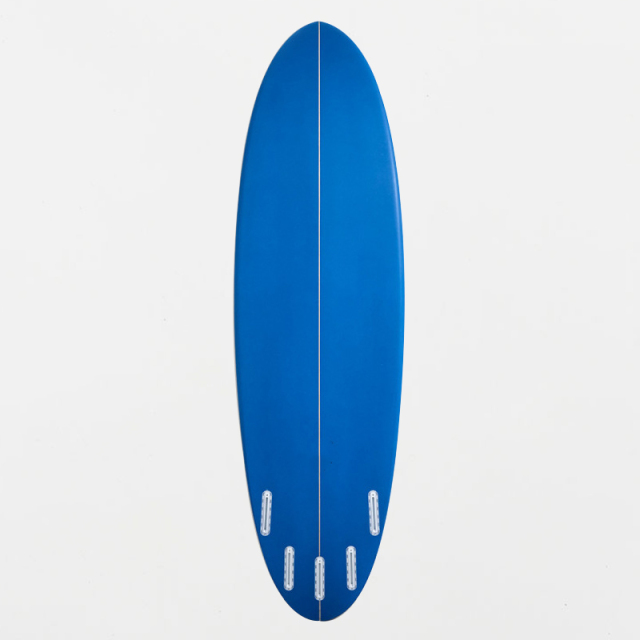
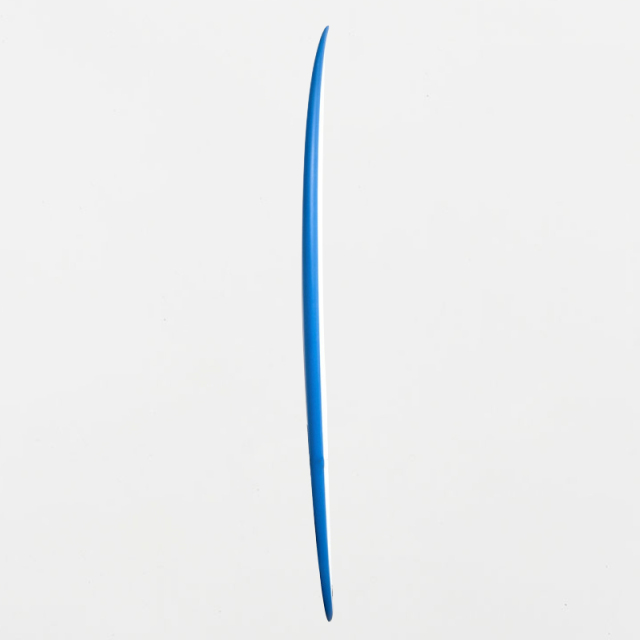
The 6ft6 is the middle of our epoxy surfboard range, and it is the length we point buyers to when they want one board that handles most days rather than a wall of specialised shapes. Rounded nose, rounded tail, a rocker line that runs continuously from end to end — nothing on the outline is there for looks alone, and the shape has been in production long enough that we know exactly how it behaves in a range of conditions.
That is the idea behind it: a board that sits comfortably under a strong intermediate working on their turns and under an experienced surfer who wants something to ride when the swell is not big enough for a step-up. It carries speed between sections, turns off the tail, and does not ask the rider to fight it.
As an epoxy surfboard manufacturer producing in our own facility, we can hold this length in stock and keep the specification steady across batches — same outline, same layup, same finish — which is the part that matters once a shop or a school starts reordering. There is no importer between our line and your delivery, and specification questions come back to the people who built the board.
Buyers come to it from two directions. Distributors and shops buying wholesale epoxy surfboards use one mid-length line to cover a broad band of customers instead of stacking three similar sizes. Schools and rental fleets use it for instructors and for students progressing off a soft-top. Both are after the same thing: a board that is straightforward to sell, straightforward to ride and straightforward to keep in service. The core is EPS foam, wrapped in fiberglass and epoxy resin, which gives a high strength-to-weight ratio with less swing weight under foot. The Futures fin system adds directional stability and predictable response through turns. The blue rail is structural as well as visual, adding resilience where the board takes impact and where deformation tends to start.
- One length, a wide band of riders: the outline carries an improver who is learning to link turns and still gives an experienced surfer something to ride when the swell is small, so a shop can move a customer up without changing model. - Light underfoot: this is a lightweight epoxy shortboard in the hand and under the feet, which means less mass to swing through a turn and a quicker recovery when a section closes out. - Ready to ride: the board arrives finished and fitted, with the leash plug in place and nothing to assemble before it goes on the wall or into a lesson. - Built to your specification: as a custom epoxy surfboard supplier we work from your spec sheet on length, fin system, rail colour and deck graphics rather than pushing a fixed catalogue item. - Easy to live with: at 6ft6 the board fits standard wall racks, van interiors and board bags without the overhang of a longboard, which keeps storage, transport and lesson logistics simple.
Every eps epoxy surfboard we make begins with a shaped EPS foam blank. EPS is a closed-cell foam — light, dimensionally stable, and far less willing to take on water than the open structures used in cheaper boards. That last point is what decides how a board ages: water reaching the core is how a board dies early, and a closed-cell core gives your repair shop time to get to it.
The blank is then wrapped in fibreglass cloth and wet out with epoxy resin. Epoxy cures harder and shrinks less than polyester, and it bonds to EPS without dissolving it, which is why the two materials belong together rather than being interchangeable. The glass schedule is built up in layers instead of one heavy pass: thin over the foam, heavier at the deck, the rails and the tail, the three areas that absorb punishment in daily use.
Resin control is the part that is easy to get wrong and hard to see. A dry patch leaves cloth unprotected; a resin-rich pool makes a board brittle and heavy. Our laminators work the resin out evenly and the board is inspected before it moves to finishing, because a defect at this stage cannot be sanded out later.
Because the foam carries stiffness on its own, less glass and resin are needed to reach a given strength. On the water the result is a board that stays light without feeling hollow. In a fleet, the result is a board whose working life is measured in seasons rather than in a single summer. Extra buoyancy and lower weight mean less energy spent paddling and more control once you are on the wave, which is felt most in longer sessions. The light build supports the quick rail-to-rail transitions progressive surfing depends on, while the durable construction cuts downtime from board damage. For schools and professional riders, that adds up to more usable sessions per board.
- Cost per season, not cost per board: what decides a fleet budget is how long a board stays in rotation, and the composite build is chosen to keep it working rather than to look good in a photograph. - Short repair loops: damage is usually local and repairable, so a board is out of service for days rather than written off, and your staff are not re-learning a replacement mid-season. - One line instead of several: buyers ordering wholesale epoxy surfboards for a shop or a school can let this length carry the middle of the range and cut the near-duplicate sizes either side of it. - Consistent batches: reorders come back with the same outline, layup and rail colour, so a fleet looks uniform and instructors are not adjusting to a different board every season. - Built for the lesson duty cycle: in the epoxy surfboard for surf schools role, a board is expected to be dragged, stacked, rinsed and used again the same afternoon, and that is the use it is designed around.
The tail carries Futures fin boxes rather than glassed-on fins or a fixed set. On an epoxy surfboard for surf schools that is the difference between a two-minute fin change and a repair booking: fins can be swapped between sessions without touching the glass, a damaged fin is a spare-part purchase, and every board built this way takes the same fin standard, so one box of fins covers a whole rack.
Fins are also the fastest way to change how a board feels. A larger, more upright set gives drive and hold when the wave has power; a smaller, looser set frees the tail in softer surf. Because the interface is standard across the range, a school or a shop carries one fin selection and one set of spares across a whole wholesale epoxy surfboards order instead of matching fins to every model on the wall.
On the 6ft6 epoxy surfboard the boxes are set into the tail laminate during layup, so they sit flush with the bottom and stay put through repeated changes. That flush fit matters more than it sounds: a box standing proud catches on the first rail-first landing and starts working loose from there.
The blue rail is the other structural detail worth knowing. It is laid in as a band through the laminate rather than painted on afterwards, so the edge that takes the most contact — rails take the hit every time a board goes down, gets stacked or slides into a van — has extra material behind it. That band is what keeps the outline crisp after a season of beach breaks and roof racks, and it is why a board two seasons old still reads as a current model on the wall.
Under a rider, the board reads as a lightweight epoxy shortboard with a little more buoyancy than its length suggests. That float is what lets a strong intermediate paddle in early and still have time to set the rail, while a heavier or more experienced surfer gets a board that does not bog down when the wave stands up. The rocker is continuous rather than stepped, so the board drives through a turn without a dead spot under the back foot. Off the top it comes round quickly because there is little mass in the tail; through a cutback it holds because the rail is buried rather than skated across the surface. Small days are where the length earns its keep. There is enough foam to keep the board moving when the wave has little push, so it does not need to be pumped constantly, and the fuller outline stays planing between sections instead of sinking back into the wave. That is the advantage of shaping around a removable fin system instead of around fixed fins. It is not a beginner's board in the way a soft-top is. A rider still learning to stand and paddle will find it tippy next to a long learner board, and that is deliberate: the trade is response and control for the people who can use it.
Trade buyers use this board to fill the middle of a wall. It is the length that answers the customer who wants something they can paddle, turn and keep for a few years, and it saves the dealer from carrying three near-identical mid-lengths that all do the same job.
Distributors and wholesalers take it as a repeat line. The shape is stable, the fin standard is common, and the finish is consistent enough that a reorder does not look like a different product next to last season's stock.
Surf schools and rental operators are the third group, and operators sourcing an epoxy surfboard for surf schools usually want one length that instructors and progressing students can both ride. That keeps the rack simple, the spares simple and the briefing at the start of a lesson short.
Brands and private labels use it as a base for their own programme. The outline is proven, so a change of rail colour, deck graphic or fin system is a specification exercise rather than a new shape development.
At the end of the chain there is the individual strong surfer, buying one board for the days when a shortboard is hard work and a longboard is too much board.
- Competitive and professional surfing: a rider training on the same shape week after week feels small changes in fin set and stance rather than adapting to a new board, and event organisers can hold spares of one model instead of four. - Surf schools: the epoxy surfboard for surf schools is the step above the soft-top, so students who can already stand, paddle and turn get a board with real rails without jumping straight onto a fragile performance shape. - Rental desks: the eps epoxy surfboard construction means a board that comes back scratched is usually still serviceable, so a hire fleet does not lose a unit every time a beginner runs it up the beach. - Shop floors and digital ranges: one mid-length that fits several customer descriptions is easier to merchandise and easier for staff to explain than a ladder of similar lengths. - Camps, clubs and travelling teams: the board packs into a standard bag, takes a repair without specialist equipment, and can be replaced from stock rather than from a one-off order. - Progression programmes: a student who learns on a school board and buys the same length later gets a familiar ride, which is a simpler sale for the shop that supplied both. The EPS core reinforced with fiberglass and epoxy resin reduces the risk of water intrusion and delamination that comes with everyday surfing wear, which matters most on boards that stay in rotation. The Futures fin system is a modular setup: fins can be swapped quickly to suit different conditions without tools or downtime.
This board is used mainly for competitive surfing, surf school programs and professional training, where one shape has to serve many sessions and many riders. Intermediate and advanced surfers can work on technical maneuvers on it without the board becoming the limiting factor. In rental and school settings it holds up to prolonged use in varied coastal conditions, and its construction needs less repair attention than a traditional polyurethane board over the same period.
| Board type | Epoxy shortboard / mid-length crossover |
| Length | 6ft6 |
| Core | EPS foam |
| Skin | Fibreglass cloth with epoxy resin |
| Fin system | Futures boxes, fitted at the factory (fin sets specified separately) |
| Rail | Blue structural band through the laminate |
| Deck | White |
| Bottom | Blue |
| Outline | Rounded nose and tail with a continuous rocker |
| Finish | Sanded and glossed |
| Order type | Stock, wholesale, custom colour and fin-system options |
On the Shop Floor
A 6ft6 board has to sell itself from the rack before anyone picks it up, and the finish does that job. The white deck and blue bottom give a clean two-tone that reads from across a shop, and the blue rail draws a hard line around the outline so the shape stays legible when boards are racked edge-on and only the rail faces the customer. Because the blue sits in the laminate rather than sprayed over it, that line survives a season of handling, which is what stops an older board from looking like ex-rental stock next to a new delivery. The rail colour is also the simplest way to build a colour story across a range. Photographs work the same way: the band separates deck from bottom, so the outline is still readable in a small product image or a printed catalogue page. On the Water An instructor on the beach is looking for one board among thirty, and colour is quicker to read than a decal. The blue rail stands out against white water, and it still shows when a board has rolled over and only the underside is visible — the reason school and rental buyers ask for high-visibility finishes in the first place. The same colour lets a lifeguard or a beach marshal pick out a board that has drifted away from the group. Fleet counting is the practical end of it. Give each length, or each season's delivery, its own rail colour and staff can sort boards into the right rack without reading numbers: the 6ft6 epoxy surfboard goes back to the mid-length slot, the shorter boards to theirs. Colour-coding by season also makes the age of a fleet visible at a glance, so the oldest boards are the first ones pulled for inspection rather than the last ones noticed. Boards that are easy to identify come back to the right place, and a rack that stays in order is a rack that gets reordered in the right quantities.
CIMI is a factory-based supplier with 16 years in surf and watersports hardgoods, manufacturing at our own facility rather than sourcing through traders. Chain stores, supermarkets and surf-brand stores buy from us because one supplier covers a full accessory assortment, so a season's order and its reorders can be planned together. We take on OEM and private-label work, adapting designs, colourways and branding to your programme, and we schedule production against your agreed range plan. Send us your buy list and target dates, and we will confirm what we can make and when.