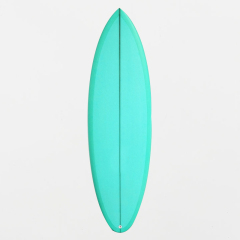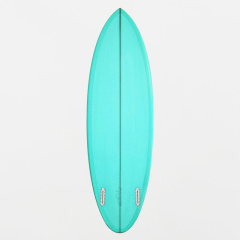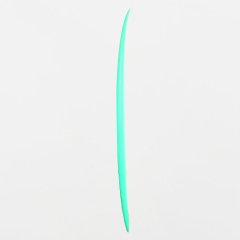
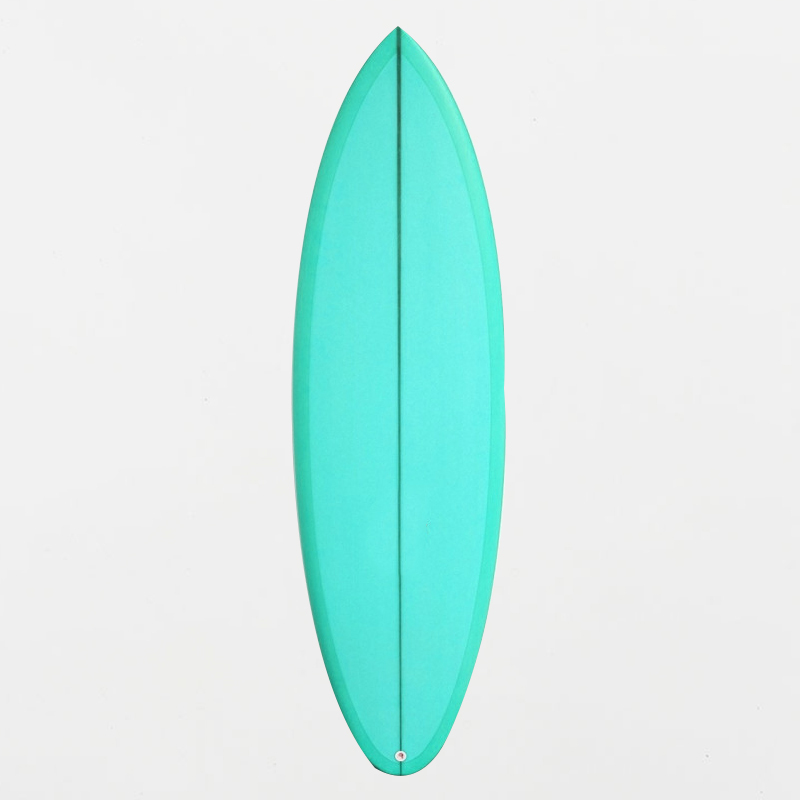
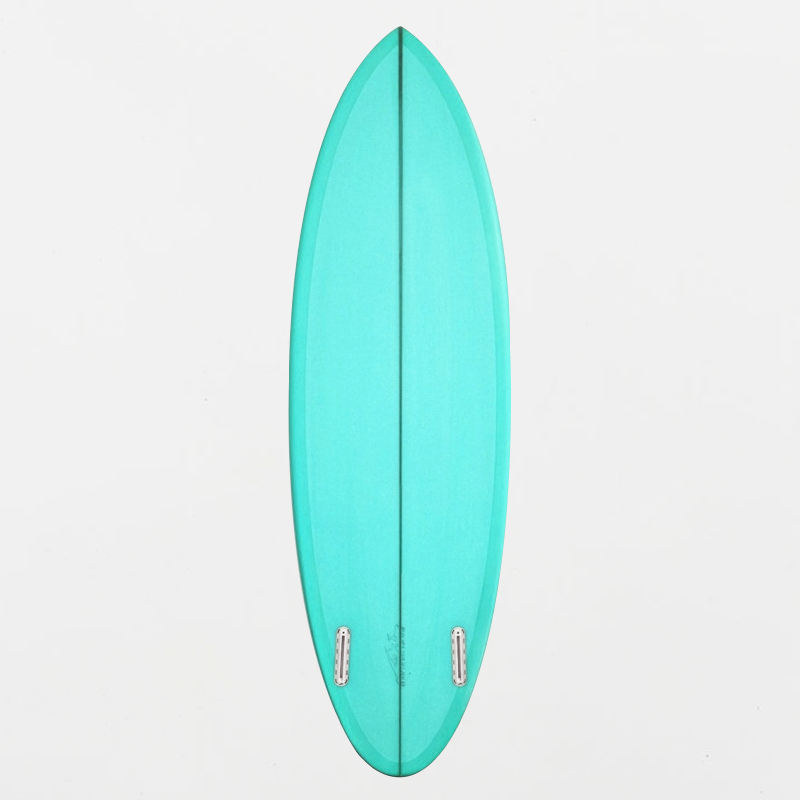
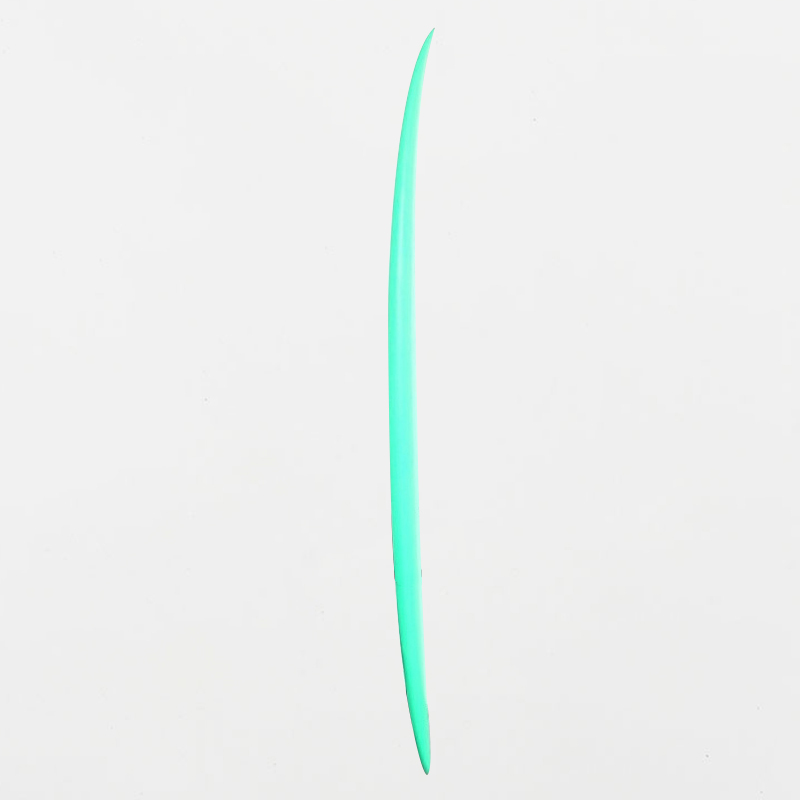
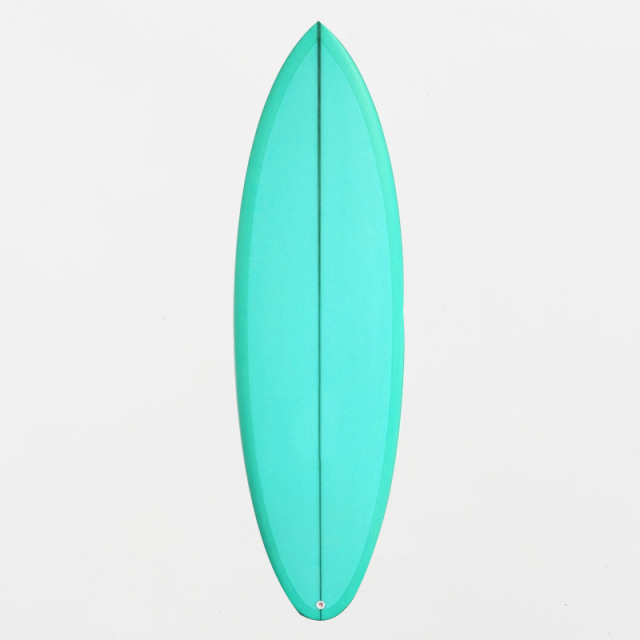
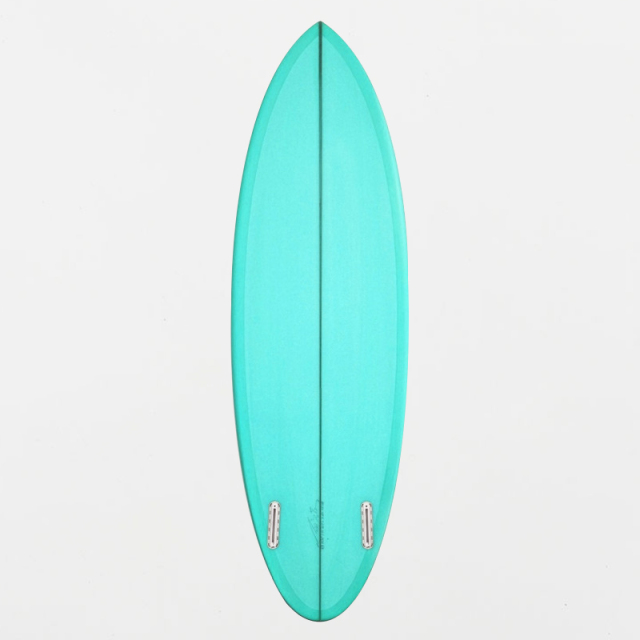
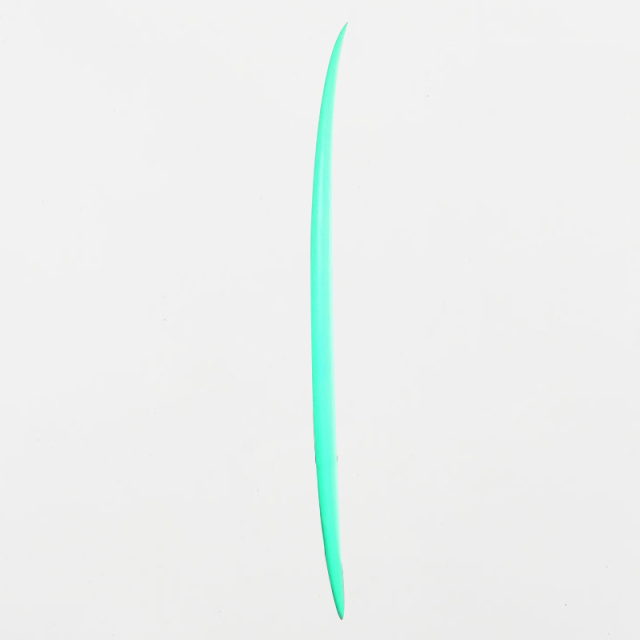
The shortboard in our performance line: a 6ft2 epoxy surfboard built on an EPS foam core, laminated with fibreglass cloth and epoxy resin, finished in a green gloss and fitted with Futures fin boxes. It uses a modern shortboard template — pointed nose, rounded tail, a continuous rocker running nose to tail — and it feels light in the hand, which is exactly what makes it quick underfoot. It is built for surfers who already know how to generate their own speed and want a board that turns when they ask and holds its line when the wave stands up. Shops that buy wholesale epoxy surfboards from us stock it as the performance option at the short end of the wall. Team managers and coaches buy it because a rider can spend a whole season on the same model and get the same response every session. Rental operations put it under advanced guests rather than first-timers. The EPS core is reinforced with epoxy fiberglass layers for a rigid yet lightweight structure that supports control during dynamic movements. Precision lamination and resin curing are intended to keep quality consistent and reduce defects, while the Futures fin box allows straightforward fin customization and replacement for easier maintenance.
Under the finish, the build is simple and deliberate. An EPS foam core gives the board its low weight and its buoyancy; fibreglass cloth is laid over the blank and wet out with epoxy resin, curing into a stiff, impact-resistant shell around a core that stays lively. Against a traditional polyurethane board, the epoxy laminate is lighter for the same volume and stands up better to the knocks of daily handling — a fin knocked against a rail, a board dropped on the sand, the constant loading and unloading of a rental rack.
Lamination and cure are where a board either keeps its shape or goes soft. As an epoxy surfboard manufacturer we lay up and cure under our own roof and work to one lamination schedule for this shape, which is why a second order feels like the first and why the deck does not lose its tension after a few months of hard use.
The green finish is sealed under a gloss coat and was specified so that the colour does not come at the expense of surface durability — the standard we hold a custom epoxy surfboard to as well. It holds up to handling and cleaning far better than a cosmetic coat sitting on top of the laminate. The board suits shortboarding and high-performance wave riding, with a robust build intended to hold up in rental and surf school fleets where low downtime matters. Its green finish is chosen for appearance while retaining surface durability, and its design supports extended use across varied surfboard inventories.
- Fleet-grade construction. The EPS and epoxy build resists dings and pressure marks far better than a poly board, so boards leave a fleet when the range changes rather than when the deck goes soft. - Repeatable from order to order. We are an epoxy surfboard manufacturer with lamination and curing under our own roof, so the tenth board in a run is built to the same schedule as the first. - One core spec, no surprises. Every eps epoxy surfboard we ship in this shape uses the same core and laminate lay-up, so a replacement behaves like the board it replaces. - Spares the shop already stocks. Standard Futures boxes mean the fins on your shelf fit this board as well as the rest of the range. - A finish that earns its place on the wall. The green gloss is bright enough to sell from a display rack and tough enough to survive a season of handling. - A model a team can settle on. Put several riders on the same board and the feedback you get back is comparable.
Waist-high and up is where the epoxy surfboard 6ft2 starts to make sense. In soft, small beach break it still needs a rider who can work the board rail to rail rather than waiting for the wave to push; once there is a little power behind it, the board generates its own speed across the flat sections between turns.
In chest- to head-high beach break it is at home. It fits into the pocket, holds a rail through a drawn-out turn and comes off the top with the speed it carried in. On a point or reef with a longer wall the epoxy surfboard keeps driving through the section instead of running out of momentum, which is where the light build pays off most.
In choppy onshore slop it feels lively rather than settled, and heavier surfers or riders still building confidence may want more volume under them. In well-overhead, fast-breaking surf most riders reach for a longer step-up. Knowing where a board stops working is as useful as knowing where it starts.
The first thing a rider notices is how little there is to swing. Because a lightweight epoxy surfboard carries less mass through a turn, it picks up speed early and redirects without the rider having to reset their stance. Underfoot it feels planted rather than twitchy, which was the balance we were after: quick enough for tight, vertical surfing, stable enough that the board does not fight back when the wave gets steep. Fin choice changes its character more than anything else. A looser set lets the tail break free on a snap; a fuller set adds drive and hold along a longer wall. Because the boxes are standard Futures, that tuning takes minutes and never requires a second board. The build also affects how much time a board spends in the water. The laminate takes knocks well, so most marks are cosmetic and can wait for a scheduled service rather than pulling a board out of rotation in the middle of a busy week. This board is the kind an epoxy surfboard manufacturer builds for surf schools and rental operations: structural toughness and ease of use keep maintenance demands low. It supports a range of skill levels for lessons and recreational use, and Futures fin compatibility makes quick configuration changes and servicing simpler.
A school's first boards are soft-tops. This is the board that comes out for the advanced lesson, the coached session or the guest who already surfs and wants something responsive underfoot. The case for the eps epoxy surfboard in a rental rack is straightforward: it takes the handling. Boards get dropped, stacked, dragged over sand and knocked against each other, and a laminated EPS core with an epoxy shell shrugs off most of that where a poly board collects dings and pressure marks and eventually takes on water. Maintenance is quick. Staff can check the boxes, seat or swap a set of fins and rinse the board between sessions, which keeps turnaround short in a busy week. The green finish also makes a board easy to point out from the beach when it needs to be tracked down at the end of a lesson. Most operators keep a couple of sizes either side of this one, so a customer can step down onto it as they improve instead of leaving for a shorter board elsewhere.
After every session. Rinse the board with fresh water, working around the fin boxes and the leash plug as well as the deck and bottom. Salt dries into a crust inside the box threads and around the plug, which stiffens the screws and can hide a fin that has started to work loose. Heat and how it is stored. The EPS core is what makes the board light, and it is also the part that dislikes heat. Never leave it on hot sand in full sun or inside a closed vehicle; store it flat or nose-up on a rack, never balanced on the tail or the nose. Supporting a board on two small contact points for months at a time is how a rocker slowly changes shape, and a board that has lost its rocker no longer surfs the way it was designed to. Fins and boxes. Check the grub screws before each session and seat the fin by hand, tightening until snug rather than forcing it. Over-tightening crushes the box, and sand left in the slot stops the tab seating flat. Ride with a loose fin and it works the box every turn — a box repair means the board leaves the water for workshop time, which is a poor trade against a two-minute check on the beach. Dings and pressure marks. Look over the rails, tail and bottom after each session, and seal any break in the laminate promptly. Water that gets into an EPS core does not drain out again: the board puts on weight and the laminate around the damage can lift, turning a small repair into a large one. Heel and knee pressure marks on the deck are normal on any lightweight epoxy surfboard and are cosmetic; a ding through the glass is not, and should be dried and sealed before the next session. Cleaning and wax. Scrape old wax off with a plastic scraper in the shade and finish with a wax remover made for the job. Keep solvents and acetone away from the gloss coat and never let them near the fin boxes or the leash plug, where they attack the plastic and the resin bond. Transport. Pad the rack bars, strap across the bottom rather than over the deck, and do not stack heavier boards on top of this one. A cover for transit pays for itself the first time a board travels in a loaded van, and it keeps wax off everything else in the vehicle. A workshop routine for fleets. Once a week, run through the fin boxes, leash plugs and the deck area under the feet, and keep a small kit on site — fin key, spare screws, sandpaper, resin and a wax comb. Rinse leashes in fresh water and hang them to dry rather than coiling them tight, because a cord stored under tension takes a set. A board pulled out of rotation for a day of repair is far cheaper than one pulled out for a month.
The EPS foam core is combined with fiberglass and epoxy resin to support a strong, lightweight build with resistance to impact and dings while keeping the flex needed for wave agility. At 6ft 2in, the board is sized to balance speed and turning ability with stability, and the Futures system allows modular fin changes for tuning hydrodynamic performance.
| Specification | Detail |
|---|---|
| Model | B70150 |
| Length | 6ft2 |
| Outline | Performance shortboard, pointed nose, rounded tail |
| Core | EPS foam |
| Laminate | Fibreglass cloth with epoxy resin |
| Fin system | Futures fin boxes set flush at the tail |
| Finish | Green gloss |
| Rider level | Experienced to advanced |
| Typical use | Performance shortboarding, team training, competition, advanced rental |
CIMI is a factory-based supplier with 16 years in surf and watersports hardgoods, manufacturing at our own facility rather than sourcing through traders. Chain stores, supermarkets and surf-brand stores buy from us because one supplier covers a full accessory assortment, so a season's order and its reorders can be planned together. We take on OEM and private-label work, adapting designs, colourways and branding to your programme, and we schedule production against your agreed range plan. Send us your buy list and target dates, and we will confirm what we can make and when.