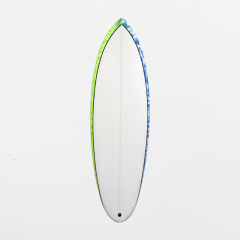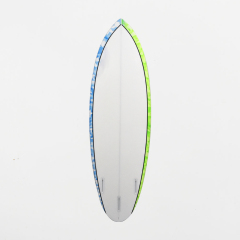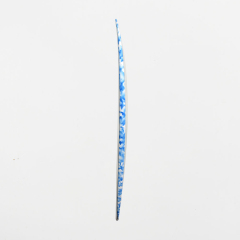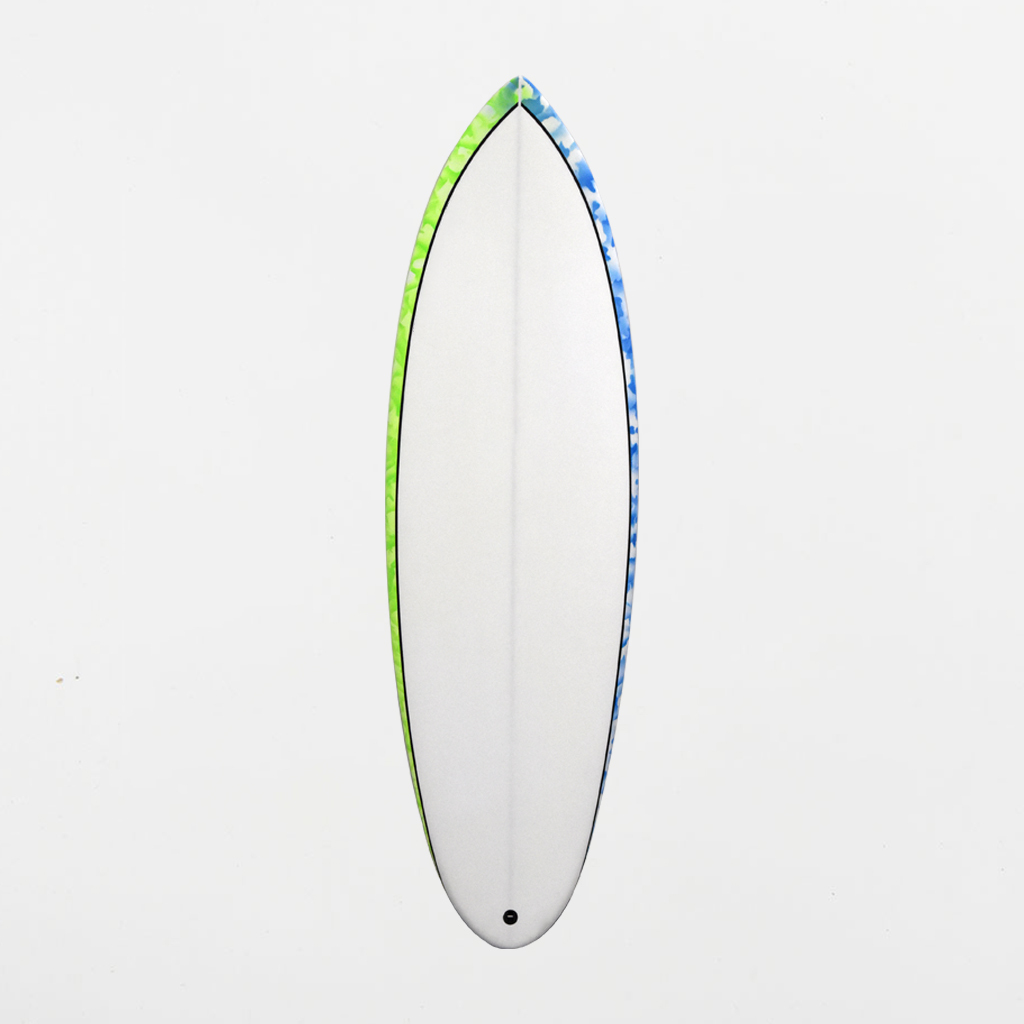
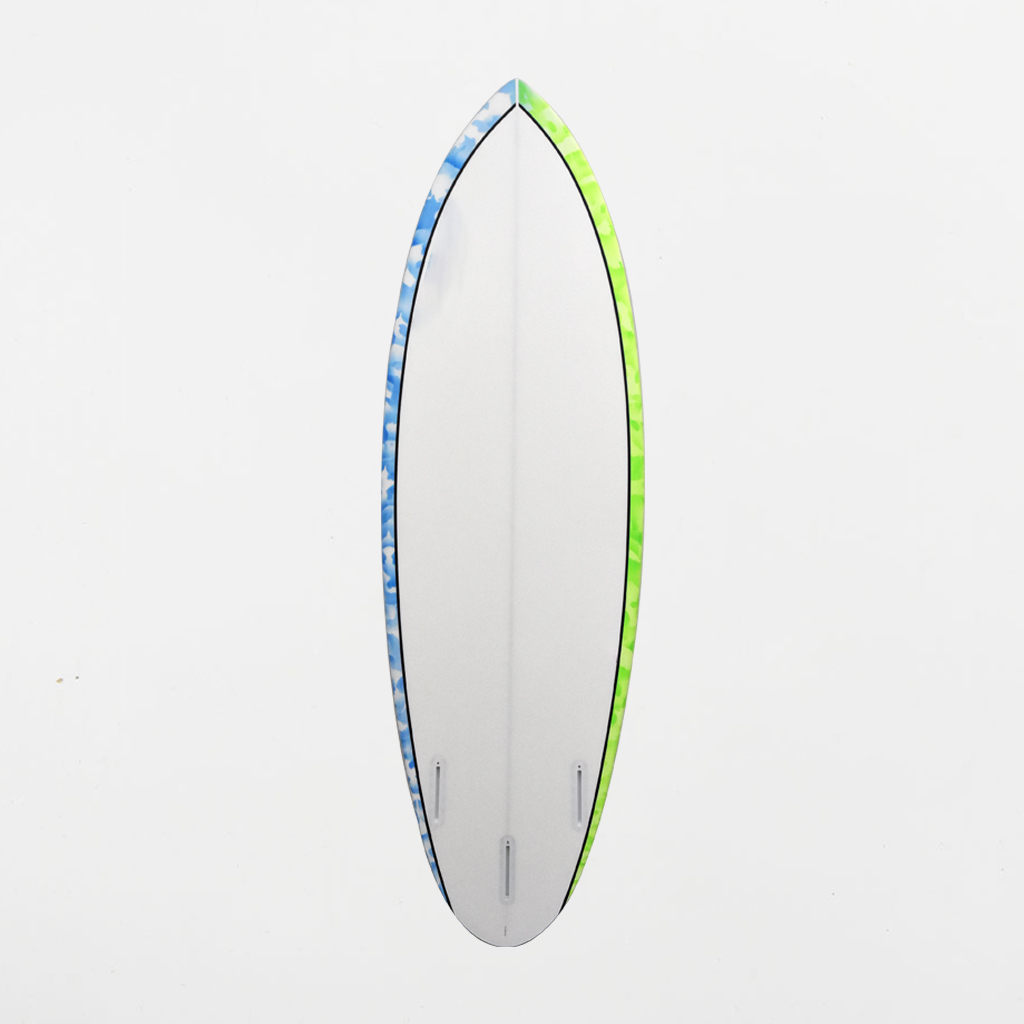
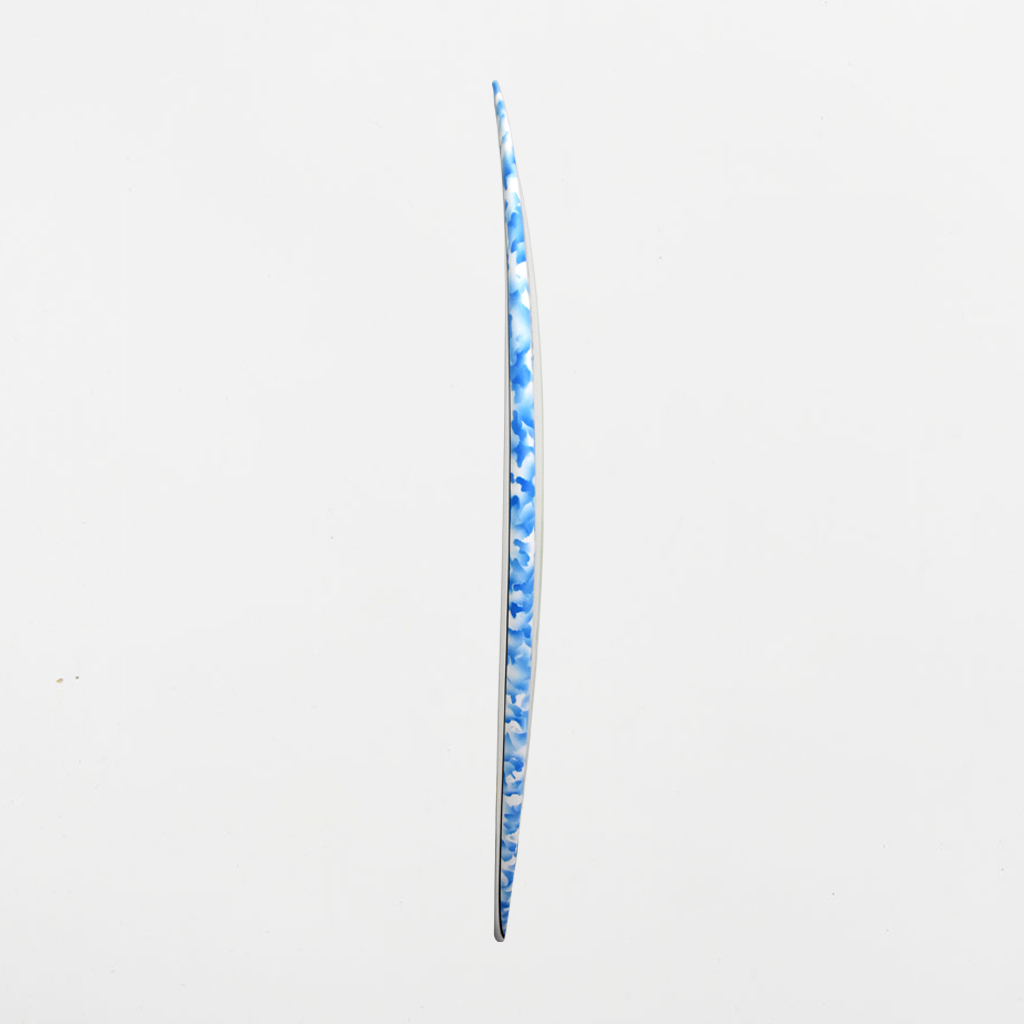
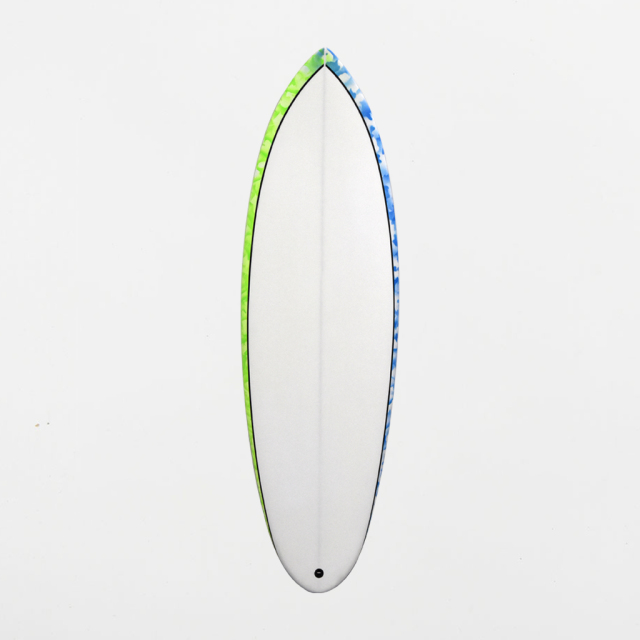
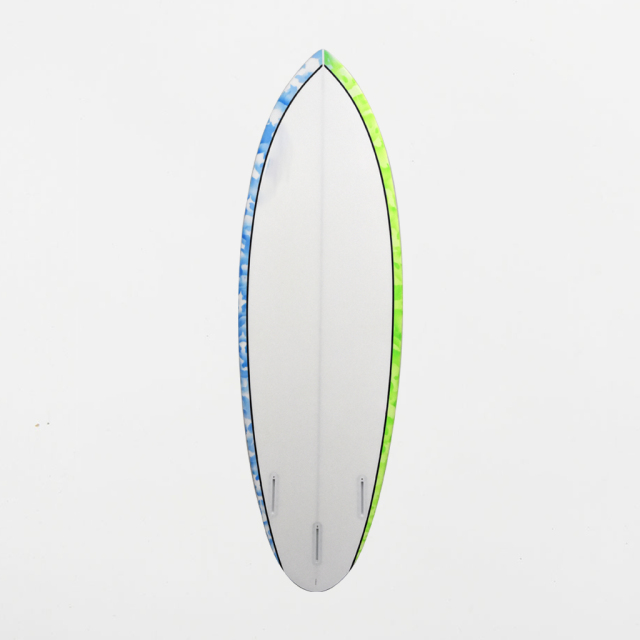
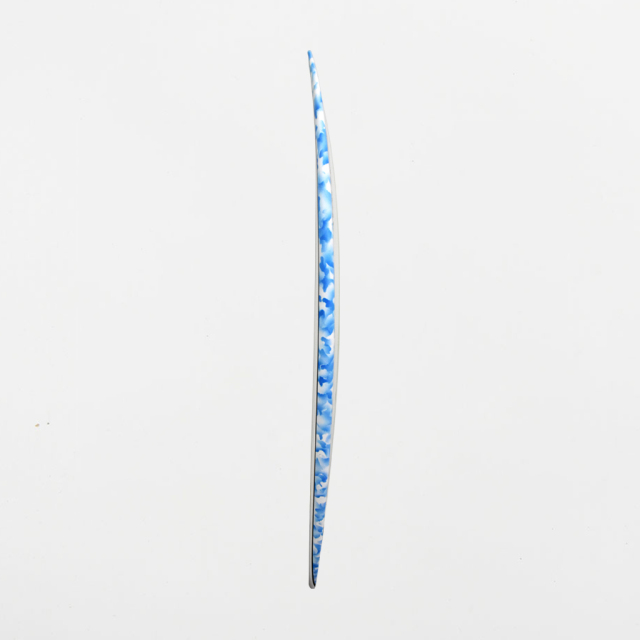
Every surf range has one board that has to work for almost everybody, and this is ours. The CIMI all-around surfboard pairs a forgiving outline with a hard laminated build: enough volume to paddle onto a wave without drama, a template that stays predictable when the wave stands up, and a deck that takes the knocks that come with shop demos and school sessions. The board shown here carries a white deck, blue and green patterned rails, a pointed nose and a rounded tail. We build it as a surfboard for wave riding rather than as a first-timer's platform. The rocker runs in one continuous curve from nose to tail, so it picks up speed early and still turns when you put it on rail, and the rounded tail releases cleanly out of a turn. Intermediate riders use it to tighten their turns; advanced riders keep one for crowded days when the take-off matters more than a radical maneuver. Because the board sits in the middle of the range, it is also the easiest one to build a set around. Fins, leash, traction pad, cover and rack come from the same production, so a shop can order a complete set instead of chasing parts from three suppliers. Custom dimensions, rail graphics and branding are all available from the same template. - Outline balance. The template is a mid-range shape rather than a specialist one: wide enough through the middle to stay steady underfoot, tapered enough at the nose to get through chop without pushing water. - Pointed nose, rounded tail. The nose entry lifts early for paddling and drops in cleanly on a steeper take-off; the rounded tail releases predictably out of a turn instead of sliding out. - Continuous rocker. There is no flat spot to catch, so the board keeps a smooth arc through a turn and carries speed between maneuvers. - Balanced weight distribution. Mass is spread to keep the board level under a standing rider, which is why the deck feels planted when the water gets choppy. - Leash plug at the tail. The plug is fitted at the tail so the board can be leashed straight out of the rack, and the tail takes a pull without stressing the outline. - Fin box integration. The boxes take single-tab and double-tab fins from our own fin range, so a shop can stock one board and several fin sets instead of matching brands. - Pad-ready tail. The tail area takes a traction pad without trimming, giving rental staff one consistent grip point to fit and replace. - Reinforced core. Reinforced foam cores and outer laminates make a durable surfboard that resists deformation, so OEM changes to graphics or dimensions do not cost you structure.
A durable surfboard is decided in the blank and the laminate, not in the finish. The core is a reinforced EPS foam blank, laminated with fibreglass and sealed with epoxy resin — a combination chosen because it resists impact and long exposure to salt water far better than a traditional poly blank of the same weight. That is the difference a rental operator notices at the end of a season, when the boards still holding their rocker are the ones that survived.
The outer layers do the everyday work. Reinforcement over the deck and rails spreads the load from a knee or a dropped rail across a wider area, so damage stays cosmetic instead of turning into a soft spot underfoot. The whole board is sealed under a gloss laminate that wipes clean after a session and keeps its appearance through a season on a rental rack.
As a surfboard OEM factory we run the same material system through the rest of our hard-board range, which matters if you stock more than one shape. A performance surfboard ordered alongside this one is built to the same core-and-laminate standard, so the boards on your wall feel consistent to a customer who picks up two of them on the same afternoon.
Finish is part of the build rather than a coat on top. The printed graphics sit under the laminate, so a shop's own artwork wears with the board instead of rubbing off the surface after a few weeks on a rack. Surf schools, rental facilities, coastal resorts, and surf travel operators can use it where boards are moved often and exposed to salt, sun, and rough handling.
Buoyancy stays consistent underfoot, so a rider still learning to shift their weight gets the same platform on every wave instead of a board that feels different each set. That predictability is what turns a session into practice. A strong intermediate can ride it in head-high surf, a lighter or less experienced rider can use the same all-around surfboard when the wave is softer, and staff only have to explain one model at the rental desk. Push it and it responds like a performance surfboard rather than a cruiser. The rail holds through a drawn-out turn, the tail releases when you weight the back foot, and the rocker keeps the board moving when the wave backs off between sections. Long sessions favor a stable surfboard that does not fight back. Consistent buoyancy and a deck that stays flat underfoot cut down the small corrections a rider makes on every wave, which is why instructors notice less fatigue across a three-hour lesson block. Swapping a fin set or fitting a fresh pad takes minutes, so conditions and riders can be matched without pulling a board out of service.
| Leash | Hypalon cuffs from 6 ft 6 mm to 9 ft 8 mm, including L00575H at 9 ft 8 mm and L00573H at 8 ft 7 mm |
| Fins | Honeycomb, timber, G10 glass and nylon, in single-tab and double-tab bases |
| Traction | Tail pads with a raised grip pattern, plus waxless pads for a deck that runs without wax |
| Cover | Basic bag, regular bag and stretch cover |
| Rack | Travel, storage and display racks |
| Fin accessories | Fin keys and small parts to keep a fleet's fin sets serviceable |
This is an intermediate-to-advanced board. A rider who can already paddle out, turn and stay with a wave will get the most from it — the stable surfboard platform rewards someone working on timing and rail-to-rail transitions. Beginners are better served by a soft-top, and we would rather say so than push a hard board into a first-timer program.
For a general sporting-goods stockist, that position is useful. As a wholesale surfboard supplier we see plenty of ranges where one hard board has to sit between the learner soft-tops and the shortboards, and this shape fills that gap for the widest spread of adult customers, with a look that works on a showroom wall as well as in the water.
Fleet buyers should size the mix rather than the single board. A school typically runs this all-around surfboard alongside longer foam boards for first lessons, while a rental desk pairs it with a shortboard for guests who arrive with existing board skills. Because the fittings match the rest of our accessory line, one spare-fin box and one box of leashes can cover the whole rack.
Where it does not fit is just as clear: a first-lesson program, a very heavy rider in weak summer surf, or a competitive surfer who wants a dedicated shortboard. Stock it as the range's bridge rather than as the beginner's board.
| Construction | EPS foam core, fibreglass and epoxy resin |
| Outline | All-around template with a pointed nose and rounded tail |
| Rocker | Continuous curve from nose to tail |
| Fin boxes | Accept single-tab and double-tab fins; confirm your fin system at order |
| Leash point | Leash plug fitted at the tail |
| Typical conditions | Medium to large wave conditions |
| Rider level | Intermediate to advanced |
| Customization | Dimensions, rail graphics and branding to order |
What you can specify. Rail graphics, deck color, logo placement, dimensions and the fittings the board leaves the factory with can all be set for your order. Most buyers start from the all-around template and adjust length and graphics rather than redrawing the outline, because the shape already sits where the widest spread of customers can ride it. As a custom surfboard manufacturer we work from your brief and your artwork rather than from a fixed catalogue of finishes.
What we need from you. A clear brief beats a long one: the dimensions or the rider you are building for, the graphic direction, the branding artwork, and the fitting spec — fin boxes, leash plug, pad or no pad. Send that and our surfboard oem factory will come back with what is straightforward, what needs a tooling change, and what would push the schedule.
How far a change can go. Graphics and fittings are the easy part. Dimensions are a matter of adjusting the template; changing the outline much beyond that starts to alter how the board rides, and we will say so when a request is likely to move it away from the all-around brief. The reinforced core and outer layers stay the same whichever version you order, so a custom build does not hide a lighter structure inside it.
CIMI is a factory-based supplier with 16 years in surf and watersports hardgoods, manufacturing at our own facility rather than sourcing through traders. Chain stores, supermarkets and surf-brand stores buy from us because one supplier covers a full accessory assortment, so a season's order and its reorders can be planned together. We take on OEM and private-label work, adapting designs, colourways and branding to your programme, and we schedule production against your agreed range plan. Send us your buy list and target dates, and we will confirm what we can make and when.
- One standard, every order. The checks run the same whether the board goes out under our name or yours — a wholesale surfboard supplier that relaxes inspection for private-label work creates problems for the brand, not just for us. - Custom builds are checked as custom builds. A custom surfboard manufacturer has to prove the custom part, not only the standard one: graphics, dimensions and fittings are verified against the approved spec before the board is packed. - Core and laminate inspection. Boards are inspected after lamination for soft spots, dry patches and sand-throughs on the rails — the three faults that shorten a board's life in rental use. - Fitting check. Every fin box, leash plug and pad area is checked for fit and finish, because a box sitting proud or a plug sitting low becomes a return. - Consistency between runs. Repeat orders are built to the approved spec sheet from the previous run, so a reorder matches the boards already on the wall. - Your own sign-off. If your team inspects before shipment, send the checklist with the order so the points you care about are the points we sign off.