Product Overview
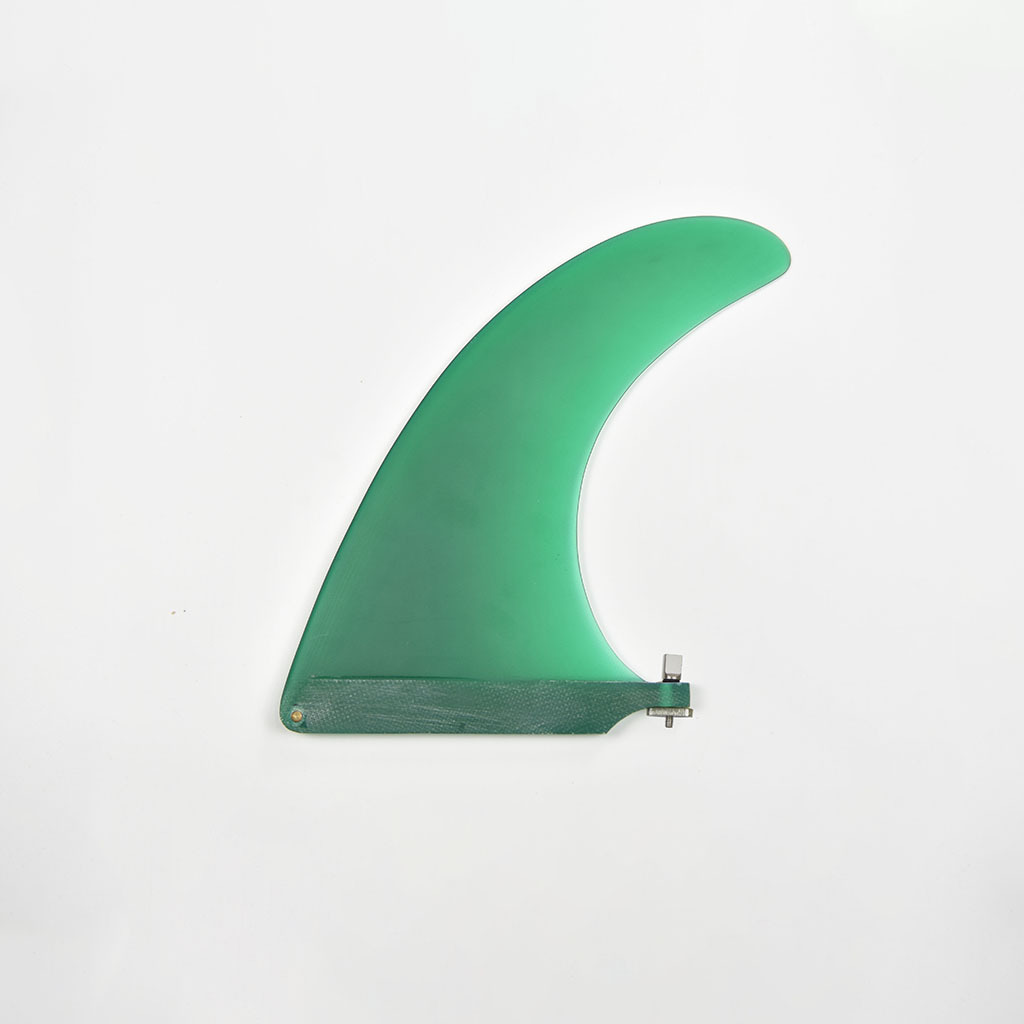
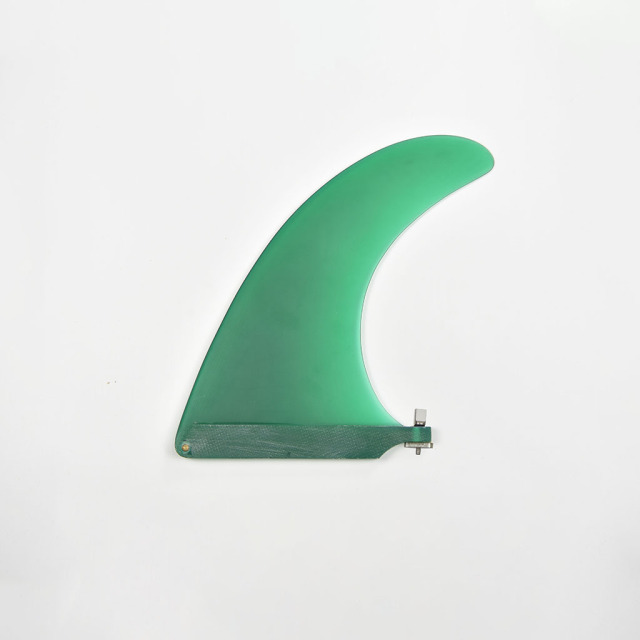
F25509 is the G10 glass fin in the CIMI range: a solid fiberglass laminate cut to a swept single-fin outline and finished with a box base, a plate and a screw. It is the stiff end of our custom fiberglass surf fins. Where a cored fin gives something back when a rider pushes against it, this one holds its shape and keeps the drive going through the turn — which is why it ends up under experienced surfers in high-energy, fast-moving water rather than under a first-season rider on a soft beach break.
The base is a simple, serviceable fitting: the plate sits inside the board's fin box, the fin sets fore or aft, and one screw locks it down. Shops take it as wholesale g10 surf fins because a single template across five rider-weight sizes covers the advanced end of the wall from one supplier, and the next reorder can be the same fin again.
Material & Build
G10 is a dense laminate, not a core wrapped in cloth. We lay up glass fiber with epoxy resin — 60% glass, 40% resin — cure it into a solid block, and cut the fin out of that block. The density is the same at the base as at the tip: no core to dent, no skin to separate from a filler, and an edge that keeps its shape after a knock that would chip a cored fin.
Cutting rather than moulding is what keeps the foil honest. Each template runs on a machine from a fixed file, so the leading edge, trailing edge and thickness distribution repeat from fin to fin; a shop that reorders gets the outline it sold last season, not a near miss.
The surface is sanded to a smooth satin over a translucent green layup, so the cloth structure reads through the finish. As a g10 surf fin manufacturer we cut these in our own workshop, which is why a template can be run again years later, and why private-label work can start from a shape that has already been proven in the water.
One honest trade: a solid laminate carries more weight than a cored honeycomb fin. On a longer board or a step-up that weight is not something a rider notices — what they notice is that the fin does not go soft in the middle of a turn.
- Stiff by design. The laminate resists bending, so the fin keeps its shape when a rider drives hard off the bottom instead of folding away under the load. - Solid all the way through. These are solid glass surf fins: layered fiberglass and epoxy with no core inside, so there is nothing to crush, soften or take on water across a season of use. - Machine cut for repeatability. Every fin is cut to a fixed file rather than hand-shaped, so the outline, sweep and base match from unit to unit — which is what lets a shop reorder stiff fiberglass surfboard fins a season later and get the same fin back. - A base you can service. Plate and screw rather than a fixed tab: if a screw strips or a plate bends, the fin is not retired along with the board. - A build that can carry your name. Because the templates are cut from our own files, custom fiberglass surf fins with your shop's branding can be worked from the same build; send your artwork and size split to your sales contact and we will confirm what is possible.
Fin Box Fitment
- Check the box first. Flush out sand, salt and old wax, and make sure the plate inside slides freely before the fin goes anywhere near it.
- Set the fore-and-aft position. Slide the base into the box and line the fin up where the rider wants it; because the base moves before the screw is tightened, fiberglass fins for surfboard boxes can be nudged forward for looser turning or back for more drive.
- Seat the base flat. The plate should sit under the lip of the box, not on top of it — if the fin rocks when pressed by hand, it is not seated.
- Snug the screw. Solid glass surf fins are dense and rigid, so the screw only has to hold the plate in place; snug it down rather than forcing it.
- Dry-fit before a sale. Set the fin in the box on the shop bench, check that it stands upright and that nothing catches, then take it out and pack it as it arrived.
- Re-check after the first session. Screws work loose on a board being surfed hard, and a quick check after the first surf is the simplest way to stop a customer losing a fin.
Ride Character & Rider Profile
Stiffness only matters if a rider can feel it, and the riders who feel it are the ones already generating speed. Push this fin through a drawn-out bottom turn and it does not fold; it keeps its shape, gives nothing back at the rider and holds the line out of the turn. That predictability is what a strong surfer wants in overhead, fast-breaking water — the fin behaves the same on the fourth turn as on the first, and it does not go vague when the board is loaded at speed. The trade is forgiveness. A fin with this much hold gives less spring out of a soft, small-wave turn, so it feels flat on a mushy beach break and it is the wrong choice for a grom or a first-season surfer who benefits from a fin that flexes back and helps the board along. It is also not the fin for a groveller, or for a board being ridden well under its ideal size. In profile, the riders we build it for are heavier, stronger or simply further along — the ones asking for pro level surf fins rather than an all-rounder.
Size & Rider Weight
- XS — under 55 kg / 120 lbs. For lighter riders already surfing at a level where they load the fin rather than just stand on the board.
- S — 55 to 70 kg / 120 to 155 lbs. The band that fits most teenagers and smaller adults on a performance board.
- M — 65 to 80 kg / 145 to 175 lbs. The middle of the range and the size most shops keep the deepest stock in.
- L — 75 to 90 kg / 165 to 200 lbs. For bigger, stronger surfers and anyone on a longer board where the fin has more water to push against.
- XL — over 85 kg / 190 lbs. The heaviest riders and the biggest conditions; also the size to reach for when a strong surfer is stepping up from a fin that felt vague.
- Size by weight first. The bands are the same across our g10 fiberglass surf fins, so staff can size this fin exactly as they size the rest of the wall, and a customer who knows their weight can be served without guesswork.
- Do not size down to soften them. These are stiff fiberglass surfboard fins: going smaller does not make them more forgiving, it just gives the rider less fin to work with.
- The bands overlap on purpose. A 78 kg rider can be an M or an L — what settles it is how hard they load the fin and how much board they are turning.
Care & Storage
Solid laminate is low maintenance, but it is not indestructible. Rinse the fin in fresh water after a session — salt left sitting in the box and around the screw is what seizes a plate, not the fin itself. Check the screw before and after a surf, especially on a board that lives on a roof rack. When the board is not in use, keep the fin out of direct sun in a board bag where possible; heat and UV do more to a resin finish over a season than water does.
Look over the trailing edge after rocky sessions. A light nick can usually be cleaned up with fine abrasive, and unlike a cored fin there is no filler underneath to expose — but a deep gouge at the base or a bent plate means replacement, not repair.
For shops holding stock through a season, keep g10 fiberglass surf fins lying flat and out of direct sunlight rather than standing them in a window, and rotate the oldest stock to the front of the peg so nothing sits unsold behind newer deliveries.
Pairing & Accessory Range
- Start with the fin, finish the setup. Shops buying wholesale g10 surf fins from us normally add the leash, pads, cover and rack on the same order, so a customer can leave with a complete setup instead of half of one. - Leash. Our Hypalon range runs from a 6 ft 6 mm lightweight leash for small to medium waves up to a 9 ft 8 mm for medium to large waves and longer boards, so the fin and the leash can be picked for the same conditions. - Fins. The wall only reads clearly when the systems are covered — box, single tab and double tab — and when the templates are visibly different from each other. Honeycomb, timber and nylon models sit in the same catalogue as the fiberglass fins for surfboard builds, so one range covers the whole display. - Traction. Tail pads, centre pads and waxless pads finish the deck side of the same customer's board; they ship light alongside a fin order and lift the average basket at the counter. - Cover. Basic bags, regular bags, stretch covers and bodyboard bags protect the board the fin is screwed into, and they are the item a customer picks up on the way out. - Rack. Travel rax with tie-downs, storage racks and display racks are what a shop needs to show the fin wall properly — a display rack is often the cheapest way to make the range sell itself.
Ordering & Delivery
- Size split. Tell us which sizes you want and in what ratio; mixed size runs are normal for a fin wall, and we will confirm what can ship together.
- System and template. Box fin is the fitment on this product. If the same wall also needs single tab or double tab, put them on the same list so the range is planned once.
- Weight the size run. If your customers are the ones asking for pro level surf fins, the L and XL bands are usually where the sell-through sits — order accordingly and confirm the split with us.
- Branding. If the fins should carry your logo or your own packaging, share the artwork and size breakdown with your sales contact and confirm what is possible before the order is fixed.
- Lead time and shipping terms. Confirm current lead time, shipping method and terms with your sales contact when you order; they depend on the size split and the season.
- Packing. Tell us whether the fins are needed loose for a pegboard, bagged for a shelf or boxed for a chain store, so the packing suits the way you sell them.
- Reorder. Wholesale g10 surf fins are cut from the same template file each time, so a repeat order can be matched to the first; note the finish and packing you received so the second shipment lines up.
- Finish and samples. If colour matching matters for your range, ask your sales contact about sample availability and check the finish against your own reference before committing.
Scale & Supply Capability
CIMI is a factory-based supplier with 16 years in surf and watersports hardgoods, manufacturing at our own facility rather than sourcing through traders. Chain stores, supermarkets and surf-brand stores buy from us because one supplier covers a full accessory assortment, so a season's order and its reorders can be planned together. We take on OEM and private-label work, adapting designs, colourways and branding to your programme, and we schedule production against your agreed range plan. Send us your buy list and target dates, and we will confirm what we can make and when.
FAQ
How is this different from your honeycomb fins?
Honeycomb fins are built around a core; these are solid glass surf fins with the same density from base to tip. That makes them heavier and considerably stiffer, so they hold a line in high-energy surf instead of springing back. If a customer wants a light, forgiving fin for small waves, the honeycomb range is the right recommendation. If they want drive and predictability at speed, this is the one.
Which size should we recommend for a given rider?
Start with weight: XS under 55 kg, S for 55 to 70 kg, M for 65 to 80 kg, L for 75 to 90 kg and XL over 85 kg. The bands overlap, so a rider sitting on a boundary goes up a size if they surf demanding water and load the fin hard. Because the same bands run across our g10 fiberglass surf fins, staff can size this fin exactly as they size everything else on the wall.
How does a stiff fin feel in small or soft surf?
Flat. These are stiff fiberglass surfboard fins, and stiffness is exactly what you do not want in weak, gutless waves — the fin will not flex back and add spring to a soft turn. Keep this template for high-energy, fast-breaking conditions and recommend a honeycomb option for everyday small surf.
Which riders are these built for?
Strong, experienced surfers in high-energy waves: heavier riders, and anyone asking for pro level surf fins rather than an all-rounder. They also suit the shop's advanced customers who already know their weight band and want the board to hold through a long, drawn-out turn. They are not a beginner's fin.
Can the fins carry our shop's logo?
We build custom fiberglass surf fins from our own templates, so branding, packing and size splits can be worked through with your sales contact. Send the artwork and size breakdown before the order is fixed, and confirm what is possible for the finish you want.
Will a reorder match the first shipment?
That is the point of cutting rather than hand-shaping. As a g10 surf fin manufacturer we cut every fin from the same template file, so outline, sweep and base repeat between batches. Resin batches can shift the finish very slightly, so if colour matters for your range, keep a reference fin and check it against the next delivery.
Will it fit any board?
It fits boards with a box-style fin box — the longboard and mid-length fitment many fiberglass fins for surfboard setups use. It will not go into a single-tab or double-tab box. Ask the customer which box their board has before you sell, or check it yourself: a box fin seats on a plate with a screw rather than on tabs.