Product Overview
F25209 is a honeycomb surfboard fin built on a double tab base: two short tabs on the underside that drop into the two slots of a twin-tab fin box. It is the version we supply most often to shops that keep a working replacement wall rather than a single display set, because one base covers a large share of the boards coming back through a store or a repair bench. A honeycomb core wrapped in glass and epoxy, laid up by resin transfer molding, is what keeps these surf fins light without leaving them soft. The core takes material out of the middle, so a set feels light in the hand and adds very little to the board on the walk down to the water, while the glass skin over it keeps the fin reading as a fin and the epoxy seals the laminate against salt. Weight is not the only reason it sells. Sizes run from XS to XL across five rider weight bands, which is enough spread for a shop to serve most of the riders who walk in holding a broken fin. That shows up at reorder time more than at first order: the second shipment has to match the first in material, finish and band, and a closed-mold process is what makes that possible.
Honeycomb Construction
- Resin transfer molding. Dry glass and honeycomb go into a closed mold and resin is drawn through under pressure, so every fin leaves the tool with the same resin-to-fiber ratio instead of varying from one hand lay-up to the next.
- Half the build is core. The honeycomb lattice accounts for 50% of the fin: it holds the two skins apart and keeps the middle from being solid laminate.
- Glass fiber carries the load. At 30% of the mix, the glass over the core gives the fin its shape along the curve and takes the knocks at the tip.
- Epoxy seals it. The 20% epoxy resin bonds core to skin and closes the laminate, so salt water does not wick into the cells.
- Light where it counts. The weight saving comes from the open cells in the core rather than from thinning the outer skin, which is why the fin still feels solid in the hand.
- Built for a range of conditions. This is an all-round fin rather than one tuned to a single window; it is intended to work across the mix of clean, choppy and smaller days that most customers actually surf.
- Repeatable on reorder. A closed mold and a controlled resin mix mean the tenth batch of surf fins matches the first, which is what keeps a shelf consistent when someone comes back a season later for the same fin.
Finished Fin Appearance
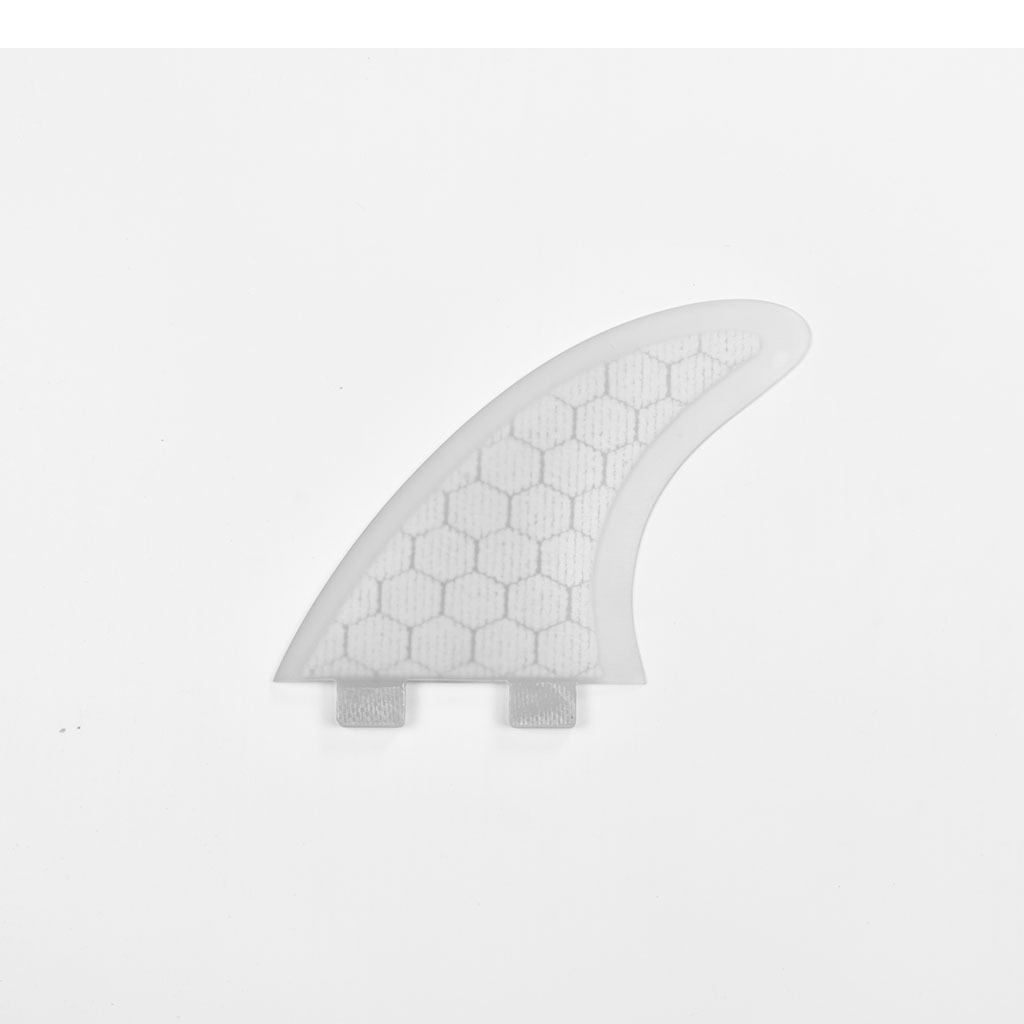
- A finished honeycomb fin shows its core as a regular hexagonal grid under the glass. The laminate is translucent enough for the pattern to run across the face, so a customer can see the construction from across the counter rather than taking the material on trust.
- If your shelf also carries the honeycomb carbon version, keep the two clearly separated. Carbon adds a carbon twill at the base and a darker weave through the fin, so the two lines do not read as the same product when they sit side by side.
- Check the base end first. On this double tab surfboard fin, the two tabs should sit flat and square, ready to drop into a twin-tab box without rocking on the shelf.
- The surface should look glossy and even, with the glass sitting tight over the core. A dull, dry or cloudy patch is a reason to pull that fin from display and check it before it reaches a customer.
- Display the fin where both the outline and the base can be seen — upright in a small stand, or laid flat with the base facing the customer. A fin buried in a deep bin loses the shape and the honeycomb pattern that make it easy to identify.
- Label the shelf with the model code F25209 and the size band, not just the material name. Staff can then compare a customer's old fin against the display, confirm the base and band, and pull the right replacement without guessing.
- Keep one display sample clean and unfitted. A fin that has been screwed down and surfed carries salt marks and a compressed tab, and it no longer shows a buyer what a new fin looks like.
Fin System Options
- Double tab. Two short tabs on the base, one forward and one aft, that drop into a box with two matching slots. This model uses that base, and it is what most twin-tab production boards are built around.
- Single tab. One long tab down the centre of the base, for boxes with a single slotted channel. Same honeycomb build, different base.
- Box fin. A long, deep base that slides into a through-box and is held at the rear; the fitting you still see on traditional longboards and many older boards.
- Telling them apart. Pull the fin you are replacing and look at its base: two tabs, one long tab, or a deep base with no separate tabs. The fins on a surfboard will not swap between these three without an adapter, so the base decides what you order.
- One build, three bases. The three main types of surf fins differ in the base, not in the core — the same honeycomb, glass and epoxy mix is molded in single tab, double tab and box fin versions.
- Why stock all three. Boards arriving at a repair bench are a mix, and a shop that carries only one base sends the rest of the trade elsewhere. Replacement surf fins move one or two at a time, so breadth across the three bases matters more than depth in any single one.
Fitting & Setup
- Match the base to the box first: two slots for double tab, one long channel for single tab, a deep through-box for box fin. Whichever of the three types of surf fins you are fitting, this is the step that decides whether the set will seat at all, so dry-fit before you touch a screw.
- Flush the box out with fresh water. Sand and dried salt under the tabs stop the fin seating flush, and a fin forced down onto grit is how tabs crack.
- Set the front tab in first, then press the rear tab down until the base sits level with the box. Nothing should rock once it is in.
- Fit the screw or plate your board uses and tighten until the fin stops moving — snug, not forced. Over-tightening crushes the tab, and a crushed tab will not sit straight again.
- Sight along the board: the fins on a surfboard should run true down the centre line and stand vertical. A trailing edge that looks twisted is usually a badly seated base rather than a faulty fin.
- Re-check the fixing after the first session in the water. Fins settle into a new box, and a screw that felt tight on the bench can work loose.
Rider Weight & Size Fit
Rider weight is the guide we publish for this surfboard fin, and the range is split into five bands from XS to XL. The bands overlap at the edges, so a rider whose weight sits near the top of one band also falls inside the next. That is deliberate rather than sloppy: weight alone does not settle which fin suits a surfer, and the overlap means the band above is available when it is the better call.
At the counter the reading is simple. Ask the customer's weight, place them in a band, then use the overlap to steer — a lighter or more cautious surfer sits at the lower band, a heavier or harder-surfing one at the upper. If they are replacing a fin they were happy with, match the band they already had rather than recalculating from scratch.
Stocking is a different question from fitting one rider. Most shops hold the middle bands deepest because they answer the widest slice of walk-in trade, and keep a few of the outer bands for surfers who ask for them by name. Rental operators and repair benches usually go the other way, carrying one or two of every band so any board that comes in can go back out with a fin on it.
Size here refers to the rider weight the fin is matched to, not a different template: the base, the materials and the profile come from the same design through the whole range. If you are buying for a specific customer or a team, send us the rider's weight and the board they ride and we will confirm the band. And if a band is out of stock when you need it, tell us the band rather than a measurement — that is how we work.
Specifications
| Model | F25209 |
|---|
| Product type | Honeycomb surfboard fin |
| Base | Double tab; single tab and box fin versions in the same build |
| Core | 50% honeycomb core |
| Reinforcement | 30% glass fiber |
| Resin | 20% epoxy resin |
| Molding | Resin transfer molding |
| Fixing | Twin-tab fin box with two slots |
| Size XS | Under 55 kg / 120 lbs |
| Size S | 55–70 kg / 120–155 lbs |
| Size M | 65–80 kg / 145–175 lbs |
| Size L | 75–90 kg / 165–200 lbs |
| Size XL | Over 85 kg / 190 lbs |
Ordering & Delivery
- Confirm the base: double tab for this model, single tab or box fin if the boards you are fitting take either of the others.
- Confirm the size split from XS to XL. A first order often mixes several types of surf fins, so list each band and quantity separately.
- Confirm how you want the fins presented for your shelf, and whether your own label or hanger goes on.
- Ask your sales contact about sample availability and cost before committing to a full range.
- Confirm lead time, payment terms and freight to your destination in writing. As surf board manufacturers we quote against our own production schedule, so the dates we give you are ours to hold.
- Confirm whether the same shipment can carry a surf leash line, so the leashes land with the fins.
- Confirm the traction side too — tell us the surfboard traction pad styles you want and we will plan them into the same run.
- If you also stock hardgoods, confirm the surfboard rack line you need: travel, storage, display or bike.
- Surf leash | Hypalon leashes L00570H 6 ft 6 mm, L00572H 7 ft 7 mm, L00573H 8 ft 7 mm and L00575H 9 ft 8 mm Fins | Honeycomb, honeycomb carbon, timber, G10 glass and nylon surfboard fins in single tab, double tab and box fin bases Surfboard traction pad | Tail pads, centre pads, skimboard pads and waxless pads Covers | Basic bags, regular bags, stretch covers and bodyboard bags Surfboard rack | Travel racks and tie-downs, storage racks, display racks and bike racks Wax | Wax and wax inserts for shop counters Paddles | SUP and board paddles
Scale & Supply Capability
CIMI is a factory-based supplier with 16 years in surf and watersports hardgoods, manufacturing at our own facility rather than sourcing through traders. Chain stores, supermarkets and surf-brand stores buy from us because one supplier covers a full accessory assortment, so a season's order and its reorders can be planned together. We take on OEM and private-label work, adapting designs, colourways and branding to your programme, and we schedule production against your agreed range plan. Send us your buy list and target dates, and we will confirm what we can make and when.
FAQ
How should I look after honeycomb fins between sessions?
Rinse them in fresh water after salt water sessions and let them dry before they go back in a bag. Check the tab edges and the base for chips whenever a fin comes out of a board — a cracked tab is the one fault you cannot fix at the bench, and that fin should be replaced rather than surfed. Keep fins out of a hot closed car and away from long spells of direct sun, and re-check the fixing after the first few sessions with a new fin.
Is the honeycomb pattern visible in the finished fin?
Yes. The laminate is translucent enough that the core reads as a honeycomb pattern through the glass, under a gloss finish. That helps on a showroom wall, because a buyer can see what they are buying, and it helps at the counter, because the pattern is a quick check that a surfboard fin is the honeycomb build rather than a solid glass or plastic one.
What comes with the fin?
The fin is the item described here. Fixing hardware such as screws and plates is not part of the build listed for this model, so tell us whether you want it supplied with each fin and we will confirm what can go with your order before it is placed.
Can I replace a single lost or broken fin?
Yes — replacement is the normal way this fin goes out. Lost and broken fins are the most common reason shops restock surfboard fins, and a single fin is a standard order. Match the band and the base of the fin that survived, and keep the model reference on file so the profile matches next time. Pairing a different band on the same board is the one thing to avoid, since the fins on a surfboard work as a set.