Product Overview
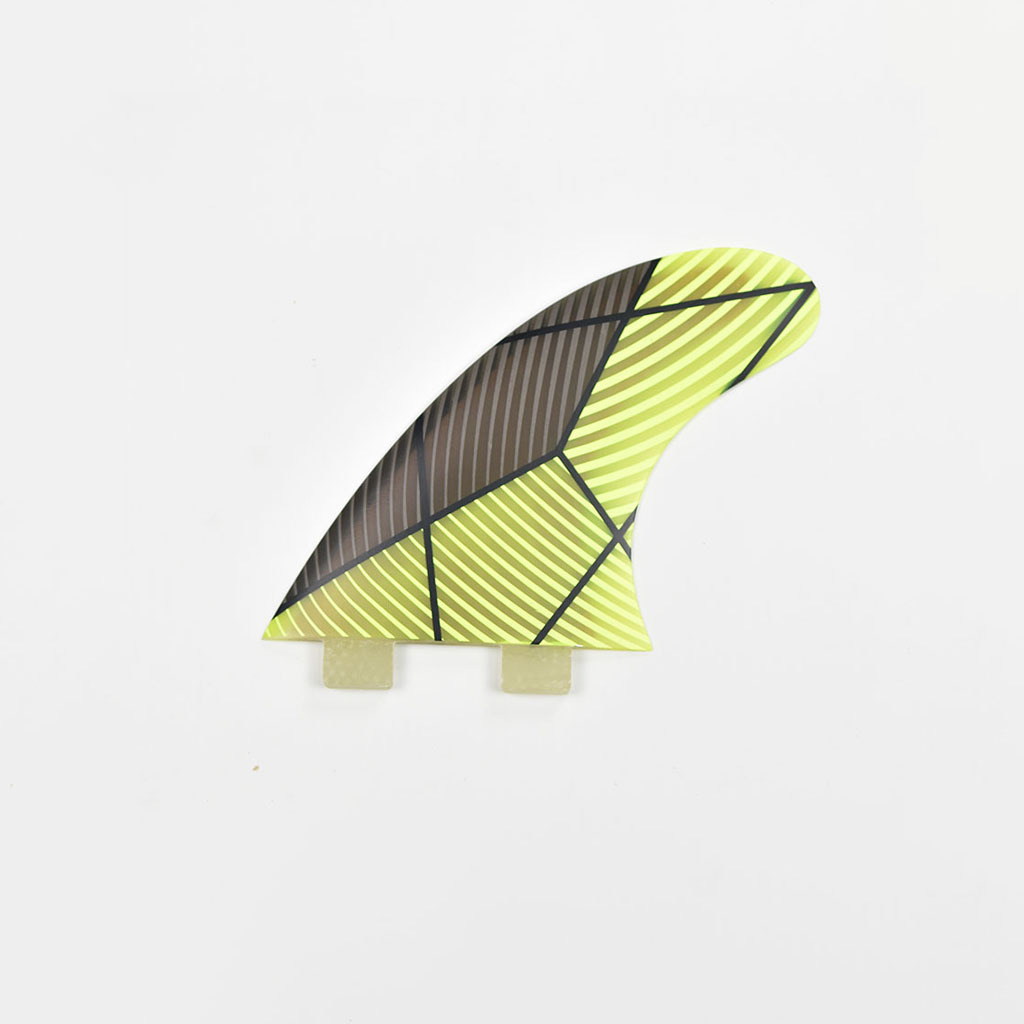
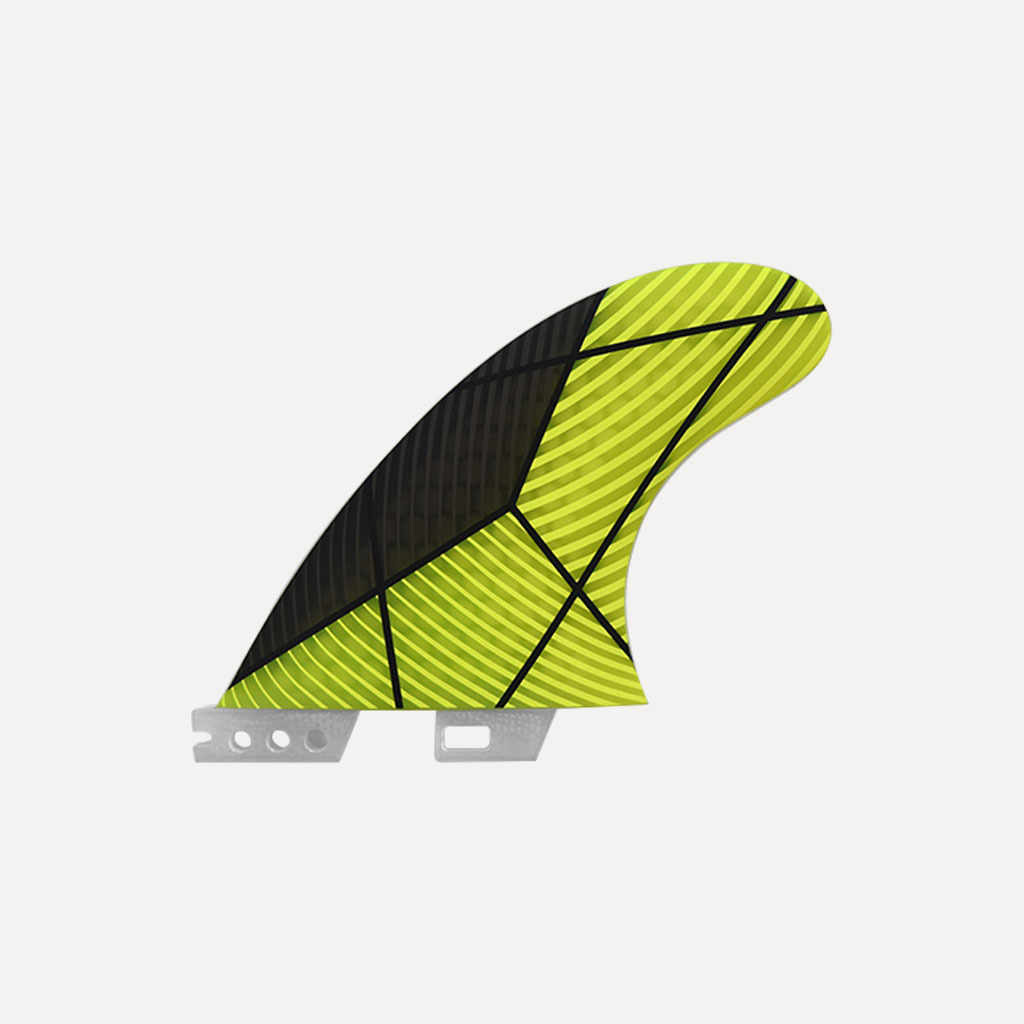
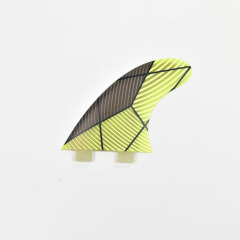
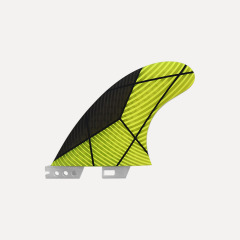
A honeycomb-core fin with a double tab base, this is the part a shop reaches for when a board comes back missing a fin or a customer wants to change how the tail feels. Keeping the core light is what shapes the ride. These surf fins feel quick underfoot and stay comfortable through the mixed, everyday conditions most boards actually meet: small to medium surf, onshore chop, and long sessions where the tail does not need extra load. Shops use them to keep a replacement line complete, and repair benches keep two or three bands on the wall so a board can go back out the same day. The moulded surface carries a graphic panel, shown here in lime green and dark brown, so the fin looks finished on a surfboard rack or display wall rather than like a bare industrial part. Surf board manufacturers, brand chains and independent shop buyers order the same fin; what changes is the size split and how it is packed for the shelf.
Honeycomb Construction
- Honeycomb core, 50% of the build. A hexagonal cell core fills the inside of the fin. It gives the fin its volume without its weight, and it is why the fin reads stiff in the water while staying light in the hand.
- Glass fiber, 30%. Glass skins bond to the core and spread load across the panel, so the fin gives back the energy a turn puts into it instead of flexing past what the rider asked for.
- Epoxy resin, 20%. Epoxy bonds the glass to the core and holds the lay-up together after cure, which is what keeps the three materials working as one piece rather than as loose layers.
- Resin transfer moulding. Resin is drawn through a closed mould instead of being brushed on by hand. The result is an even resin-to-fiber ratio across the fin and repeatable parts when you reorder the same band.
- Light in the hand, light on the board. A lighter fin changes little about paddling and a lot about how the tail releases through a turn, and it takes load off the back of the board on smaller days.
- One of the more versatile types of surfboard fins. The honeycomb build is not tied to a single kind of wave. It works in soft beach-break surf and holds well enough when the face steepens, which is why it suits a general replacement range rather than a specialist one.
- Moulded finish. The surface comes out of the mould smooth, with a graphic panel laid over it. The colour is cosmetic; the laminate underneath is the same on every version of the template.
- This fin is the all-glass honeycomb build. F25208 is moulded on a 50% honeycomb core with 30% glass fiber and 20% epoxy resin, and nothing else goes into the lay-up. It is the baseline version of the template. - The carbon honeycomb version shifts the mix. It keeps the same 50% honeycomb core and 20% epoxy resin, but glass fiber drops to 20% and 10% carbon fiber is added, with an internal carbon framework shaped to each template and a carbon twill laid at the base. - What changes underfoot. The carbon frame is built to deliver a more user-friendly flex pattern, so the fin loads and releases through a turn more progressively. This fin stays with glass and epoxy alone, so the response is simpler and more direct through the same outline. - Everything else stays the same. Both versions run the same five rider weight bands from XS to XL, the same single tab, double tab and box fin bases, and the same resin transfer moulding process. A shop can carry identical sizes and fittings in each, and a rider can move between them without changing anything else on the board. - How to place them on the wall. Keep this fin at the repair counter, in the rental fleet and on the all-round replacement shelf beside the surf leashes, where unit cost and steady reorders matter most. Set the carbon version beside it for the customer who comes back asking what the next step up does. Carbon content is the main difference in material cost between the two, so confirm current pricing with us when you build the assortment. - The rest of the family, briefly. The same range also carries a timber-named honeycomb version under F25403, a plastic double tab under F25011 and an inkjet version under F00155. All of them fill the same slot on the fin wall, so a buyer assembling a full line of fins for surfboard repair and dealer stock can anchor the range on the honeycomb glass build and step sideways from there. - Reordering. Quote the model code each time: F25208 for this fin, and the F253xx codes for the carbon honeycomb double tab versions. Keeping the code on the purchase order is what prevents a carbon fin arriving when you meant to restock the glass one.
Fin System Match & Mounting
- Look at the box on the board first. Double tab, single tab and box fin bases are the three fittings most types of surfboard fins are built around, and a fin cut for one will not seat properly in another. The base is what decides whether a set of surfboard fins can be swapped straight over.
- Order the version that matches. This template is produced in single tab, double tab and box fin versions, so the same honeycomb build can be matched to whichever base the board carries. The double tab is the version shown here.
- Dry-fit before you tighten anything. Slide the tabs in with the screw loose and check that the base sits flush and the trailing edge lines up with the board's stringer.
- Seat the tabs fully. Push the fin down until the base contacts the box along its whole length. A fin sitting proud on one tab will rock once the board is in the water.
- Tighten by hand, not with force. The screw only has to hold the fin in place. Over-tightening crushes the tab plate and makes the next removal harder.
- Check the fore and aft position. Move the fin within the box before the final tighten; small changes in position are how a rider tunes a board without buying anything else.
- Look again after the first session. Fins settle after a few waves, and a second check of the screw and the tab seating catches most problems before they cost a fin.
Rider Weight & Size Bands
- XS, under 55 kg / 120 lbs. For groms and lighter surfers, and the band a shop should keep for junior boards and small-framed adults.
- S, 55 to 70 kg / 120 to 155 lbs. The light-to-average adult band, and the usual first replacement size for a teenager moving off a soft-top.
- M, 65 to 80 kg / 145 to 175 lbs. The middle of the range and the safe default for an all-round board ridden by an average adult.
- L, 75 to 90 kg / 165 to 200 lbs. For heavier surfers, and for anyone on a bigger board that needs more fin under the tail.
- XL, over 85 kg / 190 lbs. The heaviest band, for larger riders and longboards that carry more weight through a turn.
- The bands overlap on purpose. A 70 kg surfer sits inside both S and M, and a 78 kg surfer inside both M and L. When a customer falls between two, the deciding question is how big the board is and how much drive they want from the fins on a surfboard that size, not the number on the scale alone.
- Two bands cover most walk-in trade. A small shop can serve customers with M and L on the wall, while a rental fleet or a repair bench is better served by all five, because the cost of a missing size is a board sitting out of the water. That is why most buyers treat these as fins for surfboard replacement stock rather than a single-size purchase.
Specifications
| Model | F25208 |
|---|
| Construction | Resin transfer moulded honeycomb fin |
| Core | 50% honeycomb core |
| Reinforcement | 30% glass fiber |
| Resin | 20% epoxy resin |
| Fin systems | Single tab, double tab, box fin |
| Base on this version | Double tab |
| Sizes | XS, S, M, L, XL |
| Rider weight range | Under 55 kg (120 lbs) to over 85 kg (190 lbs) |
| Surface | Smooth moulded finish with a graphic panel |
| Typical use | Replacement fins for surfboard repair, rental and resale stock |
Care & Storage
Rinse the fins in fresh water after a saltwater session and let them dry on a surfboard rack before they go back into a bag. Salt works into the tab area and around the screw, and a fin put away wet will show corrosion at the hardware long before the laminate gives any trouble.
Store fins flat or standing in a rack rather than leaning on a tip. Heat is the bigger risk than water: a fin left in a hot car or against a dark wall in direct sun goes through harder cycles than it ever meets in the sea, and repeated heat is what makes a laminate feel brittle over time. Because the fin only touches the board at its base, that is also where the fins on a surfboard show wear first, at the tabs, the screw and the plate, long before the foil does.
Wash and dry the base every few sessions and look along the foil for cracks rather than scuffs. A fin that has taken a hard impact is worth checking against a straight edge before it goes back in the box; the earlier a bent tab or a lifted edge is caught, the cheaper it is to deal with.
Matching Gear
| Part | What is available |
| Leash | Hypalon surf leashes in 6 ft / 6 mm, 7 ft / 7 mm, 8 ft / 7 mm and 9 ft / 8 mm, from a lightweight small-wave leash through to a longboard leash for medium to large waves |
| Fins | Honeycomb, timber, G10 glass and nylon surfboard fins, plus fin accessories for fitting and repair |
| Traction | Surf traction pads, including tail pads, centre pads, skimboard pads and waxless pads |
| Cover | Basic bags, regular bags, stretch covers and bodyboard bags |
| Rack | Travel rax and tie-downs, plus a surfboard rack selection covering wall racks, display racks and bike racks |
| Wax and inserts | Wax and insert accessories for day-to-day board care |
Ordering & Confirmation
- Send the size split you need. Tell us how many of each band you want rather than one figure for the whole order. A replacement line is normally mixed, and the split is what production is scheduled against.
- Confirm the graphic and finish if it has to match your range. Send artwork or a reference fin and we will confirm what can be reproduced on this template before the run starts.
- Confirm packing and labelling. If the fins go straight onto a shelf or into a chain's planogram, say so at the enquiry so packing and any planogram labelling can be agreed with the order.
- Give us the in-store date, not the order date. Production is planned against the date the goods are needed, so the season date is the one that matters when lead time is confirmed.
- Ask about sample approval before a bulk run. A physical fin is the only reliable way to check the graphic, the surface and the base fit against your own board; ask your sales contact what is available for your project.
- List the rest of the shelf on the same enquiry. If the order is also restocking surf leashes, traction pads or covers, put it on one enquiry so sizes and shipping can be planned together.
- Quote the model and band on reorders. Repeat orders placed with the same model code, size band and material keep the build consistent, and they save re-approving a fin you already sell.
Scale & Supply Capability
CIMI is a factory-based supplier with 16 years in surf and watersports hardgoods, manufacturing at our own facility rather than sourcing through traders. Chain stores, supermarkets and surf-brand stores buy from us because one supplier covers a full accessory assortment, so a season's order and its reorders can be planned together. We take on OEM and private-label work, adapting designs, colourways and branding to your programme, and we schedule production against your agreed range plan. Send us your buy list and target dates, and we will confirm what we can make and when.
FAQ
How does this fin compare with the carbon honeycomb version?
The carbon version keeps the honeycomb core but adds 10% carbon fiber, with an internal carbon frame and a carbon twill at the base, which gives a more user-friendly flex pattern. This fin stays with the straight glass-and-epoxy build: 50% honeycomb core, 30% glass fiber, 20% epoxy resin. Both come in the same five weight bands and the same three fin systems, so different types of surfboard fins here suit different budgets and different feels more than different boards. These surf fins are the simpler, lower-cost way into a honeycomb build.
Will the honeycomb core hold up to regular use?
The honeycomb is a core, not a hollow shell. It sits bonded inside a glass and epoxy laminate, and the glass skins are what carry the load. Day to day the fin takes the usual knocks of beach breaks, reef shallows and board bags, and the fins on a surfboard wear at the base, at the tabs, screw and plate, before they wear at the foil. A direct impact can still damage any fin, so the base is the first place to look after a hard hit.
Are fin screws included with the fin?
The fin is supplied on its own; screws and a fin key are normally part of the board's own hardware. Tell us when you enquire if you want screws or a key packed with the order, and we will confirm what can be added.
Can the fin be produced with our own graphics or colourway?
Yes. Colourway and graphic changes are part of our OEM work with surf board manufacturers and branded product lines. Send artwork or a colour reference and we will confirm what the moulded surface can carry, and how the graphic sits on the finished fin, before production.