Product Overview
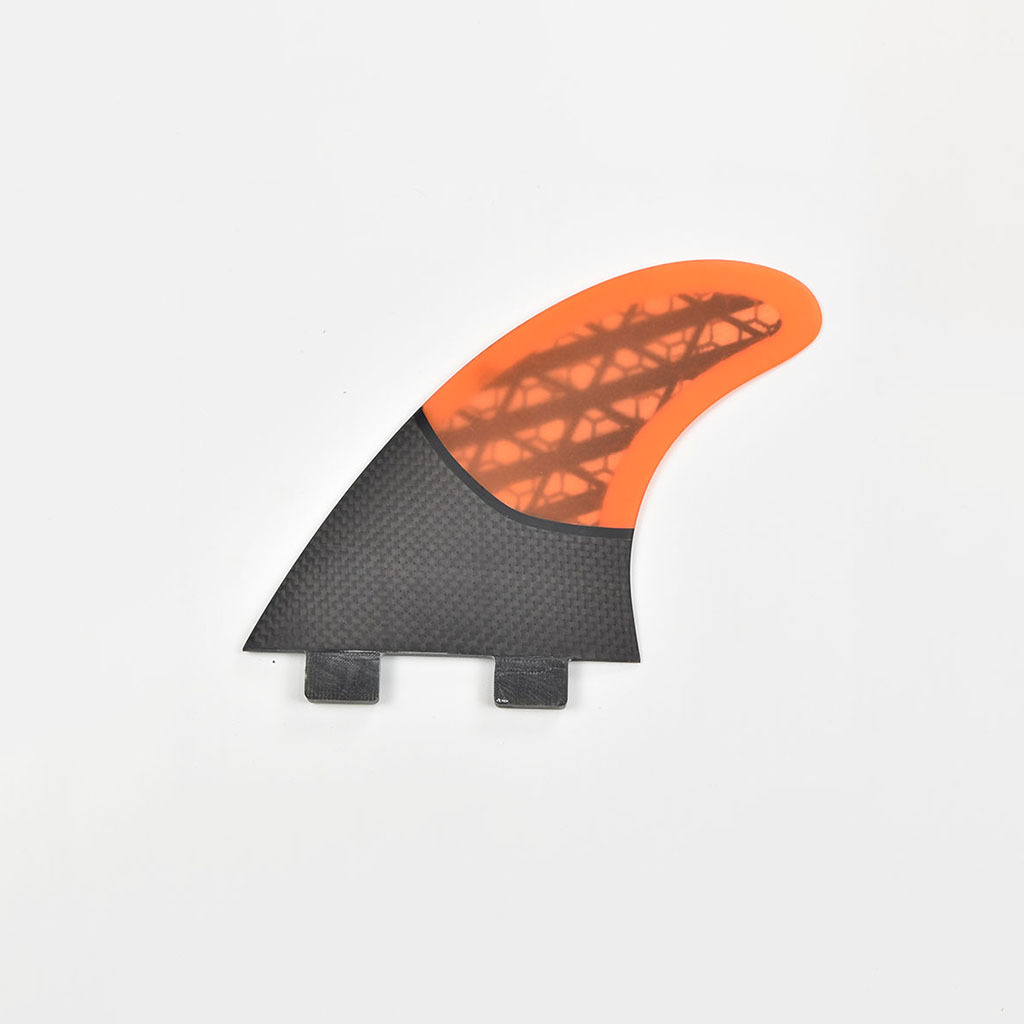
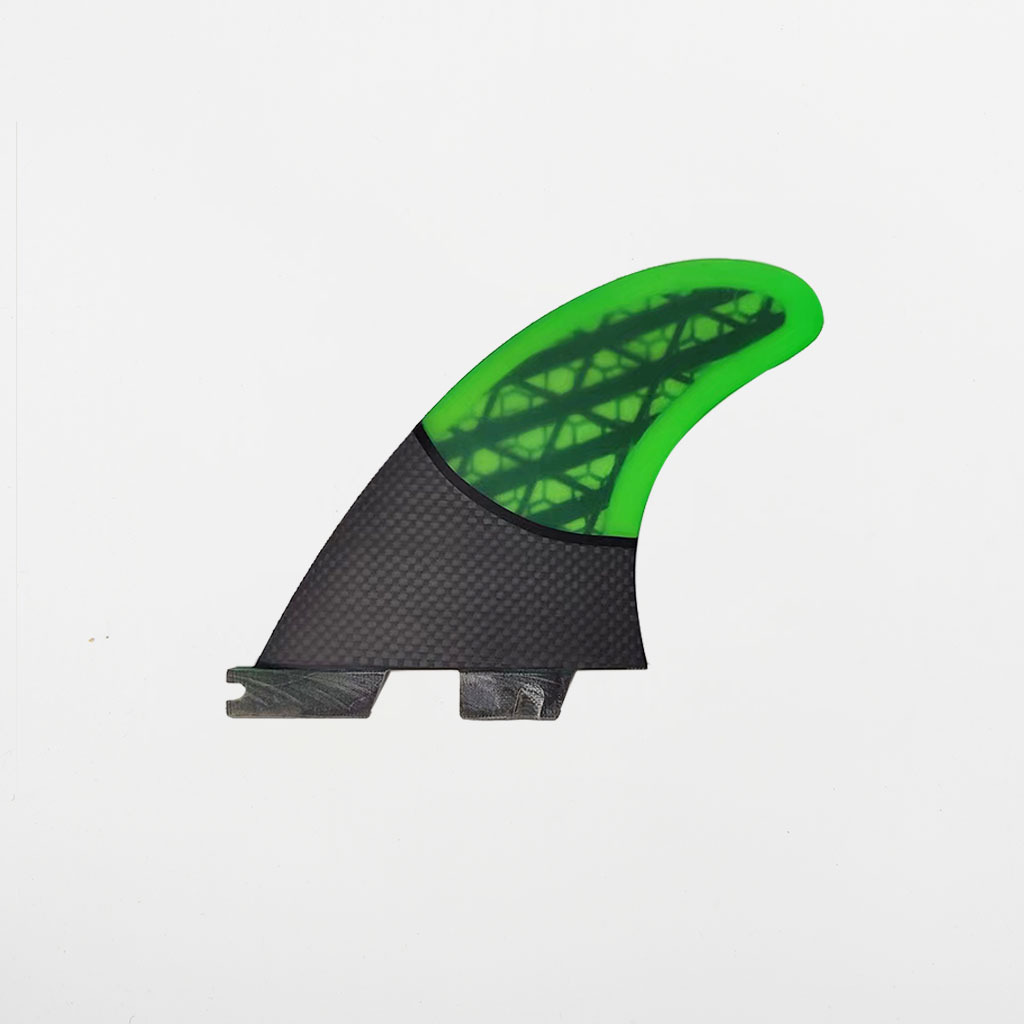
F25321 is the carbon build in our honeycomb surf fins line: a light, resin-transfer-moulded fin with 10% carbon fibre and an internal carbon frame drawn to suit its own template. It is aimed at the boards that move fastest through a shop — the everyday shortboard sizes that lose a side fin, go out on a rental board, or come back on a repair ticket.
The build is what separates it from the plain honeycomb version. Both share the same honeycomb core and the same low weight, but the carbon layup and the carbon twill running through the base give this one a more user-friendly flex pattern. For a fins surf shop, that means the carbon code sits alongside the glass fin on the wall rather than replacing it: two price points, one familiar shape, one material story to explain.
Because the same layup is produced in single tab, double tab and box fin versions, one fin covers several board systems without a second supplier conversation. Staff do not have to learn a new product every time a board arrives with a different box.
For surf board manufacturers and private-label ranges, this is a way to put a carbon option under a new board model without building a separate supply chain. Every fin is moulded in our own workshop, so the layup that leaves on the first order is the one that leaves on the reorder.
Construction & Flex
- A honeycomb core carrying half the build. The core is 50% of the material and holds the two skins apart, which is where the low weight comes from. Weight at the tip is the first thing a rider notices when a fin feels heavier than expected.
- Glass skins that take the knocks. The 20% glass fibre sits on the outside, where fins meet reef, shorebreak and the back of a van. It is the layer that absorbs the kind of impact which would otherwise crack a brittle shell.
- Epoxy resin, 20%. We build the surfboard fins in this range on epoxy rather than a polyester layup, and the switch happened at the same time as the carbon work. It is part of the reason the finished fin flexes the way it does instead of feeling locked.
- Carbon, 10%, held inside. Only a tenth of the material is carbon, and it is worked into the internal framework rather than laid on the surface. That keeps the fin from becoming the stiff carbon blade some riders expect from the word.
- A frame drawn for each template. The internal carbon framework is designed specifically to suit each template, so a larger outline is stiffened where a larger outline needs it rather than simply being scaled up from the smallest size. One surfboard fin model does not borrow another's layup here.
- Carbon twill through the base. The base is where the fin hands load into the box, so that is where the twill sits. It is the detail we credit with the friendlier flex pattern.
- Resin transfer moulding, run after run. RTM draws resin through a closed mould around the core, which keeps the resin-to-fibre ratio steady between production runs. For a buyer, that is what makes the third reorder look and feel like the first sample.
Fin System Fit
- Read the base before anything else. Three types of surfboard fins dominate most shops — single tab, double tab and box fin — and their bases are not interchangeable. Compare the base of the fin you are removing with the new one before you think about size — the check any good surfboard fins guide puts first, because it decides whether the fin fits at all.
- Match the build to the board. this product covers the double tab version. The same carbon honeycomb layup is produced in single tab and in box fin, so a board that will not take a two-tab base is not a lost sale; ask for the version that fits.
- Dry-fit every fin. Slide it in without force. It should seat cleanly and sit without rocking. If it will not, either the routing or the base is wrong, and the correct fins for surfboard boxes of that type will drop straight in.
- Write the match down. Keep a board model against the fin code on your stock sheet, so the next order does not depend on someone remembering which fin went where.
- Ask when the box is unusual. Older boards, custom routing and retro boxes do not always follow the pattern. Send a photo of the box with the old fin alongside it and we will confirm which build to send.
Size & Rider Weight
Sizing runs on rider body weight rather than board length, which is the measurement a customer can usually give you at the counter. XS covers riders under 55 kg (120 lbs) — junior boards and lighter groms. S runs 55–70 kg (120–155 lbs), where lighter adults on small shortboards land. M, at 65–80 kg (145–175 lbs), is the band that covers most adult shortboards. L runs 75–90 kg (165–200 lbs) for heavier riders and bigger boards, and XL takes riders over 85 kg (190 lbs).
The bands overlap on purpose, so a rider can honestly sit in two sizes. M and L share a 75–80 kg window, and S and M share 65–70 kg. When that happens the choice is about how much fin the rider wants under the board, not about a rule applied from a distance — keep both bands on the wall and let the rider feel the difference on the board they actually ride.
When you build the first order, weight it toward M and L and treat XS, S and XL as depth. The middle sizes are the ones a fins surf shop sells through first, and the ones a rental fleet wears out first, because nearly every adult rider fits one of them.
Printed next to the fin wall, this works as a short surfboard fins guide that answers the size question without staff involvement. If a rider sits exactly on a boundary, order both sizes instead of guessing, and run the sizing against your own board list when you send it through.
Replacement & Wholesale Stock
- Replacing a lost or broken fin. When a customer walks in missing a side fin, the carbon honeycomb build is a step-up replacement you can hand over rather than a like-for-like glass swap: the same shape family, with a carbon story the customer can feel. - Rental fleet upkeep. Rental boards shed fins all season and the middle sizes take the wear. Holding M and L in depth keeps boards on the water instead of in the back room. - Repair bench supply. A steady supply of fins for surfboard repair counters stops a board sitting in the rack for a week waiting on a part that costs very little. - A seasonal carbon option. Most ranges already carry several types of surfboard fins. Our carbon surf fins give that range a visible step-up without adding a new supplier or a new shape family. - Mixed size and base orders. A first order rarely sits in one size. List what each board or model needs against the size bands in the surfboard fins guide, and the range covers it in a single shipment.
Specifications
| Product type | Double tab surf board fins, honeycomb carbon |
| Honeycomb core | 50% |
| Glass fibre | 20% |
| Epoxy resin | 20% |
| Carbon fibre | 10% |
| Moulding | Resin transfer moulding (RTM) |
| Internal structure | Carbon framework matched to each fin template, carbon twill through the base |
| Base | Double tab |
| Other bases in this build | Single tab, box fin |
| Flex character | More user-friendly flex pattern |
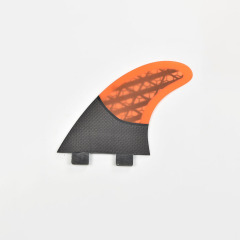
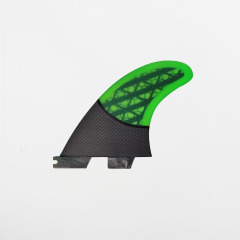
| Finish | Gloss resin, translucent tint at the tip, carbon weave visible at the base |
Companion Range
| Hypalon surf leash, 9 ft 8 mm (L00575H) | Longboard and bigger-wave ankle leash |
| Hypalon surf leash, 8 ft 7 mm (L00573H) | Durable everyday leash for medium to large boards |
| Hypalon surf leash, 7 ft 7 mm (L00572H) | All-round leash for medium waves |
| Hypalon surf leash, 6 ft 6 mm (L00570H) | Light leash for small to medium waves |
| Honeycomb surfboard fins, single tab and double tab (F00543–F00546) | Glass honeycomb build for everyday stock |
| Surf traction tail pads | Tail and centre grip for shortboards and skimboards |
| Board covers | Basic bag, regular bag and stretch cover |
| Board racks | Travel, storage, display and bike racks |
Ordering & Delivery
- Send your board list. We build to a range plan, so note the size and base needed for each board or model and send the whole list rather than one line at a time.
- Say whether you buy singles or sets. Tell us how you want the surf board fins packed and presented for your shelf, and the quotation will be built around that rather than around an assumption.
- Approve a sample first. Check the layup, the tab fit and the tip tint on a sample surfboard fin before the production run.
- Confirm quantity, lead time and terms with your sales contact. For surf board manufacturers and private-label ranges these depend on the sizes and systems in the mix, so they are quoted per order.
- Sort labels and cartons. If the fin goes out under your own brand, confirm the label artwork and carton marking at the same time as the order.
- Set a reorder point for M and L. They empty first, and running out mid-season costs more than carrying a little extra stock.
Receiving Checks & Fin Care
On arrival
Count cartons against the packing list by size and base before anything reaches the shelf. Open one carton from every size in the shipment, not one carton from the whole order: a mix-up at the moulding stage shows up as an M sitting in a bag labelled L, and it is far cheaper to catch that on the receiving table than after the surfboard fins have been priced and pegged. Seat a fin from each size into a board of the matching system and let go of it — it should drop in without force, sit flat and stay put when you rock it. Run a thumb along the tab edges for mould flash or a sharp line, which will chew at the box over a season. Hold the base up to the light and check that the carbon twill runs flat and continuous, with no pale dry patches or bubbles in the resin. Read the size marking on the fin against the bag label. Look at the tips last: a dropped carton chips a resin tip before anything else, and a chipped tip is not a fin you can sell as new. If a carton is short, mixed or damaged, photograph the open carton with the packing list beside it and keep those fins together until we have agreed a replacement.
Routine care
The carbon layup does not ask for a different routine — it is sealed in epoxy, and the carbon sits inside the build rather than on the surface — but the tab and the tip carry the wear. Rinse each surfboard fin in fresh water after saltwater use, working around the tab and into the slot it came out of, because salt crystallises hard and will make the fin sit proud the next time it goes in. Dry the fin before it goes back into a cover or a bag. Wipe grit, wax and sand out of the box slot whenever a board comes in for a service; that grit laps at the tab every time the fin is fitted. Check the tab at the same time for white stress marks, chipped corners or a base that has started to lift, and replace the fin rather than refitting it — a loose tab works on the box and does more damage than the fin is worth. Keep grub screws snug against the plate and no more, since crushing the tab edge cracks the resin at the base. Store fins flat or in a fin pocket, never loose in a hot vehicle or under a stack of boards, and keep long-term stock in closed cartons out of direct sun.
Scale & Supply Capability
CIMI is a factory-based supplier with 16 years in surf and watersports hardgoods, manufacturing at our own facility rather than sourcing through traders. Chain stores, supermarkets and surf-brand stores buy from us because one supplier covers a full accessory assortment, so a season's order and its reorders can be planned together. We take on OEM and private-label work, adapting designs, colourways and branding to your programme, and we schedule production against your agreed range plan. Send us your buy list and target dates, and we will confirm what we can make and when.
FAQ
Which boards will this fin fit?
this product covers the double tab version, so it seats in a board routed for a two-tab base. Because these are surfboard fins built around a specific base rather than a universal one, the base decides the fit before the size does. The same carbon honeycomb layup is produced in single tab and box fin, so a board with a different box is still covered by the same build. Choosing the right fins for surfboard boxes starts with the routing: compare the base of the fin you are removing with the new one before ordering, and if the routing looks unusual, send a photo of the box with the old fin beside it.
How is this fin different from your plain honeycomb fin?
Both sit on the same honeycomb core and both are light. The plain version carries 30% glass fibre and 20% epoxy resin; this one trades part of that glass for 10% carbon fibre and adds an internal carbon framework plus a carbon twill through the base. The result is the more user-friendly flex pattern described above the fold — the fin loads and releases progressively instead of feeling locked. Shops that already carry the glass honeycomb surf fins usually add this one as the step-up rather than swapping it in.
Why do the tips look different colours in the photos?
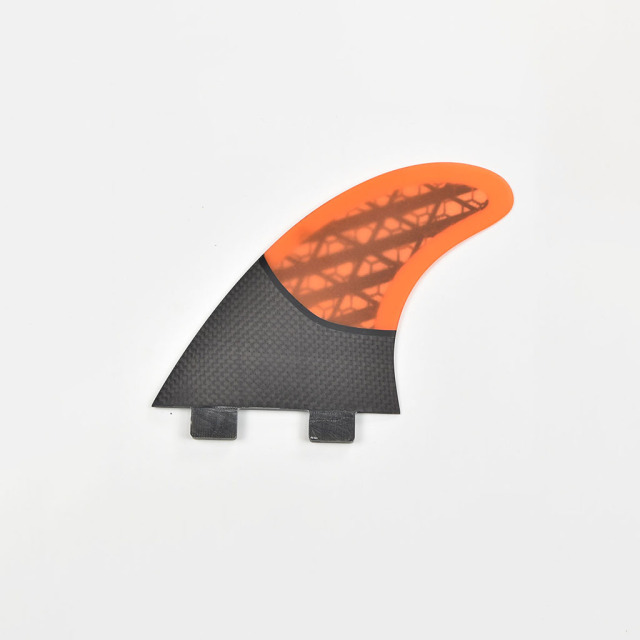
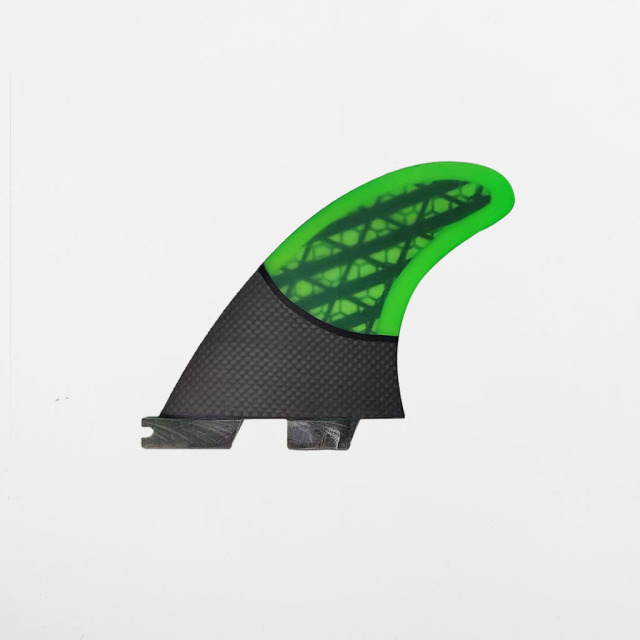
The tip is translucent, so the tint reads differently depending on light and shooting angle; our images show orange and green examples over a black carbon-weave base. The colour is a cosmetic layer over the layup, not a marker of a different construction. If a particular tint matters to your range, confirm it against a sample before the run.
Can the fin be produced with our own logo and colourway?
Yes. We build private-label surfing hardware for brands, and a fins surf shop running its own label can have the colourway and branding adapted to its programme. Send the artwork and colour reference with your order and confirm both against a sample before production.
What should we check when a shipment arrives?
Open one carton and check a fin in each size. Look for tab edges that seat cleanly, a consistent carbon weave at the base, and the size marking readable on the fin. Then check that the surf board fins you received match the sizes and bases on your order sheet — a mixed shipment is easy to sort at the counter and harder once it has been priced and shelved.
Is there anything different about looking after a carbon fin?
No special routine. Rinse in fresh water after saltwater use, dry before the fin goes back into a cover, and check the tab area of each surfboard fin for nicks or stress marks whenever the board comes in for a service. Avoid leaving fins loose in a hot vehicle or stacked under weight, since both tip and base take the load. If a tab chips, replace the fin rather than refitting it, because a loose fin damages the box. There are many types of surfboard fins on the market with different care needs, but a carbon-honeycomb fin asks for nothing beyond the basics.