Product Overview
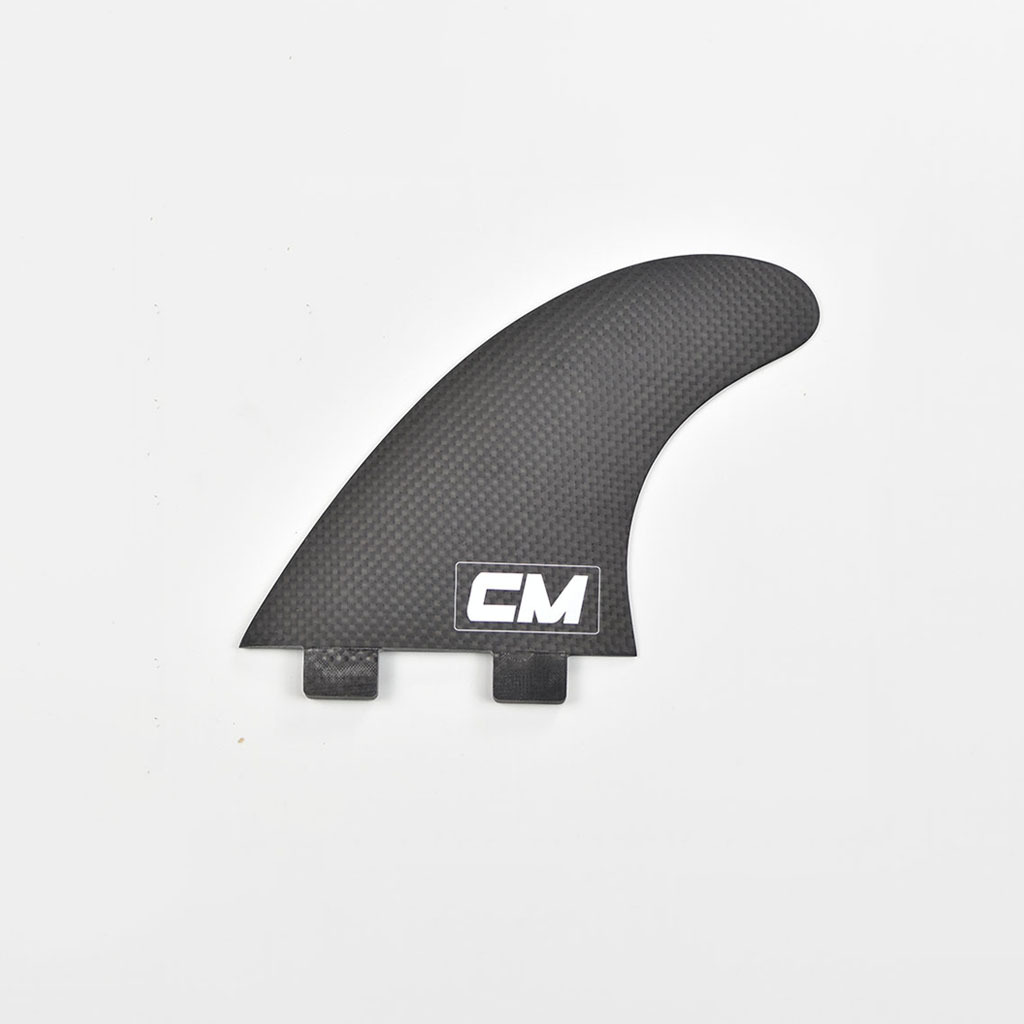
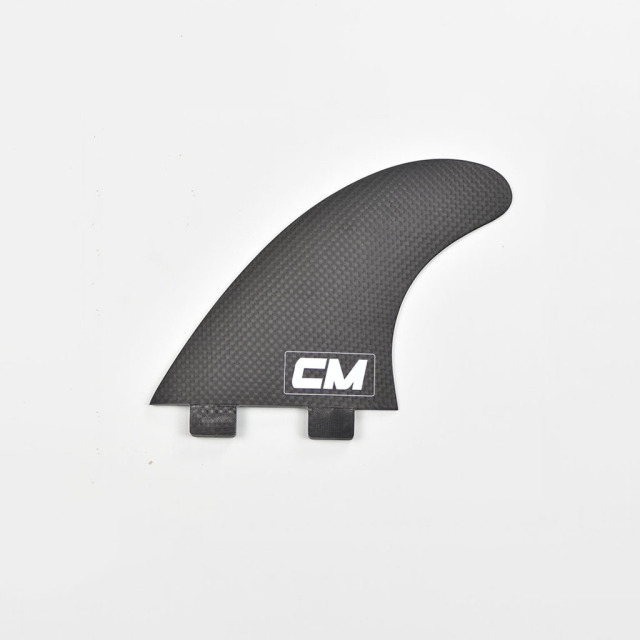
Built around a honeycomb core with a carbon frame running through it, this double tab fin is the carbon member of our honeycomb surf fins range: light in the hand, finished in gloss black over the weave, and marked with the CM logo on the side. It is a single fin, ordered in whichever sizes your shelves or your repair bench actually turn over.
Shops take it as a one-for-one replacement. A customer loses a fin on a Saturday, staff match the size and the twin-tab base, and the board goes back in the water the same afternoon. Repair benches keep a small spread of sizes because a cracked or snapped fin is one of the most common fixes that comes through the door, and rental fleets fit it to boards that were supplied with honeycomb fins in the first place. Board builders use it where a model ships with a carbon-honeycomb set and the spare has to look and feel the same as what is on the board.
For the rider the decision is usually simple: replace the fin that broke, or move a board off glass honeycomb onto something lighter. Setting up a twin fin surfboard takes two matched fins, a thruster takes three, a quad takes four. Because the fins are supplied individually, a shop can sell one and a rider can build the set the board actually needs.
Day to day it is a small, fast-moving item: a peg in the accessory aisle, a drawer at the bench, a spare under the seat of the van. It goes in with the screw and plate the board already carries and comes out again in seconds when the board is packed away. Nothing about fitting it needs a specialist, which is why it sells as readily to the parent of a grom as to a shop buying a season of replacement stock.
Material & Construction
- Honeycomb core, 50% of the build. The core gives the fin its volume without the weight of a solid layup, so a full set adds very little to the tail of a board.
- Glass fiber, 20%. The glass carries the layup and gives the fin its body around the core.
- Epoxy resin, 20%. Resin transfer molding draws the epoxy through the layup in a closed mold, so the resin is distributed evenly instead of pooling at the base the way it can in a hand layup.
- Carbon fiber, 10%. Part of the layup is carbon rather than glass, which is the difference between this fin and the plain honeycomb version.
- Internal carbon framework. The carbon is not a cosmetic layer on the outside. It runs inside the fin, shaped to suit each template, so the stiffness follows the outline of the fin rather than a generic insert.
- Carbon twill at the base. The base is where fins on a surfboard take their hardest knocks, levered against the plug when a board rolls in the shallows, which is why the twill is laid where the load is.
- A more user-friendly flex pattern. Moving this construction to epoxy resin and adding the base twill produced a flex that releases predictably under load instead of feeling harsh through a turn.
- A fixed recipe for reorders. Buyers reordering surfboard fins are working from a stated specification, not from a vague carbon label, so the material mix on the shelf does not drift between shipments.
Fin System Fit
Fins on a surfboard are held by whichever system the board was built with, and this is the double tab version: two tabs under the base drop into twin-tab plugs, and a screw at the back of the base locks the fin down. It suits shortboards, funboards and mid-lengths built with those plugs, and it is the version most repair benches keep on hand because so many boards arrive with twin-tab boxes.
There are three types of surf fins in the way we mold them: single tab, double tab and box fin, and this honeycomb carbon build is produced in all three. That matters when a shop wants one construction across a mixed wall, because the same carbon fin can cover boards with twin-tab plugs, boards with a single slot and a screw, and longboards or SUPs with a long centre box, as long as the right version is ordered for each. this product's fin is double tab, so order single tab or box fin wherever the board calls for it.
Before committing a line, look at the underside of the board. Twin-tab plugs take this fin, a single slot with a screw takes a single tab, a long box takes a box fin, and a glassed-on fin is a different job altogether. Tab spacing varies between plug systems, so compare the tabs on the fin being replaced with the ones being ordered rather than assuming every two-tab base is identical.
Rider Weight & Sizing
- XS, under 55 kg / 120 lb. Junior riders and light adults on short boards, and the size a shop keeps for grom rental boards.
- S, 55-70 kg / 120-155 lb. The common small size for average builds on everyday shortboards.
- M, 65-80 kg / 145-175 lb. The middle of the range, and the size most adult riders settle on for an all-round board.
- L, 75-90 kg / 165-200 lb. Heavier riders, or lighter riders on a bigger board who want more fin under them.
- XL, over 85 kg / 190 lb. Big riders and longboards where the board needs the extra area.
- When a rider sits between two bands. S and M overlap at 65-70 kg, M and L at 75-80 kg, and L and XL at 85-90 kg. Someone in an overlap can go either way: up for more hold on a bigger board, down for a looser feel on a small one.
- Match the set. A twin fin surfboard takes two fins, a thruster three and a quad four, so build the line in pairs where the board needs pairs and keep every fin in a set on the same size.
- Weigh the rider as they actually surf. Wetsuit and boots on, not the bathroom-scale weight in summer shorts. Use the bands as a surfboard fins guide when you draw up a buy sheet; they run consistently across the surf fins in this construction, so a mixed order stays coherent from size to size.
Fitting & Care
- Clean the plug first. Flush out sand, salt and old wax so the tabs can seat all the way down. A fin sitting proud is usually sitting on debris.
- Dry-fit the surfboard fin before tightening anything. It should drop in without force. If it binds, find out why, whether that is a burr in the plug, a swollen tab or the wrong system, rather than pulling it down with the screw.
- Use the screw and plate that belong to the board. Check the plate has located in the slot at the back of the base, then tighten to firm rather than crushing it down.
- Check alignment. Leading edge toward the nose, trailing edge toward the tail, and the fin sitting at the same depth as its neighbours in a multi-fin set.
- Re-check after the first session. Screws work loose on a new fit, and a second check after travel costs thirty seconds.
- Rinse and dry. Fresh water after salt water, then let the fin dry before it goes back into a cover or a bag.
- Avoid the two common failures. Over-tightening the screw and forcing a fin into a dirty plug account for most of the base damage we see. Spare fins store most safely upright in a dry box on the shelf rather than loose in a van where they get stood on.
Honeycomb Range Comparison
- A shop stocking the two does not need a second fitting story for staff to learn. - What the carbon replaces. The plain honeycomb version is 50% honeycomb core, 30% glass fiber and 20% epoxy resin. This one is 50% core, 20% glass fiber, 20% epoxy resin and 10% carbon fiber, so the carbon takes over part of the glass rather than being laid on top of an unchanged layup. - A frame shaped to the template. The carbon honeycomb fin carries an internal carbon framework formed to suit each template, so the stiffer material follows the outline of the fin instead of sitting in one generic insert. The plain version keeps the straight glass-and-epoxy build. - Carbon twill at the base. The base is the part that gets levered against the plug when a board rolls in the shallows. On this fin a carbon twill is laid there; the plain honeycomb fin does not list a base twill in its build. If someone is replacing a glass honeycomb surfboard fin and wants the same board with a friendlier feel underfoot, this is the one to sell them; if they were happy with what they had, the plain version is the like-for-like swap. - Carry both, or switch. Two pegs is the usual answer for a shop or chain already stocking the plain honeycomb: the glass version covers like-for-like replacement on boards that shipped with honeycomb glass, and this carbon version covers riders trading up and boards that arrived with carbon from the start. Moving a whole wall to one construction only works if your buyers are told what changed, so label the two clearly. - Do not mix constructions inside a set. A twin fin surfboard takes two fins, a thruster three and a quad four, and a set should stay on one construction so the board flexes the way it was set up. Selling singly is what lets a rider replace just the fin they lost without breaking a matched set. - Reordering the line. Place both lines by model code and size rather than by description — this fin is F25320, and the plain honeycomb versions carry their own codes in the same range — so carbon and glass do not get confused at the picking stage.
Specifications
| Model | F25320 |
|---|
| Product type | Carbon honeycomb double tab surfboard fin |
| Fin system | Double tab |
| Core | 50% honeycomb core |
| Reinforcement | 20% glass fiber, 10% carbon fiber |
| Resin | 20% epoxy resin |
| Construction | Resin transfer molding |
| Internal frame | Carbon framework shaped to each template |
| Base detail | Carbon twill laid at the base |
| Sizes | XS, S, M, L, XL |
| Finish | Gloss black over visible carbon weave |
| Supplied as | Individual fin |
Accessory Range
| Leashes | Regular leashes, non-slip strap, Hypalon strap, bodyboard leash, SUP leash |
| Fins | Other types of surf fins, including honeycomb, timber, G10 glass and nylon, plus fin accessories |
| Traction | Tail pads, centre pads, skimboard pads, waxless pads |
| Covers | Basic bag, regular bag, stretch cover, bodyboard bag |
| Racks | Travel rax and tie-downs, storage racks, display racks, bike racks |
| Wax inserts | Wax inserts for board prep and the repair bench |
Ordering & Confirmation
- Set the size mix first. Break the requirement into XS, S, M, L and XL and use the weight bands as your surfboard fins guide. A repair counter usually needs a different spread from a merchandising peg.
- Confirm the system for each line. Double tab covers twin-tab plug boards; tell us where single tab or box fin is needed instead so the lines are not mixed up.
- Give quantities per size. A mixed-size list is normal for these surfboard fins and it is the fastest way to get a firm answer back.
- Say if the fins go out under your own brand. As surf board manufacturers we work to your label and shelf presentation, so include what the packaging and labels need to show.
- Ask about sample availability and current lead time. Your sales contact can confirm both for the sizes you plan to stock before you fix season dates.
- Confirm delivery terms, packing and paperwork. These vary by destination and by your warehouse's requirements, so settle them at the quotation stage rather than at shipment.
Scale & Supply Capability
CIMI is a factory-based supplier with 16 years in surf and watersports hardgoods, manufacturing at our own facility rather than sourcing through traders. Chain stores, supermarkets and surf-brand stores buy from us because one supplier covers a full accessory assortment, so a season's order and its reorders can be planned together. We take on OEM and private-label work, adapting designs, colourways and branding to your programme, and we schedule production against your agreed range plan. Send us your buy list and target dates, and we will confirm what we can make and when.
FAQ
How durable are these surfboard fins?
They are built for normal knocks rather than for surviving everything. A 50% honeycomb core with glass, epoxy and 10% carbon gives a light fin with a reinforced base, and the carbon twill sits there because that is the area that takes the load in the plug. We do not publish impact ratings, and no fin survives a board rolling in the shallows with the fin trapped. After a hard hit, inspect the base and the trailing edge, and retire anything that has gone white or delaminated rather than refitting it.
Which conditions does this fin suit?
It is an all-round fin rather than a specialist. The honeycomb carbon build is light and usable across a wide range of conditions, which is why it works on an everyday board, in a rental fleet and as the fin a customer replaces mid-trip. For dedicated big-wave or gun setups most buyers want a different template, and sizing up within this range is a better answer than promising it will do a job it was not designed for.
Can one fin be replaced instead of the whole set?
Yes, provided the size and template match the fins that stay on the board. Dropping a different size into a three-fin set changes the balance, and if you ride a twin fin surfboard it is worth replacing both so the pair keeps the same flex. Repair benches that swap a lot of single fins should keep one of each size on the shelf rather than breaking sets.
What should we check before ordering a size we have not stocked before?
Compare the rider's weight with the bands, then look at the fin being replaced: its size tells you what the board was set up with and is usually the safest starting point. Treat the weight chart as a surfboard fins guide rather than a rule, because a heavier surfer on a small board and a light surfer on a big one can land on the same size.
Is the carbon weave visible on the finished fin?
Yes. The layup is finished in gloss black over a visible carbon weave, and the twill at the base catches the light when the fin is turned. Fins on a surfboard spend their life in salt water and sun, so the gloss layer protects the layup as much as it finishes it. Any deep scratch that reaches the weave is worth touching in, or retiring that surfboard fin before water gets into the core.
Which types of surf fins do you make in this same construction?
The honeycomb group covers the glass-and-epoxy honeycomb fin, this carbon version and a timber version, and the wider fin range adds G10 glass and nylon. All of the honeycomb fins are available in single tab, double tab and box fin, so a shop can cover several board types from one supplier without mixing brands on the wall.