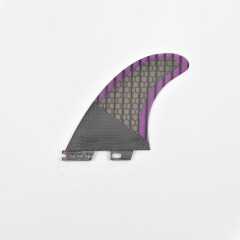
Material & Build
- Honeycomb core, 50% of the layup. The core sets the shape and removes most of the weight. Instead of a solid panel the interior is a honeycomb cell structure, which is what gives the fin its light feel in the hand. - Glass fiber, 20%. The glass skins bond to the core and spread load across the panel, protecting the honeycomb from point impact. - Epoxy resin, 20%. Epoxy is the matrix that locks glass and carbon together, and it is the reason the flex can be user-friendly rather than brittle. - Resin transfer molding. Resin is drawn through the dry layup inside a closed mould, which gives a repeatable resin-to-fiber ratio from one fin to the next. That repeatability is what lets surf board manufacturers and shop buyers reorder and receive the same product they signed off on. - Internal carbon framework. The carbon frame is laid to suit each template rather than cut from one generic pattern, so the reinforcement follows the shape of the fin. The twill ties that root into the internal frame. - Light to carry and to fit. The honeycomb core does most of the weight saving, which keeps these surf fins easy to stack in a board bag and quick to change at the bench. These honeycomb carbon surfboard fins are the carbon-built version of our honeycomb range: a honeycomb core inside, glass and epoxy around it, a carbon frame running through the layup and a carbon twill laid into the base. The result is a light fin with a more user-friendly flex pattern — the phrase we use for a fin that loads smoothly under pressure and returns without a hard, snappy feel. The mounting format is double tab: two tabs on the base, two matching slots in the plug, one screw through the tab. The same template is also built in single tab and box fin, so one shape can cover three board systems instead of forcing you to source a different fin for each one. Sizing is graded by rider weight across five bands from XS to XL, so a single line can cover everyone from a light junior to a heavier adult as long as you carry the full run. Where it earns its place is replacement work. A lost or cracked fin is one of the most common reasons a board comes off the water, and having the right fin on the shelf turns a repair into a sale. Board builders also fit it to new boards as a finished fin that matches the rest of the build.
Flex Character
"More user-friendly flex pattern" is the phrase this fin is built around, and it is worth unpacking because it is the main thing that separates the carbon build from plain glass.
Inside the fin, the carbon frame is laid to suit each template rather than cut from a single generic pattern. That matters because a fin only bends where its outline and its base allow; reinforcing to the shape means the frame works in the right place instead of stiffening the whole blade evenly.
At the base, the carbon twill ties the root into that frame. The base is the part of the fins on a surfboard that sits in the plug and takes the load every time the fin presses, so a stiff, well-bonded root keeps the fin seated and lets the blade above it do the flexing.
The practical result is a fin that loads progressively and releases without a hard snap. Surfers who find very stiff carbon fins nervous underfoot usually get on better with this layup, which means shop staff can describe it honestly as a more forgiving carbon fin rather than an outright performance blade.
Carbon is a tenth of the layup by design. It is there to change the feel, not to make the stiffest fin in the range.
Fin System Fit
- Look at the plugs on the board. Two slots side by side across the plug means double tab, which is what this model uses.
- Match the tab count. A double-tab fin will not seat in a single-tab plug or a box-fin channel, and forcing it damages both the fin base and the box.
- Check the screw. Double-tab plugs take a screw through the rear tab; if it is missing or seized, replace it before the fin goes back in.
- Check the tab condition. The tabs are the part of the fins on a surfboard that carry the screw load, so cracked or rounded tabs should be retired rather than reused.
- Order the right version for mixed board counts. This template is built in single tab, double tab and box fin, so a fleet or a shop working on several board brands can be covered from one supply.
- Send a photo if you are unsure. A picture of the plug tells us in seconds which of the types of surfboard fins you need.
Size & Rider Weight Bands
| Rider weight | Primary sizing input; the bands are built from weight, with kilograms and pounds shown together |
| XS | Under 55 kg / 120 lbs — juniors and light surfers on small shortboards |
| S | 55–70 kg / 120–155 lbs — teenagers and smaller adults |
| M | 65–80 kg / 145–175 lbs — the middle of the run, between the junior and heavier adult bands |
| L | 75–90 kg / 165–200 lbs — heavier adults and riders who want more fin underfoot |
| XL | Over 85 kg / 190 lbs — large adults on bigger boards |
| 65–70 kg | Sits inside both S and M; board length and the feel you want decide |
| 75–80 kg | Sits inside both M and L; the upper band suits a longer board or a rider who wants more drive |
| 85–90 kg | Sits inside both L and XL; take XL at the very top of the guide |
| Between bands | No gap in the run — every weight from a light junior up to a heavier adult lands inside at least one band |
| Fin system | The same five bands apply whether the fin is ordered in single tab, double tab or box fin |
| Range coverage | XS through XL covers juniors to heavier adults in a single grading, so one line can fit out a full surfboard rack and still serve every customer who walks in |
Applications
- Surf shops and chain stores. Replacement fins move steadily because fins are lost and broken all season. One all-round model in five sizes covers most walk-in demand without a wall of specialist templates, so the surfboard rack can stay stocked with finished boards rather than waiting on a part.
- Rental and hire fleets. A hire board with a split fin, or a stretched surfboard leash that has to be swapped before the board goes out, is a board sitting on the dock. Small stock of both keeps the fleet earning.
- Repair benches. A snapped fin and a customer who has worn through a surfboard traction pad usually arrive in the same visit, so a bench that stocks both finishes the job in one sitting.
- Board builders. As one of the surf board manufacturers supplying finished fins to board brands, we build these to a repeatable layup so a production run matches the deck it is fitted to.
- Catalogue and e-commerce sellers. Clean specifications and clear images let a reseller list surf fins confidently without ever handling the board they will end up on.
Specifications
| Model | F25317 |
|---|
| Product type | Honeycomb carbon surf fin |
| Mounting format | Double tab |
| Also available in | Single tab, box fin |
| Honeycomb core | 50% |
| Glass fiber | 20% |
| Epoxy resin | 20% |
| Carbon fiber | 10% |
| Construction | Resin transfer molding |
| Internal reinforcement | Carbon framework matched to the template |
| Base reinforcement | Carbon twill at the base |
| Flex character | More user-friendly flex pattern |
| Size run | XS, S, M, L, XL |
Model Code & Appearance
- F25317 identifies the build, not the outline. The code tells you this is the honeycomb carbon model; it cannot tell you how the template sweeps or how deep the fin sits, so judge the shape from the photos or a sample rather than from the number alone.
- Codes group by build in this range. The carbon honeycomb models carry F253xx codes, the plain honeycomb models F252xx, the timber model F254xx, plastic F25011 and inkjet F00155. Quoting the code when you reorder is what gets you the same layup back.
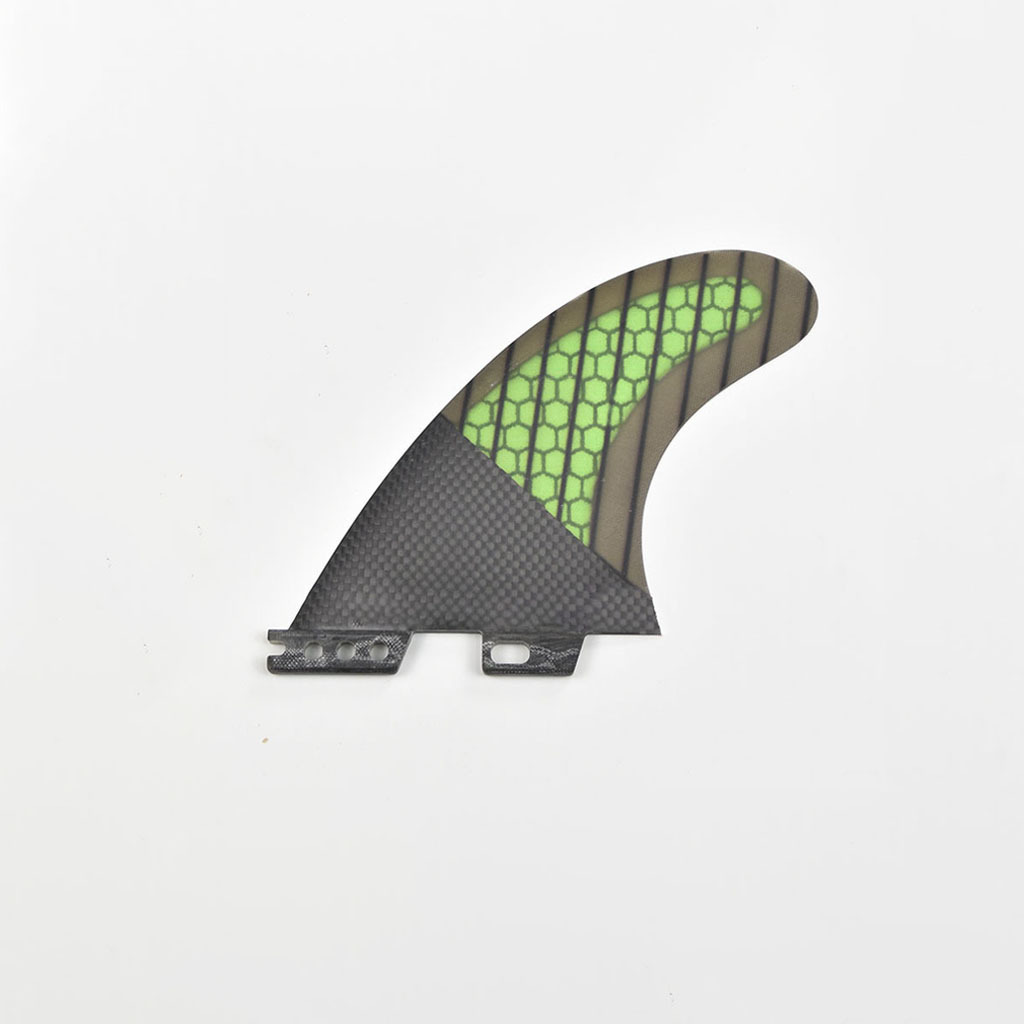
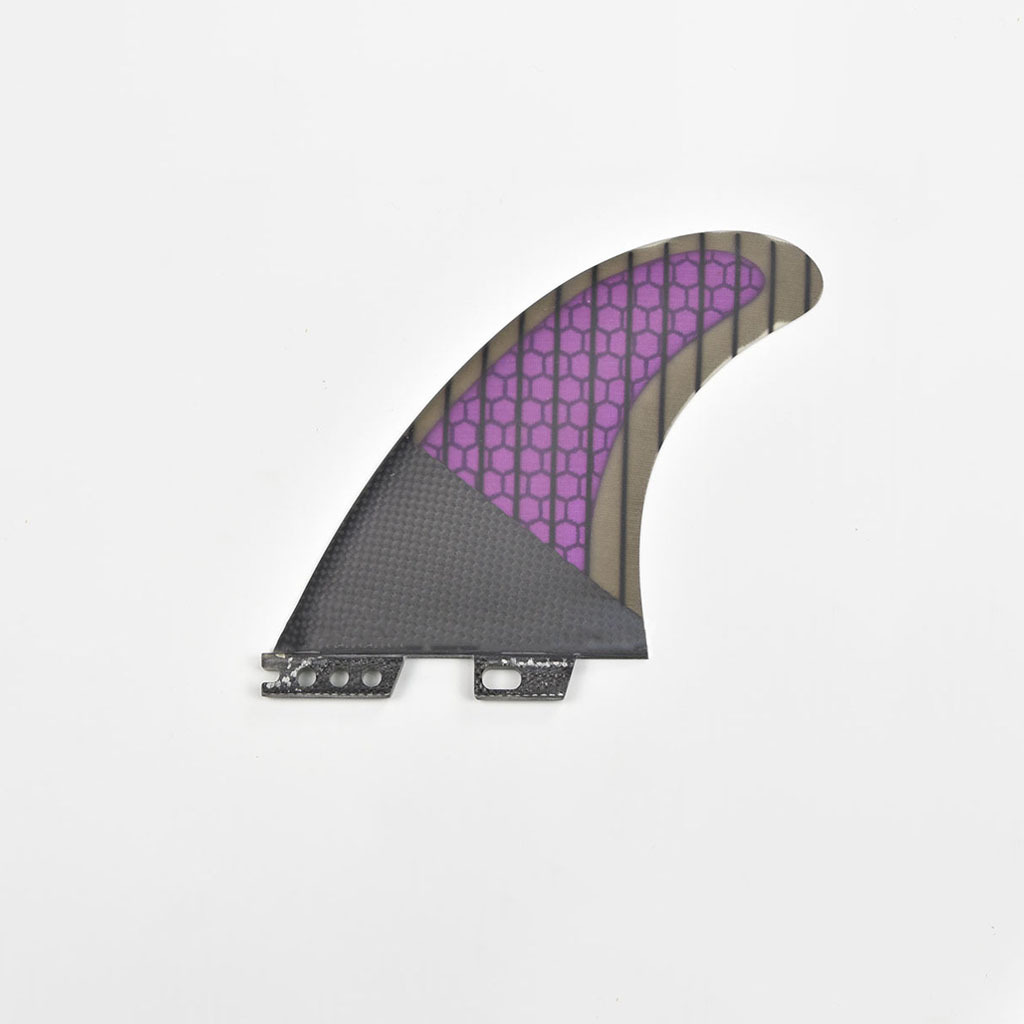
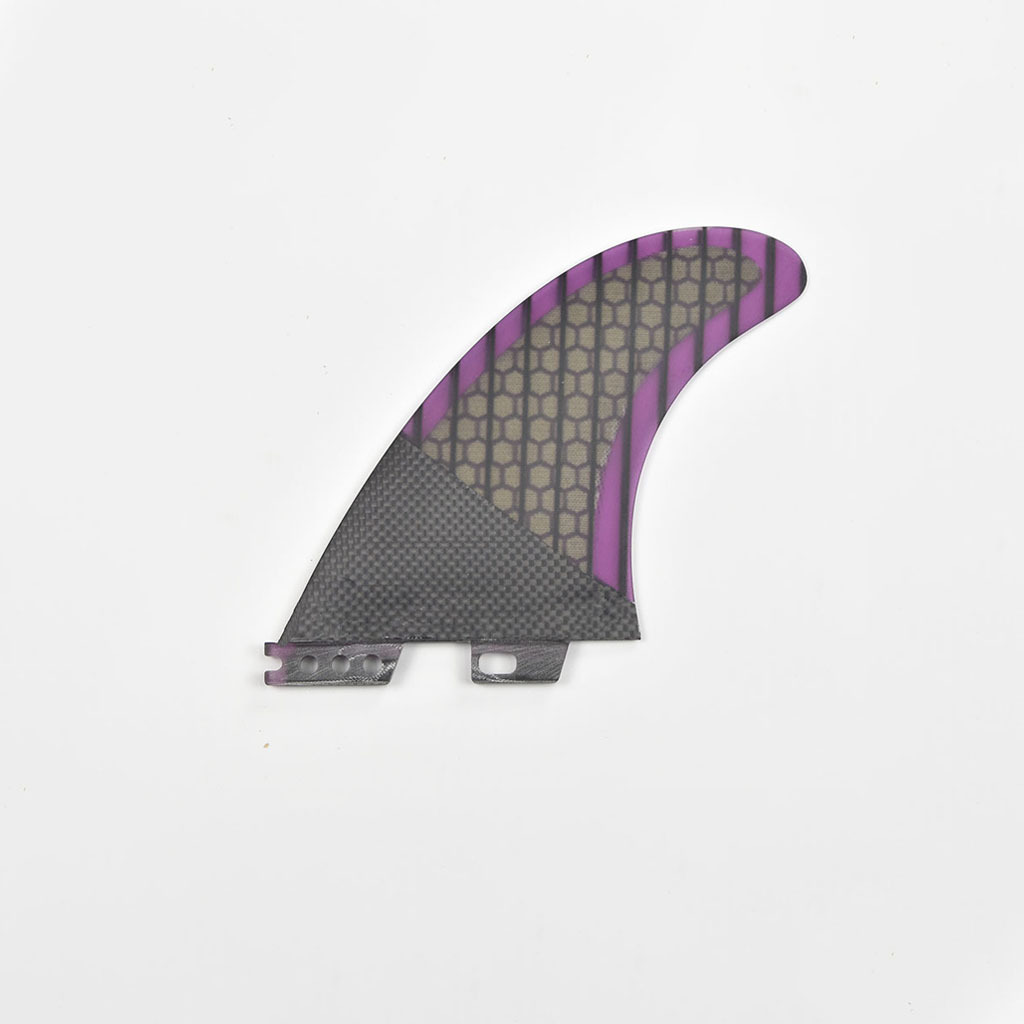
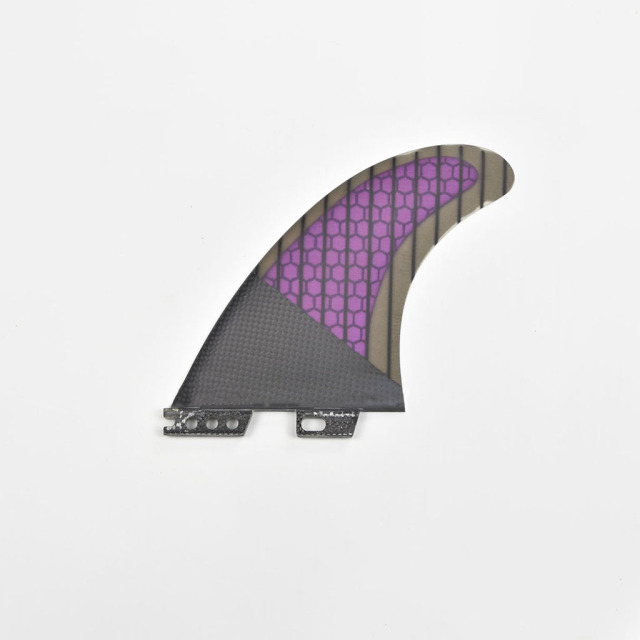
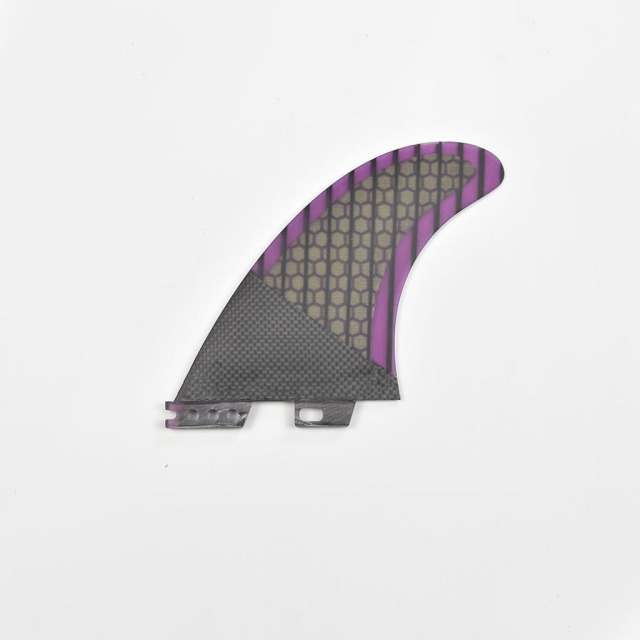
- What the fin looks like on the face. The honeycomb core reads through the skin as a regular hexagonal cell pattern, and the carbon twill sits as a darker woven band just above the tabs, so the fin is recognisable in a mixed box without a label.
- The base gives away the system. Two tabs, one behind the other, with a screw hole through the rear tab: that is a double-tab base, and it is visible before you check any paperwork.
- Judge the template from the photos. A side profile shows the sweep and the tip, a base-on shot shows the tab spacing, and a squared-up shot against a ruler gives you the depth. Ask for whichever of these you need before a listing goes live.
- One shape, other systems. The same template is built in single tab and box fin, so if the outline in the photo is right but the board takes a different plug, you can still order the shape you picked.
- Matching a fin with no packaging. Send a photo of the fin and its base and we will match it against the range — tab shape and core pattern identify most of the types of surfboard fins we supply.
Accessories & Aftercare
What travels with it
A surfboard leash is the natural companion on the shelf and in a package deal. Match the leash to the board rather than to the fin, since a longboard and a shortboard of the same rider need different lengths.
A surfboard traction pad completes the deck kit. A customer replacing a fin after a bad session has often smoothed the tail deck at the same time, so stocking both turns one repair into a full refit.
A surfboard rack keeps fitted boards upright in the shop, the workshop or the garage, and keeps a fin off the floor while it dries. A board cover protects a fitted fin in transit, which matters most on the fins that stick out furthest from the tail.
The rest of the surfboard fins we build run through honeycomb glass, timber, plastic and inkjet finishes, so a shop can hold one shape and offer a step-up at each price level.
Keeping it in service
Rinse the fin in fresh water after a session and let it dry before it goes back into a bag or a cover; salt left in the tab area is what starts most corrosion around the screw. Check the tabs whenever a fin comes out of a board, and retire any fin with a crack running from the tab into the base. Free a sticking fin by hand rather than levering it against the base with a tool, which is how most base damage happens. Finally, give a fin the once-over after a session in the shorebreak — impact damage at the base is easy to miss until the fin fails in the water.
Ordering & Delivery
- Confirm the mounting format. Double tab is the standard build for this model; tell us if you need the single-tab or box-fin version of the same template instead.
- Confirm the size mix. Give us the split you want across XS, S, M, L and XL, or tell us the rider weight range you are buying for and we will suggest one.
- Confirm quantity and packing. Unit counts per carton, and whether you need shelf-ready labelling or plain bulk packing, both change how the order is prepared.
- Confirm branding. We work as an OEM supplier, so ask your sales contact about private-label and custom colour options for your programme before the order is placed.
- Confirm lead time, shipping terms, delivery port and Incoterms with your sales contact, since none of these are fixed on this product.
- Ask about sample availability before committing to a full run, particularly if you are matching a fin that is already in your range.
Scale & Supply Capability
CIMI is a factory-based supplier with 16 years in surf and watersports hardgoods, manufacturing at our own facility rather than sourcing through traders. Chain stores, supermarkets and surf-brand stores buy from us because one supplier covers a full accessory assortment, so a season's order and its reorders can be planned together. We take on OEM and private-label work, adapting designs, colourways and branding to your programme, and we schedule production against your agreed range plan. Send us your buy list and target dates, and we will confirm what we can make and when.
FAQ
Which fin system does this fin fit?
Double tab. The fin carries two tabs on the base that slot into a matching double-tab plug, with a screw through the rear tab to lock it in place. It will not seat in a single-tab plug or a box-fin channel, so check the plugs on the board before ordering. If you need this template for a different system it is also available in single tab and box fin, and between them those versions cover the main types of surfboard fins a shop is likely to be asked for.
What does the internal carbon frame actually do?
It controls how the fin loads and releases. Fins on a surfboard do two jobs at once — they resist sideways load and they return to shape after it — and the carbon frame is laid to suit this specific template rather than cut from one generic pattern, so the reinforcement runs where that shape actually bends. Combined with the carbon twill at the base, which ties the root of the fin into the frame, it produces the more user-friendly flex pattern this model is built around: it loads up smoothly and returns without the hard, sudden feel of a very stiff layup.
What conditions is this fin built for?
It is an all-round fin rather than a single-purpose one. The honeycomb build is light and works across a variety of different conditions, so it does not need swapping out every time the forecast changes. That is why these surf fins are the ones we suggest to shops that would rather carry one dependable all-round model than a specialist fin for every kind of day.
How is this different from the glass honeycomb fin in the same range?
Same core, different skin. The glass honeycomb fin is 50% honeycomb core, 30% glass fiber and 20% epoxy resin. This carbon version is 50% core, 20% glass fiber, 20% epoxy resin and 10% carbon fiber, with a carbon frame inside the layup and a carbon twill at the base. The practical difference is the flex — the glass version is the straight glass-and-epoxy layup, while this one is built for the more forgiving feel described above. Stock glass for volume replacement and carbon where the customer wants a better feel underfoot.
What does the fin look like in the hand?
It has a glossy finish with the honeycomb core reading through the layup as a hexagonal cell pattern, and a dark carbon-weave face at the base where the twill sits. The outline is a curved swept template on a tabbed base. Because the core shows through the skin instead of being hidden under a solid colour, the fin reads clearly as a honeycomb build.