Product Overview
F25207 is the double tab version of our honeycomb surfboard fins — a light, resin transfer moulded fin built from a 50% honeycomb core, 30% glass fiber and 20% epoxy resin. That combination gives you a fin that feels light in the hand and still holds a clean, sealed shape through regular use in a range of conditions. It goes straight into double tab boxes as a replacement for a fin that has been lost, broken or simply worn out, and with five rider weight bands from XS to XL one product line covers groms through heavier adults. Shops usually start with a spread across the bands and top up whichever sizes move fastest as the season runs.
Construction & Materials
The layup is deliberately simple — three materials, each doing a separate job. The 50% honeycomb core is the internal structure that holds the fin's foil shape, so the part does not have to be a solid slab of glass and resin. The 30% glass fiber builds the outer skin, the surface that meets the board, the sand and the inside of a board bag. The 20% epoxy resin wets out that glass and seals the fin, and it is what puts the gloss on the finished part.
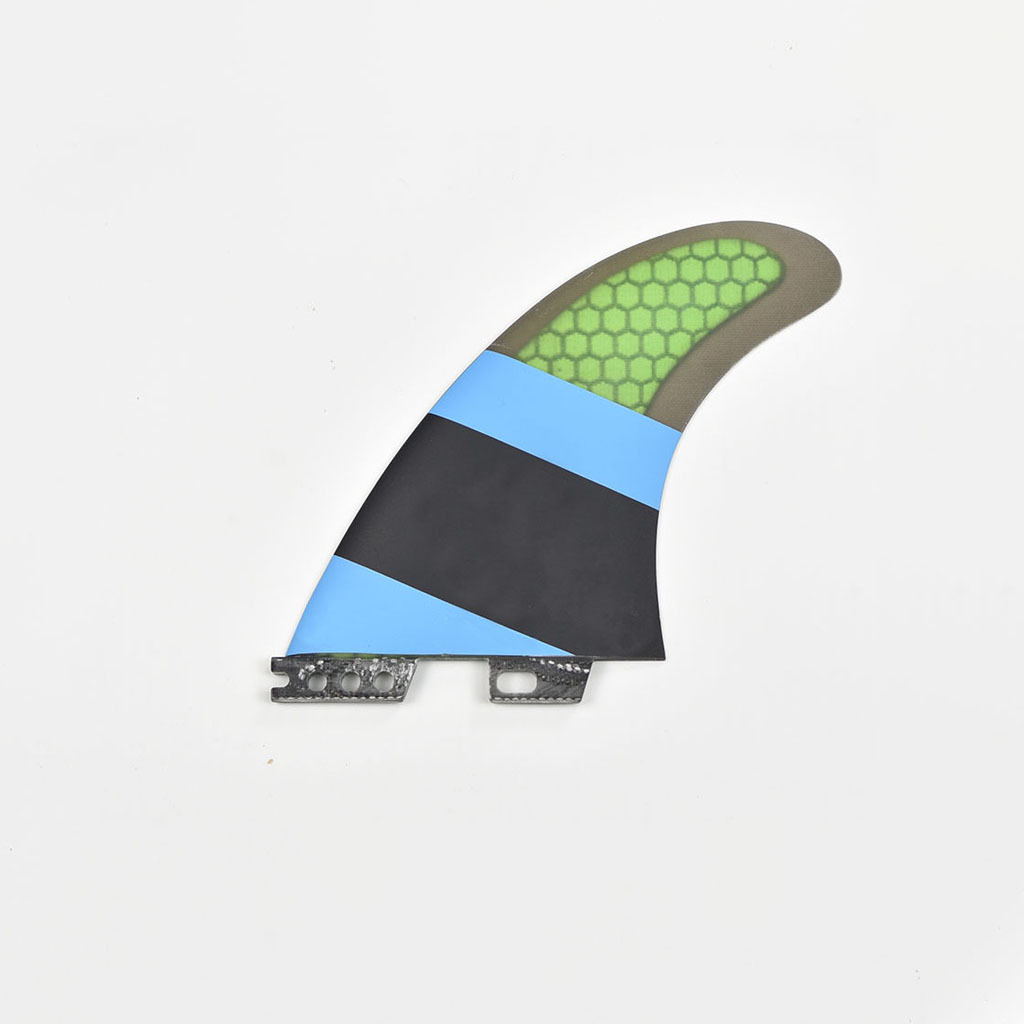
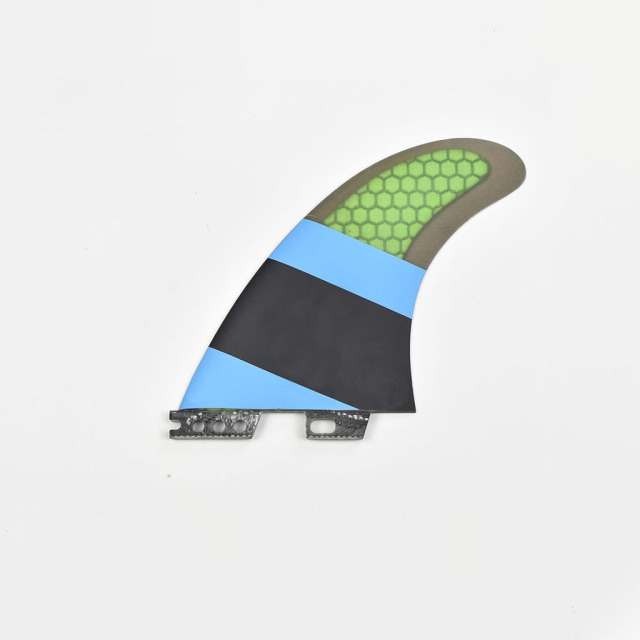
Resin transfer moulding draws the resin through the layup inside a closed mould rather than laying it up by hand, so it spreads evenly and the profile repeats from one mould cycle to the next — which is what keeps a large surf fins order consistent from the first fin to the last. The small details are finished properly too: the base is moulded with the tabs flush so the fin seats flat, and on this model the green honeycomb core reads through the layup beneath blue and black diagonal panels, sealed under a gloss resin coat.
Fin System Fit
- Check the boxes before anything else. Two short parallel slots take a double tab; a single slot takes a single tab; one long routed channel takes a box fin. Those are the main types of surfboard fins mounts this honeycomb build is produced in.
- Match the version to the board. This listing is the double tab build. If a board on the bench needs a single tab or a box, order the same honeycomb construction in that mount rather than adapting this one to fit.
- Dry-fit the fin. Slide the surfboard fin into the box while it is dry — the tabs should drop in without force and the base should sit flat against the board along its whole length.
- Seat it fully. Press the tabs home so no gap is left at the front of the box. A fin sitting proud of the board will work loose once it is in the water.
- Re-check after the first session. Pull the fin, look for movement or shiny wear marks on the tabs, then reseat it and check the base again.
- Ask us if the box is unusual. Repaired boxes and older boards sometimes take a different mount — send a photo of the box and we will tell you which version to order.
Size & Weight Bands
- XS — under 55 kg / 120 lbs. The lightest band, sized for junior riders and small surfers on boards that do not carry much volume.
- S — 55–70 kg / 120–155 lbs. A common first adult band and the one most shops hold deepest for walk-in replacement orders.
- M — 65–80 kg / 145–175 lbs. The middle of the range and the safe default when a shop wants one band that covers the widest spread of customers.
- L — 75–90 kg / 165–200 lbs. For heavier or stronger surfers, and for rental boards that get ridden hard by adults all season.
- XL — over 85 kg / 190 lbs. The top band, kept in smaller numbers on most shelves but important for bigger riders who otherwise get pushed onto a band that is too light.
- Where the bands overlap. S and M share 65–70 kg, M and L share 75–80 kg, and L and XL share 85–90 kg. A rider inside an overlap can go either way: the lighter band suits a lighter or less strong surfer, and the heavier band puts more surfboard fin under a stronger rider or a board carrying extra volume.
- Building a shelf or a fleet. Shops tend to hold S, M and L in depth with lighter XS and XL stock, because the middle bands turn over fastest. Fleets work the same way but replace in batches, so it helps to order the bands your rental boards actually use rather than an even spread.
Who It's For
- Surf shops replacing a lost or broken fin. The most common order of all: a customer comes back with one fin missing and the shop needs the right band on the shelf that week. Holding XS through XL in the surfboard fins bay turns that into a counter sale instead of a special order.
- Repair benches. A broken fin usually arrives with a board already in the workshop for a ding repair, so the fin gets fitted in the same visit. The moulded tabbed base seats without extra fettling and keeps the job moving.
- Rental and surf-school fleets. Rental boards get ridden by everyone, so the middle of the range does most of the work. Fleets tend to hold S through L and keep a few XS and XL pieces, because the surf fins that fail first are always the ones on the busiest boards.
- Board builders. If you are building boards under your own label, or you are one of the surf board manufacturers supplying shops with finished boards, the fin can be ordered by band to match the rider each board is shaped for, so it leaves the workshop already set up.
- Stores fitting out a board wall. Display and storage come up at the same time as the fins; a surfboard rack and a fin pegboard are usually planned together, and ordering both on one shipment keeps the wall consistent from day one.
- Deck and tail work. Workshops that re-grip a board as part of a service often add the fin at the same time — a surf traction pad on the deck, the fin in the box, and the board goes back to the customer finished.
Specifications
| Property | Specification |
|---|
| Model | F25207 |
| Product type | Honeycomb surfboard fin, double tab |
| Core | Honeycomb, 50% of the layup |
| Reinforcement | Glass fiber, 30% of the layup |
| Resin | Epoxy, 20% of the layup |
| Construction | Resin transfer moulding |
| Fin systems | Single tab, double tab and box fin |
| Size bands | XS, S, M, L and XL, matched to rider weight |
| Finish | Gloss resin over the honeycomb layup |
Handling & Maintenance
Seating and removal. Wipe out the box before a fin goes anywhere near a board. Sand, dried salt and old wax all stop the tabs seating fully, and a surfboard fin sitting proud of the board is the one that works loose in the water. If it will not drop in, the cause is almost always the box or the wrong mount rather than the fin itself — check both instead of sanding or filing the tabs to force a fit, because once material comes off a tab it never seats tight again. When you pull a fin, ease it up squarely by the tip with a cloth in your hand rather than levering it sideways against the board.
On the beach and in transit. Fins are the lowest point of a board when it is set down, so never stand a board on them on pavement, rock or hard sand, and never let a board lie fin-down in the back of a van. Set it deck-down with the fins in the air, or bag it, and the tips and trailing edges come back unmarked.
Inspection points. At the end of a session, run a thumb along the tab roots, the base line and the trailing edge. You are looking for a hairline crack in the resin skin, a cloudy or darker patch where water has worked into the honeycomb core, or a tab that flexes further than it used to. A fin that took a knock on reef or rocky shore can look fine at a glance and still carry a crack at the base.
Cleaning. Fresh water and a soft cloth deal with salt and sand, and a little mild soap lifts the film that sunscreen and wax leave behind. Leave solvents, acetone and abrasive pads alone — they dull the gloss and can attack the resin skin. Dry the fins off before they go back in a bag so the base area is not sitting damp for days.
When to replace rather than keep riding. A cracked tab, a chip out of the base or a soft, water-darkened patch at the root is the moment to swap the fin. A fin that shears off in the water can damage the box, and sorting out a box costs far more than the part — which is why shops and fleets keep a spare set of the popular bands on the shelf rather than waiting for an order to arrive.
Fleet turnaround. On rental and school boards, check the surf fins at the end of each day. A missing fin is obvious; a loose or cracked one is not, and it usually fails under the next customer. Quick-swap stock in the middle bands keeps a board in service instead of parked.
Handing over to a customer. Shop staff can pass on the short version at the counter: seat it dry, check it sits flat, re-check after the first session, and bring it back if the tabs ever look cracked. That one-minute conversation prevents most of the avoidable returns on a low-cost part.
Ordering & Delivery
- Set the size mix. Tell us how many of each band you need, XS through XL, based on the riders your shelf, fleet or board range actually serves.
- Name the mounts. If the order covers more than one of the types of surfboard fins mounts, split the quantities by single tab, double tab and box so each board gets the right version.
- Confirm the finish and any branding.
- Agree the packing and presentation. Say whether the fins ship loose, bagged or in a shelf-ready format, and whether labels or barcodes are needed.
- Confirm quantities, payment terms and delivery dates with your sales contact. These are set per order and per destination, so they are agreed when the order is placed.
- Add the leash lengths. If the shipment carries a surfboard leash line, list the lengths and fittings with the fins so the whole board kit arrives matched.
- Add the deck items. Surf traction pad shapes on the same order save a second shipment and keep the accessory wall consistent.
- Add storage and display. If you need a surfboard rack for the floor or the wall, put it on the same order so it lands with the fins. Leash | Hypalon surfboard leash builds from 6 ft to 9 ft, sized to board length and wave size Fins | Honeycomb, carbon honeycomb, timber-named, G10 glass and nylon surfboard fin ranges Traction | Tail pads, centre pads, skimboard pads and waxless surf traction pad shapes Covers | Basic bags, regular bags, stretch covers and bodyboard bags Racks | Travel rax and tie-downs, storage racks, display racks and wall-mounted surfboard rack options Wax and inserts | Wax and fin inserts for the counter
Scale & Supply Capability
CIMI is a factory-based supplier with 16 years in surf and watersports hardgoods, manufacturing at our own facility rather than sourcing through traders. Chain stores, supermarkets and surf-brand stores buy from us because one supplier covers a full accessory assortment, from fins to a surfboard rack, so a season's order and its reorders can be planned together. We take on OEM and private-label work, adapting designs, colourways and branding to your programme, and we schedule production against your agreed range plan. Send us your buy list and target dates, and we will confirm what we can make and when.
FAQ
How do I fit a double tab fin so it sits flush?
Slide the two tabs into their slots dry and press the fin down until the base meets the board along its whole length. If the front edge lifts, the tabs are not fully home — lift the fin out, check for grit or old wax in the box, and seat it again. A set of surf fins that sits flat stays put; one riding proud will work loose once it is in the water. Re-check the fit after the first session.
What does resin transfer moulding change about the fin?
Because the resin is drawn through a closed mould rather than laid up by hand, it reaches the whole layup evenly and the shape repeats from one production run to the next. That is what makes a reorder dependable — the surfboard fins you receive next season sit in the same boxes and carry the same profile as the batch before them.
Do you make this fin for other mount types?
Yes. The same honeycomb construction is produced across all three of the main types of surfboard fins mounts — single tab, double tab and box fin. This listing is the double tab build; if your fleet or your shelf runs a mix of boards, order each mount to match rather than adapting one version to fit everything.
How should I look after honeycomb fins between sessions?
Rinse them in fresh water after salt water use and dry them before they go back into a bag, along with the surfboard leash and anything else that was out that day. Keep them out of a hot car and out of a closed board bag in direct sun, check the tabs for cracks or shiny wear marks every few sessions, and store them flat instead of standing them on the tips.
What do the finished fins look like?
On this model the honeycomb core shows as a green internal pattern beneath the clear layup, framed by blue and black diagonal panels, with a gloss resin coat over the whole fin and a flush tabbed base. Colours can read differently under studio lighting, so compare the product photos against the model you are weighing up, and ask us if the exact look needs confirming before a large order.