Product Overview
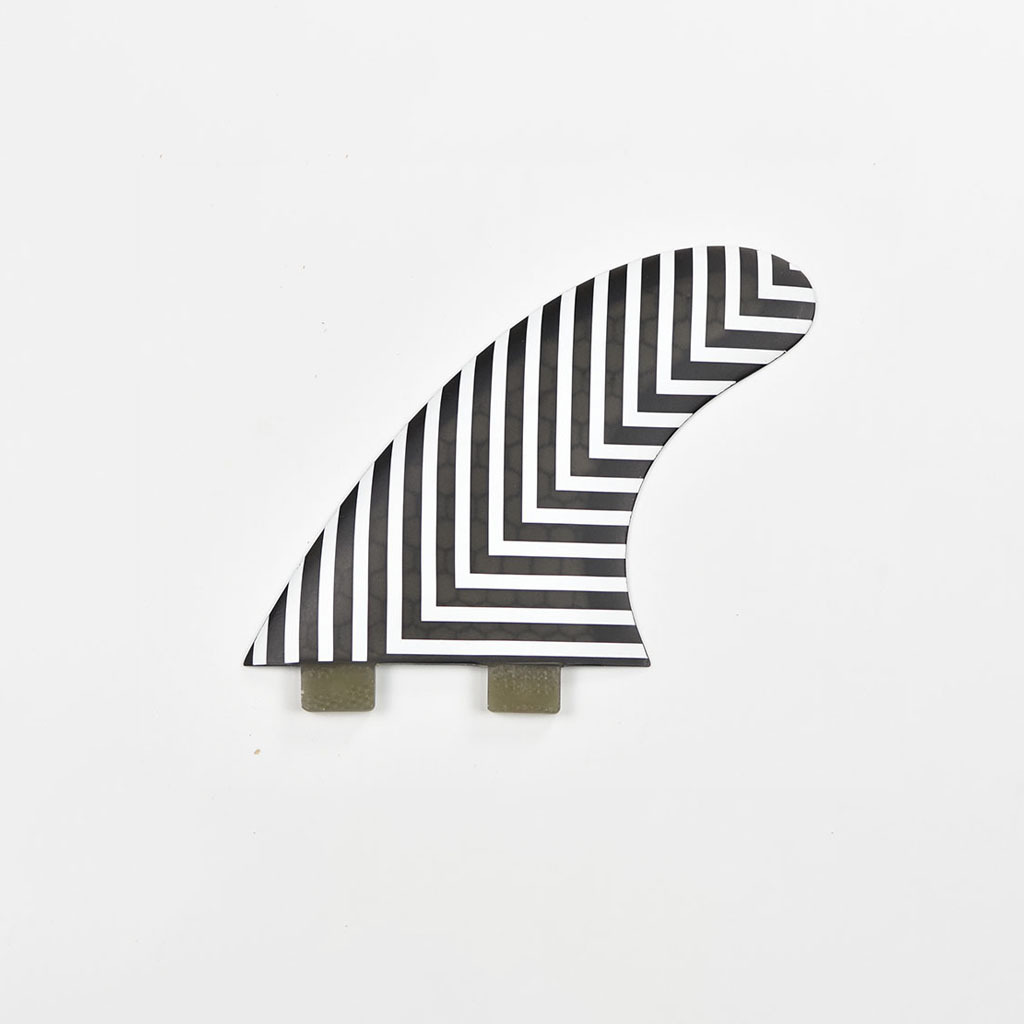
This is the double-tab model in our honeycomb surf fins line: a resin transfer moulded fin built on a honeycomb core with glass fiber and epoxy. It sits light in the hand, keeps its shape under load, and is shaped for the everyday conditions most shops sell into rather than one narrow corner of the market. It is a replacement part, so it is built to move off a pegboard or out of a parts drawer. A store reaches for it when a customer breaks or loses a fin, when a hire board comes back short, or when a repair counter needs replacement fins for surfboard work in a hurry. The size is marked on the fin and the chevron face makes it easy to pick out, so staff can identify it without digging through a catalogue. A repair bench fits whichever base the board in front of it uses, and a board builder fits the fin to the finished board and then restocks it all season.
Material & Construction
Fins on a surfboard need a structural middle, and in this fin the honeycomb is it — a lightweight cell pattern that holds the two skins apart and gives the part its stiffness without a solid, heavy centre. The glass fiber skins carry load across that core, and the epoxy bonds the stack into one piece and forms the surface a customer sees and touches. Moulding is by resin transfer: dry reinforcement goes into a closed mould, resin is injected under pressure, and the part cures before the mould is opened. Compared with an open hand lay-up, the closed mould holds the resin-to-fiber ratio close to the design value and leaves fewer voids in the laminate, which is why the tenth fin in a run behaves like the first. It is also why we can build as surf board manufacturers with a repeatable part rather than a hand-finished one. The practical result is predictability. A shop that reorders the same size six months later gets the same build and the same weight in the hand, so nobody has to explain a change to a customer who bought earlier in the season. Holding one recipe across every surfboard fins size also means a mixed order — XS through XL on one line — arrives as a consistent set rather than a collection of different laminates. Worth checking when a delivery lands: sight down the trailing edge of each fin for a straight line, sit it on a flat bench to see that both base tabs are level, and look over the chevron face for a clean print. Anything that looks off is easier to raise on the delivery note than at the fitting bench. - Light at the tip, solid at the base — the honeycomb core takes weight out of the part while the base stays thick enough to seat firmly in the box, so the fin does not feel fragile in the hand. - Closed-mould resin transfer molding — resin is injected into a closed mould around dry reinforcement, so each part comes out with a consistent resin content instead of depending on the laminator's hand that day. - One outline, three bases — most of the types of surf fins a shop is asked for fall into three fitting groups, and this outline is made in all three, so one template covers more of the wall. - A working all-round shape — the outline is intended for mixed, everyday conditions rather than a single-wave template, which is what makes it sensible to hold across every size band. - A face that reads across the shop floor — the black and white chevron graphic sits on a finished moulded surface and gives a small dark part visible shelf presence. - Finished on both faces — the surf board fins arrive with both sides closed and smooth out of the mould, so there is no trimming step between the carton and the fitting bench.
Fin System Fit
- Read the base, not the board name. Buyers comparing types of surf fins should start here, because the base decides whether a fin fits at all. Photograph the box if you are ordering remotely — it is faster than measuring.
- Match the base to the box. This model is the double-tab version: two tabs drop into two slots and lock with the board's own grub screws. Boards built as a twin fin surfboard normally carry the same two-slot box, while older or custom boards may use a single tab or a long box — the single-tab and box-fin versions of this outline cover those.
- Dry fit before tightening anything. Slide the fin in with the screws backed off, check that both tabs seat fully, and confirm the fin sits vertical rather than leaning to one side.
- Check the hardware on the board. The grub screws, plates and keys that hold fins on a surfboard vary by board and are not something we can confirm for your setup, so see what the board ships with before the customer leaves the shop.
- Set the position, then tighten evenly. Line the fin up with the markings on the box and tighten one screw at a time, so the base does not cock and lift a tab.
- Re-check after the first session. Fins settle into a new box. A quick look at the tabs and screws after the first surf is the same routine a hire fleet should run between rentals, and it is what prevents a lost fin and a return.
Size & Rider Weight Bands
| Size | Rider weight | Typical rider |
| XS | Under 55 kg / 120 lb | Groms and very light riders |
| S | 55–70 kg / 120–155 lb | Lighter adults and smaller surfers |
| M | 65–80 kg / 145–175 lb | Most adult riders |
| L | 75–90 kg / 165–200 lb | Heavier riders and larger boards |
| XL | Over 85 kg / 190 lb | Big riders and heavy equipment |
Specifications
| Specification | Detail |
|---|
| Model | F25206 |
| Fin system | Double tab — single tab and box fin versions built to the same recipe for twin fin surfboard setups and other two-slot boards |
| Core | Honeycomb core, 50% of the construction |
| Reinforcement | Glass fiber, 30% |
| Resin | Epoxy, 20% |
| Moulding | Resin transfer molding in a closed mould |
| Sizes | XS, S, M, L, XL |
| Rider weight coverage | Under 55 kg / 120 lb through to over 85 kg / 190 lb |
Matching Accessories
- Leashes — Hypalon leashes in 6 ft 6 mm, 7 ft 7 mm, 8 ft 7 mm and 9 ft 8 mm, covering small-wave days through to longboards and bigger surf. Pairing a leash with a surf fins order lets a shop sell the whole setup in one visit.
- Fins — our fins for surfboard use run across honeycomb, honeycomb carbon, timber-named honeycomb, plastic and inkjet finishes, so a store can ladder from an entry price up to a carbon option without changing supplier.
- Traction — tail pads, centre pads, skimboard pads and waxless pads for the boards that go out with these fins; the grip can travel in the same carton as the fin.
- Covers — basic bags, regular bags, stretch covers and bodyboard bags protect a board between sessions and give the accessory wall something to hang beside the fin pegs.
- Racks — travel racks with tie-downs, storage racks, display racks and bike racks move and store boards; a shop fitting out a floor or a rental store can order them on the same shipment.
Ordering & Delivery
- Send the mix, not just a model. List sizes, systems and rough quantities. First orders usually spread across XS to XL with more M and L than anything else. If you carry several types of surf fins, split the list by base first and then by size — it makes the packing plan much faster. 2. Say where the order is going. A display pegboard, a rental fleet and a repair bench ordering fins for surfboard work each need different labelling and packing, so tell your sales contact which one applies and the order is quoted to suit it. 3. Agree what travels with the fin. Grub screws, plates, printed size labels and resale packaging are not standard across every market. Settle them before production rather than after. 4. Ask about a sample. If you want to handle the build before committing, ask your sales contact about sample availability and the current terms. 5. Lock the commercial details in writing. Lead time, payment terms, freight and packing are confirmed per order, because they depend on the size mix and the destination. Get them on the order confirmation. 6. Plan the reorder. Most buyers come back within a season for the same sizes.
Scale & Supply Capability
CIMI is a factory-based supplier with 16 years in surf and watersports hardgoods, manufacturing at our own facility rather than sourcing through traders. Chain stores, supermarkets and surf-brand stores buy from us because one supplier covers a full accessory assortment, so a season's order and its reorders can be planned together. We take on OEM and private-label work, adapting designs, colourways and branding to your programme, and we schedule production against your agreed range plan. Send us your buy list and target dates, and we will confirm what we can make and when.
FAQ
How does a honeycomb fin compare with a solid glass fin?
The honeycomb core replaces the solid centre of a glass lay-up with a cell structure, so the fin carries less weight for the same outline without feeling hollow in the hand. In practice that makes surf fins easier to handle in quantity and lighter on the board, and the build is intended for a variety of conditions rather than one type of wave. If your customers are used to solid glass, start with a mixed run and let them compare on the board.
Which size should I pick for a rider who sits between two bands?
The bands overlap on purpose. A 68 kg rider fits both S (55–70 kg) and M (65–80 kg), and a 78 kg rider fits both M and L. Smaller riders usually prefer the lighter band on smaller boards and in weaker surf, while the larger band gives more fin under a heavier or faster surfer. Stocking both bands at the overlap is the safest way to cover a mixed customer base.
Can this fin go on a twin fin surfboard?
If the board carries the two-slot box, yes — that is the base this fin uses, and twin fin surfboard setups commonly run it. Check the box before promising it to a customer, because some older and custom boards use a single tab or a long box instead; for those, order the single-tab or box-fin version of the same outline.
Are the surfboard fins finished when they arrive?
Yes. Both faces come out of the closed mould smooth and the base tabs are formed, so there is no trimming before the fin goes onto a board. What is not fixed is the small hardware — grub screws and plates normally belong to the board rather than the fin, so confirm what your order includes when you place it.
What do the fins look like out of the box?
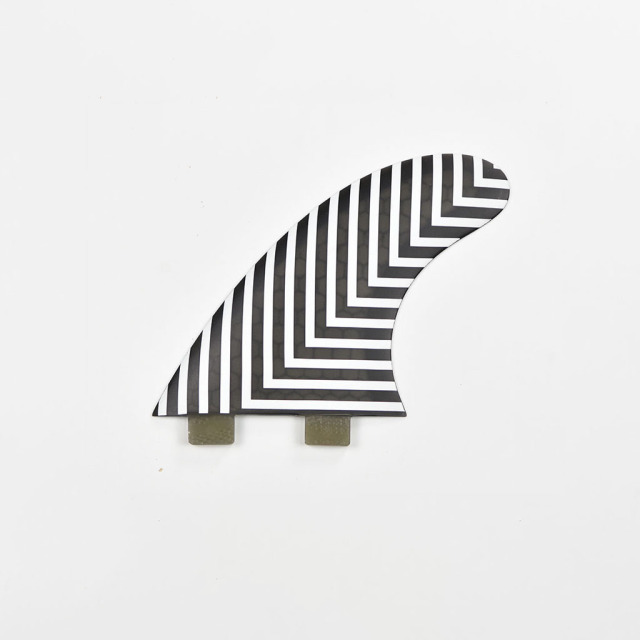
The surf board fins shown here carry a black and white chevron graphic across a finished moulded face, on a swept-back outline with two tabs at the base. It is a graphic rather than a paint layer over a rough surface, so it holds its look when the fin is handled and wiped down.
How should the fins on a surfboard be looked after between sessions?
Rinse in fresh water after salt water use and dry the fin before it goes back in a bag or a parts drawer. Check the base tabs and the screws whenever a board is swapped or a fin is refitted, and sight down the trailing edge after a knock — a fin that has taken a hit at the tip is easier to replace from stock than to explain at the beach.