Product Overview
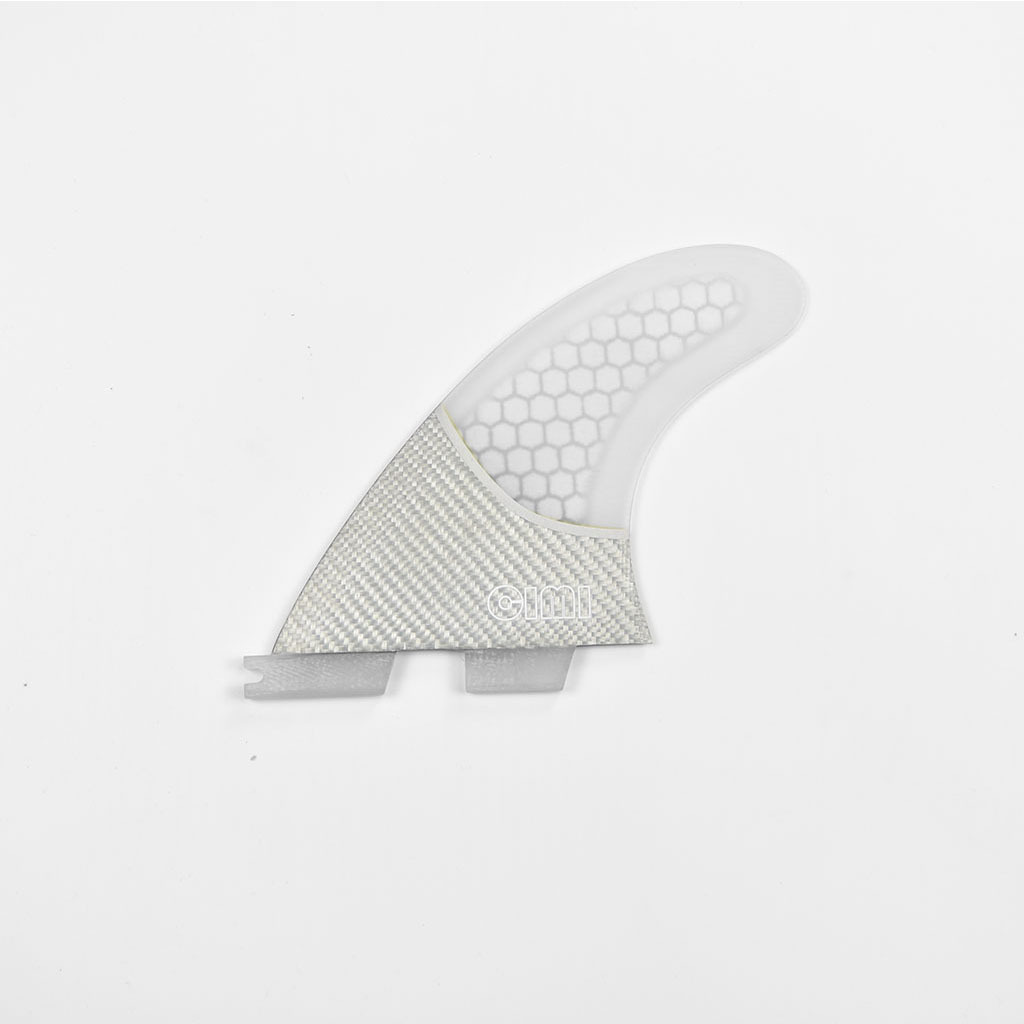
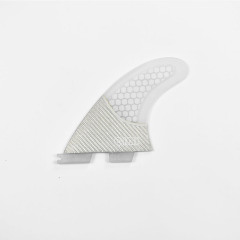
This is the carbon member of our honeycomb fin line, built on a double-tab base: a honeycomb core, an epoxy laminate, an internal carbon frame laid in to suit the template, and a carbon twill worked into the base where the fin meets the board. It is the model a shop puts next to the plain honeycomb fin when a customer comes in for fins for surfboard replacement and wants a little more than the standard part.
Honeycomb keeps the fin light, which matters twice over: a light fin is easy for a rider to handle and easy to fit at the counter, and it keeps cartons sensible when you are moving quantity rather than single units. The resin transfer moulding process we use gives a consistent laminate from one production run to the next, so the second delivery of the same model looks and feels like the first — an important detail for a chain that lists the same code season after season.
The fin works as a replacement part and as a build component. A surf shop fits it when the original is lost or broken; a repair bench keeps a spread of sizes on hand for exactly the same reason; a board builder fits it to a new board so the template, the size and the base match the rest of the build. Rental and school fleets use it the same way, holding a single model across the fleet so any board that comes back short can be fitted from one box.
We make it in our own factory alongside the leashes, traction pads, covers and racks that fill the same accessory wall. That is what lets a buyer build a complete accessory order from one source, with the codes and finishes staying consistent across reorders instead of being matched from three different traders.
Carbon Frame & Flex
The carbon in this fin is not a cosmetic layer on the outside. An internal carbon frame is shaped to suit the template it sits in, so the frame follows the outline, the base and the tip of that particular fin instead of being a stock spar pushed into every model in the line. That is what keeps the fin predictable when it is loaded through a turn: the frame carries the load path and the honeycomb core supports it from the inside.
At the base, a carbon twill is laid into the laminate. The base takes the screw load and the pressure of the board, and it is where a fin usually shows wear first. A twill layer there stiffens the area without making the whole fin feel harsh through the rest of the outline.
Switching this model to epoxy resin and adding the carbon base is what gives it the flex pattern we build it for: a more user-friendly feel than the plain glass honeycomb fin, with a return that comes back smoothly rather than sharply. Riders who find a stiff carbon laminate too reactive tend to get on better with this construction, and a shop can present it as the middle option — softer than a stiff carbon layup, more controlled than the glass fin it sits beside.
Look closely at the finished fin and you can see the honeycomb texture sitting under the gloss laminate, with the woven carbon showing across the base. Both are quick ways to tell this model apart from the plain honeycomb version once the surfboard fins are out of the packaging, which helps at the counter and at goods-in.
Fitting & Handling
- Check the board first: a double-tab fin needs two separate slots with screws. A single routed slot with one screw takes a single-tab fin, and one long routed box takes a box fin, so order the version of this template that matches the board.
- Wipe salt and sand out of the plugs before anything goes in. Grit under a tab stops the base seating flat, and a fin that sits proud will rock no matter how hard the screw is turned.
- Seat the rear tab first, then press the front tab down until the base sits flush with the board surface.
- Fit the tab screws and tighten by hand until the fin is firm. Stop as soon as the base stops moving — a screw turned past that point only loads the tab.
- Sight along the board before the customer walks out: the fin should stand vertical and show no rock. If it rocks, a tab is not fully seated, so take it out and start again rather than tightening through it.
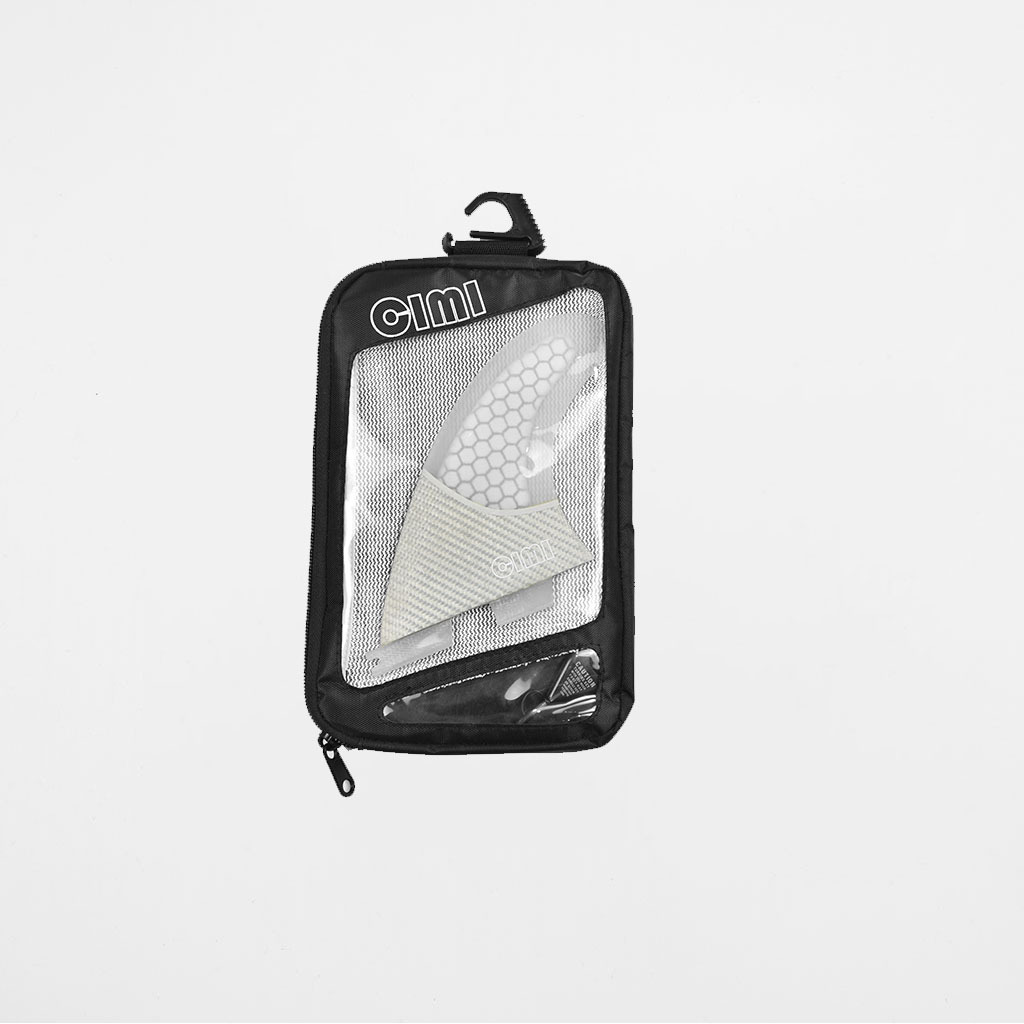
- Rinse in fresh water after a session, dry, and store in a padded pocket or the mesh pouch. Surfboard fins left loose in a board bag collect dings on the trailing edge, and a chipped tip is the most common reason a fin comes back.
Commercial & Service Applications
- Surf shop replacement shelves — a shop that keeps a block of surf fins on the wall sells more of them than it sells boards, because fins are lost and broken far more often than a board is replaced. Holding two or three sizes of the carbon model beside the plain honeycomb fin gives the customer a visible step-up without a long conversation at the counter.
- Repair benches — most fins for surfboard repairs go out one at a time, so the bench needs a spread of sizes rather than depth in a single band. A repaired board should leave the same day, which means the right size is already on the shelf when the job comes in.
- Rental and school fleets — fleet boards lose fins and fray a surf leash at a steady rate all season. Standardising on one fin model across the fleet means a board that comes back short can be refitted from stock without checking which template it was built with.
- Board builders — a builder fitting out new boards needs the template, the size and the base to match the rest of the set. Ordering the carbon version in the same sizes as the glass honeycomb makes an upgrade line easy to offer without changing anything else in the build.
- Distributors and accessory programmes — buyers assembling a full range can take this fin together with a surf traction pad, covers and leashes from one production base, which keeps packaging, colour and finish consistent across the whole accessory order.
Specifications
| Attribute | Detail |
| Model | F25314 |
| Product name | Surf Fin Honeycomb Carbon |
| Construction | Resin transfer moulding |
| Composition | 50% honeycomb core, 20% glass fiber, 20% epoxy resin, 10% carbon fiber |
| Fin systems | Single tab, double tab and box fin versions |
| Size range | XS to XL in five rider-weight bands |
| Finish | Gloss laminate over the honeycomb core |
| Typical use | Replacement surfboard fins and new-board builds |
Size & Rider Weight Bands
| Size | Rider weight | What it suits |
| XS | Under 55 kg / 120 lbs | Lighter riders, small-wave boards and grom setups |
| S | 55–70 kg / 120–155 lbs | Everyday riders on shortboards |
| M | 65–80 kg / 145–175 lbs | The widest-selling band for average adult riders |
| L | 75–90 kg / 165–200 lbs | Heavier riders and larger boards |
| XL | Over 85 kg / 190 lbs | The heaviest riders and big-board setups |
Matching Accessories
- Leash — Hypalon surf leashes in four lengths: 6 ft 6 mm for small to medium waves, 7 ft 7 mm for all-round conditions, 8 ft 7 mm for a durable everyday leash, and 9 ft 8 mm for a longboard in medium to large waves. A shop that fits a fin usually fits the leash in the same visit.
- Fins — the range covers the main types of surfboard fins: honeycomb, timber, G10 glass and nylon, so a buyer can build a complete fin wall rather than a single material story.
- Traction — tail pads, centre pads, skimboard pads and waxless pads. A surf traction pad is the easiest add-on attachment at the same counter, and the pads are finished to sit alongside the same board range.
- Cover — basic bags, regular bags, stretch covers and bodyboard bags. A cover is what the customer buys when the new fin is fitted to a board that lives in a car or a garage.
- Rack — travel rax with tie-downs, storage racks, display racks and bike racks. A surfboard rack is what turns a stack of boards in the back room into a display the customer can walk around, and it is the item most shops add once the board and fin range has grown.
Ordering & Delivery
- Send the size mix you need for each line of surfboard fins. Most trade orders combine two or three bands rather than committing to a single size.
- Check every surfboard fin against the rider-weight chart before the order is packed. If you are buying for a fleet, tell us the weight spread so the split between bands is balanced.
- Say whether the fins should ship bulk or with your own brand labelling, barcode and hang tag.
- Ask for the current lead time, payment terms and shipping terms to be confirmed on the quotation — they vary by destination and by order size.
- Tell us whether the order is for trade stock, for board builds or for repair benches.
- If your range also carries a surf leash, put it on the same quotation so freight is calculated on the whole consignment rather than per line.
- A surf traction pad and a cover are light, low-volume items; adding them to the same order keeps the shipping cost sensible against the value of the goods.
- A surfboard rack ships as a bulky item, so ask for it to be quoted alongside the fins but costed separately for freight.
- Ask your sales contact about sample availability and current terms before you commit to a seasonal programme.
Scale & Supply Capability
CIMI is a factory-based supplier with 16 years in surf and watersports hardgoods, manufacturing at our own facility rather than sourcing through traders. Chain stores, supermarkets and surf-brand stores buy from us because one supplier covers a full accessory assortment, so a season's order and its reorders can be planned together. We take on OEM and private-label work, adapting designs, colourways and branding to your programme, and we schedule production against your agreed range plan. Send us your buy list and target dates, and we will confirm what we can make and when.
FAQ
Which fin system does this fin fit?
This fin is built on a double-tab base, so it fits a board with two separate slots and tab screws. The same template is also produced as a single-tab version and as a box-fin version, which covers older boards and longboard centre boxes. Tell us which system your stock uses when you order and we will match the base to it — every surfboard fin in the carbon range is supplied in all three.
What does the carbon frame change compared with the glass honeycomb fin?
Two things. Inside, an internal carbon frame is shaped to suit the template, so the fin keeps a predictable load path from base to tip instead of relying on the laminate alone. At the base, a carbon twill is laid in to stiffen the area that takes the screw load. Together they give the more user-friendly flex pattern we build this model for: forgiving underfoot rather than sharp. Weight stays low because the honeycomb core does the light work. Shops that stock both surf fins usually show the carbon model as the natural step up when a rider asks what the extra carbon buys.
How do I choose between two size bands for a rider?
The bands overlap on purpose, because body weight is only one input. Start with the rider's weight, then adjust for the board and the conditions: a heavier rider on a longer board sits at the top of a band, a lighter rider on a short board at the bottom. If you are splitting an order of fins for surfboard stock, cover two bands rather than dropping a size. The smallest and largest bands move slower than the middle ones, so give the middle bands the depth.
How do I check a board will accept this fin before I order?
Look at the fin box on the board. Two separate slots with screws take a double-tab fin; one long routed box takes a box fin; a single slot with one screw takes a single-tab fin. The range covers the main types of surfboard fins, so order the version that matches the board instead of forcing the wrong base. If you are buying for a fleet you cannot inspect, a photo of the box is the quickest way to confirm it.
How does honeycomb carbon compare with the other types of surfboard fins in the range?
Honeycomb and honeycomb carbon are the lightest builds in the family, because the core is a honeycomb structure rather than a solid laminate. The carbon version adds the internal frame and the twill at the base, and that is what changes the feel. The range also includes timber, G10 glass and nylon fins, so a shop can cover several price points without splitting the order across suppliers. If a fin has to match a particular board model, send us the board details and we will point you to the right base and band.
Which other accessories are usually fitted with these fins?
A leash is the usual pairing — match the length to the board and the wave size rather than picking a standard. Most riders also fit a traction pad for grip on the tail, and a cover keeps the board protected between sessions. For storage and display, a surfboard rack gets boards off the floor in the shop or the back room. All of them come from the same production base as the fins, which is what keeps a single accessory order consistent.