Product Overview
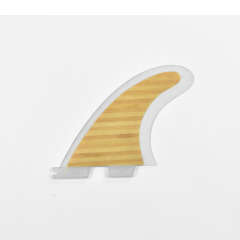
This honeycomb timber fin is one of the surf fins we build for shops, repair benches and board brands that want a replacement part with a bit of character. What separates it from the plain honeycomb model is the face: a visible timber grain runs across the foil, so a set on the wall reads as something more considered than plain glass. Because the fin is built around a standard honeycomb layup rather than a one-off shape, it suits buyers who need continuity — the same model, the same size run and the same finish on every reorder. Shops use it as an everyday replacement fin, and repair counters keep a short run of each size so a customer can walk out with a matched replacement instead of waiting on a special order.
Material & Build
- Honeycomb core — a honeycomb lattice sits at the centre of the fin. It is the reason a set this size adds so little weight to a board, and why the foil holds its shape instead of feeling hollow underfoot.
- Glass fiber skin — glass layers over the core carry load from the tip down into the base; on surfboard fins this is the layer that keeps the outline crisp through a season of knocks.
- Epoxy resin — epoxy bonds core, glass and base into a single moulding and gives the face a sealed surface for the finish to sit on.
- Closed-mould resin transfer — the resin is drawn through a dry layup inside a closed mould. A closed mould gives a repeatable resin-to-glass ratio, and repeatability is what makes a reorder look like the last one.
- Timber-grain face — the visible grain is the finish detail that gives this model its own number. The working build underneath is still the honeycomb, glass and epoxy layup.
- Moulded base — the tabbed base is formed with the fin rather than bonded on afterwards, so the tabs sit square to the foil.
- Wider range — one of several types of surfboard fins we produce, with carbon, plastic and inkjet builds covering the other price points.
- Reorder consistency — the same layup schedule goes out to surf board manufacturers and shop buyers, so a repeat order matches the set already on the wall.
Fin System & Compatibility
This is one of the surf fins we supply on a double tab base, which is what most shortboards and hybrid shapes are built around. If a board in your fleet runs a different system, the same honeycomb build is available in single tab and box fin bases, so you can keep one material and one finish across a mixed rack. When an order goes in, tell us the system each board uses, or send a photo of the fin box, and we will match the base before anything is moulded.
The base is the part that decides whether an order works, and it is where most returns begin. Among the types of surfboard fins buyers ask us for, double tab is the most common request from shortboard stockists, single tab covers boards built around that plug, and box fin is what longboard and single-fin shapes need. Running the same layup across all three means a shop can tell one material story and still fit three different boards.
Specifications
Junior riders and light adults on shortboards. If your shop fits a lot of groms, this is the size you will restock most. - S — 55 - 70 kg / 120 - 155 lb. Lighter adults, older juniors, and anyone stepping down from a bigger board. - M — 65 - 80 kg / 145 - 175 lb. The middle of the range and the safest single size for a shop that only wants to hold one or two sizes of surfboard fins. - L — 75 - 90 kg / 165 - 200 lb. Heavier adults and riders on thicker or longer boards. - XL — over 85 kg / 190 lb. Big riders and big boards, and the size a rental fleet needs for its heaviest customers. - Where the bands overlap — S/M and M/L share a few kilos on purpose. A rider at 70 kg or 80 kg can ride either, and the deciding factor is the board and how the surfer likes it to sit in the water. - Match the set — when one fin is replaced, stay on the same model and the same size so the rest of the set keeps the same geometry. Mixed sizes in one set is a common reason a board stops working the way its owner expects. - Buying fins for surfboard repair stock — order the sizes your bench sees most; M and L cover the widest spread of adult riders, with a couple of XS for junior boards.
Fitting, Care & Storage
- Dry-fit first. Before fitting a new set of fins for surfboard repairs or your own board, seat each fin in its box and check that the base sits flush.
- Press it home. A fin left halfway up the box loads the tab corners; it should drop in and sit flat before you secure it.
- Secure with the board's own fixing. Use the screw or plate the box was made for, then check it again after the first session.
- Rinse after every salt session. Fresh water and a dry cloth keep the timber face clean, and the same rinse you give a surf leash stops salt drying inside the box.
- Keep it out of long heat. Resin does not enjoy a closed car in summer; store the fin in its pouch rather than on a dashboard.
- Store it off the floor. A surfboard rack or a padded cover keeps fins away from the ground, which is where most tab damage happens.
- Retire damaged fins. A fin with a cracked tab or a lifted skin should come out of the set; it will not hold its shape, and it can damage the box it sits in.
Matching Accessories
| Accessory line | What is available |
| Leashes | Hypalon surf leash models from 6 ft 6 mm up to 9 ft 8 mm, for shortboards through longboards |
| Fins | Honeycomb surfboard fins in single tab and double tab, plus carbon, plastic and inkjet builds |
| Traction | Tail pads, centre pads, skimboard pads and waxless surfboard traction pad styles |
| Covers | Basic bags, regular bags, stretch covers and bodyboard bags |
| Racks | Travel rax and tie-downs, storage racks, display racks, bike racks and surfboard rack systems |
| Wax and fin accessories | Wax, inserts and the small parts that go with a fin change |
| Paddles | Paddles for SUP and prone use |
Ordering & Confirmation
- Send the size split you need — rider weights and board types for the coming season, not just one size.
- Name the model. The timber honeycomb face is its own model, separate from the plain honeycomb fin, so put the right one on the order.
- Say what the fins are for — replacement stock for a rental fleet, fins for surfboard repairs on a shop bench, or new-season stock for your sales floor. It changes the size mix we suggest.
- Add the lines that ship with the boards; a surf leash and a cover for the same boards can travel on one order and one delivery.
- Add the tail grip if the boards need it — the surfboard traction pad range is ordered the same way.
- Plan the wall. If you need shop fittings, ask about the surfboard rack and storage options while the order is open.
- Confirm quantities, packing and delivery terms with your sales contact, and ask about sample availability before a first order.
Scale & Supply Capability
CIMI is a factory-based supplier with 16 years in surf and watersports hardgoods, manufacturing at our own facility rather than sourcing through traders. Chain stores, supermarkets and surf-brand stores buy from us because one supplier covers a full accessory assortment, so a season's order and its reorders can be planned together. We take on OEM and private-label work, adapting designs, colourways and branding to your programme, and we schedule production against your agreed range plan. Send us your buy list and target dates, and we will confirm what we can make and when.
FAQ
Are the timber and plain honeycomb fins interchangeable?
Yes. They share the same base options and the same size run, so whichever one goes on the board, the set-up is the same. The difference is the face: the timber version carries a visible grain and has its own model number. Among the types of surfboard fins we make, these two are the closest pair, which is why shops often stock both in M and L.
Are the fins supplied as a set or as single fins?
Both orders come through — shops restocking a full set, and repair counters buying one fin. Tell us the set-up you are fitting, twin, thruster or five-fin, and we will confirm how the surf fins are packed for your order before it is released.
Can the fins be supplied under our own brand?
Yes. Private-label work is a normal part of what we do for surf board manufacturers and shop brands. Send your artwork and tell us where you want it placed on the fin; we will confirm what the timber face can carry before anything goes into production.
How is each fin packed for bulk orders?
Packing is planned around how the fins will actually be sold, not just how they leave the mould. Each fin is bagged before it goes into the outer carton, so the timber-grain face is not rubbing against the next fin in transit, and that same pouch becomes the shelf-ready pack the moment the carton is opened. Bulk orders are normally consolidated by model and size, which means a carton can go straight onto a peg or be split across a repair counter without sorting loose pieces first. If your range mixes double tab, single tab and box fin versions, tell us the split you want per carton and we will pack to that breakdown; the same applies if you would rather spread the size run across several cartons than concentrate it in one. Carton labelling, barcode stickers and price tickets are confirmed at order stage, because they depend on your own shelf and till systems. Buyers running both a display wall and a repair bench often ask for the pouch packs to stay intact and for cartons to be marked by size, which makes stock checks quicker between deliveries. Ask your order contact to confirm carton quantities and the exact packing breakdown for your first run, and again whenever the size mix changes.
What usually goes on the same order as these fins?
The surfboard traction pad line is the most common companion, because a rider who has just replaced a fin is often halfway through refreshing the tail grip as well. Ordering them together keeps the accessory wall consistent and keeps the delivery dates aligned.