Product Overview
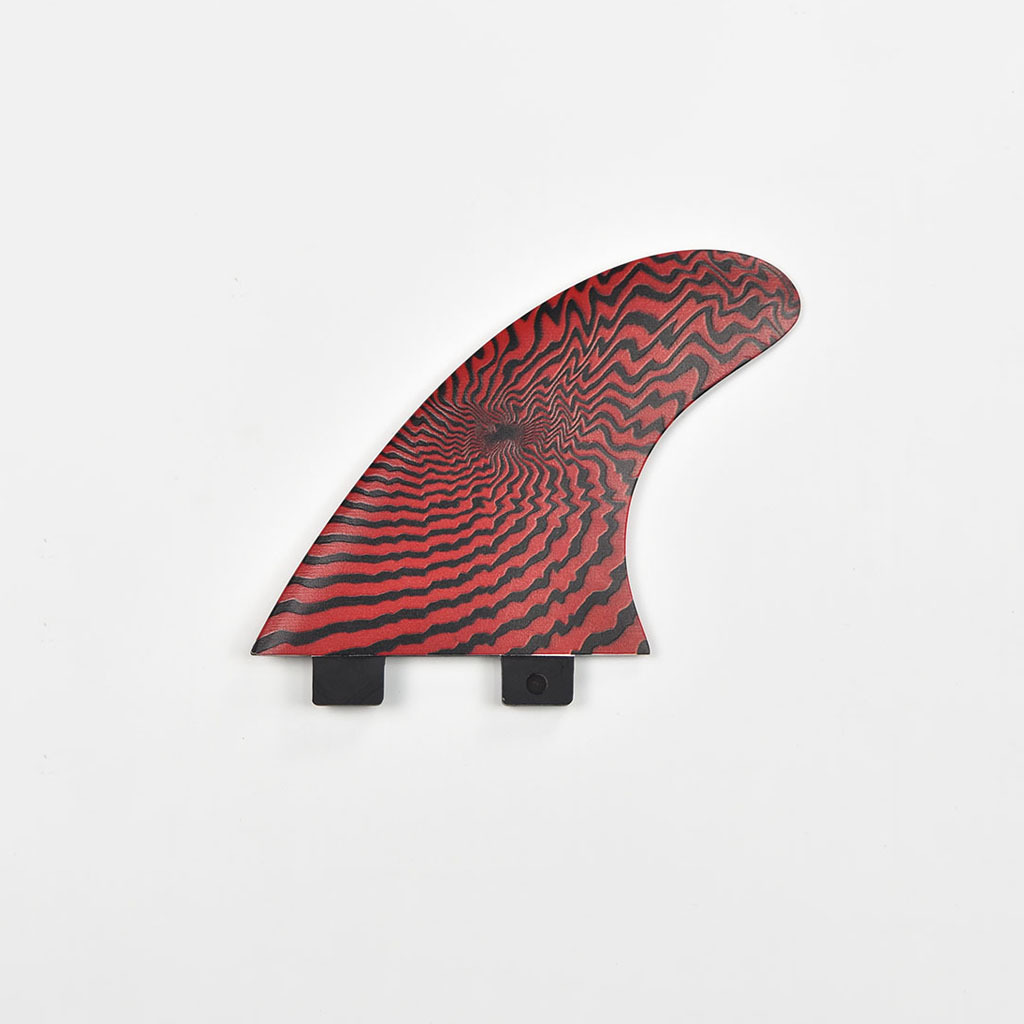
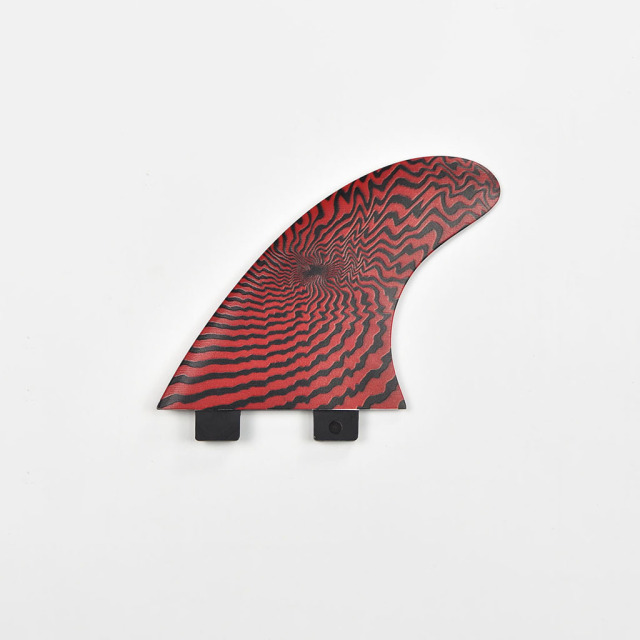
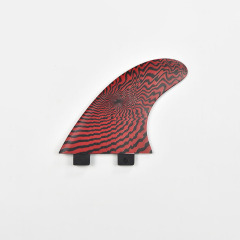
Instead of a plain moulded colour, the face carries a red and black swirl across the blade, with the CIMI mark and the words Fins Unlimited printed into the same artwork. That is the practical difference on a shop wall: a fin a customer picks up rather than walks past, and a graphic that ties a board's tail to the rest of a brand's look. Riders buy it to replace a lost or damaged fin; shops and rental fleets buy it as part of a graphic story across the accessory wall. - Printed face instead of a moulded colour — inkjet printing lays a multi-colour graphic with fine linework, so a swirl, lettering and a brand mark can sit on one blade; the fin reads clearly from a few metres away, which is what a crowded accessory wall needs. - A fitting most shortboards already use — the two-tab pattern matches boards built around a two-slot box, so a customer replacing a fin is usually replacing like for like rather than changing systems. - Swept, curved outline — the template narrows toward the tip in a clean sweep; when you build a set, check it against the board's other fins so the tail looks coherent to the customer. - Branding printed into the artwork — the CIMI mark and Fins Unlimited sit inside the graphic rather than on a separate sticker, so there is nothing to peel at the counter. - A look that ranges with the rest — these surfboard fins share the fitting and the shelf presence of the wider fin line, so a printed model can stand beside honeycomb and carbon fins without looking like an odd item out.
Inkjet Graphics & Finish
Inkjet printing puts the pattern onto the fin as artwork rather than as a single pigment mixed into the moulding. That is what allows a two-colour swirl, a fine line and a piece of lettering to sit together on one blade, and it is the reason this one reads differently from the plain surf board fins around it. The fin in the photos carries a red and black wave pattern across the full face, with the CIMI address and the Fins Unlimited wording printed as part of the same layout.
Brands and surf board manufacturers use printed graphics to carry a house pattern onto the tail of a board without changing the template. If the graphic has to follow a season, a board print or your own mark, send the artwork reference with your enquiry and our team will confirm what the printing setup can hold for your quantity and schedule. Keep an approved sample and the artwork file with the order record: print is matched against a reference, so a reorder is only as consistent as the sample both sides signed off. The print is decoration on the fin — it does not change the template, the fitting or the way the fin sits in the box.
Double-Tab Base & Fit
- Dry-fit before you tighten anything — seat the fin in the box and check that both tabs go all the way down with no gap under the base; the same check applies to most surf board fins with a two-tab base, so you know the fin is sitting on the box and not on a burr.
- Snug, not forced — the box screw should hold the rear tab firmly; over-tightening is the usual way a tab or a box thread gets damaged.
- Inspect the box on used boards — hairline cracks around the slots or a stripped thread will not hold a new fin, and a fin that lets go mid-session is the usual result.
- Replace rather than refit a chipped fin — a damaged base passes load into the box and can crack the slot.
- Know what it does not fit — a single long centre-tab box or a through-box takes a different model; this one is the two-tab pattern only.
- Wrong box, right answer — the range also covers single-tab and box-fin versions, so a customer with a different board still leaves with a fin.
The Wider Fin Range
The range covers the main types of surf fins a shop is asked for. Honeycomb fins use a honeycomb core with glass fibre and epoxy, made by resin transfer moulding, and they stay light in the hand across a wide spread of conditions. The honeycomb carbon version adds carbon fibre, an internal carbon frame and a carbon twill at the base, with the more user-friendly flex pattern that comes with that build.
There is a timber-look honeycomb model and a plastic double-tab model for the traditional and entry ends of the shelf, and this printed fin for the tail that should carry a pattern rather than a material colour. Across the range the same fitting patterns recur, so a shop can stock several surf board fins and still answer the box question the same way: single tab, double tab and box fin versions cover the systems most boards are built with.
Leash, Traction, Covers & Racks
- Leashes — Hypalon leashes in four lengths: L00570H 6ft 6 mm for small to medium waves, L00572H 7ft 7 mm for all-round conditions, L00573H 8ft 7 mm, and L00575H 9ft 8 mm, a regular longboard ankle leash for medium to large waves or a longer board. A surfboard leash is the first thing to look at when a tail comes in for repair, because a worn string or rail saver is what lets go first.
- Traction — tail pads, centre pads, skimboard pads and waxless pads; a surf traction pad takes the same wear as a fin at the tail, so shops tend to replace the two together.
- Covers — basic bags, regular bags, stretch covers and bodyboard bags, for the customer who buys a board and wants it protected on the way home.
- Racks — storage racks, display racks, bike racks and travel tie-downs; a surfboard rack solves the display problem on the shop floor and the storage problem at home.
- Why order them together — surf fins, leashes, pads, covers and racks come from the same factory, so a range reset arrives with a consistent look and one conversation about sizes, colours and quantities.
Daily Care & Storage
Rinse the fins in fresh water after every session and let them dry before they go back in the pouch, a routine that suits all types of surf fins. Salt and sand collect in the corners of the tabs and around the base, and grit left sitting in the box is what wears a tab thin over a season. Wipe the printed face with fresh water and a soft cloth; solvent cleaners, acetone and abrasive pads attack the print instead of cleaning it, and a hard scrub once a month is worth less than a quick rinse after each use.
Storage matters as much as cleaning. Spare fins belong in the pouch, not loose in a van where they rub against wax combs, keys and other fins. A board that stays assembled should sit on a surfboard rack rather than lean tail-down against a wall, where the fin carries the board's weight and the box takes the strain. Keep any fin out of a closed car in summer — heat is hard on the print and on the resin underneath it.
Specifications
| Model | F00155 |
|---|
| Product type | Printed surfboard fins |
| Fin system | Double tab |
| Base | Two mounting tabs |
| Outline | Swept, curved template |
| Finish | Inkjet-printed graphic |
| Graphic coverage | Printed across the full face of the blade |
| Marking | CIMI wordmark and Fins Unlimited print |
| Box match | Boards built around a two-slot fin box |
| Fixing | Tabs seated in the box slots and held with fin screws |
| Range position | Printed option within the double-tab fin line |
Ordering & Delivery
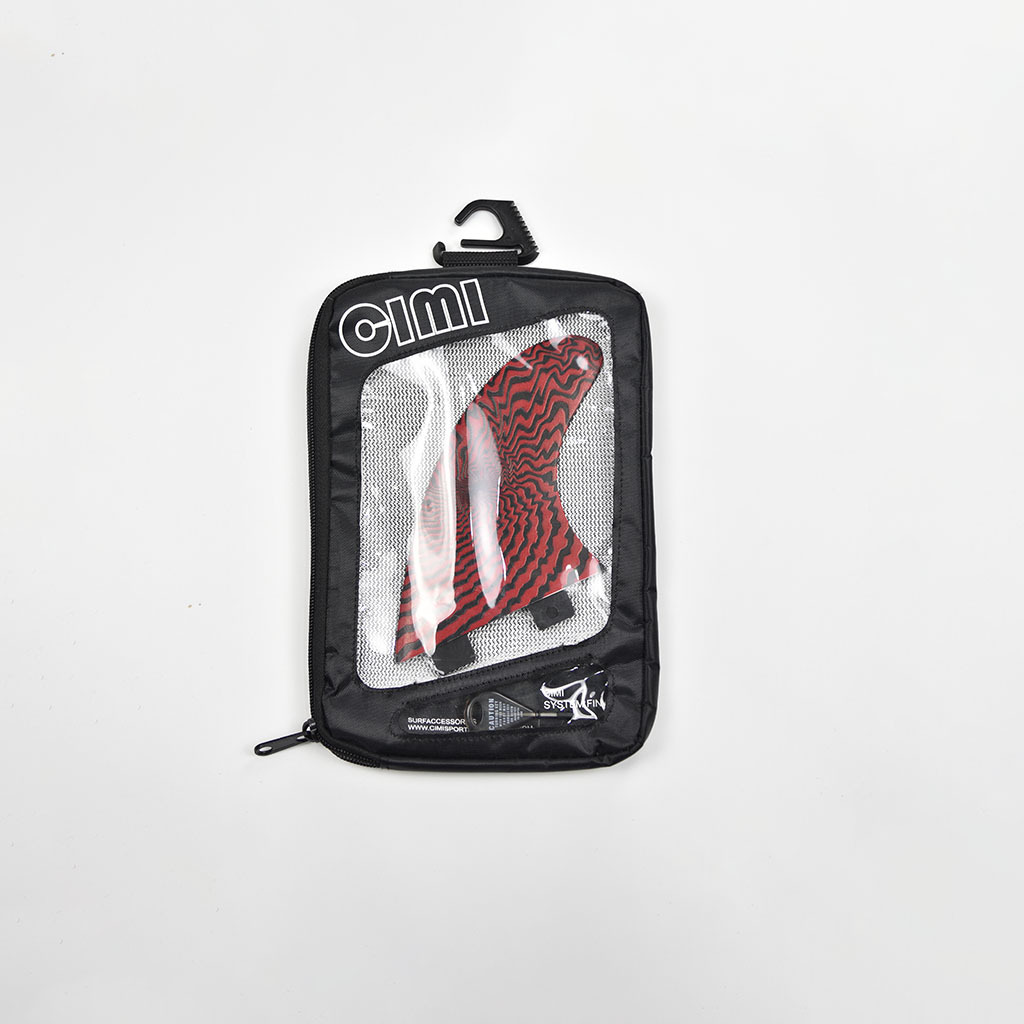
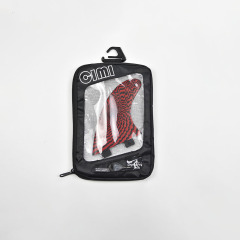
- Start with the range: tell us which types of surf fins you want alongside this printed model and which fin box the boards in your market use. 2. Ask for the current construction details for this model before you commit, so the build on your order is written down rather than assumed from a sister fin. 3. 4. Confirm packing and labels: the fins are shown in a mesh zip pouch with a hanging header, and any barcode, hangtag or product label is agreed per order. 5. Add the rest of the tail if you need it — a surfboard leash line goes on the same order as the fins so the range is planned together. 6. Include deck goods: a surf traction pad range, wax and spare screws are small items that are easier to handle alongside the fins than as a separate order. 7. Ask your sales contact about order quantities, lead time and sample availability for the programme you have in mind. 8. As surf board manufacturers we build against a range plan, so sending the full accessory list and your in-store dates at the start keeps the schedule realistic.
Scale & Supply Capability
CIMI is a factory-based supplier with 16 years in surf and watersports hardgoods, manufacturing at our own facility rather than sourcing through traders. Chain stores, supermarkets and surf-brand stores buy from us because one supplier covers a full accessory assortment, so a season's order and its reorders can be planned together. We take on OEM and private-label work, adapting designs, colourways and branding to your programme, and we schedule production against your agreed range plan. Send us your buy list and target dates, and we will confirm what we can make and when.
FAQ
How is this model different from the other surf fins you make?
The template and the fitting come from the same double-tab family as the rest of the line; what changes is the face. This one is finished with an inkjet-printed graphic rather than a plain moulded colour, so the red and black swirl, the CIMI mark and the Fins Unlimited wording all sit on the blade. If the fins are being bought for the look of a wall or to match a board graphic, this is the model; if the material build is the reason for the order, the honeycomb and carbon models are the ones to compare.
Will the print wear off with use?
Print is a surface finish, so it is the part that shows age first. Water, salt and wax are part of every session and are not what marks it; abrasion is — a board dragged across a car park, a loose fin rattling against keys in a gear bag, or a zip pulled over the blade. Keep the fin in its pouch between sessions and wipe it with fresh water rather than anything harsher, and the pattern stays presentable.
Will the double-tab base fit my board?
It fits boards built around a two-slot fin box, where two short tabs drop in and the box's screw clamps the rear tab. A single long centre-tab box or a through-box takes a different model. The quick check is to look at the box: two slots side by side means this pattern is the right one. If you are buying for a board you cannot inspect, send a photo of the box and we will confirm before the order is packed.
What is the fin actually made from?
The build for this model is confirmed with your order rather than assumed from a sister fin — ask your sales contact for the current material breakdown and it goes on the record. The honeycomb, honeycomb carbon and timber models each carry their own published layup, and a printed finish is a surface treatment, so ask which build it sits on for the run you are buying.
Printed or honeycomb — which should a shop stock?
They answer different questions. The printed fin is the one for a wall that has to look different and for a board whose tail should carry a pattern; the honeycomb and honeycomb carbon models are the ones to choose when the material build and the flex story are the reason for the order. Plenty of shops carry both under the same double-tab fitting, with the printed model on the pegboard and the material range behind the counter.
How many fins come in a set?
That depends on the board: a single-fin set-up, a thruster at three or a quad at four. Tell us the set-ups your customers ride and we will match the set composition on the order, so the shop is not left holding three fins when the next customer needs four.