Product Overview
F25313 is a double tab surfboard fin built around a honeycomb core with carbon in the layup. It is the carbon version of our honeycomb fin — the same light core, the same outline, with carbon fibre added and a carbon frame inside the fin.
Shops buy it as a replacement fin for the repair counter and as a step-up option next to the glass honeycomb fin. Board builders spec it when a model needs a fin that matches a carbon build. Rental fleets keep a few on hand for the board that comes back missing a fin, and a spare surf leash for the same reason.
Fitting is the normal double tab routine, so it goes onto a shortboard or a twin fin surfboard without a fitting lesson. Nothing about the fin asks the rider to change how they surf: the tabs, the screw and the box are the ones they already use.
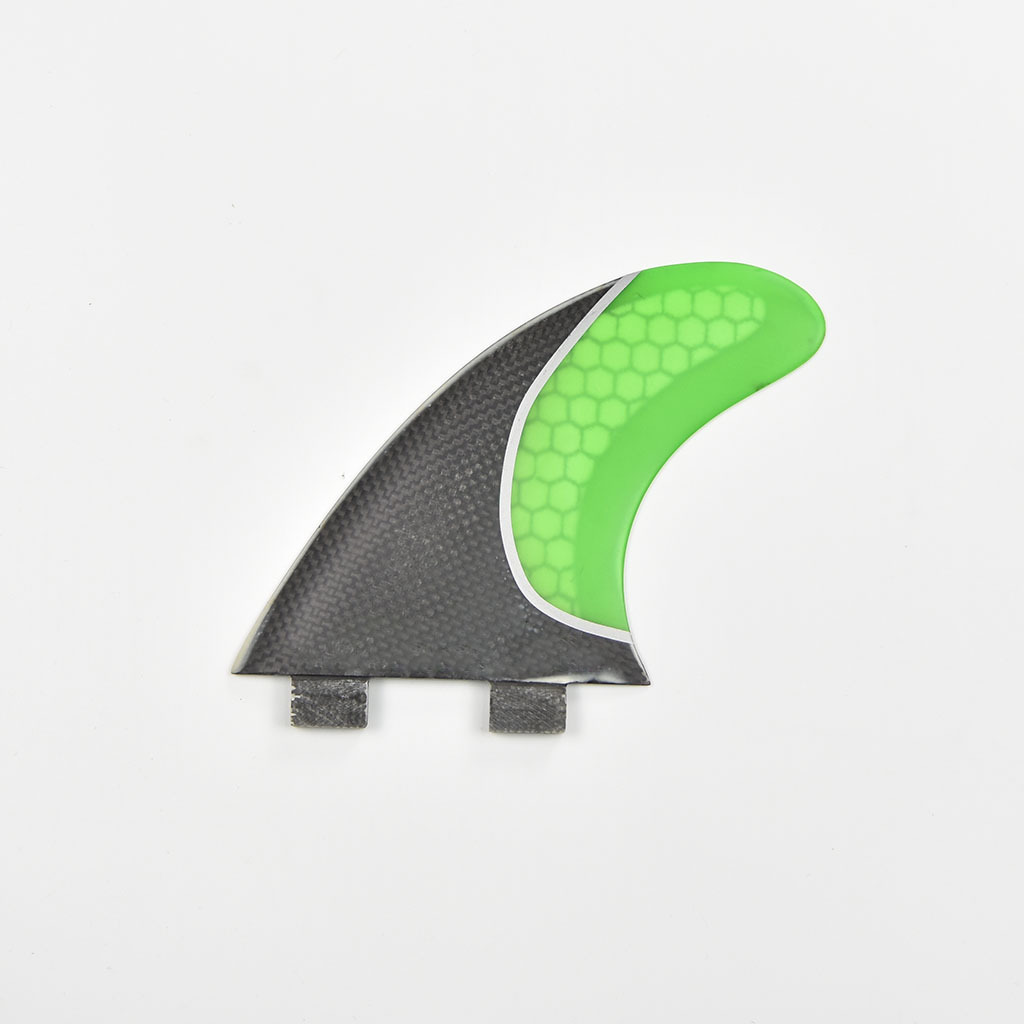
The face is a grey woven carbon with a lime-green honeycomb inlay through the middle, so the difference between this fin and the glass version is visible before a customer picks it up.
Material Composition
- Honeycomb core, 50% of the build. The hex core gives the fin volume without the weight; it holds the shape while the glass, epoxy and carbon carry the load.
- Glass fibre, 20%. The glass layers wrap the core and spread load across the panel so the honeycomb does not crush where the fin takes pressure.
- Epoxy resin, 20%. Epoxy binds core, glass and carbon into one piece and carries the surface finish. It is also the part of the layup that holds the flex behaviour together.
- Carbon fibre, 10%. Carbon is what separates this fin from the all-glass honeycomb version. At 10% of the mix it changes how the fin loads and releases without changing the outline.
- Resin transfer moulding. Resin is drawn through a closed mould so the layup fills evenly from fin to fin — that even fill is what keeps the second order matching the first.
- Internal carbon frame. Each template gets its own carbon framework rather than one generic frame, so the stiffest part of the fin follows the outline it is built into.
- Carbon twill at the base. The twill sits where the tabs meet the fin, the area that carries load every time the fin is screwed down and every time the board lands flat.
- One layup family. Shops ordering several types of surfboard fins can keep the same fitting routine and the same size bands across the glass and carbon honeycomb versions, and let the carbon be the step-up on the shelf.
- Model | F25313 Core | Honeycomb, 50% of the material mix Glass fibre | 20% Epoxy resin | 20% Carbon fibre | 10% Construction | Resin transfer moulding Internal frame | Carbon framework shaped to the template Base | Carbon twill Fin system | Double tab; single tab and box fin versions in the same range Flex | More user-friendly flex pattern than the all-glass honeycomb build Sizes | XS, S, M, L, XL Finish | Grey woven carbon face with a lime-green honeycomb inlay
Flex Pattern
The flex is where this fin earns its place in a range. We build it to deliver a more user-friendly flex pattern than the all-glass honeycomb surfboard fins we make: the layup is tuned so the fin loads and releases in a way a broad spread of riders can get on with, rather than only the rider who already knows exactly what they want from a fin.
That is a useful thing to have on a shelf. When a customer wants something a little more than the standard honeycomb fin, you are not asking them to relearn how they surf — the template, the double tab fit and the size bands stay the same, and the difference sits in how the fin behaves under load.
It also gives a board builder a clean pair of options: the same fin can be offered in glass honeycomb and carbon honeycomb, with the carbon build as the one above it in the range.
What we do not publish is a flex figure. A single number on a sheet tells a rider very little, and a set of surf fins is judged by feel in the end. Judge this one the way your customers will: fit it, ride it, and compare it against the glass version on the same board.
Fitting & First Use
- Read the box before you touch the fin. A double tab box has two slots side by side; a single tab box or a box fin box will not take this fin, so check the board first.
- Dry fit with the board flat on the bench and any surfboard traction pad facing down. Drop both tabs in, press the fin down and look along the base — it should sit flush, with no rocking and no gap at the front or back of the box.
- Set the fin fore and aft where the rider wants it. The position of the fins on a surfboard changes how the board turns, so match this fin to the others already fitted rather than guessing a spot.
- Fit the plate and screw that came with the board and tighten until the fin is firm. Stop at firm — driving the screw down hard can crush the tab and crack the base.
- Check for movement before the board leaves the shop. Grip the tip and try to rock the fin side to side; any movement means the tabs are not seated or the screw needs another turn.
- Re-check after the first session and after any knock. On a twin fin surfboard, set both boxes and check both fins at once so the pair sits at the same fore-aft position.
- Take the surfboard fins out for travel and for long storage, and refit them with the same screws and plates they came out with.
Size & Weight Bands
| Size | Rider weight | Typical rider | How the band overlaps |
| XS | Under 55 kg / 120 lbs | Junior and smaller riders | Starts the range, no overlap below |
| S | 55 kg – 70 kg / 120 – 155 lbs | Teenagers and smaller adults on a shortboard or twin fin | Overlaps M from 65 kg to 70 kg |
| M | 65 kg – 80 kg / 145 – 175 lbs | The middle of the range, where most adult riders land | Overlaps S from 65 kg to 70 kg and L from 75 kg to 80 kg |
| L | 75 kg – 90 kg / 165 – 200 lbs | Taller or heavier riders, and riders on a longer or thicker board | Overlaps M from 75 kg to 80 kg and XL from 85 kg to 90 kg |
| XL | Over 85 kg / 190 lbs | The heaviest riders and the biggest boards in the range | Overlaps L from 85 kg to 90 kg |
Range & Matching Accessories
- Fins across the range. Honeycomb glass, honeycomb carbon, timber-named honeycomb, plastic and inkjet builds sit alongside the G10 glass and nylon lines, so a shop can cover several types of surfboard fins from one supplier without splitting the order. - Surf leash options. Hypalon leashes in 6 ft 6 mm for small to medium waves, 7 ft 7 mm for all-around conditions, 8 ft 7 mm, and 9 ft 8 mm for longer boards and medium to large waves. - Surfboard traction pad range. Tail pads, centre pads, skimboard pads and waxless pads — the usual add-on a customer picks up with a fin. - Covers and bags. Basic bag, regular bag, stretch cover and bodyboard bag for the boards these fins end up on. - Surfboard rack options. Travel rax and tie-downs, storage racks, display racks and bike racks, which is what a shop needs when it refits a floor or a rental fleet wants boards off the ground. - Planned as one order. Because we are surf board manufacturers as well as fin suppliers, this fin sits inside a full accessory range.
Care & Wear Points
Rinse it the same day it comes out of the water. Salt left in the box slots and around the tabs dries into crystals that grind every time the fin shifts. A minute under a fresh-water tap — both faces and the tab area — is enough, then let it air dry before it goes back into a board bag.
Clean with water and mild soap, nothing stronger. Acetone, solvent thinners and abrasive pads cut into the epoxy surface and dull the carbon weave in a single pass. Board wax comes away with a soft cloth and warm water; a scraper dragged across the fin will mark the skin long before it lifts the wax.
Know what wears first. The tab area and the base go first: the carbon twill at the base carries the screw load every time the fin is fitted, and over-tightening crushes the edge of the tab before anything else gives. The trailing edge comes next, taking knocks from board bags, car doors and sand. The lime-green inlay through the middle is cosmetic — it scuffs and dulls, it does not fail. After a hard knock, check the base and the trailing edge before the next session rather than after it.
The screw and plate wear faster than the fin. When a surfboard fin comes off a board, put the screw and plate back in the box or tape them to the fin. A missing plate is the usual reason a sound fin ends up sitting unused in a repair drawer.
Store spares flat and cool. A fin left on a dashboard or in a hot car through a summer sits in the one condition epoxy does not like, and a fin rolling loose in a toolbox picks up chips along the trailing edge. Keep spares flat in a fin wallet or a compartment of their own, away from tools and wet neoprene.
Fleets: rotate a single fin, not the pair. Keep one spare surf fin per size band on the shelf and swap only the damaged one. Because the layup and the flex are consistent across the range, a replacement in the same size band keeps a board behaving the way the rider remembers it, and the pair does not have to be written off together.
Ordering & Confirmation
- Confirm the fin system against the board before anything else. Double tab is the build here, and single tab or box fin versions are available in the same range, so tell us which one the boards use.
- Confirm the size mix. Give us the split across XS to XL you want in the first order rather than a single size, so the shelf covers the riders you actually see.
- Confirm branding and packing. Tell us what should appear on the fin and on the pack, and how the fins should be bagged or boxed for your shelf.
- Ask about samples and the current lead time before you fix a launch date, and we will tell you what is possible for the quantity and finish you need.
- Agree the shipping terms and the delivery address with your sales contact. Fins travel light, so they are usually consolidated with the rest of an accessory order rather than shipped alone.
- Bring the rest of the accessory order into the same conversation. A surf leash for the same boards is a common pairing and keeps the paperwork together.
- Tell us if the delivery also includes a surfboard traction pad or a cover, so it can be planned with the fins rather than added afterwards.
Scale & Supply Capability
CIMI is a factory-based supplier with 16 years in surf and watersports hardgoods, manufacturing at our own facility rather than sourcing through traders. Chain stores, supermarkets and surf-brand stores buy from us because one supplier covers a full accessory assortment, so a season's order and its reorders can be planned together. We take on OEM and private-label work, adapting designs, colourways and branding to your programme, and we schedule production against your agreed range plan. Send us your buy list and target dates, and we will confirm what we can make and when.
FAQ
Which fin box does this fin fit?
Double tab — two tabs that drop into a box with two slots, held by one screw. The same template is also made in single tab and box fin versions, so if a board uses a different system, tell us and we will point you to the right one. On a twin fin surfboard you will see two boxes, one either side of the stringer, and this fin goes into either of them.
The size bands overlap — which one should I fit?
The bands are overlapped on purpose, so S runs into M, M into L and L into XL. A rider whose weight falls inside a shared range can go either way: fit towards the smaller band when the board is short and the rider wants an easy, loose feel, and towards the larger band when the same weight is carried on a longer or thicker board. If a set is going onto one board, keep every fin in the same band.
What conditions are these surf fins built for?
They are made to work across a variety of conditions rather than one narrow window, which is what makes the honeycomb build a straightforward stock item for a shop selling into mixed conditions. The carbon version changes the flex without changing the outline, so it stays useable wherever the glass version is. How the fins on a surfboard actually behave still comes down to the board, the rider's weight and where the fin sits in the box — the fin is one part of that, not the whole of it.
How do I look after the fin?
Rinse the surfboard fin in fresh water after salt water, dry it before it goes back into a bag, and avoid leaving it in a hot car for long periods — heat and sun dull the finish before the water ever does. After a hard knock, check the trailing edge and the tab area before the next session rather than after it.
Can we order these under our own brand?
Yes. We make several types of surfboard fins in-house and take on private-label work, so branding, colourways and packing can be agreed as part of a programme. Send your artwork and the sizes you want to your sales contact and we will confirm what is possible for your order.