F25205 is a honeycomb surfboard fin in the double-tab format, and the same model is also built as a single tab and a box fin for boards that mount differently. The laminate is a glass-and-epoxy skin over the honeycomb core, moulded by resin transfer rather than hand lay-up.
Shops and repair benches order it as a replacement part. When a fin is lost on the reef or snaps a tab, the board goes back into service on the same model and the same size it came in with, and because one model covers five rider-weight sizes and three mounting systems, a single order can look after the mixed boards sitting on the same shelf.
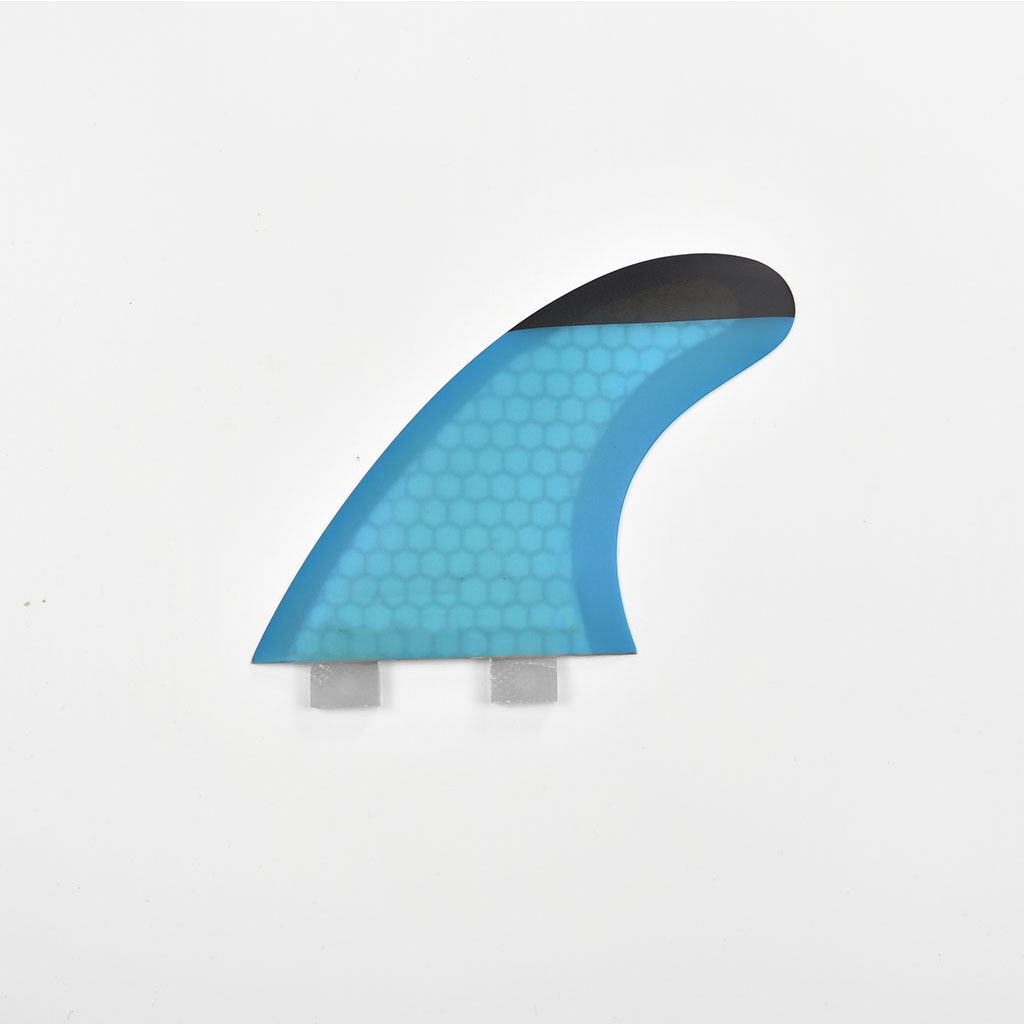
As surf board manufacturers we keep the specification recorded against the model, so a repeat order arrives with the same core, the same laminate and the same tab layout as the last one. Riders tend to notice the weight first: the fin is light in the hand, and the honeycomb cells show through the translucent blue laminate, with a black tip finishing the top.
It rarely travels alone, either. A surf leash, a set of traction pads or a board cover usually goes out on the same order, which is why the accessory range is worth planning as one buy rather than item by item.
The core is the reason this fin is light. A honeycomb sheet is mostly open cell held inside a thin wall structure, so it gives the fin thickness and shape with very little material inside it. Glass fiber supplies the tensile strength, and epoxy resin bonds core and cloth into a single panel that holds its form under load.
Moulding happens by resin transfer. The dry core and glass are loaded into a closed mould and resin is injected under pressure, wetting the laminate through in one pass. Against hand lay-up, that gives a more even resin-to-fiber ratio across a production run, which is the practical difference a buyer sees when the second delivery has to match the first.
In the water it is the weight riders comment on, and the glass-epoxy skin is what keeps the base solid where it meets the box. The same honeycomb platform runs across the other types of surf fins we mould, so a shop can keep one visual family across its wall.
As surf board manufacturers we also build the boards these fins sit on, which is why the sizes are listed by rider weight rather than board length: the two do not track each other reliably. If you are matching an existing stock of surfboard fins, work from the weight bands first and confirm the mounting system second.
What actually changes is the laminate. This model is 50% honeycomb core, 30% glass fiber and 20% epoxy resin. The carbon version keeps the honeycomb core at 50% and the epoxy at 20%, takes glass fiber down to 20% and adds 10% carbon fiber. Both are moulded by resin transfer, so the surface finish and the light feel in the hand stay close between the two.
Where the carbon sits inside the fin. On the carbon model the internal carbon framework is shaped to suit each template, and a carbon twill is laid into the base. What that buys is a more user-friendly flex pattern — a different feel rather than a stronger fin. Keep that distinction when you describe the two to a rider, because the carbon content is not a durability claim.
What carries over unchanged. Five weight bands from XS to XL, and single tab, double tab and box fin mounting. A rider can move from one build to the other without changing size, box or screw, which is the simplest way to explain the pair on a shop floor: same fit, different feel.
Which build to put in front of which buyer. For replacement stock, repair benches and rental fleets, this glass-and-epoxy version is the one to keep as the default, because it covers the widest spread of boards and riders without a second decision. The carbon version belongs beside it for the rider who asks what else the range offers, or who already knows they want to try something different.
Stocking both lines. As surf board manufacturers we mould both, so keep the size split aligned across the two — the same XS to XL quantities in each — and a shop can sell up or sideways without re-planning the shelf. Across the types of surf fins we produce, this is the pair that gets ordered together most often, and buying them on one purchase order keeps the delivery and the finish matched.
Where carbon is not the answer. Do not present it as a repair for a cracked tab, and do not quote flex figures for either build — we describe the carbon feel in words, not in measured numbers. If a buyer needs a specific feel to match an existing board, ask for a sample of both and compare them in hand before the order is fixed.
| Accessory line | What we make |
| Surf fins | Honeycomb, carbon honeycomb, timber, G10 glass and nylon — the main types of surf fins we mould |
| Surf leash | Regular and Hypalon builds, 6 ft to 9 ft |
| Traction | Tail pads, centre pads, skimboard pads and waxless pads |
| Covers | Basic bags, regular bags, stretch covers and board bags |
| Racks | Travel rax and tie-downs, storage racks, display racks and bike racks |
| Paddles | SUP and board paddles |
- XS — under 55 kg / 120 lbs. Juniors and small adults. - S — 55 to 70 kg / 120 to 155 lbs. Lighter adults and older juniors. - M — 65 to 80 kg / 145 to 175 lbs. The middle of the range and the easiest size to explain on a shop floor. - L — 75 to 90 kg / 165 to 200 lbs. Heavier adults and stronger surfers. - XL — over 85 kg / 190 lbs. The top of the range. - The bands overlap on purpose. A 68 kg rider sits in both S and M; for a replacement set of surf fins the usual call is the band their weight sits squarely in, moving up only when they are at the very top of one. - Size follows rider weight, not board length or wave size. When you are ordering fins for surfboard repairs, replace the size the board came in with rather than guessing from the board. - Growing juniors. Re-check the band each season instead of re-ordering last year's size on autopilot.
| Specification | Detail |
|---|---|
| Model | F25205 |
| Core | Honeycomb, 50% |
| Reinforcement | Glass fiber, 30% |
| Resin | Epoxy, 20% |
| Construction | Resin transfer moulding |
| Fin systems | Single tab / double tab / box fin |
| Size range | XS, S, M, L, XL |
| Sizing basis | Rider weight |
| XS rider weight | Under 55 kg / 120 lbs |
| S rider weight | 55–70 kg / 120–155 lbs |
| M rider weight | 65–80 kg / 145–175 lbs |
| L rider weight | 75–90 kg / 165–200 lbs |
| XL rider weight | Over 85 kg / 190 lbs |
CIMI is a factory-based supplier with 16 years in surf and watersports hardgoods, manufacturing at our own facility rather than sourcing through traders. Chain stores, supermarkets and surf-brand stores buy from us because one supplier covers a full accessory assortment, so a season's order and its reorders can be planned together. We take on OEM and private-label work, adapting designs, colourways and branding to your programme, and we schedule production against your agreed range plan. Send us your buy list and target dates, and we will confirm what we can make and when.