Product Overview
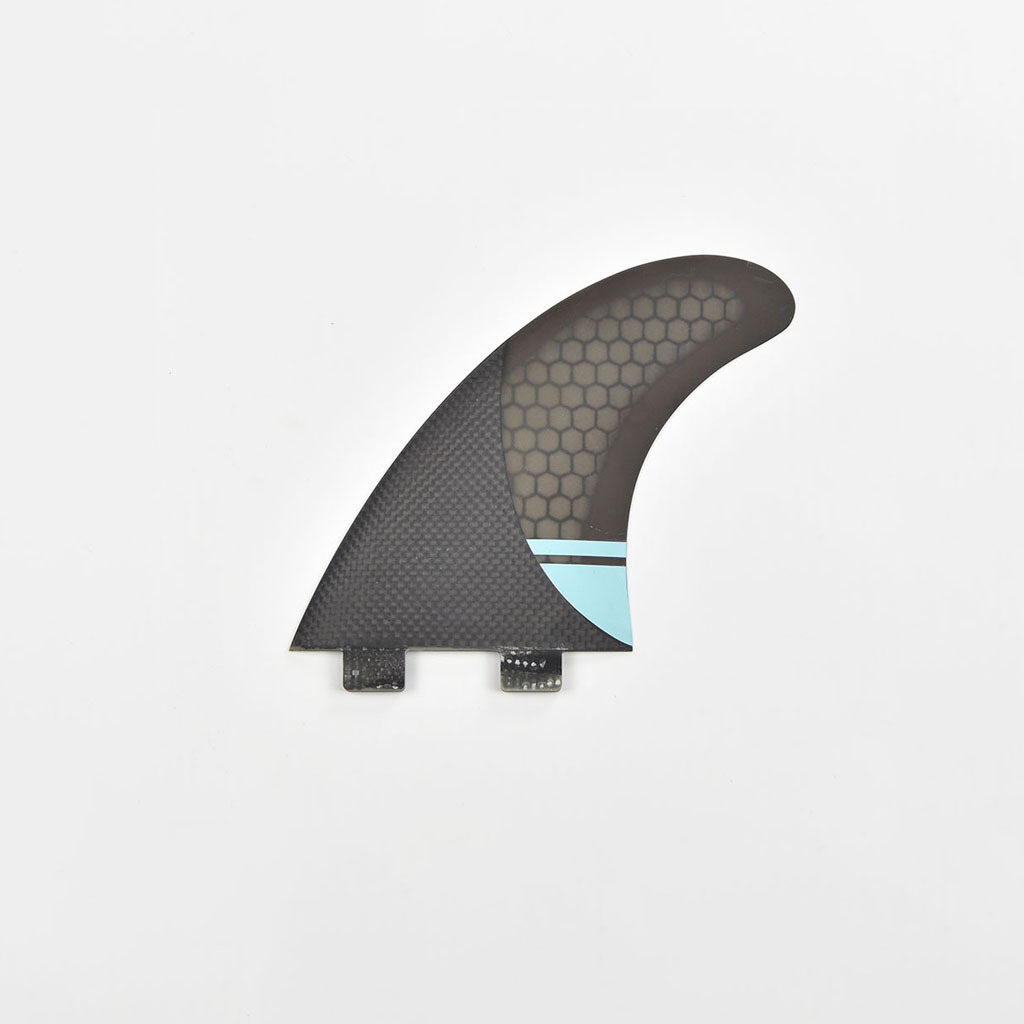
F25312 is the carbon build in CIMI's honeycomb surf fins line, shaped on a double tab base so it seats in a two-tab fin box. A shop pulls it when a customer breaks or loses a fin and wants to stay with the set-up the board was built around; a rental desk keeps a few sets on the shelf for exactly the same reason.
It feels light in the hand for its size and holds its shape under load instead of folding away, which is what makes it an everyday fin rather than a specialist one — it works across a spread of conditions rather than being tuned to a single kind of wave.
The full size run follows rider weight, and the same template is produced in single tab and box versions, so the three types of surfboard fins here cover boards that do not take a two-tab base. Board builders and surf board manufacturers buy it as a stock fin; shops and repair benches buy it as a replacement part that stays available season after season.
Material & Construction
- Honeycomb core. The centre of the fin is a hexagonal cell panel. It carries most of the volume while keeping weight down, which is why the fin feels light next to a solid glass layup of the same outline. - Glass fiber skins. Glass laminate bonds to both faces of the core and forms the outer surface, so the fin takes the knocks that come from boards knocking together in a surfboard rack or a van. - Epoxy resin. Resin transfer molding draws epoxy through the dry layup inside a closed mould. Resin content stays even from fin to fin, which matters when a reorder has to match the set already on the shelf. - Internal carbon framework. The carbon is laid as a frame that follows the template, so stiffness goes where that outline needs it rather than being spread evenly across the whole fin. - Carbon twill at the base. The woven carbon visible at the base reinforces the tab roots, the part that carries the most load where the fin meets the box. - Finished edges. Edges are smoothed and the base finished cleanly, so a set reads well next to other surfboard fins on a shelf and seats normally in the box.
Fin System Fit
- Look at the fin box first. A double tab box shows two short slots side by side, a single tab box shows one longer slot, and a longboard box is a single deep channel with a screw at the back.
- Match the box to the fin. This model is the double tab version, with two tabs at the base that drop into the two slots.
- Take the template and the size from the fin you are replacing, not from the board's model name, because the same board can ship with more than one fin set.
- If a board arrives bare, read the system off the shaper's spec sheet before ordering. The three types of surfboard fins in this line are not interchangeable in the same box.
- Order the same template in single tab or box form when a board in your range takes one of those systems, so a customer is not sent away over a small part.
- Keep one spare set per base type on the bench if you work on mixed boards. That is usually the difference between a same-day repair and a week's wait.
Size & Rider Weight
| Size | Rider weight |
| XS | Under 55 kg / 120 lb |
| S | 55-70 kg / 120-155 lb |
| M | 65-80 kg / 145-175 lb |
| L | 75-90 kg / 165-200 lb |
| XL | Over 85 kg / 190 lb |
| Sizing basis | Rider body weight |
| Neighbouring sizes | Bands overlap at the top and bottom |
Applications
Repair benches are the heaviest user of this fin. A snapped or lost fin is a same-day fix, and the double tab base is common on shortboards, so keeping XS to XL on hand covers most of what comes through the door. Rental and school fleets run fins hard and lose them often. On the counter side, surf board fins sell as an add-on and as a replacement part all season. A shop that shelves them beside the surf traction pad range catches the customer who is already buying something else. Board builders use them two ways: as the stock fin on a new model, and as a service part for boards already sold. A twin fin surfboard, a thruster or a five-box setup takes the same fin in different counts, so the buy list is a count per board as much as a size mix. After each session. Rinse the fins in fresh water and let them dry before they go back into a bag or under a cover. Salt and grit left sitting in the fin box is what wears the tab roots first, because every small movement of the fin grinds that grit against the base. Coil a surf leash separately in the same bag so the cord and rail saver are not pressing against the fin edges on the drive home. What wears first. The tab roots and the screw threads in the base carry the most load, followed by chips along the leading and trailing edges from boards knocking together in a shop rack or a van. Check those three places at the start of a season. A fin with a cracked tab root should be retired rather than refitted, since the tab is the part that holds the fin in the box. Heat and storage. Epoxy softens with heat, so keep these surfboard fins out of a closed car in the sun and out of a black bag left on the beach. Store them flat or on a rack rather than standing on the tips, and keep them clear of heavy tools in a parts drawer. Matching one replacement. Most orders for this model are a single unit rather than a full set. Match the outline and height against the fins still on the board, confirm the base is the double tab version, and compare the finish so the new fin sits comfortably beside the older ones. On a twin fin surfboard, matching the surviving fin is usually enough to bring the board back into service; on a thruster, look at both remaining fins for hairline cracks at the base before deciding that only one needs replacing. Keeping spares on hand. Hold one spare per size and base type that moves fastest at your counter, and write the size on the spare's bag so a staff member can grab it without opening every pack. Replacements go out the door far more often than full sets, and a shop that can match a customer's broken fin on the spot keeps the sale.
Specifications
| Product type | Surf fins, honeycomb carbon, double tab |
| Model | F25312 |
| Honeycomb core | 50% |
| Glass fiber | 20% |
| Epoxy resin | 20% |
| Carbon fiber | 10% |
| Core build | Honeycomb panel with internal carbon framework |
| Base | Double tab, carbon twill at the base |
| Fin systems available | Single tab, double tab, box |
| Molding | Resin transfer molding |
| Flex | More user-friendly flex pattern |
Related Accessories
- Surf leash. The Hypalon range runs from the 6 ft 6 mm leash for small to medium waves up to the 9 ft 8 mm longboard leash for bigger surf, so a fin order can leave with the leash the same customer needs.
- More fins. The honeycomb template also comes in single tab and double tab builds, and the surf board fins in this line extend to plastic and inkjet finishes, so one order covers several types of surfboard fins and fills a wall rather than a single peg.
- Surf traction pad. Tail pads, centre pads and waxless pads fit the same board as the fins and are usually bought on the same trip to the shop.
- Covers. Basic bags, regular bags and stretch covers protect the board the fins sit on, which makes a cover the natural add-on for a customer replacing hardware.
- Surfboard rack. Travel rax with tie-downs, storage racks, display racks and bike racks are what shops and rental operators use to hold stock, and a display rack is how a fin wall gets seen from the door.
Ordering & Confirmation
- Send a size and base-type breakdown per board in your range. Most adult volume sits in M and L, with XS and S covering juniors and smaller riders, and a twin fin surfboard takes two fins where a thruster takes three.
- Confirm the base types your boards take before the season is set. A double tab order for a range that also ships single tab boards leaves a gap on the shelf.
- Confirm packing and labelling specifications if the fins go on a peg rather than behind the counter.
- Ask your sales contact about sample availability and the current lead time for the size mix you need.
- Plan freight around the whole order rather than the surf fins alone. A carton of surf leash sets fills the same consignment, and so does a case of surf traction pad stock.
- Confirm payment terms, shipping details and the delivery address with your sales contact before the order is released.
- Ask whether display units ship with the order. A small surfboard rack or counter stand turns a carton of fins into a selling display.
- Check | What to look for | Why it matters --- | --- | --- Set contents | Ask your sales contact whether an order ships as single fins, pairs or three-fin sets, and whether grub screws and the plate are packed with each one | On many boards the screws and plate belong to the fin box, so what counts as complete depends on the box you are fitting Tabs and base | Tabs clean and square, no resin run or flashing, screw hole clear | A tab with flashing will not seat fully, and the fin will sit proud of the box Edges | Run a thumb along the leading and trailing edges; the finish should be even and free of chips | Edge chips are the first thing a customer sees on a peg Set match | Stand two fins from the same set side by side and compare outline and height | A mismatched pair reads as a second-grade set on the shelf Carton and count | Count each box of surf board fins against the packing list before the stock goes out, and check cartons for crush damage before signing | A mixed size order is easy to short-pick, and freight damage is far easier to claim at the door Pack labels | Confirm size and base labels on the packaging if the fins go on a peg rather than behind the counter | Shop staff need to read the size off the pack without opening it
Scale & Supply Capability
CIMI is a factory-based supplier with 16 years in surf and watersports hardgoods, manufacturing at our own facility rather than sourcing through traders. Chain stores, supermarkets and surf-brand stores buy from us because one supplier covers a full accessory assortment, so a season's order and its reorders can be planned together. We take on OEM and private-label work, adapting designs, colourways and branding to your programme, and we schedule production against your agreed range plan. Send us your buy list and target dates, and we will confirm what we can make and when.
FAQ
How does this compare with the glass honeycomb fins?
The template and the honeycomb core carry over between the two; the layup is what changes. The glass version runs a higher glass content, while this one trades part of that glass for carbon fiber and carries carbon through the base. In the water it reads as a fin that gives a little under load rather than staying hard all the way through a turn, which suits everyday surfers and mixed rental boards. Buyers who take both, including several surf board manufacturers we supply, use the pair to cover a range without changing anything else on the board.
Do grub screws and a plate come with the fins?
On most boards the grub screws and the plate belong to the fin box rather than to the fin itself, but what is packed with an order varies. Tell your sales contact which base you are fitting and ask what comes with each set, so the shop is not short of a screw when a customer is standing at the counter.
How should the fins be looked after between sessions?
Rinse them in fresh water after salt water use and let them dry before they go back into a bag or under a cover, because grit left in the box is what wears the tab roots first. Keep them out of a hot car and out of a closed bag in direct sun, since epoxy softens with heat. If a surf leash goes into the same bag, coil it separately so the cord and rail saver are not pressing against the fin edges.
Can I replace just one fin from a set?
Yes, if the template and the size match. Match the outline and height of the fins still on the board against the one you are ordering, and check the remaining fins for damage before you commit. On a twin fin surfboard, matching the surviving fin is enough to bring the board back into service; on a thruster, look at both remaining fins first, because a mixed set will feel uneven underfoot.
What should I check when a fin order arrives?
Start with the base: the tabs should be clean and square, with no resin run or flashing that would stop a fin seating in the box. Then look along the leading and trailing edges for an even finish, and put two fins from the same set side by side to confirm the outlines match. Count each box of surf board fins against the packing list before the stock goes on the shelf, since a mixed size order is easy to short-pick at the counter.