Product Overview
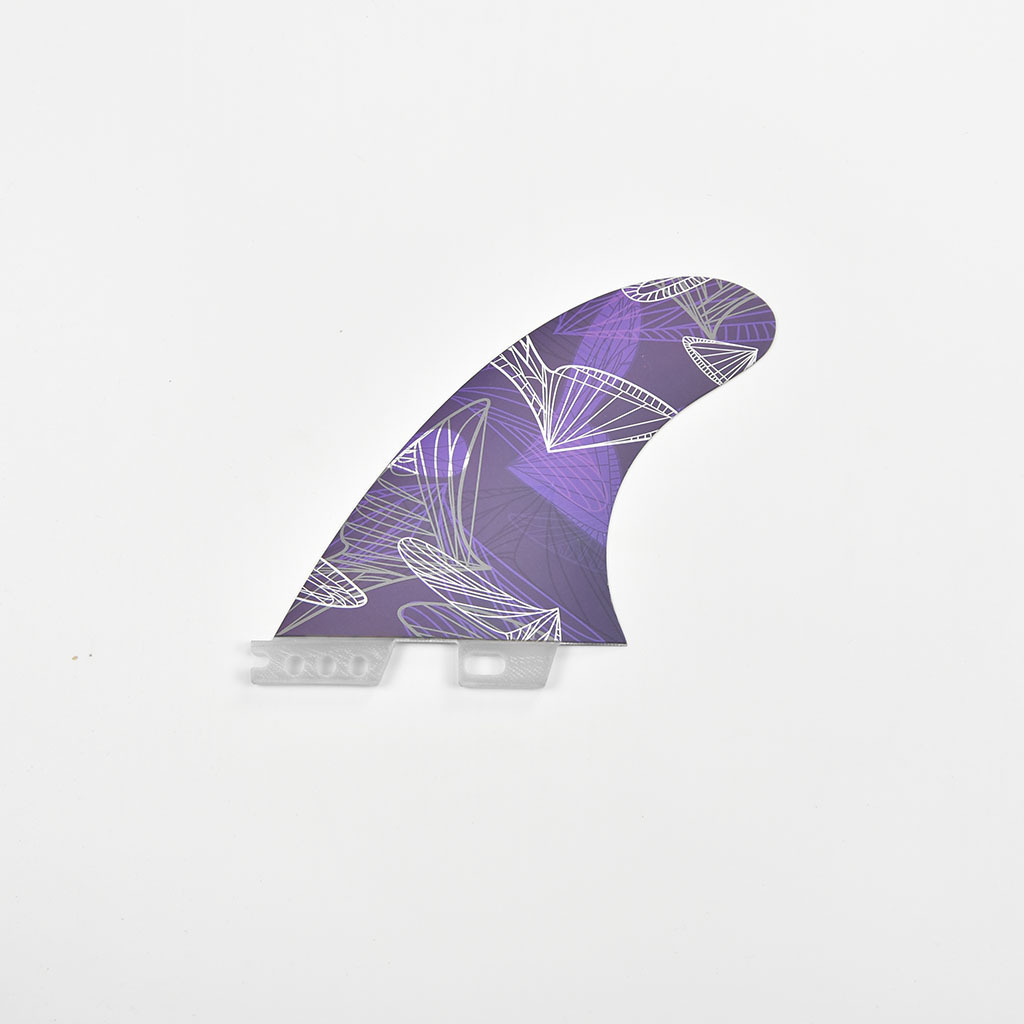
A honeycomb fin on a two-tab base, built for the wall of a surf shop rather than for one rider's private quiver. It is the fin that replaces a worn or snapped one on a board already in the water, and the one a shop fits to a new board before it goes on the surfboard rack. That is the audience: surf shops, schools and rental operators restocking, and surf board manufacturers and chain accounts building a fin line. The board does not have to be special.
Material & Build
The core is why the fin feels light: it is a thin cellular sheet rather than a solid slab, and it holds the glass skins apart so the fin keeps its section instead of collapsing under load. The glass carries the structural work and the epoxy bonds the assembly and seals it against water. Molding runs by resin transfer: dry glass and core go into a closed tool, resin is drawn in, and the part cures to the shape of the mold. The practical difference for a buyer is repeatability. Resin content is set by the tooling rather than by how heavily a laminator worked the cloth that morning, so a reorder lands close to the sample you approved — the same weight in the hand, the same outline, the same feel underfoot. Board builders and surf board manufacturers fitting these as original equipment get that consistency without inspecting every unit. Across the types of surf fins in the range, honeycomb sits in the middle: lighter than a solid glass layup and simpler to build than a carbon-skinned version, while still taking a clean, glossy surface. This one carries a patterned graphic over the gloss with a clear base around the tabs, so the mounting area reads as part of the molding rather than a block glued on afterwards.
Fin System Fit
- Three base types. Across the types of surf fins we produce, the base decides whether a fin fits: single tab, double tab or box fin. Everything else about the fin is secondary until that is settled.
- Double tab — this listing. Two short tabs at the base drop into a double tab box, the set-up used on most modern shortboards.
- Single tab. One long tab, for boards built around single tab boxes. The same honeycomb core and layup is molded in this base.
- Box fin. A deeper base that seats in a through-box, the arrangement longboards and mid-lengths usually use for a centre fin.
- Identify from the old fin. Pull the fin you are replacing and look at the base: two tabs means double tab, one long tab means single tab, a deep blade-shaped base means box.
- Match the slot, not the brand. The shape of the box is what matters. A box fin will not seat in a double tab box, and two tabs will not hold in a through-box, so a buyer fitting a mixed board range should order surfboard fins by base rather than by template.
Size Guide by Rider Weight
Fin size is chosen by rider weight, not by board length. XS covers riders under 55 kg (120 lbs), S covers 55–70 kg (120–155 lbs), M covers 65–80 kg (145–175 lbs), L covers 75–90 kg (165–200 lbs), and XL covers anyone over 85 kg (190 lbs). The bands overlap on purpose: a 68 kg rider is legitimately inside both S and M, and either can be right.
That overlap is where the judgment sits. Take the smaller fin for a looser, quicker-turning feel in small surf and for lighter surfers with lower force output; take the larger one when the rider wants drive in bigger or faster waves, or carries more power than their weight suggests. Board length, and where the fin sits in the box, shift the answer again, so treat the chart as the starting point and the rider's own feedback as the tie-breaker.
For a shop, the stocking logic is simple: keep the middle of the range deepest, hold a few XS for groms and smaller riders, and a few XL for the heaviest customers. That is how we help buyers sizing fins for surfboard ranges that have to cover a whole market rather than one rider.
Conditions & Board Pairing
- Small, soft beach break. The neutral template keeps the board predictable when there is not much push behind it, so a lighter rider is not fighting the fin in weak surf.
- Reef and point with some length. More water moving means more to push against, which is where a light, stiff honeycomb build feels cleanest through a turn.
- Rental and school fleets. These are the surf fins that get checked out, ridden hard and put back wet; a repeatable build means the tenth replacement feels like the first.
- Fleet wear. In a school quiver the surf traction pad and the fin wear on the same cycle, so standardising both shortens the repair list and the reorder list at the same time.
- Travel quivers. One model across several boards keeps the bag light and the ride familiar when conditions change from day to day.
- Board builders and surf board manufacturers. Fitting a standard honeycomb fin as original equipment gives a new board a known feel straight off the rack, without a custom fin programme behind it.
Handling & Care
Check the tabs before every session. A fin that has worked its screw loose will rattle in the box, and a rattling fin is a fin about to crack a tab. Seat it firmly, tighten by hand and re-check after the first hour in the water.
Rinse the fin with fresh water after salt water and let it dry before it goes back in a bag; a surf leash left to dry with salt on the fittings is the same problem in a different shape. Keep the fin out of long spells of hard heat — a car dashboard in summer is the usual way an otherwise sound fin ends up with a soft edge. After a solid impact, look over the base and the tab roots for hairline cracks; that is the early warning, and it is a low-cost fix compared with a fin that fails mid-session.
Between trips, store boards on a surfboard rack rather than leaning them against a wall, where the fin takes the weight and the tip takes the knocks. For travel, take the fins out of the board and wrap them separately.
Specifications
| Product type | Surfboard fins, double tab base |
| Model | F00164 |
| Construction | Resin transfer molding (RTM) |
| Core | Honeycomb |
| Composition | 50% honeycomb core, 30% glass fiber, 20% epoxy resin |
| Fin system | Double tab; the same build is also made in single tab and box fin |
| Size range | XS, S, M, L, XL — matched to rider weight |
| Mounting | Two tabs at the base |
| Outline | Swept-back template |
| Surface | Glossy patterned finish |
Accessory Range
- Leash. A surf leash in Hypalon runs from 6 ft to 9 ft in the range, matched to board length and wave size — the ankle strap and rail saver are the parts that wear first, so match the length to the board rather than reaching for the longest one. - Fins. Beyond this double tab model, the honeycomb line is molded in single tab and box fin, plus carbon and timber versions, so a shop can cover the fins for surfboard set-ups that come through the door on more than one base. - Traction. Tail pads, centre pads and full-deck formats: a surf traction pad gives the back foot something to lock into, and on a shop wall pads and fins sell to the same customer. - Covers. A day bag or stretch cover keeps sun and wax off the deck between sessions and takes the knocks in the back of a van. - Racks. Storage, display and travel racks, including a wall-mounted surfboard rack for a shop floor or a garage.
Ordering & Delivery
- Confirm the base. Tell us which system the board uses — double tab, single tab or box fin — and we match the base before the order is built. This is the one detail that spoils an otherwise good order.
- Confirm the size mix. Send the rider weights your market covers and we will suggest how to split the order across XS to XL, the same way we plan surfboard fins for a multi-store chain's size run.
- Confirm the finish against a physical sample. Ask your sales contact about a production sample and check the surface, the graphic and the tab area against it before you commit to a bulk run.
- Confirm packaging requirements. Hang tag, barcode, size marking and carton configuration are set per customer; send the specification you need and production is built to it.
- Confirm quantities, lead time and payment terms with your sales contact. These are agreed per order and per market rather than fixed by the catalogue.
- Confirm mixed programmes. If the order also includes a surf traction pad line, list it with the fins so the whole shipment can be planned and packed as one programme.
- Plan the reorder. Shops that come back within a season get the same base, size and finish by keeping the original order reference; add a surf leash or cover line to the same programme and it ships on the same schedule.
Scale & Supply Capability
CIMI is a factory-based supplier with 16 years in surf and watersports hardgoods, manufacturing at our own facility rather than sourcing through traders. Chain stores, supermarkets and surf-brand stores buy from us because one supplier covers a full accessory assortment, so a season's order and its reorders can be planned together. We take on OEM and private-label work, adapting designs, colourways and branding to your programme, and we schedule production against your agreed range plan. Send us your buy list and target dates, and we will confirm what we can make and when.
FAQ
Can I run these fins as a thruster, quad or twin?
Yes — fins mount one per box, so the board decides the set-up: three boxes is a thruster, four is a quad, two is a twin. A double tab fin works in any of those positions as long as the box itself is a double tab box. For stock, most shops buy individual fins and let the customer build the set-up on the board rather than holding pre-matched sets.
What is the difference between this honeycomb fin and the carbon honeycomb version?
Same honeycomb core and the same closed-mold process. The carbon version adds carbon fiber to the layup for a livelier, more user-friendly flex, which suits riders chasing a faster feel underfoot. Across the types of surf fins in our range, the plain honeycomb build is the all-round one and covers the widest spread of conditions, which is why it is usually the model we point a shop to first when the wall needs one dependable fin.
Can a chipped or cracked fin be repaired?
A small chip on the trailing edge or the tip can usually be filled and sanded by any workshop that repairs surfboards and surf fins, and the fin stays usable. Cracks at the tab root or a split along the base are different — replace the fin rather than riding it, because that is where a failure starts.
What should I check when a fin shipment arrives?
Check the base first: the tabs should be clean and square with no cracks at the root, and the fin should sit in a box without rocking. Then compare the graphic and the gloss against your approved sample, and confirm the size markings on the packaging match the size run you ordered before the cartons go into stock.
Will these work on a mid-length or a longboard?
On the sides of a 2+1 set-up, yes. A pair of double tab fins either side of a box centre fin is how most mid-lengths are set up, and it is the arrangement most customers buying fins for surfboard set-ups of this length ask for. As the centre fin of a longboard you need the box fin version of the same build instead, because that position takes a through-box.