Product Overview
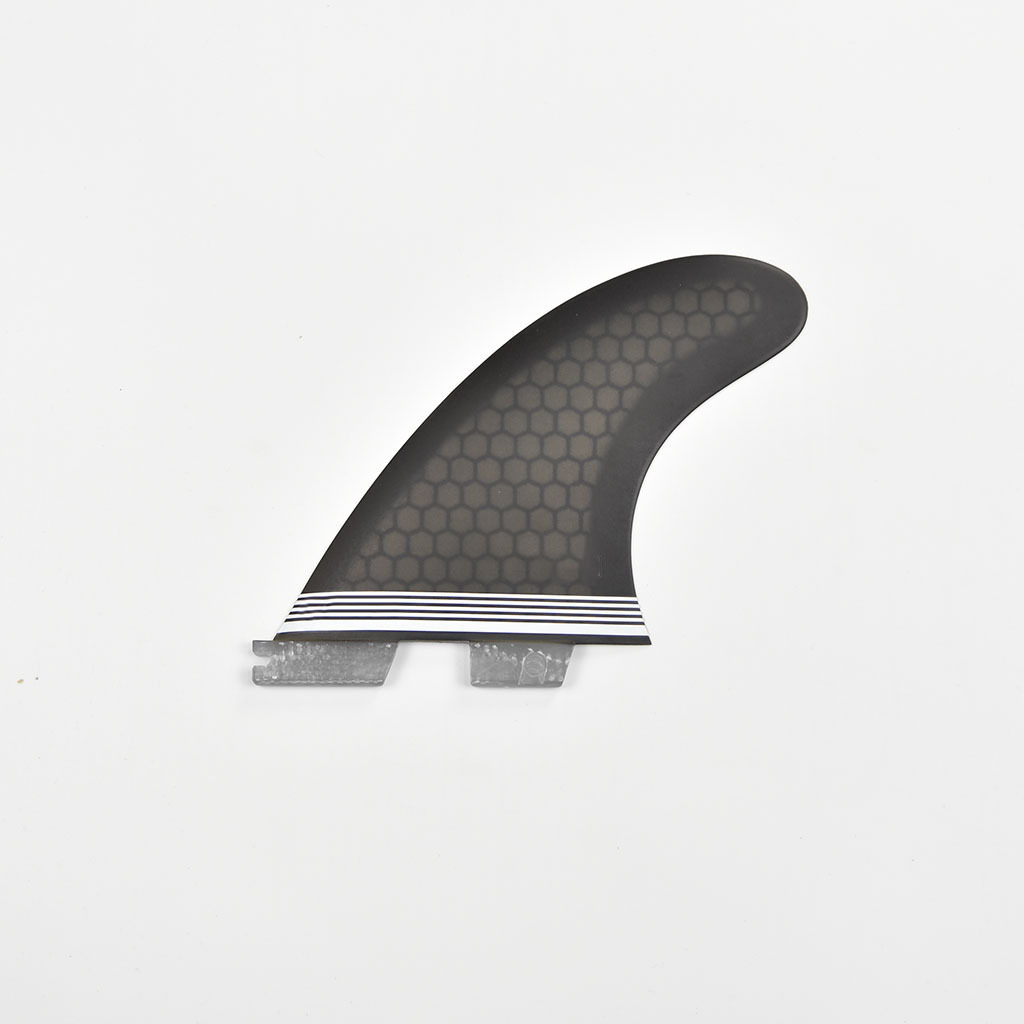
CIMI's honeycomb double tab fin is an everyday fin: light in the hand, moulded in a closed tool rather than cut from a panel, and shaped to work across the conditions most surfers actually get. It is what a dealer reaches for when a customer needs a replacement before the weekend, and what a board builder fits when the brief is a good all-round shortboard. As a surf fins option it stays predictable — the kind of fin a rider puts in and forgets about while they work on the rest of their surfing.
The build is a honeycomb core wrapped in glass and epoxy. Two tabs at the base drop into a double tab box and a single screw locks the fin in place, so swapping one out takes a key and a few seconds. Wholesale accounts, surf schools and the surf board manufacturers we supply order it as replacement stock, as the fin that ships with a new board, or as both.
Material & Build
- Honeycomb core — The centre of the fin is a honeycomb cell structure rather than solid laminate. It carries the template's shape while keeping the finished fin light, and it is why the cell pattern is visible through the skin.
- Glass fiber laminate — Glass wraps the core and gives the fin its structure: enough stiffness for the tip to hold under load, without the dead feel of a solid layup.
- Epoxy resin — Epoxy bonds core and laminate and seals the glass against the water it spends its life in. It is also what gives the fin its gloss.
- Resin transfer molding — Resin is drawn into a closed mould around the core instead of being hand laid. The surfboard fins that come out hold a repeatable resin-to-fibre ratio, with fewer dry patches and a clean surface straight from the tool.
- Light underfoot — A lighter fin changes how a board feels. This one keeps the tail lively in small surf and does not weigh down a board that is already carrying volume.
- White base band — A striped band runs along the base where the tabs are moulded in, and the gloss carries down to meet it.
- Repeat-order consistency — Closed-mould production holds the template, but gloss level and how strongly the honeycomb reads can shift slightly between tools. Approve a reference unit and we match production to it, so shops and the surf board manufacturers we supply can fit the same fin across a board range and have each batch look like the one before.
- Fins on a surfboard take more punishment than they look like they should: board bags, car boots, sand and reef. A few habits keep this one working. Rinse salt water off after a session, especially around the tabs, where salt and grit collect and make the screw stiff to turn. Dry the fin before it goes back in the bag. Heat is the bigger risk. A car parked in the sun will soften an epoxy fin over time, and a fin left leaning against a wall under load can take a set. Keep the board on a surfboard rack or in a bag rather than standing it on its tail in a hot car. Check the tabs before every session. A fin that has taken a hit can crack around the base without failing visibly, and a surfboard fin that lets go mid-turn means a long swim in. If a tab is cracked or the trailing edge is ragged, retire it. Replace the screw if the head rounds off, and keep a spare key in the glovebox.
Fin Systems & Board Fit
Fins on a surfboard are held by whatever box system the board was built with, and it is worth checking yours before you order. This one uses the double tab system: two rectangular tabs on the base slide into two slots in the box, and a single screw through the rear tab clamps it down. Look at the tail of the board — if you see two slots side by side with a screw plate between them, this is the fit, and no adapter is involved.
The three types of surfboard fins fixing we mould are single tab, double tab and box fin, and this product covers the double tab version. The same honeycomb build is produced in the other two, so a board with a single tab box or a longboard-style single box can still be fitted with the same core and laminate. If you are ordering for a shop, check the system split across the boards you actually sell before committing to a quantity; the mix is usually what causes trouble later, not the fin itself.
Rider Weight Sizing
- XS — under 55 kg / 120 lb — Junior riders and lighter adults on small, soft waves. A smaller fin keeps the package proportional to the board and stops a light surfer being over-finned.
- S — 55 to 70 kg / 120 to 155 lb — The band most shops sell through for average-weight adults on a shortboard, and a sensible first replacement.
- M — 65 to 80 kg / 145 to 175 lb — The overlap band. At around 70 kg you can ride S or M; take the larger fin if you ride with more force, surf bigger waves, or ride a low-volume board.
- L — 75 to 90 kg / 165 to 200 lb — Heavier surfers, and anyone on a board that needs more drive out of the tail.
- XL — over 85 kg / 190 lb — The top of the range, with overlap into L for surfers sitting between 85 and 90 kg.
- Weigh yourself as you surf — Wetsuit, booties and a full session add weight that matters. If you sit between two bands, use your dressed weight rather than your morning weight.
- Sizing follows the rider, not the board — Take the band that matches your weight. A surfboard fin does not need re-sizing for board length, only for how much drive the tail needs.
- Board and conditions move you within a band — A heavier surfer on a low-volume twin fin surfboard usually prefers the larger of two sizes, while a light surfer on a longboard can drop down.
- Planning a run for a shop or school — S, M and L cover most adult riders; size XS and XL to your local market rather than to a formula.
Commercial & Fleet Use
Shops use this fin two ways. On the wall it is the replacement surf fins option for a customer who has lost or damaged a fin and wants the board back in the water this week; behind the counter it is the fin that, with a surf leash and other accessories, turns a board sale into a complete setup. Keeping a size run means you fit the customer in front of you instead of ordering the part in. Board builders fit it during assembly. Each surfboard fins order can be split by size, so the fin that ships with a lighter rider's board is not the one that goes out with a heavier rider's board. That matching is the detail buyers notice first, and it is why a spread of sizes beats one bulk quantity. Surf schools and rental operators get the most out of it because the fin is quick to swap and easy to replace. A school running a mixed fleet — thrusters, quads, the odd twin fin surfboard — can standardise on one honeycomb fin per size and stop hunting for odd parts at the start of the season. Replenishment is simpler when the whole kit comes from one supplier.
Specifications
| Product code | F25204 |
| Construction | Resin transfer molded in a closed mould |
| Core | Honeycomb, 50% of the build |
| Reinforcement | Glass fiber, 30% |
| Resin | Epoxy, 20% |
| Base | Double tab, one screw |
| Sizes | XS, S, M, L, XL |
| Other bases in the family | Single tab and box fin |
| Finish | Gloss, honeycomb visible through the skin |
| Typical supply | Replacement stock and new-board assembly |
Matching Accessories
- Fins — Beyond this template, the honeycomb surf fins family covers single tab and box fin bases, plus carbon and timber finishes, so a range can stay on one core and still offer a choice.
- Leash — Hypalon ankle leashes in 6 ft 6 mm, 7 ft 7 mm, 8 ft 7 mm and 9 ft 8 mm. Match the surf leash to the board and the day: the 6 ft for small to medium waves, the 7 ft for all-round conditions, the 8 ft when you want a stronger build, and the 9 ft for a longer board or medium to large surf.
- Traction — Tail pads, centre pads, skimboard pads and waxless pads, so a board can leave the shop with grip that matches the fin it is fitted with.
- Cover — Basic bags, regular bags, stretch covers and bodyboard bags for storage, travel and shop stock.
- Rack — Travel rax and tie-downs, storage racks, display racks and bike racks. A surfboard rack keeps boards off the workshop floor and turns wall space into display space.
Ordering & Confirmation
- Confirm the system before anything else. Double tab, single tab and box fin are the three types of surfboard fins we mould, and an order placed on the wrong one cannot be corrected at the packing stage.
- Give the size mix, not just a total. XS through XL come from separate tools, so tell us how many of each you want, or ask us to suggest a split for your market.
- Say what the fin is for — replacement stock, new-board assembly or a school fleet — so we can advise on the mix and on packing.
- Tell us how you want it packed and labelled. Bulk, poly bag or hanger are the usual routes; we will confirm what is available for this fin and what it changes.
- Book the delivery against your season and confirm the lead time in writing. The earlier the mix is fixed, the easier it is to hold a date.
- Consolidate where you can. Pads, covers and a surfboard rack can travel on the same order as the fins, which means one delivery to check in and one set of paperwork.
- Add a surf leash to the same list if your season needs it; matching leash length to the boards you sell is easier when both sit on one order.
- For surf board manufacturers running a private-label programme, send artwork and the reference unit together so branding and tooling are approved at the same time.
- Ask your sales contact about sample availability, current lead time and the payment terms that apply to your order — those move with the size mix and the season.
Scale & Supply Capability
CIMI is a factory-based supplier with 16 years in surf and watersports hardgoods, manufacturing at our own facility rather than sourcing through traders. Chain stores, supermarkets and surf-brand stores buy from us because one supplier covers a full accessory assortment, so a season's order and its reorders can be planned together. We take on OEM and private-label work, adapting designs, colourways and branding to your programme, and we schedule production against your agreed range plan. Send us your buy list and target dates, and we will confirm what we can make and when.
FAQ
Will this fin fit my board?
It fits boards built with the double tab system: two slots in the box and one screw through the rear tab. Look at the tail — if the box has two side-by-side slots with a screw plate between them, these surfboard fins drop straight in.
If the board takes a different fixing, the same honeycomb build is moulded in the other types of surfboard fins fittings we produce, single tab and box fin, so you are not stuck for a match.
How do I choose between the sizes?
Choose by rider weight, not board length. The bands run from XS for lighter juniors up to XL for heavier adults, and neighbouring bands overlap on purpose — if your weight sits in the overlap, take the larger fin when you surf high-energy waves or ride a low-volume board, and the smaller one when you are on a longer, fuller board. A rider moving off a twin fin surfboard usually wants the larger of two sizes because the tail carries more of the drive.
What does the honeycomb core change about the ride?
It takes weight out of the middle of the fin and leaves the glass and epoxy to carry the structure. In the water that reads as a fin that feels quick and neutral and works across a range of conditions rather than in one narrow window. How stiff it feels to you also depends on the board, the size you ride and the wave — if flex is the deciding factor, handle a unit before you commit to a bulk run.
Do I need special tools to fit or remove it?
A fin key or a small flat driver is enough. Loosen the screw, slide the fin back out of the box, seat the replacement fully and then tighten. Do not overtighten — the screw only has to hold the tab, and a crushed tab is harder to get out next time. After fitting, check the fins on a surfboard sit flush: the base should meet the box with no gap at the front of the tab.
How should I look after the fin?
Rinse it in fresh water after surfing, dry it before it goes back in the bag, and keep it out of a hot car. Check the tabs and the trailing edge every few sessions — a surfboard fin that has taken a hit can crack at the base without looking damaged from the deck. If the screw stiffens up, take it out, rinse the thread and put it back with a little grease.
How does this compare with the carbon honeycomb version?
This is the base honeycomb build: honeycomb core, glass laminate and epoxy. The carbon version in the same range adds carbon fibre to the laminate and a carbon framework formed to its own template, which gives it a different flex feel. If you are choosing between the two for a board range, tell us the boards and the conditions you sell into and we will point you at the one that suits.