Product Overview
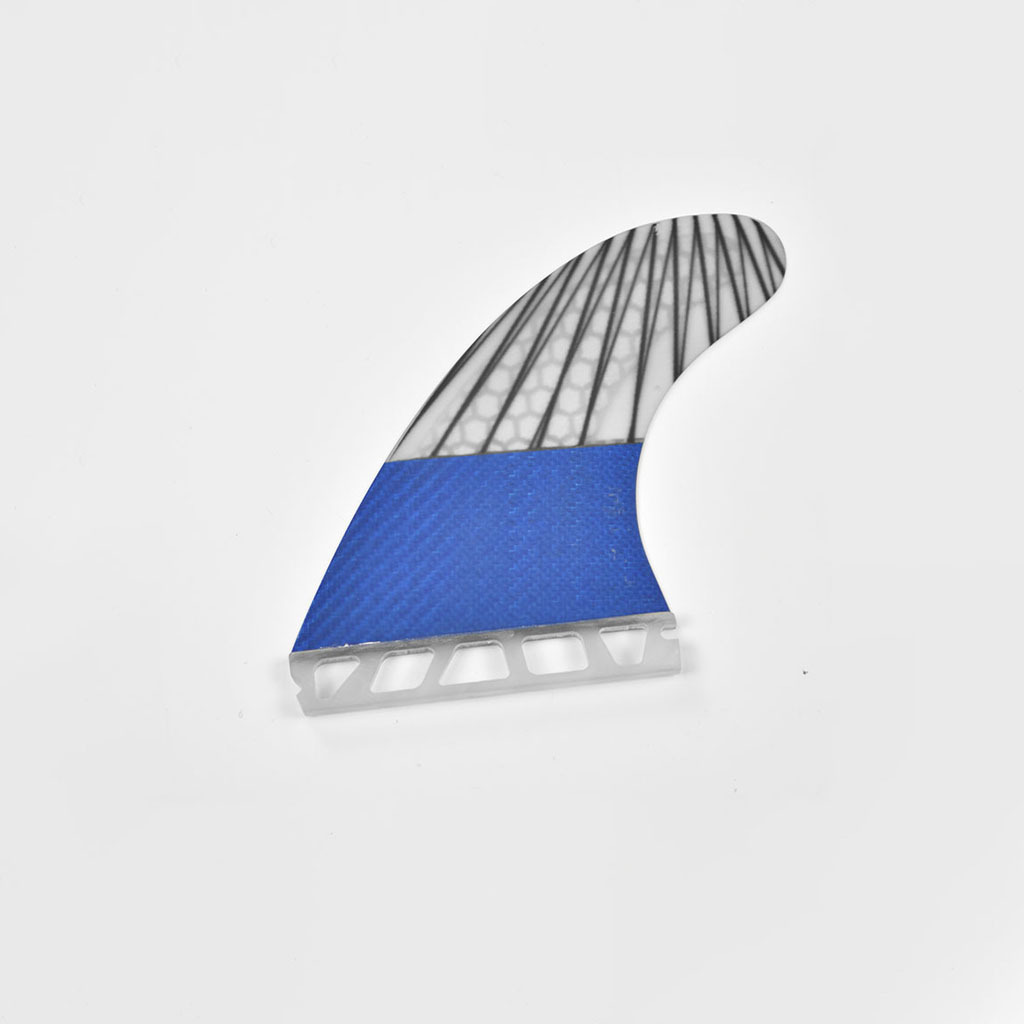
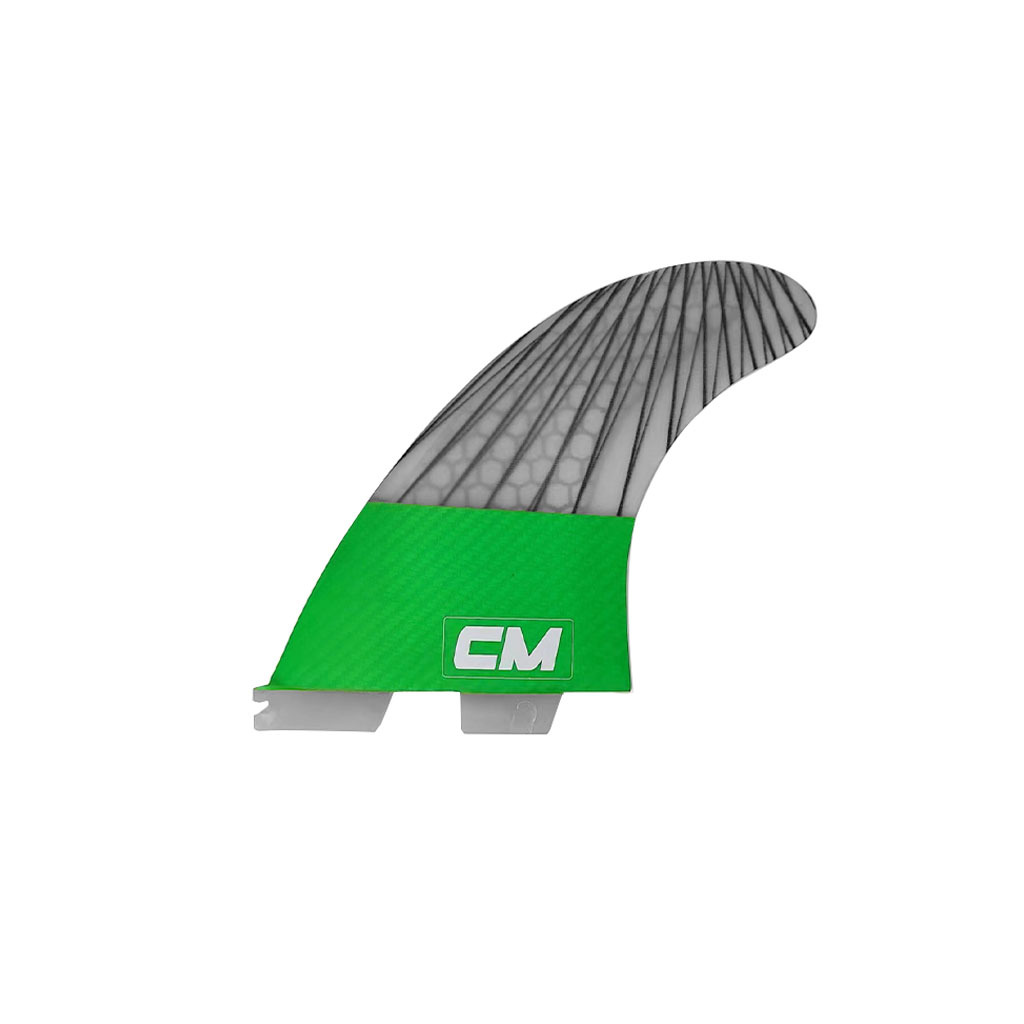
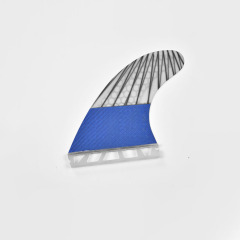
The single tab version of our carbon-framed honeycomb fin is built for riders who want a quicker, more connected feel from the tail without stepping up to a dead-stiff layup. Shops buy it as part of a range of wholesale surf fins that covers every size band and all three mounting systems, so a customer's weight and board can be matched at the counter instead of ordered in specially. Board builders fit it to finished shortboards and step-ups, and rental fleets treat it as the replacement that goes straight back in the board when a fin is lost or snapped. In the water it behaves like a fin with more life in it than a plain glass set. Direction changes feel crisp because the fin has already returned to shape by the time the next turn starts, and it stays forgiving enough that a heavier surfer can lean on the tail without the fin feeling like it is fighting back. Everyday handling is simple.
Construction & Moulding
- Resin transfer moulding. As a surf fin manufacturer we close the layup in a tool and draw resin through it under vacuum, so resin content stays even from tip to base instead of pooling at the root. An even cure is what keeps the flex predictable across a production run.
- Honeycomb core. The core fills most of the fin's volume, which keeps mass low where it is felt most, high in the tip. Less weight out there is what lets the frame snap the fin back to shape when it unloads.
- Glass and epoxy skin. Glass carries the load across the core and the epoxy bonds the stack into one piece, giving a fin that takes knocks at the base without turning brittle.
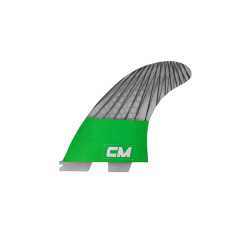
- Carbon twill over the base. On carbon fiber surf fins the twill wraps the root, right where the fin meets the box. That area takes the screw pressure and the scrape of sand and reef, so it is where the extra material earns its place.
- Hand finishing. Every set of fins for surfboard use is finished at the tab and checked for a flat, clean seat before packing, so the fin sits in the box without rocking.
- Controlled batches. As a honeycomb surf fin supplier we keep the core, the twill and the cure in-house, so the set you reorder is moulded to the same outline and the same flex as the set you first stocked.
- What the build is not. The carbon is a frame and a base reinforcement, not a full carbon shell. That is deliberate — a full carbon skin would make this template harsher than it is meant to feel.
Single Tab Fitment
- Look at the box before anything else. A single tab fin sits in a routed single-tab box with one central slot. Two short slots side by side take a double tab fin, and a long through-box takes a box fin. Checking the slots first is the quickest way to sort fins for surfboard repairs, replacements and new builds.
- Set the position with the screw loose. Slide the fin fore and aft in the slot; further forward loosens the tail and turns quicker, further back settles it for drive down the line.
- Seat the plate and tighten by hand. Snug the screw until the plate grips the base, then stop. Over-tightening distorts the base and is the usual reason a tab cracks.
- Check that the base sits flush. The bottom of the fin should meet the box with no rocking. If it rocks, clean the grit out of the box and off the tab and refit.
- Take the right base for the board. Single tab, double tab and box fin are the three types of surf fins we mould in this build, so the same template can go on almost any board in a shop's range.
- Keep both tab styles on the wall. Most customers arrive knowing only that their board has one slot or two, and handing them the right base is what closes the sale. Shops that order wholesale surf fins from us usually take the single tab and double tab versions of the same template together.
- One seat across the range. These honeycomb surf fins share the same single-tab seat as the other honeycomb templates we mould, so a rider replacing a lost fin already knows how it fits.
Size & Rider Weight
| Size | Rider weight | Suits |
| XS | Under 55 kg / 120 lbs | Juniors and very light adults |
| S | 55-70 kg / 120-155 lbs | Lighter adults and smaller boards |
| M | 65-80 kg / 145-175 lbs | The middle of most shop size runs |
| L | 75-90 kg / 165-200 lbs | Heavier surfers and longer boards |
| XL | Over 85 kg / 190 lbs | Large surfers, step-ups and longboards |
Flex & Ride Character
- The frame follows the template. As a honeycomb surf fin supplier we cut the carbon spine to suit the outline it sits in rather than using one universal frame across the range, so a wide-based template gets a frame that fills its area and a narrower one gets a lighter spine. That match is the reason this fin and the next template in the range do not feel the same.
- Springback rather than fold. The fin loads progressively through a turn and returns as the board releases. A very stiff fin holds its shape and lets go in one hard step; this one hands the tail a smoother exit from the arc.
- Drive out of the turn. Because the fin comes back to shape quickly, what a surfer puts into the tail comes back as the board comes off the bottom. It suits a rider who turns off the back foot and wants the board to keep running between turns.
- Hold under load. In a hard bottom turn the spine keeps the tip from washing out, so the fin stays predictable at the exact moment the board is most loaded.
- Against plain honeycomb surf fins. The standard honeycomb template is softer through the middle of a turn; the carbon frame tightens that section up. It is the difference a rider notices on the first wave, and the reason both types of surf fins stay in the range.
- Everyday conditions. These carbon fiber surf fins are not a specialist big-wave set. They work in the waist- to head-high surf where most sessions happen and stay comfortable when the wind picks up and the face turns choppy.
- Across a quiver. The template carries its feel from a shortboard to a step-up, which makes it one of the more versatile fins for surfboard use that a shop can stock — a customer does not have to change fin when the board gets longer.
Use & Care
Salt water is not what damages a fin; heat, weight and grit are. Rinse the fin in fresh water after a session, dry it before it goes back in the board, and keep the set in a cover or on a rack rather than loose in the back of a car, where fins sit in the sun and end up under everything else in the boot.
Travelling with surfboard fins is the other place they get hurt. Pack a set flat and separated, never let a board press on an unprotected fin inside a cover, and check the base before the first surf of a trip rather than after the first ding.
Spare sets belong somewhere cool and dry, out of direct sun, with the plate and screw kept alongside them so a replacement does not mean hunting for hardware at the beach.
Specifications
| Property | Value |
|---|
| Honeycomb core | 50% |
| Glass fiber | 20% |
| Epoxy resin | 20% |
| Carbon fiber | 10% |
| Moulding process | Resin transfer moulding |
| Fin system | Single tab |
| Base | Carbon twill over the base |
| Frame | Carbon framework matched to the template |
| Flex character | Progressive load, quick springback |
| Sizes | XS, S, M, L, XL |
| Product code | F25323 |
Private Label & Bulk Supply
Putting your own name on the fin begins with the outline, not the artwork. This template and the rest of the honeycomb range are moulded on our own tooling, so a house-brand line means your branding on a shape that already exists rather than a new shape built from scratch. Send the mark you want to use and tell us which templates in the range it should go on, and our team will confirm where it can sit on the fin and how it will be applied. Branding does not have to stop at the fin. Packaging belongs in the same conversation: how the sets are packed, what is printed on the sleeve or header card, and how the size and the mounting system are marked so a customer can pick the right one off a peg unaided. Tell us the format you sell in — a single fin or a set of three, hanging or boxed — and we will confirm what we can produce for your programme. The build itself stays ours. That coverage is usually the reason a multi-store buyer asks about a house brand in the first place: a fin carrying their own label, in every size and system the boards on their floor need. Two points worth settling early. A house-brand line is not a custom fin — the outline, the foil and the frame are the ones already in the range, and a shop that wants a shape of its own is a separate project with its own tooling. And the mark is yours to supply: send the artwork together with confirmation that you hold the rights to it, and we produce to that. Reorders under your own label come off the same tooling, so the second run matches the first set of surfboard fins you stocked.
Ordering & Accessories
- Start with the fin. As a surf fin manufacturer we cut the same template across all three, so one outline can cover every board on the floor.
- Build the size run. The five sizes are normally taken as a mix rather than a single size: middle sizes turn fastest, and one or two XS and XL sets keep the ends covered. That is how most fins for the surfboard trade leave us, a spread of sizes against one template and topped up on the reorder.
- Add leashes. Shops that buy wholesale surf fins from us usually put the leashes on the same order, because the leash has to match the board the fin goes on. Hypalon leashes run from 6 ft 6 mm for small to medium waves up to 9 ft 8 mm for longboards and bigger surf.
- Add traction. Tail pads and centre pads are the two shapes most shops keep beside the fins; a waxless pad covers the customer who does not want to wax at all.
- Add covers. Basic bags, regular bags, stretch covers and bodyboard bags give a customer a way to protect the board and the surfboard fins on the way home.
- Add racks. Travel rax with tie-downs, storage racks, display racks and bike racks handle the display and transport end of the same wall.
- Send the list for confirmation. Tell us the systems, the size mix and the accessory lines you need, then ask your sales contact to confirm packing, current lead time and shipping terms for your destination, and about sample availability if you want to check the finish before committing. If you are building a whole wall around one honeycomb surf fin supplier, the leashes, pads, covers and racks can be planned in the same conversation.
Scale & Supply Capability
CIMI is a factory-based supplier with 16 years in surf and watersports hardgoods, manufacturing at our own facility rather than sourcing through traders. Chain stores, supermarkets and surf-brand stores buy from us because one supplier covers a full accessory assortment, so a season's order and its reorders can be planned together. We take on OEM and private-label work, adapting designs, colourways and branding to your programme, and we schedule production against your agreed range plan. Send us your buy list and target dates, and we will confirm what we can make and when.
FAQ
Can the fins carry our shop's logo?
Yes — private-label work is part of what we do. As a surf fin manufacturer we keep moulding, finishing and packing in-house, so branding can be carried on the product and on the packaging as part of a production run. Send the artwork, the template you want to use and the sizes in your range, and our team will confirm what is possible on this fin.
Is the carbon version harder to ride than a plain fin?
Not in ordinary surf. The frame is there to bring the fin back to shape, not to lock it in place, so carbon fiber surf fins in this build still flex under a lighter load. The extra firmness shows up when a rider pushes hard, which is why stronger surfers feel the response sooner while a lighter or newer surfer keeps the forgiveness.
Which fin system does this fit?
This is the single tab version, so it fits a board with a routed single-tab box and a plate-and-screw fixing. Single tab, double tab and box fin are the main types of surf fins used on production boards, and this template is moulded in all three. Check the slots on the board before ordering, because the systems do not swap between boxes.
How do I pick between the five sizes?
Start with the rider's weight, not the board. The honeycomb surf fins range runs on one size ladder across every template, so a customer already riding one of our fins in a size takes the same size here. Where two bands overlap, use the board and the conditions: a bigger board or stronger surf suits the larger of the two options.
When is a fin like this ready to be replaced?
When the tab is damaged, not when the foil looks worn. Most surfboard fins are retired because of the base — a chip, a crack at the root, or a tab that has been over-tightened once too many times. Check the base before every trip, and retire any fin that rocks in the box or shows a hairline crack where it meets the base.