Product Overview
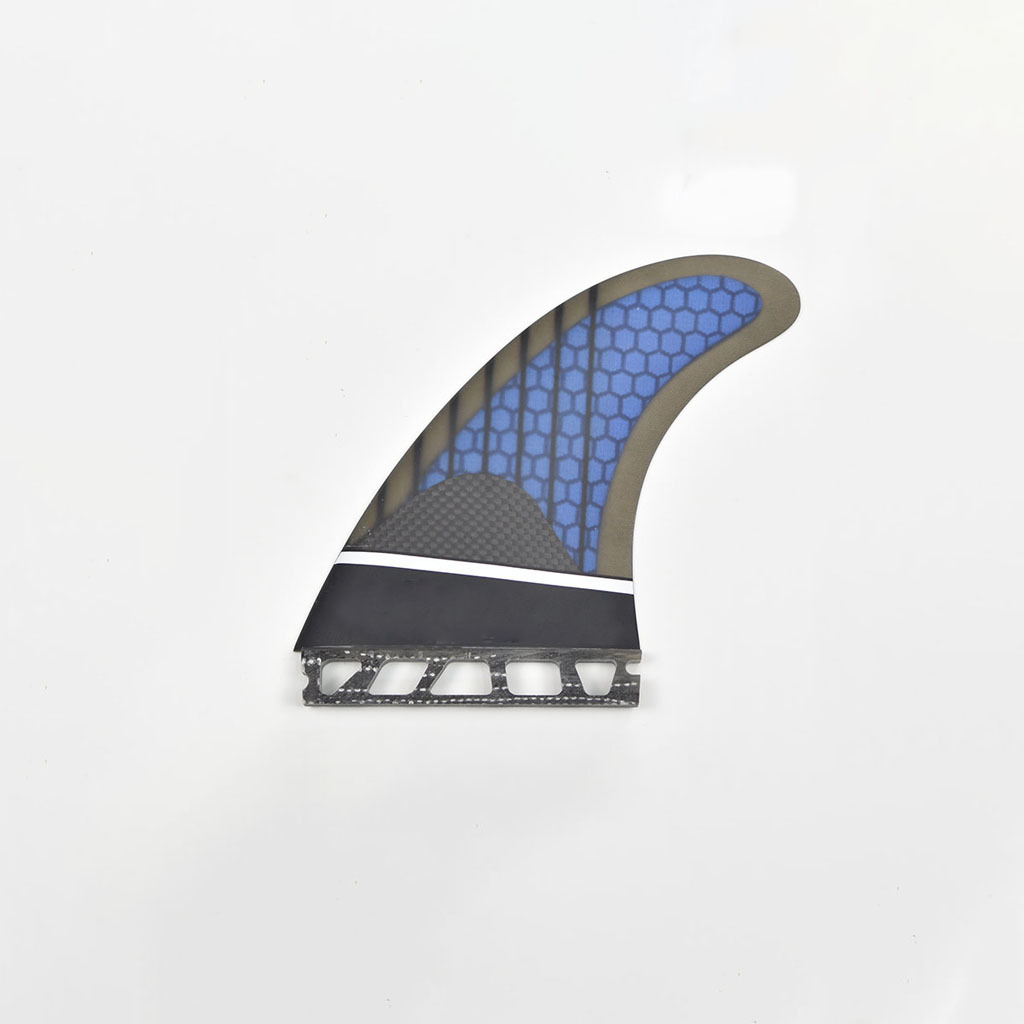
A single tab fin built on a honeycomb core, with a carbon frame laid to suit this particular outline. It is the second of our two carbon-framework templates, and the difference between them is shape rather than material — the same recipe, drawn differently for a different set of conditions.
In the water this one loads smoothly through a bottom turn and gives that energy back as the board comes off the top. There is response in it without the hard, dead feeling a very stiff fin passes on to a lighter or less forceful surfer, which makes it an easy fin to put in front of a wide spread of customers rather than only the strongest ones.
It is built for the trade. Shops and board builders who buy wholesale surfboard fins by the range rather than the piece need the same template, flex and finish to come back on the next order, so this line is kept simple: one outline, five rider-weight sizes and the full set of fin systems.
As a honeycomb carbon surf fin supplier we mould each template on its own tooling instead of shaping one generic fin and calling it a range. That is why this fin and our other carbon template feel different underfoot even though the material list is identical, and it is also why the size run holds together — every size comes off the same outline.
Most shops sell it as part of a set: the fin, a leash matched to the board, a tail pad and a cover. All of it comes from the same range, so the accessory wall arrives together and the reorder does too.
Template & Ride Character
- A curved, moderately swept outline. Area is carried through the middle of the fin and tapers into a relatively fine tip, so it holds a line through a drawn-out turn rather than pivoting on the spot.
- Drive first, release second. There is enough base to push against off the bottom, and the tip lets go cleanly when you unweight it at the top of the wave instead of fighting the rider at the end of a turn.
- Light underfoot. These lightweight surfboard fins add very little swing weight, so the fin stays quiet under a smaller surfer and does not load up the tail on a late take-off.
- Everyday surf through to good days. Drawn for waist-high beach-break sessions as much as for clean, well-shaped overhead surf; it is the fin that stays on the board when the forecast is uncertain.
- Intermediate and above. A progressing rider gets feedback without a punishing ride, and a stronger surfer gets a template that stays composed when it is pushed hard.
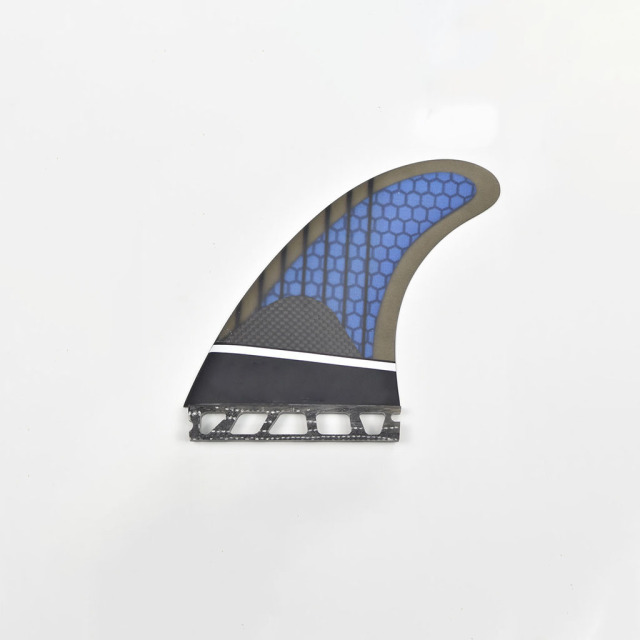
- A finish that reads at arm's length. The honeycomb face shows through the laminate under a gloss coat and a carbon twill band runs into the base — enough visual difference that a customer can see what they are paying for on the peg.
- Same build, different shape from our other carbon template. Both are honeycomb carbon surf fins made the same way; outline and area are what separate them, and they sit side by side in the range because they suit different boards and different days.
- One family, several outlines. The honeycomb core surfboard fins we make all use the same material recipe, so what a customer is really choosing between is shape — which is why staff should talk about the template rather than the spec sheet.
Material & Construction
RTM is what keeps the resin content even from one fin to the next — the reinforcement goes into a closed tool and resin is drawn through it, so the fin you receive weighs what the last one weighed and flexes the way the last one flexed. The carbon is not a cosmetic layer on the outside. It forms an internal framework drawn to suit this template's outline, and a carbon twill runs into the base where the fin meets the tab. Epoxy resin, a carbon frame inside and carbon in the base together produce a more user-friendly flex pattern: the fin bends progressively under load and returns without a sudden snap. Because the fins are moulded in our own workshop, the frame can be matched to each template rather than being a component bought in already shaped. As a surf fin manufacturer we would rather change the layup per outline than sell one compromise fin under several names, and that is what separates the templates in this range from one another. The base gets particular attention because it is the part that takes the abuse. On a demo or rental board that is the area to check when a fin comes back. The carbon fiber surfboard fins we build for shops come off the same line as the rest of the fin range, so a mixed order still arrives with a consistent finish and a consistent size ladder across the family.
Fin System & Fit
- Check the box on the board first. This honeycomb carbon surf fin has a single tab, so it needs a single-tab box with a screw-down plate; a double-tab box or a longboard box takes the matching version of the same template.
- Back the screw out, lift the plate and flush any sand or salt out of the box before the fin goes in — grit trapped under the tab is what strips threads.
- Seat the tab fully, then slide the fin fore or aft to set how the board turns. These lightweight surfboard fins are easy to reset in the box, so try a position, surf it and move it a few millimetres at a time.
- Tighten until the fin is firm and no more. Snug by hand with the correct key is enough; over-tightening crushes the base and is the most common way a good fin is ruined.
- Sight down the leading edge before you paddle out. The fin should sit straight and the foil should run cleanly from base to tip.
- Re-check the screw after the first session on a new set; things settle once the fin has been loaded a few times.
- Rinse and dry the fin before it goes back into a bag or cover, and keep a key in the board bag for changes on the beach.
Size & Rider Weight
| Size | Rider weight | Typical rider |
| XS | Under 55 kg / 120 lbs | Junior or small-framed surfer |
| S | 55-70 kg / 120-155 lbs | Teenager or lighter adult |
| M | 65-80 kg / 145-175 lbs | Average adult weight |
| L | 75-90 kg / 165-200 lbs | Heavier or stronger surfer |
| XL | Over 85 kg / 190 lbs | Large surfer on a bigger board |
Specifications
| Property | Detail |
|---|
| Model | F25322 SURF FIN HONEYCOMB CARBON |
| Fin system | Single tab |
| Moulding | Resin transfer moulding (RTM) |
| Honeycomb core | 50% |
| Glass fiber | 20% |
| Epoxy resin | 20% |
| Carbon fiber | 10% |
| Base detail | Carbon twill laid into the base |
| Size range | XS, S, M, L, XL |
| Also available in | Double tab and box fin |
Pairing & Accessories
- Leashes. Hypalon leashes in 6ft 6 mm, 7ft 7 mm, 8ft 7 mm and 9ft 8 mm — short and light for a shortboard, longer and thicker for a longboard or a bigger day. Matching the leash to the board is the difference between a clean set on the wall and a customer coming back for the right one.
- Traction. Tail pads, centre pads, skimboard pads and waxless pads add grip where the back foot lands, and they are the first thing a customer reaches for when a new board goes out the door.
- Covers. Basic bags, regular bags and stretch covers. A cover with a fin pocket keeps a spare set from knocking against the tail in transit, which is how most fins get chipped before they ever reach the water.
- Racks. Travel rax with tie-downs, storage racks and display racks — one set for the shop floor and one for the customer's garage.
- The rest of the fin wall. Honeycomb, G10 glass, timber and nylon fins across single tab, double tab and box fin, so one template never has to carry the whole category on its own.
- One supplier for the whole set. As a honeycomb surf fin supplier we hold the fin, the leash, the pad, the cover and the rack in a single range, which is what makes a planogram easy to fill and a reorder easy to plan.
- Made under one roof. Because we are the surf fin manufacturer rather than a trading agent, a change of logo, colourway or packing goes straight to the production floor instead of through a third party.
Care, Storage & Travel
After a session
Rinse the fin in fresh water once the board is out of the sea, paying particular attention to the tab and the screw, where salt and sand collect. Dry it before it goes back into a bag or a cover — a fin packed wet picks up a dull film, and the screw can seize in the plate over a season. While it dries, run a thumb along the trailing edge and the base: a nick in the tip is cosmetic, but a crack running into the tab or the base means the fin should come out of the set rather than go back in the box.
On the beach and in the car
Most fin damage happens on land. Set the board down fin-up rather than fin-down, and never drag it tail-first across sand or rock. When the board rides on a roof rack, in a truck bed or in the back of a car, the fin is the part that takes the knock, so a cover with a fin pocket or a simple sleeve is worth more than it costs.
Storing a set
Keep fins shaded and out of a car left in the sun; repeated heat cycles are hard on any resin finish and on the bond around the base. Store sets together by size so the right fin goes back with the right board, and keep the poly bag and hang tag the set arrived in — it makes a serviceable sleeve and stops loose fins from chipping each other in a shop drawer.
Travelling
For a flight or a long drive, take the fins out of the boxes, wrap them flat in a towel or a fin pouch, and bag the screws and plate rather than leaving them loose. A fin rattling around a board bag with a leash, a key and a wax comb will lose its tip before it reaches the water. Because these are lightweight surfboard fins, a spare set in the sizes a trip actually uses adds almost nothing to the bag.
Shop floor and rental fleet
Display fins base-down in the rack rather than resting on their tips, and keep a couple of spare screws and plates at the counter. On a rental or school fleet, check the tab and screw on every turnaround and rinse the set at the end of the day; ask your sales contact what spare hardware is available to ship with your order.
Ordering & Delivery
- Send your size and system split. For a wholesale surfboard fins order the fastest start is a line list: how many of each size, in which fin systems, and which templates you want alongside this one.
- Tell us how it should arrive. Poly bags, hang tags, carton marking and barcode labels all change the packing spec, so agree them before production rather than after.
- Ask your sales contact about sample availability and the current lead time before you commit to a launch date.
- Agree payment terms, shipping terms and the delivery date with your sales contact — they are set per order rather than fixed for the range.
- Keep the template code on file. Reordering by code is the simplest way to keep the second shipment matched to the first in outline, flex and finish.
- We act as the honeycomb surf fin supplier for repeat runs as well, scheduling them from the same tooling so a reorder can be planned against your season instead of against whatever happens to be in stock.
Scale & Supply Capability
CIMI is a factory-based supplier with 16 years in surf and watersports hardgoods, manufacturing at our own facility rather than sourcing through traders. Chain stores, supermarkets and surf-brand stores buy from us because one supplier covers a full accessory assortment, so a season's order and its reorders can be planned together. We take on OEM and private-label work, adapting designs, colourways and branding to your programme, and we schedule production against your agreed range plan. Send us your buy list and target dates, and we will confirm what we can make and when.
FAQ
What is inside this fin, and what does the carbon actually do?
Honeycomb core surfboard fins are a sandwich: a honeycomb core, glass fiber, epoxy resin and a carbon frame, moulded in one closed tool. In this template the carbon is laid to suit the outline rather than being a standard frame dropped into every fin, and a carbon twill runs into the base where the tab sits. What a rider feels is a fin that springs back after it is loaded instead of folding over and staying folded.
Will this fin fit my board?
This is a single tab fin, so it fits a board with a single-tab box and a screw-down plate. Check the box before you order: a double-tab box or a longboard box takes the matching version of the same template, and this outline is made in all of them. If you are not sure which one a board has, a photo of the box is usually enough for us to tell you.
Which size should I choose for a rider around 70 kg?
Start with rider weight on the size chart: M is the middle of the five and the usual pick for an average adult, S for a lighter rider or a smaller board, L for a heavier or stronger surfer. Where a rider sits between two sizes, go with the board they surf most — a bigger board carries a bigger fin comfortably.
Is the same template available in double tab and box fin?
Yes. This outline is made in single tab, double tab and box fin, so a shop can cover shortboard and longboard customers from one template. The carbon fiber surfboard fins in this outline use the same construction across all three systems, so the only thing that changes is the base.
How does it compare with the G10 glass fins?
G10 glass is the stiff end of the range: layered solid fiberglass, machine cut, holding its shape under a heavy load, which is why strong surfers in demanding waves choose it. This template sits closer to the middle — the carbon fiber surfboard fins here give more feedback through a turn and release more easily at the end of it. Set against the plain honeycomb core surfboard fins, the core and glass are the same; the carbon frame is what changes how the fin returns to shape.
How should I store and travel with them?
Rinse in fresh water after a session, dry the fin before it goes back into a bag, and check the tab for nicks when you take it out. Being lightweight surfboard fins, they slip into a fin pocket or a cover without weighing a board bag down, so a spare set in the sizes a rider uses most is easy to carry.