Product Overview
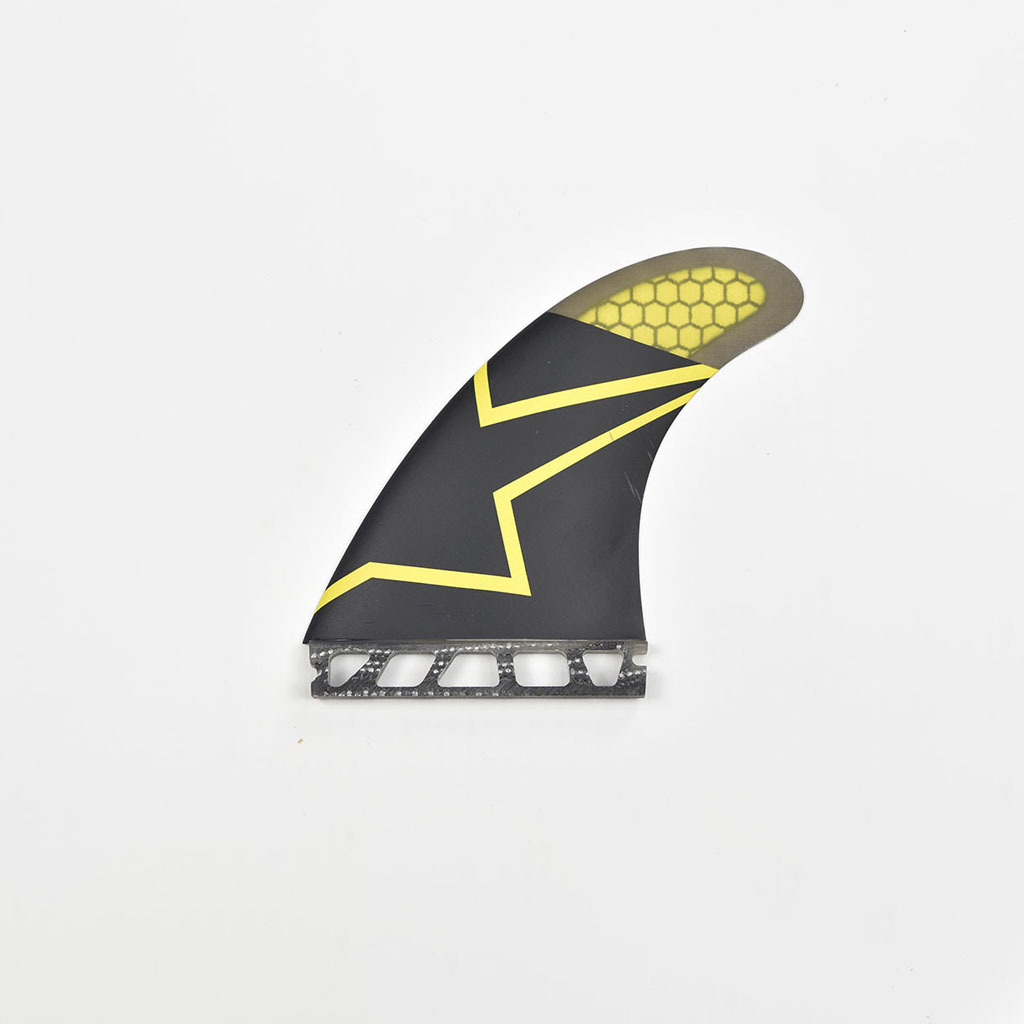
Built for the everyday end of the fin wall, this is one of those honeycomb surfboard fins a shop reaches for when a customer needs a dependable all-rounder rather than a specialist shape. The honeycomb core keeps it light in the hand and easy to reset between boards, and the build is comfortable across the mixed, choppy-to-clean conditions most people actually surf in. The template is a swept, curved blade on a notched tab base. Because one template covers XS through XL, the fin fills a whole size run rather than one slot in it: staff can match a rider to a weight band at the counter and the wall stays readable. We supply these as wholesale surfboard fins, or as OEM surfboard fins, to surf shops, board-sport chains, distributors and watersports trade accounts, so a season's planogram can be built from one line and topped up on reorder.
Build & Performance
- Honeycomb core. Half the fin's makeup is a honeycomb core, and it is the main reason honeycomb surfboard fins feel light in the hand. Low mass at the tip keeps the blade from feeling dead underfoot and makes handling a rack of demo boards far less fiddly. That is why epoxy surf fins hold a clean, closed surface instead of the soft, resin-rich face that scuffs the first time it goes into a board bag. - Resin transfer moulding. Every fin is resin transfer moulded rather than hand laid, with resin drawn through the dry layup under vacuum. The ratio is set by the process instead of by the operator, so fin two hundred comes out like fin one. - Weight where it belongs. The core carries the volume and the skin carries the strength, so the blade stays light without going soft. In a shop's hands that means the XS feels like the same product as the XL, just smaller. - One layup across the size run. XS through XL use the same materials, the same moulding and the same finish, so staff can stock the full ladder without worrying that the extremes behave like a different fin. - Our own tooling. We cut and mould the range on our own equipment, tab fins and longboard box fins alike, which is how a honeycomb surf fin manufacturer keeps a template identical from one season to the next instead of re-sourcing it and hoping the shape lands the same.
Template, Finish & Graphics
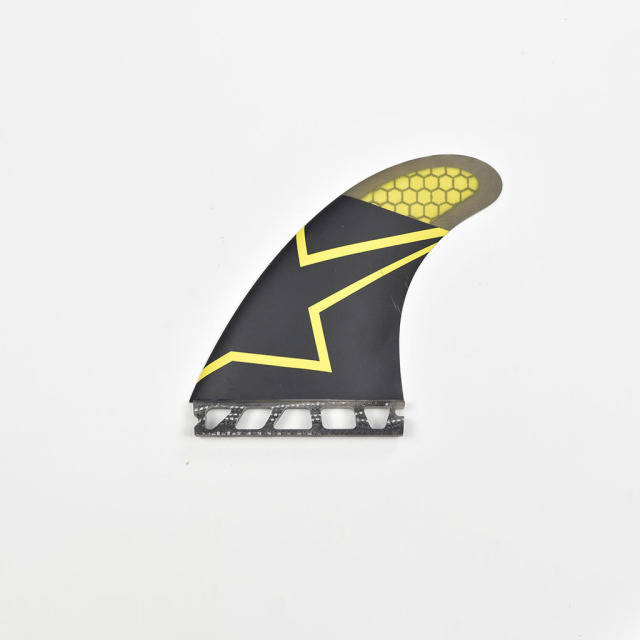
The blade. A swept, curved outline with a clean leading edge. It is a working template rather than an ornamental one, and the curve is what makes it read as a modern all-rounder on the rack beside a board. The finish. Black blade, honeycomb pattern showing at the tip, and a glossy yellow zigzag graphic across the face. That contrast does real work at the counter: on a pegboard of near-identical black fins it gives a customer something to point at and staff something to pick out of a box quickly. The gloss is a good sign in itself, because it tells you the skin has been sealed — exactly what you want from epoxy surf fins that will live in salt water. It is the same fitment pattern used across single tab surf fins, so it drops straight into the boxes already on the boards in your shop with no adapter and no guesswork.
Sizing & Fin System Fitment
- Start with the rider's weight. Fin size follows body weight rather than board length. Weigh the rider in a wetsuit and boots, because the difference between a summer and a winter setup can be enough to move a customer up a band.
- Match the weight to a band. The XS to XL ladder in the specifications is the one to sell from. The bands overlap deliberately, so a fast, higher-output intermediate can step up a size without changing template.
- Check the box on the board. A single-tab box takes two screws and lets the fin slide fore and aft. It is the fitment most shortboards and hybrid boards arrive with, and it is what the single tab surf fins in this range are built for.
- Twin-tab boxes take a different base. If the board has a two-slot box, order the same template as double tab surf fins — the outline is the same, only the base changes.
- Longboards need the box-fin build. A longboard-style box with one screw takes the box-fin version, one of our longboard box fins, not the tab version. Fitting the wrong base is a common reason a fin comes back.
- Build the size spread, not a flat quantity. Most shops work M and L in depth with XS and XL as the tails, so staff can size almost any walk-in from stock instead of ordering in a fin for a weekend customer.
- Seat it and check it before the customer leaves. Slide the tab in, tighten both screws, and push the trailing edge to make sure the base sits flush. A fin that rocks in the box will feel loose in the water and come back as a complaint.
Specifications
| Model | F25212 |
|---|
| Fin type | Single tab |
| Construction | Honeycomb core, glass fibre, epoxy resin |
| Core | 50% honeycomb |
| Glass fibre | 30% |
| Epoxy resin | 20% |
| Moulding | Resin transfer moulding |
| Sizes | XS, S, M, L, XL |
| XS | Under 55 kg / 120 lbs |
| S | 55–70 kg / 120–155 lbs |
| M | 65–80 kg / 145–175 lbs |
| L | 75–90 kg / 165–200 lbs |
| XL | Over 85 kg / 190 lbs |
| Also available | Double tab surf fins and box fin versions |
Accessory Range & Pairing
- Leashes sized to the board. A 6 ft 6 mm Hypalon leash for a shortboard, stepping through 7 ft 7 mm and 8 ft 7 mm for longer boards and bigger days, up to a 9 ft 8 mm for a longboard in real size. Order them alongside the fins and the wall arrives together.
- Traction pads. Tail pads and centre pads, plus skimboard and waxless pads, so the boards the fins go on leave the shop fully set up.
- Covers and bags. Basic bags, regular bags, stretch covers and bodyboard bags, sized to the boards your customers actually carry.
- Racks and storage. Travel rax and tie-downs, storage racks, display racks and bike racks — the fixtures that hold the fin wall and the board wall in place.
- Fin accessories. Inserts, wax and the small parts that turn a single fin sale into a fuller basket.
- One supplier for the accessory wall. We supply wholesale surfboard fins, and we make the leashes, pads, covers and racks that hang beside them, so a shop can fill the wall from one factory rather than stitching together three.
- Your name on the range. We produce OEM surfboard fins with your own artwork, header card and packaging, so the fin on your pegboard carries your logo instead of ours.
Ordering & Delivery
- Start with the size spread. Shops buying wholesale surfboard fins rarely want a flat quantity per size. Tell us which weight bands your customers actually buy and we will build the order around that split. 1. 1. 1. Confirm quantities, schedule and terms. Order volumes, production dates, payment terms, packing and shipping arrangements are agreed with your sales contact for each order rather than fixed in advance, so ask for them in writing with the quotation. 1. Plan the reorder. Because the tooling and the layup stay the same, a repeat order can be raised against the original specification. We are a honeycomb surf fin manufacturer with our own production, so the schedule is ours to hold rather than a third party's.
Handling & Care
- Loosen before you pull. Back both screws out with a fin key and slide the tab straight out of the box. Pulling the blade while the screws are still biting, or twisting it sideways to free it, is what rounds the tab shoulders and stars the box — and a cracked box is a board repair, not a fin swap.
- Snug the screws, don't crank them. Two screws hold this single tab fin in place; tighten until the tab stops moving and go no further. Over-tightening crushes the tab and can crack the box around the screw hole, and it is the usual reason a fin later works loose mid-session.
- Flush the box, not just the blade. Grit and dried sand left in the channel grind the tab down every time the fin goes in and out, and a worn tab rocks no matter how hard the screws are turned. A rinse with fresh water and a wipe before the fin goes back in keeps the fit tight.
- Check the base after every knock. After a hit from another board on the rack, from the bottom, or from the shorebreak, look at the base: white stress marks, a hairline crack along the tab or a lifted skin mean retire the fin. A blade that snaps in the water can take the box with it.
- Tidy the edges, don't sharpen them. Small nicks along the leading edge smooth out with fine wet-and-dry paper and a rinse. Deep gouges that reach the core should not be filled with putty — the skin on these honeycomb surfboard fins is a sealed glass laminate, and once that seal is broken the fin takes on water.
- Carry spares out of the board bag. Keep spare fins in a fin bag or wrapped in cloth rather than loose among the boards, and never stack boards fin-down on fin. More blades chip in the back of a car than in the water.
- Keep them out of a hot closed car. The resin in epoxy surf fins softens under sustained heat, so a black fin left on a dashboard or in a locked car on a summer afternoon can take a set or lift at the base. Shade or a cool room is all it needs.
- Show the customer at the counter. A shop that takes a minute to demonstrate the two screws, the loosen-first habit and the quick post-surf check gets noticeably fewer returns than one that hands the fin over in a bag — and the customer leaves knowing how to keep the fin in service for seasons rather than weeks.
Scale & Supply Capability
CIMI is a factory-based supplier with 16 years in surf and watersports hardgoods, manufacturing at our own facility rather than sourcing through traders. Chain stores, supermarkets and surf-brand stores buy from us because one supplier covers a full accessory assortment, so a season's order and its reorders can be planned together. We take on OEM and private-label work, adapting designs, colourways and branding to your programme, and we schedule production against your agreed range plan. Send us your buy list and target dates, and we will confirm what we can make and when.
FAQ
What conditions are these honeycomb surfboard fins built for?
They are an all-round fin rather than a specialist one. The light honeycomb build suits everyday surf — waist-high to head-high, onshore chop through to clean lines — and the sealed skin means a day of shorebreak does not leave the blade looking tired. Riders who only surf high-energy, overhead reef will usually be steered towards a stiffer fin.
Is the fin the same from one batch to the next?
That is what moulding in-house buys you. The resin-to-fibre ratio is set by the resin transfer process rather than by an operator's hand, so weight, finish and tab thickness stay within the same working range from one production run to the next. It is the difference between buying from the honeycomb surf fin manufacturer and buying from someone reselling finished stock.
Will this fin fit the boards we already stock?
This is one of our single tab surf fins — the two-screw base most shortboards and hybrid boards come with. Before you commit to a size run, check one board from each model family on your floor: a box that has been repaired or re-set can sit fractionally off, and it is far easier to catch that in the shop than at the counter.
Can the fin carry our own logo?
Yes. We build OEM surfboard fins to your artwork, header card and packaging, so the fin arrives shelf-ready under your name. Send the artwork and the packaging specification with your order and we will confirm how it maps onto the blade and the card before production starts.
Do you make the same template with a two-tab base?
We do — double tab surf fins use the identical outline with a twin-tab base. That matters for a shop with a mixed board wall: the customer gets the same look and the same size ladder whether the board takes one tab or two, and you are not carrying a second, unrelated fin line to cover it.
Is there a longboard version?
There is. Longboard box fins take the single-screw box-fin base rather than a tab, and they suit the boards where a rider is walking and trimming rather than pumping. If longboards are a meaningful part of your wall, put both bases on the same order and keep the sizing consistent between them.
How should a fin this light be looked after?
Treat it like any epoxy surf fin: rinse in fresh water after salt, dry it before it goes back in a bag, and do not let loose fins knock against each other in a box. Because it is one of our epoxy surf fins with a sealed skin, sand and salt wipe off with fresh water and a soft cloth rather than working into the surface.