Product Overview
This is the single-tab fin in CIMI's honeycomb range: one fin, one clean template, made to drop into a single-tab box and put a rider back in the water. Honeycomb surf fins are built around a cored centre instead of a solid layup, so the fin carries its area without carrying the same mass — the tip comes back into place instead of fighting the turn. That is what lightweight surf fins buy a rider: quicker response underfoot, an easier recovery between turns, and less fin dragging through a soft section.
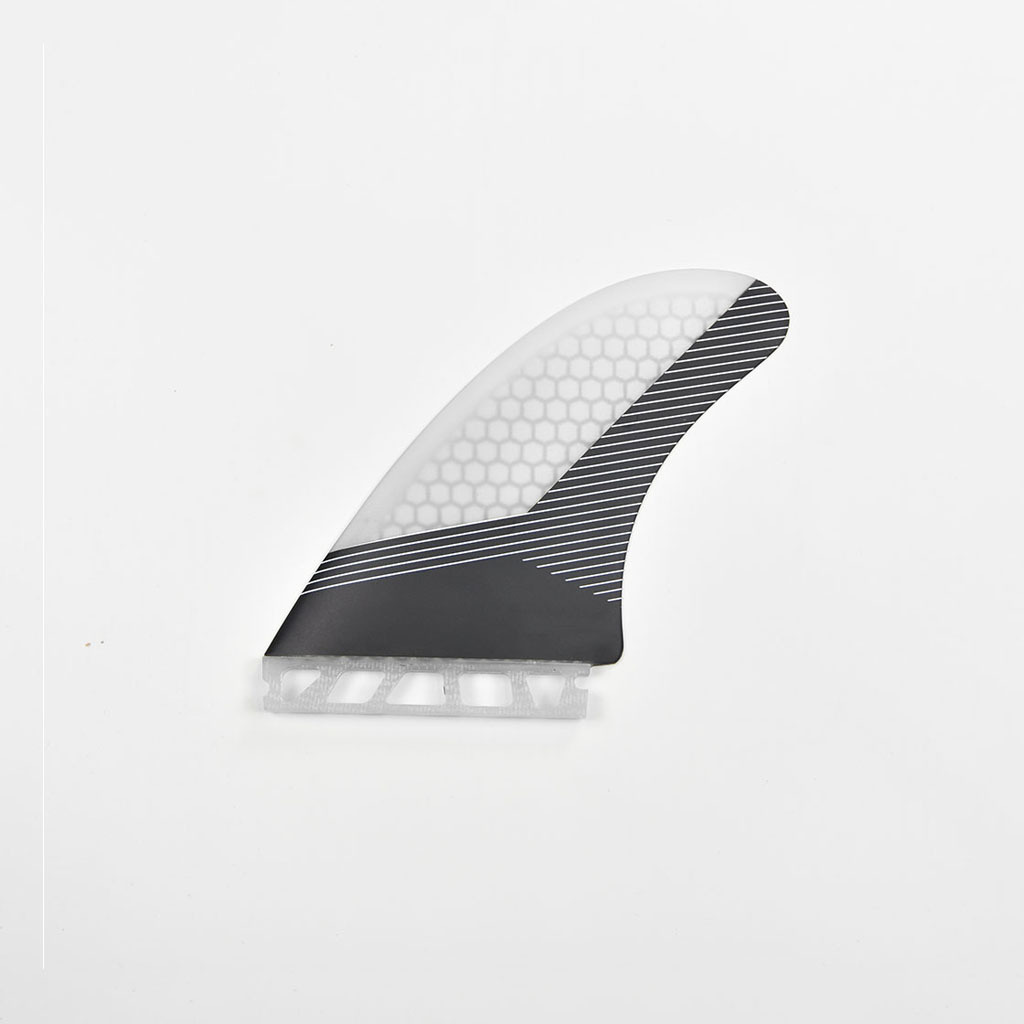
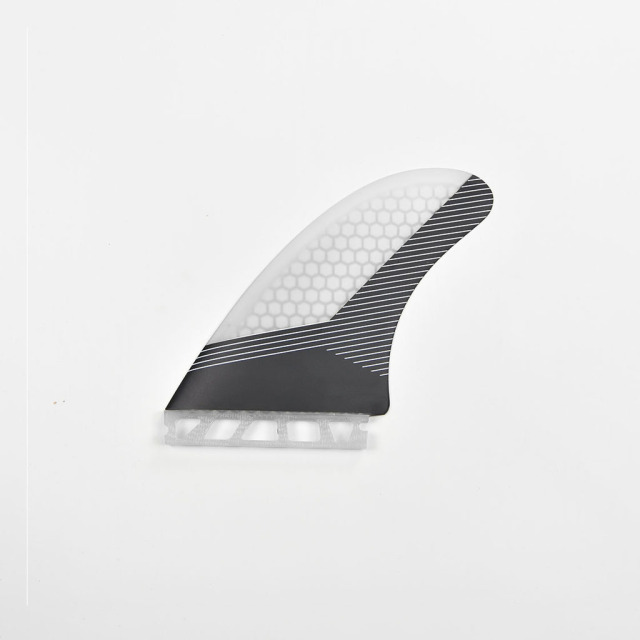
The fin itself is easy to read. A white honeycomb core shows through a gloss skin, the lower section goes black where the foil stiffens into the base, and a single tab sits at the bottom. It looks finished on a pegboard, which matters on a wall where nobody is there to explain it — a custom surf fins factory is judged at arm's length before a buyer ever picks the fin up.
Day to day it does two jobs. On the shop floor it is a straightforward replacement or upgrade for a customer who already owns a board with a single-tab box and knows roughly what they ride. Behind the counter it keeps a size run complete: hold the five sizes, fit the right one at the counter, reorder the template when a size runs down. It travels with the rest of the wall too — a leash for the board it goes on, a pad for the tail, a cover for the trip home.
Template & Foil Shape
- An outline built for ordinary surf. Neither a narrow high-aspect fin nor a wide longboard blade, this template carries enough area to drive through a bottom turn and release cleanly off the top — the shape that suits the conditions most riders actually get.
- Gradual sweep in the tip. The tip rakes back rather than standing straight up, so the fin pivots from the base first and the tip follows. For a rider still building timing, that reads as predictable rather than snatchy.
- A stiffened base section. The black lower area is where the fin takes load from the box. Keeping that section solid while the upper foil stays light is what gives a consistent feel instead of a soft, vague one under pressure.
- The core reads through the skin. Honeycomb surf fins show white cells sitting under the gloss, so a buyer can see at a glance that this is a cored fin and not a solid glass blade. That visibility does real work on a wall where fins otherwise look alike.
- Gloss finish. The surface comes up clean and even, so the fin looks finished straight out of the pack and needs no dressing before it goes on display.
- What it gives an intermediate rider. Hold through the turn without a locked, punishing feel — the fin talks back instead of dictating. Riders stepping up from a basic moulded fin notice the difference in drive first.
- Where it sits in the line. This is the standard single tab surf fins template in the honeycomb family. The outline logic carries across the range, so a shop can build a consistent story across sizes and systems.
- A single-tab base. One tab, held by a screw through the box — the fitment a large share of shortboards in a shop's range are already built around.
Honeycomb Construction
The layup is stated plainly: 50% honeycomb core, 30% glass fiber, 20% epoxy resin. Half the fin by composition is the core, which is where the weight saving comes from, while the glass gives the skin its strength and the surface you see. The epoxy bonds core, glass and base into one piece and carries the gloss.
The fin is moulded by resin transfer. A dry layup and the core go into a closed mould, resin is drawn through under pressure, and the part cures to the shape of the tool. Against hand layup that gives a more even wall thickness, a cleaner surface straight from the mould and less variation from one fin to the next — the part a shop actually feels, because the second order arrives looking and flexing like the first.
As a honeycomb surf fins manufacturer we keep this build consistent across the family, so a buyer stocking this template alongside other sizes and systems is working with one material story rather than several. In the water the build loads progressively and releases without a snap, and it stays light enough that a rider notices the board rather than the fin.
Two things it deliberately is not. It is not a solid G10 layup, so a heavy, hard-driving surfer in big water will find the machine-cut glass fin stiffer. It is not the carbon-framed version either, so it does not have that spring-back. Within the range, the plain honeycomb layup is the versatile one — the fin for changing beach breaks and riders who want predictable rather than specialist.
Fin System Fitment
The honeycomb build is made in three systems, and this fin is the single-tab version. A single tab is exactly that: one tab on the base that slides into a single-tab box and is held by a screw through the side of the box. Before the screw goes tight, the fin can be nudged fore and aft, which is how a rider tunes turn feel without buying anything else.
Two checks before ordering. Match the base to the box on the board — a single-tab fin will not seat in a twin-tab box, and it will not work in a longboard through-box. Then confirm which way the fixing enters, because boards are not all set up the same. A fin that fights the screw is the wrong fitment rather than a tight one.
For a buyer filling a wall, the same layup is produced as double tab surf fins for boards that take two tabs, and as box fin surfboard fins for longboards and mid-lengths with a through-box. Carrying all three in the honeycomb build is what lets a wholesale surf fins supplier settle a fitment question on the spot instead of sending the customer to another material story. This template is the single tab surf fins version — the one to stock for boards already built around that system.
If the system is unclear, read the box rather than the old fin: the number of slots tells you the system, and the fixing tells you what hardware the fin needs.
Size & Rider Weight
- XS — under 55 kg / 120 lb. Lighter juniors and small adults on shortboards. Enough fin to feel the turn without over-finishing a light rider.
- S — 55–70 kg / 120–155 lb. The first adult size for most shops, and the one that moves fastest in a mixed fleet.
- M — 65–80 kg / 145–175 lb. The middle of the ladder and the safest single size to hold deep, covering a wide band of recreational riders.
- L — 75–90 kg / 165–200 lb. Stronger or heavier surfers, and lighter riders on a longer board who want more drive.
- XL — over 85 kg / 190 lb. Heavy riders and larger, higher-energy surf where hold matters more than release.
- The bands overlap on purpose. 65–70 kg sits in both S and M, 75–80 kg in both M and L, 85–90 kg in both L and XL. At a boundary the smaller fin releases faster and the larger one drives harder — a genuine choice, not an error in the chart.
- Weight is the starting point, not the whole answer. Board length, tail width and the waves a rider normally surfs all push the choice up or down. A light rider on a long board is often better on more fin than weight alone suggests.
- What to ask at the counter. Body weight, board type, box type and what the rider is on now. Those four answers settle the size in under a minute.
Everyday Conditions & Riders
What this fin is designed for is ordinary surf: waist- to head-high beach breaks, water that changes through the tide, a rider who wants a board that behaves the same way twice. Its natural rider is intermediate to advanced-intermediate — someone already turning, who knows what a fin feels like when it lets go, and who wants feedback rather than a specialist feel they have to adapt to. On the trade side the buyer is usually a shop or a small chain refilling a fin wall. That buyer is not hunting a hero template. Schools and rental fleets use fins as consumables. A fleet loses fins to rocks, sand and the back of a van, and lightweight surf fins are simple to handle, simple to reset and simple to replace without rethinking the whole set. Repair shops and small shapers buy the same way when a board leaves the workshop needing a fin. One more group arrives with a logo rather than a template in mind.
Specifications
| Specification | Detail |
|---|
| Model | F25211 |
| Fin type | Honeycomb core, single tab |
| Core | Honeycomb |
| Skin | Glass fiber with epoxy resin |
| Moulding | Resin transfer moulding |
| Base | Single tab; double tab surf fins and box fin surfboard fins use the same layup |
| Size range | XS, S, M, L, XL |
| Finish | Gloss skin over a visible honeycomb core |
| Typical use | Everyday surf, intermediate to advanced riders |
Fitting, Care & Storage
- Rinse the fin after every session. Salt and sand collect around the tab and inside the box; fresh water and a soft cloth keep the base clean and stop grit grinding at the fitment.
- Dry it before it goes back in the bag. A lightweight surf fins set dries quickly, but a fin left wet in a closed cover is how a gloss skin picks up marks and how a box fills with grit.
- Check the tab and the screw before paddling out. A fin that has taken a knock usually shows it at the base first, and a ten-second look saves a long swim.
- Seat the fin, then tighten. Push the tab fully home, set the fore-and-aft position, and tighten the screw by hand until the fin is firm. Leaning on the driver does not make it hold better; it distorts the base.
- Do not lever the fin out of the box. Work it free with a straight pull. Prying against the foil is what chips a base.
- Store fins flat and out of direct sun. A spare set kept in a cupboard stays straight; a set rattling loose in a hot van does not.
- Retire a damaged fin. A crack at the base or a crushed tab is a replacement, not a repair — that area takes load on every turn.
Accessory Range
A fin is rarely bought on its own, so the rest of the CIMI accessory range is worth planning in the same conversation. Leashes run from a 6 ft 6 mm Hypalon leash for small to medium waves up to a 9 ft 8 mm for longboards and bigger days, with 7 ft 7 mm and 8 ft 7 mm filling the middle — the choice is mostly board length and how much swell the rider expects. The fin line itself covers this honeycomb template, the carbon and G10 glass builds, and the other outlines in the range. Traction splits into tail pads and centre pads, with a skimboard pad and waxless pads for the boards that need them: the tail pad gives the back foot a solid spot to push against and a bit of drive, the centre pad covers a longer board where the stance travels. Covers run from a basic bag through a regular bag to a stretch cover, plus a bodyboard bag for shops that sell them. Racks cover the shop side of the business — travel rax and tie-downs, storage racks, display racks and bike racks — which is what a buyer needs when the fins are going onto a wall rather than into a box. Setting the wall up as one range rather than five products also makes life easier for shop staff, who can then sell a fin, a leash and a pad in a single conversation.
Ordering & Confirmation
- Confirm the size mix. The range runs XS to XL, and most buyers do not order evenly. Tell us how your riders are weighted and we will help you set a mix rather than a flat split.
- Confirm the systems. As a honeycomb surf fins manufacturer we make this template in single tab, and the same layup as double tab and box fin versions, so a first order can cover more than one board type.
- Confirm what comes with the fin. Fixing hardware varies with the box system; tell us what your customers expect in the pack so nothing is missing at the counter.
- Confirm branding early. Shops wanting the fin under their own name should raise it at quotation stage — as a custom surf fins factory we plan tooling, branding and packing around the buyer's programme.
- Confirm packing requirements. Fins are light and easy to mark in transit; say whether they need to arrive shelf-ready or bulk-packed for your own labelling.
- Ask about samples. If you are trialling the template, ask your sales contact about sample availability before you commit to a range.
- Confirm lead time and terms with your sales contact. Timings move with the season, so put your target dates on the table at the start.
- Keep the template on file. Record the model and size you ordered. As a wholesale surf fins supplier we build to the same specification on reorder, and that reference is what keeps the next delivery matched to the first.
Scale & Supply Capability
CIMI is a factory-based supplier with 16 years in surf and watersports hardgoods, manufacturing at our own facility rather than sourcing through traders. Chain stores, supermarkets and surf-brand stores buy from us because one supplier covers a full accessory assortment, so a season's order and its reorders can be planned together. We take on OEM and private-label work, adapting designs, colourways and branding to your programme, and we schedule production against your agreed range plan. Send us your buy list and target dates, and we will confirm what we can make and when.
FAQ
Which fin system does this fin use?
This one is a single tab: one tab on the base, held by a screw through a single-tab box, with fore-and-aft adjustment before you tighten. The same honeycomb layup is also made as double tab surf fins and as box fin surfboard fins, so the single tab surf fins version here is the one for boards built around that box. If you are unsure, check the box on the board rather than the fin that came out of it — the number of slots tells you the system.
Is this a single fin or a set?
One fin. That suits a rider replacing a lost or broken fin, or a shop selling from the pegboard one at a time. If you are building a thruster or another multi-fin setup, order the number of fins the board needs and keep the sizes consistent across the set so the board stays balanced.
How does the honeycomb build compare with the carbon and G10 glass versions?
All three are cored or layered composite fins, but they feel different. Honeycomb surf fins like this one use a light cored layup with a glass skin and epoxy resin, which gives a forgiving, predictable ride in everyday conditions. The carbon version adds a carbon frame that springs back harder, and the G10 glass fin is a solid layered fiberglass build that stays stiff under a strong surfer in demanding waves. As a honeycomb surf fins manufacturer we make all three, so a wall can carry the full progression from this fin upward.
Can the fin be produced with our own logo?
Yes. The template is ours, so it can be produced under your own name and packed for your shelf — that is the work our custom surf fins factory does for shops and small brands. Branding is easiest to plan before the order is confirmed, because it affects the base marking, labels and packing rather than the shape of the fin itself.
Why can I see the honeycomb pattern through the fin?
The gloss skin is thin enough over the core that the white cells read through it. That is a characteristic of the cored build rather than a defect, and it is useful on a wall where a buyer can see the construction without picking the fin up. Because the core sits under a moulded skin, the pattern can shift slightly from one fin to the next; the outline, base and finish stay the same.
What should a shop check when the fins arrive?
Look at three things before the fin goes on display: the base and tab for damage in transit, the gloss skin for any crack where the foil meets the base, and that the tab sits straight. A fin with a chipped or crushed tab should not go out to a customer. If something arrives damaged, send your sales contact a photo of the fin and the packing it came in.