Product Overview
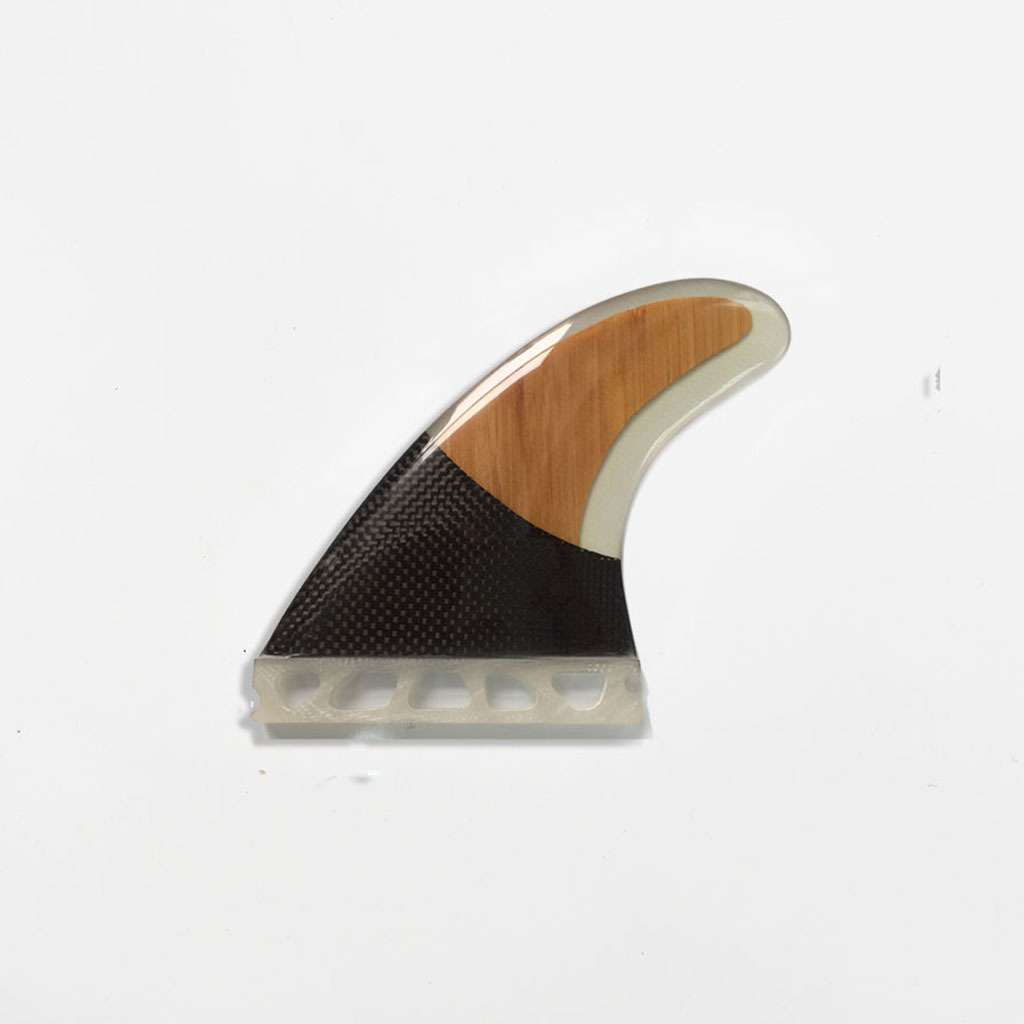
F25308 is the single tab member of CIMI's honeycomb carbon surfboard fins line: a swept, lightweight fin built on a honeycomb core, skinned in glass and epoxy, with an internal carbon framework laid up to suit this exact template. In the water it is an easy fin to live with. It comes up to speed quickly, feels light underfoot and covers a wide spread of everyday conditions rather than being tuned to one narrow window of wave size or power. That breadth is what a shop or a board builder needs when one template has to keep a lot of different riders happy. CIMI has been supplying surf hardware to surfboard manufacturers, surf shop chains and surf schools since 2007.
Material & Construction
By weight the fin is 50% honeycomb core, 20% glass fiber, 20% epoxy resin and 10% carbon fiber. We publish the proportions plainly so a buyer can hold them against every other fin in the range and see exactly what changes between builds.
Everything is made by resin transfer molding. Dry reinforcement and the honeycomb core go into a closed tool, and epoxy resin is drawn through under pressure until the laminate is fully wet out. Because resin quantity and consolidation are controlled by the tool rather than by hand, the surf board fins that come off it stay consistent from one production run to the next, which matters more on a repeat order than on any single sample.
The honeycomb core is what keeps the weight down. A light fin at the tips of a set lets the board release and reset with less effort, and it is easier on the rider over a long session.
The carbon framework inside is laid out specifically for this template rather than being a generic spar dropped into any outline. Stiffness therefore follows the shape: the base stays controlled while the tip is free to load and return.
Moving to epoxy resin and adding a carbon twill to the base changed how the fin behaves at its root. The flex pattern comes out more user-friendly — predictable when you push against it, with a smoother return than a stiff carbon blade gives.
The same layup runs across all five sizes, so a rider who moves from S to L gets the same character in a bigger fin rather than a different animal.
Fin System & Board Fit
- Single tab base. One tab with slots, made to seat in a board built for a single tab box. Look at the box on the board before you look at anything else.
- Compare it with the fin you are replacing. Pull the old fin and lay both bases side by side. Tab count, tab width and slot position tell you in seconds whether these surf fins will seat without modification.
- Two-tab and long box boards need a different base. The outline and the layup stay the same across the three builds, so if the board takes a two-tab or a long box, order the double tab or the box version instead of forcing this one.
- Dry-fit before you fix it in place. Slide the tab in dry and press the fin down. It should sit flush with no rocking and no gap at the base; if it binds, stop and check the box rather than pushing it home.
- Keep the systems apart on the shelf. Single tab and two-tab versions look almost identical on a peg, so store them in separate bins and let counter staff hand over the right surfboard fins without second-guessing.
- Ask before a large buy. Send the board model and a photo of the old fin's base and we will confirm which build of these surf fins belongs on the order.
Applications & Riding Conditions
Fins spend their life under load, and most of the volume around a template like this is replacement demand. A rider loses or breaks a fin, a shop sells one off the wall, a school tops up a rental fleet before the season. Because the outline is held across all five sizes, replacing a single fin keeps the rest of the set feeling the way it did.
Surf board manufacturers fit the same fin to new boards. If a model ships as a thruster, ordering sizes to match each board length keeps the packaged board offering consistent from the first batch to the tenth, and the shop that buys the board can reorder the same surf board fins later.
On the water the fin is deliberately unfussy. It works across a spread of conditions rather than being tuned for one narrow kind of wave, which suits a shop that would rather stock one dependable option than three specialist surf fins.
Schools and rental operators get good use out of it. The single tab is quick to fit and quick to check at handover, which counts when you are buying fins for surfboard fleets rather than a single board, and the carbon-reinforced base stands up to the knocks a fleet collects between seasons.
If a board is coming onto the bench for new fins, fit a fresh surf traction pad in the same session — the tail takes the same wear and the board only has to be cleaned once.
When you are comparing the types of surfboard fins we make for a particular board, match the fin to how that board is actually ridden rather than to the biggest wave it might one day see.
Specifications
| Model | F25308 |
|---|
| Fin system | Single tab |
| Construction | Resin transfer molding |
| Honeycomb core | 50% |
| Glass fiber | 20% |
| Epoxy resin | 20% |
| Carbon fiber | 10% |
| Carbon framework | Laid up to suit this template |
| Base | Carbon twill layer with a slotted tab |
| Finish | Gloss coat with the carbon weave visible at the base |
| Sizes | XS, S, M, L, XL |
| Size basis | Rider weight |
Size & Rider Weight
- XS, under 55 kg (under 120 lbs). Juniors and light adults, and the size that keeps a small surfer's board turning rather than running away from them.
- S, 55 to 70 kg (120 to 155 lbs). Light to average adults on shortboards.
- M, 65 to 80 kg (145 to 175 lbs). The middle of the chart and the size most boards are set up around.
- L, 75 to 90 kg (165 to 200 lbs). Average to heavier adults, and the usual pick for a bigger board under a solid surfer.
- XL, over 85 kg (over 190 lbs). Heavy adults and stronger surfers who load the fin hard through a turn.
- The bands overlap on purpose. A 70 kg rider sits inside both S and M. Read the overlap as a choice: the smaller size feels quicker and looser under a light or finesse-led surfer, the larger holds a heavier rider or a bigger board with more drive.
- Weigh the board as well as the rider. A long, thick board loads a fin differently from a short, thin one, so when a rider sits between two bands the bigger board takes the bigger fin.
- Size is set by the rider, not the wave. When you are working through the types of surfboard fins in the range, start from rider weight and board size, then look at conditions; a fin that is too small shows up first as a lack of drive, not as a problem with the wave.
Accessory Range & Pairing
- Leashes. Hypalon surf leash in 6 ft 6 mm, 7 ft 7 mm, 8 ft 7 mm and 9 ft 8 mm, so a shortboard and a longboard can both leave the shop with the right cord. - Traction. Tail pads and centre pads from the surf traction pad range, for the deck area that wears fastest. - Covers. Basic bags, regular bags and stretch covers for transport and storage between sessions. - Racks. Travel, storage, display and bike racks — display racks are the practical way to build a fin wall in store.
Care & Inspection
Salt, sun and sand do most of the damage to a fin, and a short routine keeps a set serviceable for years.
Rinse in fresh water after a session, especially a long one. Salt left in the slot and around the base dries into a crust that makes the next fitting harder than it needs to be.
Keep board and fins out of a hot car and out of long direct sun. A dark cover left on a beach all afternoon turns into an oven, and heat is the one thing that will soften a resin laminate over time.
After a knock, look at two places: the base of the tab, where a crack shows as a fine white line, and the trailing edge, where a chip can run. Scuffs in the gloss coat are cosmetic and can be left alone. A crack that runs into the tab or through the base is not, so take that fin out of the water until it is replaced.
Check the seat before every session. A fin that has started to move in its box feels vague underfoot long before it fails, and reseating it takes less time than swimming in.
Spare surf board fins should be stored flat, out of the sun and away from anything heavy; a loose set rattling around in a van picks up exactly the knocks that shorten its life.
Ordering & Delivery
- Confirm the fin system. Tell us the board model and, if you can, send a photo of the base of the fin you are replacing, so we can check that a single tab is the right fit.
- Set the size split. Give us quantities for each size from XS to XL rather than one total, so a mixed run of fins for surfboard inventory packs the way your shelves are planned.
- Confirm presentation. Plain, bagged, or with your own branding on the fin and the packaging — raise it with your sales contact and we will confirm what is possible for this build.
- Agree the delivery date and shipping terms with your sales contact, including how the cartons should be marked for your warehouse.
- Add the rest of the programme. If the season also needs covers, racks or the surf leash range, put it on the same order.
- Check the source of supply. We are the surf board manufacturers behind this fin rather than a trading desk, so a size run and its repeat order come off the same tooling and the same finish specification — worth confirming against your approved reference fin before the first bulk run.
Scale & Supply Capability
CIMI is a factory-based supplier with 16 years in surf and watersports hardgoods, manufacturing at our own facility rather than sourcing through traders. Chain stores, supermarkets and surf-brand stores buy from us because one supplier covers a full accessory assortment, so a season's order and its reorders can be planned together. We take on OEM and private-label work, adapting designs, colourways and branding to your programme, and we schedule production against your agreed range plan. Send us your buy list and target dates, and we will confirm what we can make and when.
FAQ
Which fin system will this fin fit?
Single tab. The base is one tab with slots, so it seats in a board built for a single tab box. Take the fin you are replacing out and compare bases before ordering — if the old fin has two tabs or a long box base, this version will not fit. The same template is made as a double tab and a box fin, so you can stay with the outline and change only the base. If you are unsure, send us a photo of the old base and we will point you to the right version of our surfboard fins.
How do I choose a size when I am fitting fins for surfboard repairs or a new build?
Start with the rider's weight and match it to the band for XS through XL. The bands overlap deliberately, so a rider who sits between two sizes takes the smaller fin for a quicker, looser feel and the larger one for more drive and support. For a repair to a set that is already fitted, stay with the size that is on the board unless the rider's weight has changed or the board is being used differently.
What does the carbon build change compared with other surf fins?
The carbon framework stiffens the fin along its outline while the carbon twill at the base softens the transition into the board. In practice the fin loads predictably through a turn and returns smoothly instead of snapping back. Riders coming up from a plain composite fin usually notice it feels more settled at speed; riders used to a full carbon blade usually notice it feels more forgiving. That makes it a sensible choice for a mixed-ability quiver where one fin has to work for several people.
Is this the same fin as the double tab and box versions?
The outline, the honeycomb core and the carbon layup are the same; only the base changes to suit the board's system. That is deliberate — a shop can carry one outline across single tab, double tab and box boards, and a rider who changes boards keeps the same feel underneath. If you are ordering for a range rather than a single board, tell us which system each store's boards use and we will split the surf board fins accordingly.
What does the fin look like out of the box?
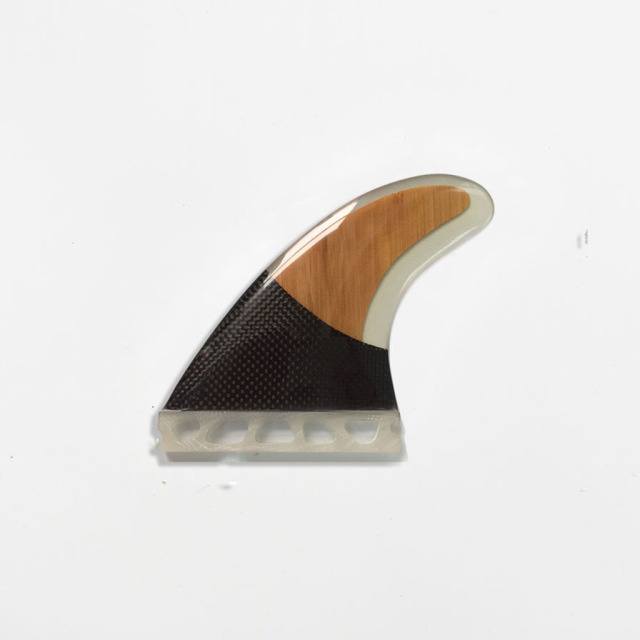
Gloss-coated, with the carbon weave clearly visible through the base where the twill is laid. Across the upper part of the blade the tone lifts into a warmer, more natural panel, and the edge carries a slightly translucent halo where the laminate thins out. The outline is a clean swept shape with a slotted tab at the base. Finishes read differently under shop lighting and daylight, so check a physical fin against your display if the look matters for your wall.
Which sizes do shops usually stock first?
Most start with M and L, because those bands cover the widest spread of adult riders, then add S for lighter surfers and smaller boards. XS and XL are the long tail — worth carrying if the store serves junior riders or a heavy-surf local crew, but they move more slowly. A shallow run across all five sizes usually keeps a wall looking complete without tying up space in one band.
How does this compare with the plain honeycomb and timber versions?
All three share the honeycomb core and the same approach to molding, so weight and the general feel of the outline stay close. The plain honeycomb build leaves out the carbon framework and is the simplest, lightest option. This honeycomb carbon version adds the carbon layup and twill base for a more controlled flex. The timber version keeps the honeycomb core but carries a wood-look cosmetic for boards where the finish is part of the build. Between the types of surfboard fins, the choice usually comes down to how much feel the rider wants from the fin rather than to conditions alone.