Product Overview
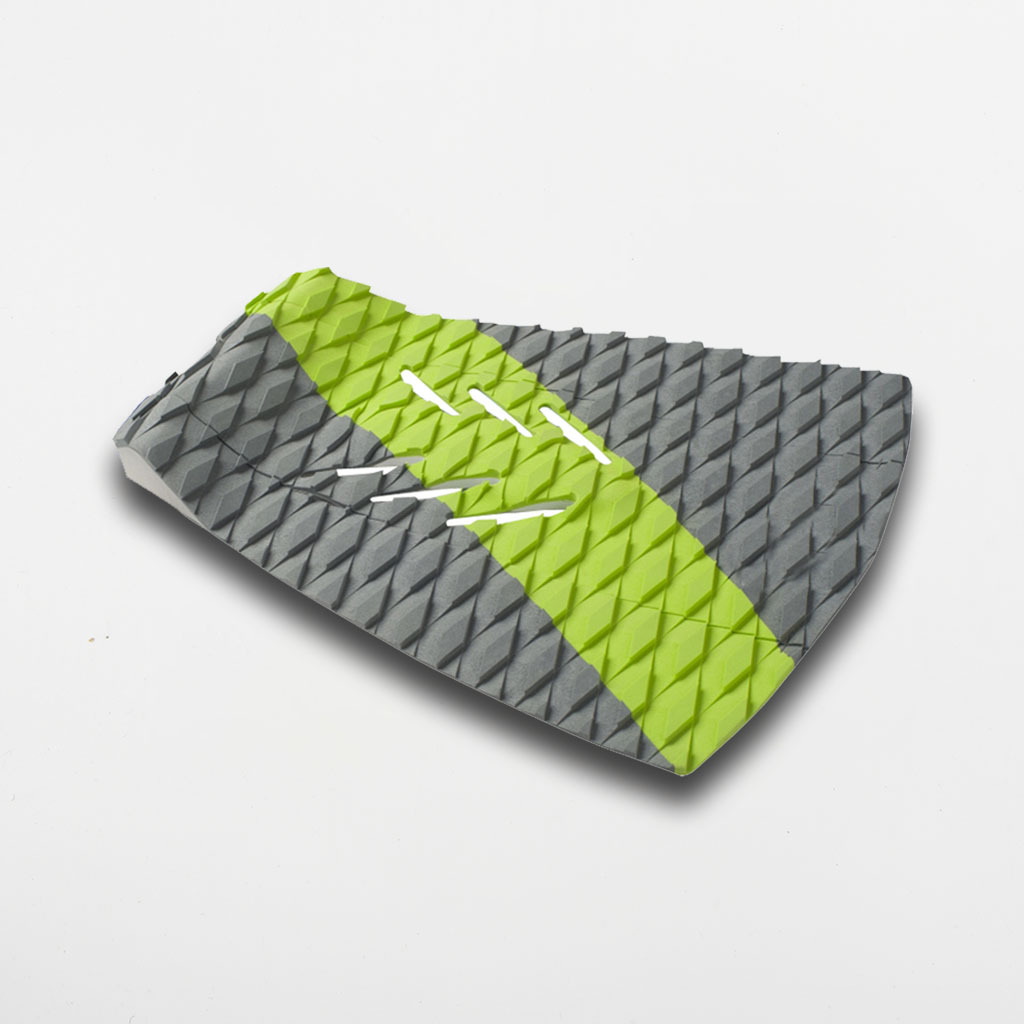
This is a three-piece surf traction pad for the tail of a surfboard: a diamond-pattern grip set that fixes to the deck with 3M adhesive and gives the back foot a defined surface to push against through turns. It is the pad a rider reaches for when the old one has gone slick, and the one a board builder fits before the board leaves the workshop.
We make it in our own factory and supply it as part of a full board kit rather than as a stand-alone item, which is why surf board manufacturers, wholesale distributors and surf shops can plan a season of accessories in one place instead of splitting grip and hardware across suppliers.
Day to day it behaves like any well-fitted tail pad: it stays under the back foot through take-off and off the top, and it can be replaced when the grip finally wears through. Board builders fit it alongside surfboard fins during assembly, shops fit it to demo boards, and riders fit it themselves in a few minutes on the kitchen table.
Grip Surface & Build
- Diamond pattern on every piece — the raised diamond texture runs across all three sections, so a surf traction pad gives the same feel under the heel whether the foot lands on the tail piece or out on a side piece.
- Matte foam, not a slick sheet — the surface is a matte foam with a raised pattern rather than a smooth panel, which is what stops a surfing traction pad from turning slippery once the deck is wet.
- Centre stripe and slit accents — a lime green stripe runs down the middle of the set with white slit accents along the panels, so the pad reads clearly on a shop wall without being loud enough to fight the board's graphics.
- Flat, tapered profile — cut flat and tapered with curved side edges, this is a traction pad for surfboard tails that sits low on the deck and follows the outline instead of standing up under the heel.
- A surface that photographs honestly — the matte finish does not throw glare back at the camera, so the same set works in a catalogue shot, on a shelf and under a foot.
Tail Coverage & Three-Piece Layout
Three pieces rather than one sheet is the practical part of this design. The tail piece sits over the back of the board where a turn loads up, and the two side pieces follow the rail curve, so a surfboard tail pad of this layout covers the area a back foot actually travels across — stringer to rail — without one oversized panel that has to be trimmed to fit.
That layout also lets the set adapt to different tails. A squash or thumb tail takes it in the conventional position with the three pieces close together. A wider tail can carry the side pieces further apart, the way a longboard traction pad is normally spread, so the grip still reaches the rail line. A narrow step-up tail can be fitted with the pieces pulled in, keeping the grip under the back foot rather than out over the edge.
Where the deck is domed or the tail carries a lot of rocker, the gaps between the pieces let the set follow the curve instead of bridging it and lifting at the corners. That is why the three-piece format has stayed standard on performance boards: it wraps around the shape, it lets water and sand clear between sections, and a single worn piece can be replaced without pulling the whole set off the deck.
Installation & Bonding
- Wipe the tail deck down with fresh water and let it dry completely — the backing adheres most reliably on a clean, dust-free surface with no wax residue left in the channels.
- Lay the three pieces out on the deck before you peel anything. A surf traction pad is far easier to judge in place than in your hand, and you can line the gaps up with the stringer.
- Check the tail piece against the back of the board and leave enough deck behind it for the leash plug to work without the pad sitting over it.
- Mark the outline of the outer pieces lightly with pencil or tape. Once the 3M backing touches the deck it grips on contact, so the first placement should be the final one.
- Peel a short section of backing, press that edge down, then work along the piece and peel as you go. If a surf front traction pad is going on in the same session, fit the tail set first so the gap between the two is measured from the back of the board.
- Press each piece from the centre outwards with the heel of your hand, then run a cloth over the diamond pattern to seat the edges.
- Leave the board flat and out of direct sun before the first session so the surfing traction pad has time to settle, and check the edges again afterwards.
Cleaning & Maintenance
Routine Rinse & Storage
Rinse the pad with fresh water at the end of every session and let it dry flat, out of direct sun and out of the board bag, before the board goes back in. Salt and sand left sitting in the diamond pattern dull the bite under a wet foot, and a pad that goes back into a closed bag damp keeps moisture against the adhesive and along the edges. Shops running demo or rental boards get the longest life out of a set by rinsing it fresh and checking the edges after a busy weekend — a corner caught early can be cleaned, dried and pressed back down, where one that has collected sand underneath generally needs replacing instead.
Removing Wax from the Foam
Keep wax off the pad itself and wax only the deck forward of it. Wax that has smeared across the grip, usually from a board bag or a waxy hand, lifts off by scraping gently with a wax comb or the flat edge of a plastic scraper, working along the pattern rather than digging across it, then wiping the residue away with a damp cloth. Never use acetone, solvent cleaners or alcohol-based degreasers on this surf traction pad — they soften the foam and break down the 3M adhesive underneath, and the raised pattern will not come back once it has been flattened.
Sand worked into the texture brushes out with a soft brush and fresh water. Do not pick at the diamonds with a knife or screwdriver, and do not scrub with an abrasive pad; both take the height off the surface that makes a surfing traction pad grip underfoot. The same routine covers a longboard traction pad or a surf front traction pad fitted to the same deck.
Heat is the other thing to watch. A board left in a hot car or in a black bag in the sun can soften the adhesive and let an edge curl, so store it flat and shaded between sessions and check the tail piece again before the next paddle out.
Specifications
| Specification | Detail |
|---|
| Model reference | T27018 |
| Product type | Surf traction tail pad |
| Pieces per set | 3 |
| Set layout | One tail piece with two side pieces |
| Grip pattern | Diamond |
| Adhesive | 3M |
| Mounting | Peel-and-stick |
| Fitting stance | Neutral layout, suits regular or goofy riders |
| Fitting surface | Clean, dry, wax-free deck |
| Deck position | Tail, under the back foot |
| Typical use | Replacement pad or new-board fit |
Accessory Range & Matching Kit
- Leashes — regular, non-slip strap, Hypalon and SUP leashes, in the lengths that match the boards this pad is fitted to.
- Fins — honeycomb, timber, G10 glass and nylon surfboard fins across single tab, double tab and box systems, so the same board can leave the workshop with grip and fins fitted together.
- Traction — tail pads, centre pads, skimboard pads and waxless pads; the longboard traction pad shapes sit in the same section as the shortboard sets.
- Front and centre grip — where a rider wants grip forward of the tail, a surf front traction pad covers the middle of the deck and leaves the tail set to do its own job.
- Covers — basic bags, regular bags, stretch covers and bodyboard bags for storing and travelling with a board that has grip fitted.
- Racks — travel rax and tie-downs, storage racks, display racks and bike racks for shops showing boards and riders storing them between sessions.
- One range, one source — pads, leashes, fins, covers and racks are made under the same roof, the arrangement surf board manufacturers and multi-store chains ask for when they want a single accessory supplier.
Order Planning & Confirmation
- Start with the code and the piece count: confirm that this three-piece diamond set is the traction pad for surfboard decks on your buy list, rather than a centre pad or a waxless sheet from the same section.
- Check the deck it will sit on. A surfboard tail pad of this layout fits a narrow shortboard tail and a wide longboard tail differently, so send the board dimensions or a photo of the tail along with the enquiry.
- Agree the colourway and graphics against a physical sample. The grey, lime and white arrangement shown here is the one to match, and a signed-off swatch is what a repeat batch should be checked against.
- Set quantities by the set rather than by the single piece, so the count on the order matches what actually ships in each bag.
- If the pads go out under your own brand, work from approved artwork for the sleeve or header card. Most of the surf board manufacturers and surf brands we supply run their accessory line this way, and it keeps the pad, the leash and the fins looking like one range on the shelf.
- Confirm packing, labelling and delivery terms with your sales contact before the order is released, and keep one approved sample on file so each repeat batch can be checked against it.
Scale & Supply Capability
CIMI is a factory-based supplier with 16 years in surf and watersports hardgoods, manufacturing at our own facility rather than sourcing through traders. Chain stores, supermarkets and surf-brand stores buy from us because one supplier covers a full accessory assortment, so a season's order and its reorders can be planned together. We take on OEM and private-label work, adapting designs, colourways and branding to your programme, and we schedule production against your agreed range plan. Send us your buy list and target dates, and we will confirm what we can make and when.
FAQ
Is this the same thing as a front traction pad?
No. A surf front traction pad sits further forward on the deck, around the middle of the board, and is normally a separate purchase. This set is cut for the tail, behind the back foot's usual stance, with a tail piece shaped to sit over the back of the board without covering the leash plug. Riders who want grip along the whole deck usually run a tail set and a centre or front pad together.
Does the grip still work once the pad is wet?
Yes — that is what the diamond pattern is there for. The texture stands proud of the surface of a surfing traction pad rather than being pressed into it, so water runs off the high points and the foot still has something to bite on. Most riders leave wax off the pad itself and wax only the deck forward of it.
How do I check it will fit my board's tail before sticking it down?
Lay the three pieces on the deck and look at the gaps. A surfboard tail pad of this shape needs the tail piece behind your normal back-foot position and clear of the leash plug, with the side pieces reaching the rail curve without overhanging. On a very narrow or very wide tail, send the board dimensions or a photo of the tail and we will tell you whether this set or a different spacing suits it better.
Can it be used on a longboard?
It can. On a broad square tail the same set is spread wider and set further back, which is how a longboard traction pad is normally positioned, because each of the three sections is placed independently. A narrow pin tail simply takes the pieces closer together. What changes between boards is the spacing, not the pad.
How do I clean it and get wax off the surface?
Rinse the surf traction pad with fresh water after a session and let it dry out of direct sun. Wax that has smeared onto the pad lifts off by scraping gently with a wax comb or the flat edge of a plastic scraper, then wiping with a cloth. Keep solvent-based cleaners away from it, since they soften the foam and the adhesive underneath. If sand has worked into the pattern, a soft brush and fresh water clears it without flattening the diamonds.
How firmly does the 3M adhesive hold, and can I move a piece if it goes down crooked?
The 3M backing bonds on contact, so treat the first placement as final. A traction pad for surfboard use is under constant sideways load from the back foot, and lifting and re-pressing a piece that has already gone down weakens the bond. If one does go down crooked, lift it slowly from a corner, clean the deck again and fit the piece flat rather than pressing the same one back into place.
Will the pad get in the way of the leash plug or the fin boxes?
No — the set is laid out to leave the hardware clear. The tail piece stops short of the leash plug, and the side pieces sit forward of the boxes where your surfboard fins are fitted, so neither is covered. If a board has an unusually far-forward plug or a wide twin-fin layout, dry-fit the pieces first and shift the whole set forward rather than trimming it.