Product Overview
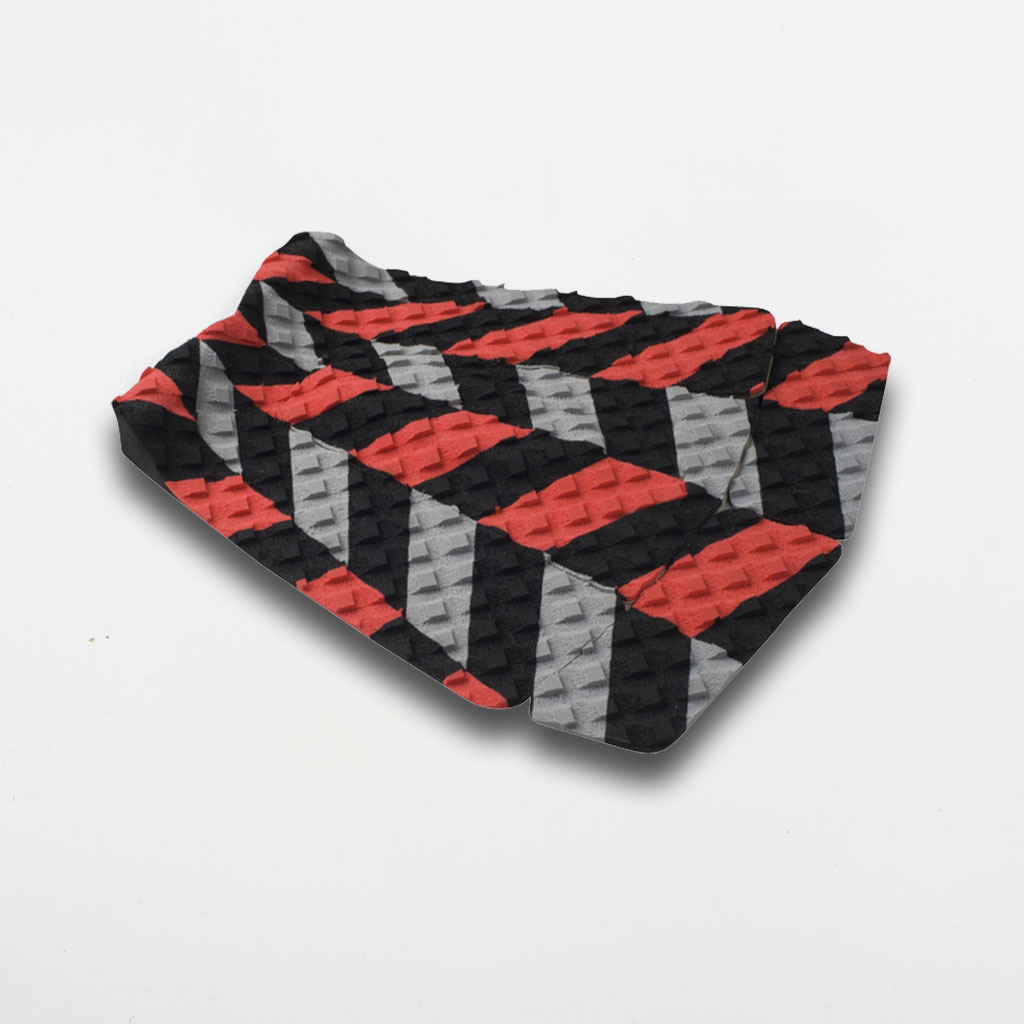
This is a three-piece surfboard traction pad for the tail — the zone the back foot drives off. Each set is supplied as three separate square-pattern pieces with a raised grip surface and a pre-applied 3M adhesive backing, so fitting is a peel-and-press job: no glue, no clamps, no mixing.
Shops fit it to boards going onto the rack, surf schools fit it to fleet boards that need a wax-free tail, and brands work it into an accessory range as a stock pattern. It also covers the replacement case: when an old pad has gone smooth or lifted at the corners, a fresh set goes on in the time it takes to dewax the tail and let it dry.
We are one of the surf board manufacturers that store chains and surf brands purchase traction from, and we have been supplying this kind of hardware since 2007. Pattern and colour are controlled to a reference, so one delivery matches the next.
Key Features
- Three separate pieces — the set arrives as three pieces rather than one wide sheet, so each can be aligned to the tail's curve instead of being stretched or creased into place. - Square pattern — straight-cut edges line up along the stringer and leave a clean border, which is what you want when a board goes on display with the pad already fitted. A clean, dry, wax-free deck is the whole of the preparation; press it down and it stays put. - Raised grip surface — the texture stands proud of the base sheet, so the heel and ball of the back foot have something to bite on when the deck is wet. - Flexible sheet — the pad follows the rocker and dome of the tail rather than bridging over the middle and lifting at the rails. - Notched, angular cut — outline notches and cut corners let the pieces sit inside a squash, round or pin tail instead of hanging over the edge. - Repeatable fitting — a surfboard traction pad that goes on peel-and-press lets a shop fit a run of boards to the same standard, whoever is on the bench that day. - Works at assembly or at the counter — the same 3M-backed sheet is a traction pad for surfboard builders to fit before a board ships and for shops to fit before it goes on the rack.
Fitting & Installation
- Strip the old wax from the tail, then wash the deck with mild soap and fresh water. Let it dry completely — adhesive laid over wax dust or damp foam is the usual reason a pad lifts.
- Lay the three pieces out with the liner still on and stand on the board. The surfboard traction pad needs to sit under the back foot, where riders push against it, not behind it.
- Mark the outline with strips of tape or a soft pencil so each piece can go back in exactly the same position.
- Peel the first few centimetres of liner from one end, press that end down, then work along the piece with your thumb, pushing air out ahead of the adhesive.
- Fit the other two pieces the same way, keeping the gaps even so the chevron lines up across the tail.
- Press everything down firmly, with extra attention to the notches and cut corners — that is where edges lift first, on a longboard traction pad as much as a shortboard one.
- Leave the board flat for a while before waxing around the pad or taking it in the water, so the adhesive can settle. 8.
Pattern & Grip Surface
The grip comes from the raised blocks of the pattern rather than from a wax coat. The high points sit where the heel and ball of the back foot land, and the channels between them give water and sand somewhere to go instead of holding it under the sole. Most riders stop waxing the tail once a traction pad for surfboard tails is down, which keeps the deck cleaner and saves a block of wax over a season.
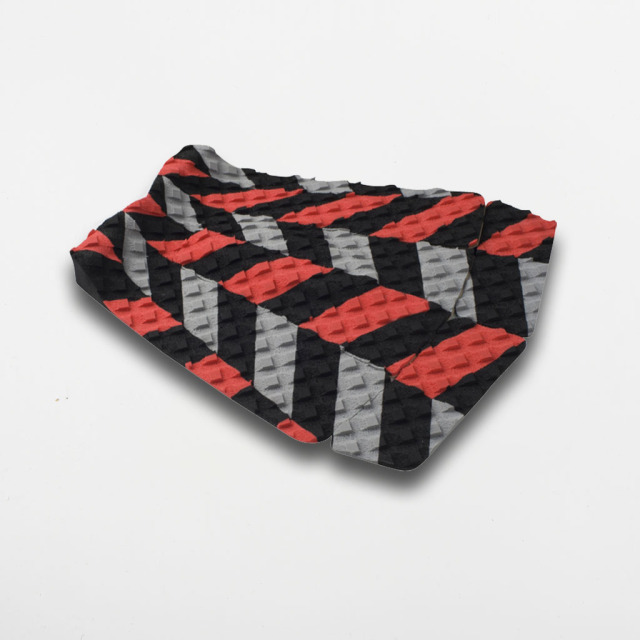
The chevron runs across the pad in red, black and grey, and the matte finish keeps those colours flat rather than glossy. On a white or clear deck the pattern gives the tail a defined edge; on a board with a spray graphic, the three pieces can be lined up so the chevron echoes the deck design. That flat finish is also what makes a surfboard tail pad easy to photograph for a catalogue or an e-commerce listing, with no glare bouncing back at the camera.
Because the pieces are separate, the chevron can be laid pointing towards the nose or back towards the tail. Decide which way it should run before the liner comes off — it is the one choice on this pad that cannot be adjusted afterwards.
Care & Maintenance
- Rinse after every salt-water session — fresh water keeps salt and grit out of the low channels of the pattern, where it otherwise grinds underfoot.
- Skip the solvents — acetone and heavy degreasers soften the 3M adhesive at the edges; mild soap and water are enough to clean a traction pad for surfboard tails.
- Scrape wax with plastic, not metal — a plastic scraper run along the pad edge lifts wax without catching the raised blocks and tearing a corner.
- Keep the board out of a hot car — sustained heat is what lets a longboard traction pad creep at the corners, and it does the board no favours either.
- Re-press lifting corners early — clean under the edge, let it dry, then press it back down with the deck flat. A corner caught early usually holds.
- Check the edges after travel — board bags and straps press on the tail, so look the pad over when you unpack and press any soft edge back down before the next session.
Range & Pairings
| Leashes | Ankle leashes from 6 ft to 9 ft, in regular and Hypalon strap builds |
| Fins | Honeycomb, honeycomb carbon and timber, in single tab, double tab and box systems |
| Tail pads | Surfboard tail pad formats across the range, in square, graphic and plain designs |
| Traction | Tail pads, centre pads, skimboard pads and waxless pads |
| Longboard options | Longboard traction pad and wider centre pad formats for longer decks |
| Covers | Basic bags, regular bags and stretch covers for daily storage and travel |
| Racks | Travel rax and tie-downs, storage racks, display racks and bike racks |
| Wax inserts | Wax combs and inserts for deck preparation |
Specifications
| Specification | Detail |
|---|
| Model | T27022 |
| Pieces per set | 3 |
| Pattern | Square |
| Adhesive | 3M pressure-sensitive backing |
| Backing liner | Peel-off release paper |
| Surface | Raised textured grip |
| Form | Notched flat sheet with cut corners |
| Mounting position | Tail, under the back foot |
| Sheet | Flexible, conforms to the deck curve |
| Board types | Shortboards, funboards and longboard tails |
Ordering & Delivery
- Send the model code, the quantity and the boards the pad is going on.
- Confirm minimum order quantity, price and lead time for your destination. These are set per item and per order, and we put them in writing before production starts.
- Confirm packing and labelling: poly bag or header card, barcode, hang tag or carton marking, whichever your shelf and your warehouse need.
- Ask your sales contact about sample availability and the current sample lead time before you commit to a bulk run.
- 6. Confirm the shipping terms, documents and import paperwork with us before the goods leave.
Scale & Supply Capability
CIMI is a factory-based supplier with 16 years in surf and watersports hardgoods, manufacturing at our own facility rather than sourcing through traders. Chain stores, supermarkets and surf-brand stores buy from us because one supplier covers a full accessory assortment, so a season's order and its reorders can be planned together. We take on OEM and private-label work, adapting designs, colourways and branding to your programme, and we schedule production against your agreed range plan. Send us your buy list and target dates, and we will confirm what we can make and when.
FAQ
How many pieces come in one set, and how do I decide where each one goes?
A set contains three pieces, cut in a square pattern. They sit across the tail under the back foot, and because they are separate you can open or close the gaps slightly to suit the tail width instead of forcing one wide sheet flat. Keep the gaps even so the pattern stays aligned, and dry-fit the whole surf traction pad with the liner on before anything is stuck down.
Will the 3M adhesive hold on a board that has already been waxed and ridden?
It will, provided the deck is prepared properly. Scrape off the old wax, wash the residue away with mild soap and fresh water, and let the tail dry completely before the liner comes off. Adhesive laid over wax dust or a damp surface is the usual reason a surfboard tail pad lifts at a corner, and it is entirely avoidable.
Can I trim the pad if my tail is narrow or pointed?
Yes — trim before the liner comes off, work in small steps from the edge and test-fit as you go. Cut through the notches rather than across the raised blocks where you can, and take a little off each piece rather than everything off one, so the pattern still reads evenly. Fitting a traction pad surfboard shapers trim for a custom tail follows the same rule: remove less than you think you need.
Which boards does this pad suit?
It is sized for shortboards and funboards and works on longboard tails as well. This surfboard traction pad needs a tail wide enough for three pieces to sit side by side with an even gap; on a very narrow pin, trim the two outer pieces. If you are unsure, send us the tail width and we will tell you how the set will sit before you cut anything.
Does the grip work without wax?
Yes. The raised pattern grips a wet deck on its own — the high points give the foot an edge and the channels drain water away. Most riders leave the pad bare and wax only the deck in front of it. If you do wax over a surfing traction pad, keep the coat thin so the texture still shows through.
Can we order this pad with our own logo or colourway?
Yes. Custom graphics, colourways and branding are part of what we do as surf board manufacturers, and a pattern can be adapted across the three pieces so it breaks in the right place. Send your artwork or a colour reference and we will confirm what can be reproduced on this pad before anything goes into production.