Product Overview
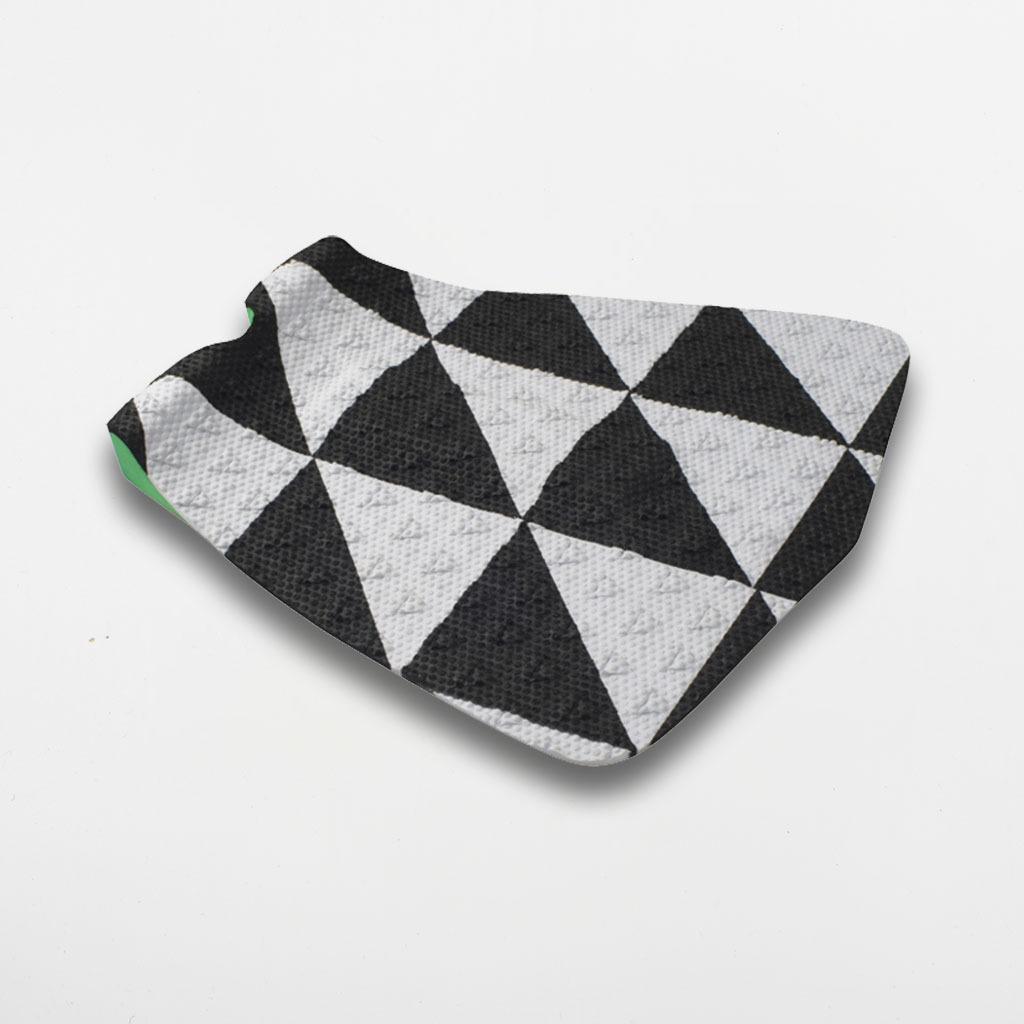
This single-piece surf traction pad is shaped for the tail of the board, the section your back foot drives through every turn. The deck face carries a DOT pattern, the backing is 3M adhesive, and the pack contains one pad — enough to cover the tail of one board with nothing else to buy.
The tail is the part of a deck that works hardest. Wax gives out there first, heel and toe pressure polish the surface, and a board with years of life left in it starts to feel vague under the back foot. Fitting a surfboard traction pad puts a permanent textured layer over that area and takes wax out of the equation for the part of the deck you push against most.
Shops fit them during board assembly, schools fit them to rental fleets, and wholesale buyers stock them as a replacement part a customer can pick up without being measured. Because the pad is one piece, with no separate arch or kick sections to keep matched, there is one code to order, one shelf position to manage and one line on the reorder sheet.
Dot Pattern Grip
- Raised dots, not a flat sheet. The deck is a regular grid of raised dots, so the back foot rides on a series of contact points instead of one smooth surface. Between those points the surface steps back down, which gives water and sand somewhere to sit rather than directly under the heel.
- The same feel in both directions. The grid repeats evenly across the whole pad, so it reads the same whether the back foot is square on the tail or angled into a turn.
- The dot layout identifies the code. On a wall of surfboard tail pad designs, this is the one a customer can describe without pointing at a photo, which keeps repeat purchases landing on the same pattern.
- Wear you can see. When the tops of the dots flatten and stop standing as separate points, the pad has told you it is close to replacement — well before the grip actually goes.
- One piece or part of a set. These surf traction tail pads work alone on the tail, and they can also be paired with a centre pad and a surf front traction pad when a rider wants grip running further up the deck.
- Holds its shape on display. Fine dot detail photographs cleanly and keeps its definition on a peg or a counter, so the pad still looks intentional after a season of handling.
Tail Pad Range & Assortment
The DOT pad is one design inside a wider tail pad range rather than a stand-alone item. Every code in the range does the same job — covering the tail deck and giving the back foot something to push against — and they differ in the pattern cut into the deck and the graphic that pattern creates. That makes the range easy to plan: choose two or three patterns, give each one a place on the wall, and let the customer choose between them. Any traction pad for surfboard use in the range can be reordered by its own code, so a pattern that sells in one store can be repeated in another without changing anything else on the order.
Tail width decides which pad fits and which one is too much. A pad that overhangs the rail or runs past the tail edge will lift at the corner, and one set too far forward leaves the actual tail bare — the opposite of the job. Wider decks, including a longboard traction pad used on a longer board, need a footprint that covers the tail without crowding the leash plug. Send us the board model and tail width and we will tell you which code is the closest match.
For assortment planning, treat the pad as a replacement part with steady, unglamorous demand rather than a seasonal push. Boards already in the water outnumber new boards sold, so replacement is the volume; the pattern mix decides how much of that replacement business your store captures. Keep one core pattern deep, add a second or third graphic for display variety, and reorder on the same codes so the wall stays consistent between seasons.
Fitting & Installation
- Strip the tail back to bare deck. Lift any old pad, scrape off old wax and adhesive residue, then wipe the area down so it is clean and completely dry. Adhesive only works on the surface it is given.
- Dry-fit before you peel anything. Set the pad on the tail, stand on it in your normal stance and check that it sits under the ball and heel of the back foot with the tail edge still clear.
- Check the leash plug and any tail hardware. If the pad would sit over the plug, mark and cut that opening before fitting, never after the adhesive is exposed.
- Mark the outline. Run a strip of tape along the tail edge or draw a light line on the deck itself — never on the adhesive side of the pad.
- Peel the backing in stages. Expose a strip at the front edge, set it on your mark and press it down before peeling the rest of the liner away a little at a time.
- Work from the centre outwards. Push the air towards the edges with your thumbs or a soft roller, and spend extra time on the corners, which is where a surfboard traction pad lifts first.
- Let it bond. Give the 3M adhesive time to settle before riding, and keep the board out of the water and out of a hot car while it does.
- Keep wax off the pad. Wax worked into a textured surface fills the pattern and undoes the reason for fitting it.
Care & Removal
- Rinse rather than scrub. After salt water, a quick rinse and a soft brush through the gaps between the dots is enough. Harsh solvents and abrasive cleaners dull the surface and creep under the edge.
- Keep wax where it belongs. Wax the deck ahead of the pad only; wax worked into the dot grid fills the pattern and takes the texture out.
- Watch the heat. A board left in a hot car or full sun is where a surfboard traction pad usually starts to lift at the corners.
- Check the border regularly. Run a thumb around the edge; a lift caught early can be pressed back down, while one left alone collects sand and grows.
- Removal, when the time comes. Warm the pad gently, lift from a corner and peel slowly, then scrape and wipe the deck clean before anything new goes on.
- Know when it is finished. A traction pad for surfboard use has reached the end when the dots have flattened and the surface reads smooth under a hand. Replacing it then is cheaper than waiting for a foot to slip.
- Keep the code on file. These surf traction tail pads are reordered by code, so note the code inside the shop before the old pad goes in the bin.
Related Accessories
A board leaves the shop as a set, and the pad is only one part of it. CIMI supplies the leash side of that set in regular, non-slip strap, Hypalon strap, bodyboard and SUP versions, so the same account can order a surfboard tail pad and a matching leash on one purchase order. Covers follow the same logic — a basic bag or a regular bag for everyday storage, a stretch cover for travel — sized to the boards the pad is fitted to.
The fin programme runs alongside traction: honeycomb, timber, G10 glass and nylon fins across single tab, double tab and box systems, plus fin accessories. On the traction side the range continues past the tail with centre pads, skimboard pads and waxless pads, and a rider who wants a surf front traction pad can be fitted from the same catalogue instead of being sent elsewhere.
Racks complete the picture — travel rax and tie-down, storage racks, display racks and bike racks. We supply these families together because a wholesale buyer sourcing from several surf board manufacturers spends more time chasing paperwork than selling product; one supplier, one schedule and one point of contact keeps a season's range moving.
Specifications
| Product type | Surf traction pad |
| Part no. | T27024 |
| Pieces per pack | 1 |
| Deck pattern | DOT |
| Adhesive | 3M |
| Fitting position | Tail deck, under the back foot |
| Board types | Shortboards, hybrids and longboards |
| Colourways | Confirmed with each order |
| Foam grade and thickness | Confirmed with each order |
| Packing configuration | Confirmed with each order |
Ordering & Delivery
- Send the buy list — codes, quantities and colourways, split by store or region if the order ships to more than one place.
- Confirm the fit before the quantities are fixed. Tell us the board types you are fitting; a shortboard pad and a longboard traction pad do not share the same footprint, and we will confirm which code matches your tail widths.
- Settle the packing and labelling. Poly bag, header card or bulk carton, and what needs to appear on the label, are all confirmed with your sales contact for each order.
- Approve the artwork and the pre-production sample. As surf board manufacturers we produce against the approved sample, so the details agreed at this stage are the details that repeat.
- Agree the schedule. Lead time, shipping terms and payment terms depend on the quantity and the season, and are confirmed with your sales contact rather than fixed on this product.
- Ask about sample availability and current lead times before you commit a launch date, so the range lands when the store needs it rather than when production allows.
Scale & Supply Capability
CIMI is a factory-based supplier with 16 years in surf and watersports hardgoods, manufacturing at our own facility rather than sourcing through traders. Chain stores, supermarkets and surf-brand stores buy from us because one supplier covers a full accessory assortment, so a season's order and its reorders can be planned together. We take on OEM and private-label work, adapting designs, colourways and branding to your programme, and we schedule production against your agreed range plan. Send us your buy list and target dates, and we will confirm what we can make and when.
FAQ
What does the DOT pattern do that a plain flat pad does not?
The deck of this surf traction pad is a grid of raised dots rather than one continuous surface, so the back foot sits on a set of defined contact points with gaps between them. Those gaps are where water and sand end up instead of directly under the heel, and they are also what makes wear easy to read: once the dot tops flatten, the pad is telling you it is near the end of its life.
How do I know it will fit my board?
Measure the tail width where your back foot lands, then compare it with the pad before peeling anything. The right traction pad for surfboard tails sits fully on the deck with the tail edge and the leash plug still clear — no overhang past the rail, and no bare strip left at the very back. Dry-fit it first, and if it does not sit cleanly, send us the board model and tail width and we will point you to a closer code in the range.
Is this for the tail or for the front foot?
This is a tail pad. It goes on the back section of the deck, under the rear foot, and comes as a single piece. If a rider wants grip further forward as well, that is a separate surf front traction pad or a centre pad from the same traction range, ordered as its own code.
Can I fit a new pad straight over the old one?
No. These surf traction tail pads are designed to go onto bare, clean, dry deck. Any old pad, wax and adhesive residue has to be removed first, because the 3M backing bonds to whatever surface it is given — and an uneven surface under the pad is what causes corner lift later on.
Does it work on a longboard?
It can, provided the footprint sits inside the tail area. A longboard traction pad usually needs a wider or differently proportioned footprint than a shortboard pad, so the check is simply whether the pad covers the stance area without running past the rail or over the leash plug. Tell us the board and tail width and we will confirm whether this code or another in the range is the better fit.
Will the 3M adhesive hold once the board is in the water?
The backing is 3M adhesive, and like any pressure-sensitive adhesive it depends on the deck underneath. A clean, dry, wax-free surface and a firm press from the centre outwards are what make the difference. Give it time to bond before the first session and keep the board out of the water and out of a hot car while it sets — a surfboard tail pad that lifts is almost always a preparation problem rather than an adhesive one.
Can the pad carry our own graphic or branding?
Private-label and OEM work is part of what we do, so graphics, colourways and branding can be discussed for your programme. Share the artwork and the quantities you have in mind with your sales contact and we will confirm what is possible for this pad and what it means for the schedule.