Product Overview
T27026 is a two-piece surf traction pad made for the tail of a surfboard — the section of deck a rider's back foot drives through every turn. It arrives as a matched pair of pieces cut in a square pattern, each backed with 3M adhesive, so fitting is a matter of preparing the deck and pressing the pad down rather than mixing resin or glue.
The pad covers the deck behind the rear fin cluster and under the back foot. That is the area which takes the heaviest and most repeated pressure, and the area that wears smooth first, which is why a surfboard tail pad is usually the earliest piece of grip a board needs replacing. A shop fitting one for a customer restores the drive the rider had when the board was new; a board builder fitting one finishes a new deck before it leaves the workshop.
Supplying the pad in two pieces gives a fitter something a single-sheet traction pad for surfboard tails cannot offer. Each half can be positioned and checked on its own before any adhesive is committed, which matters on a tail with a pronounced curve, a squash or a narrow pin, and it makes it easier to keep both sides symmetrical and leave a clean line along the tail's edge.
This is a tail pad, not a full deck covering. Front-foot grip comes from a separate surf front traction pad, and the two are normally bought together when a board is being set up from scratch or when a shop is building a traction wall.
Pattern & Grip Surface
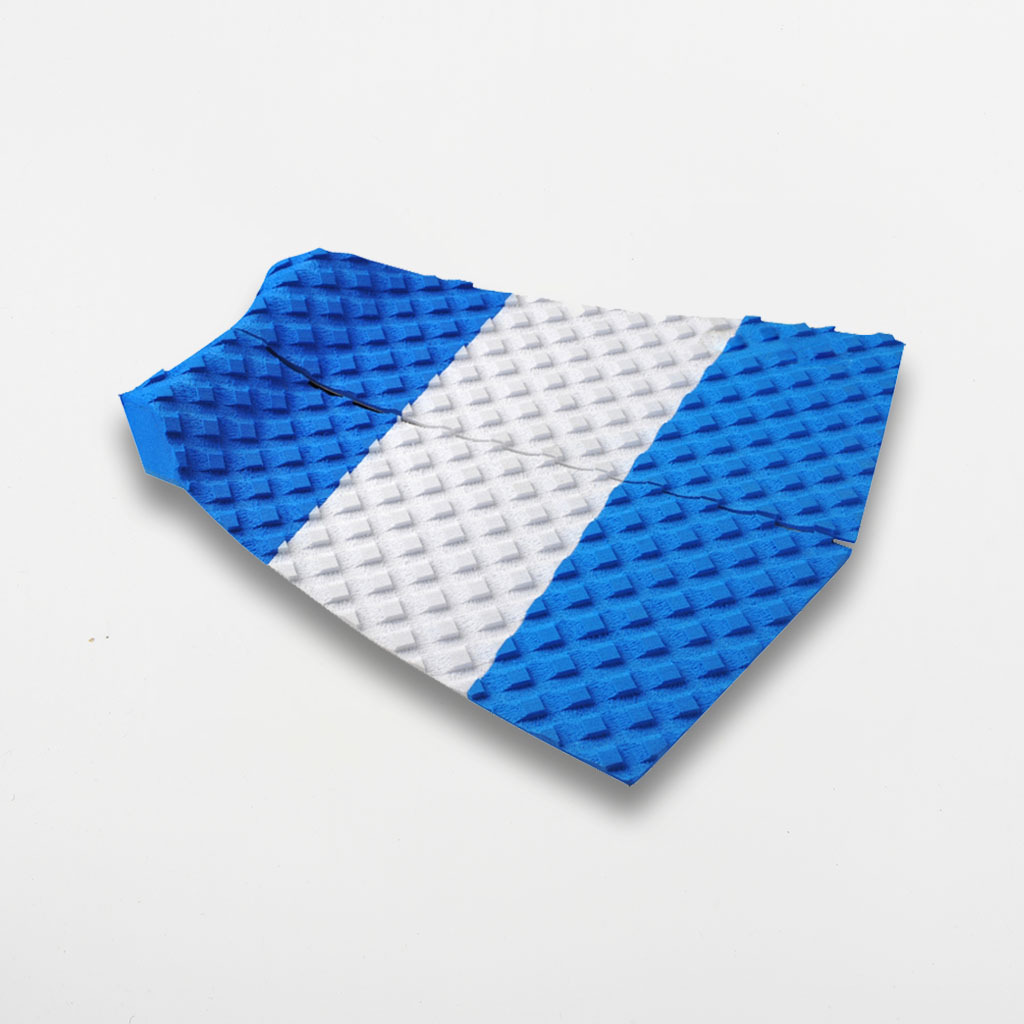
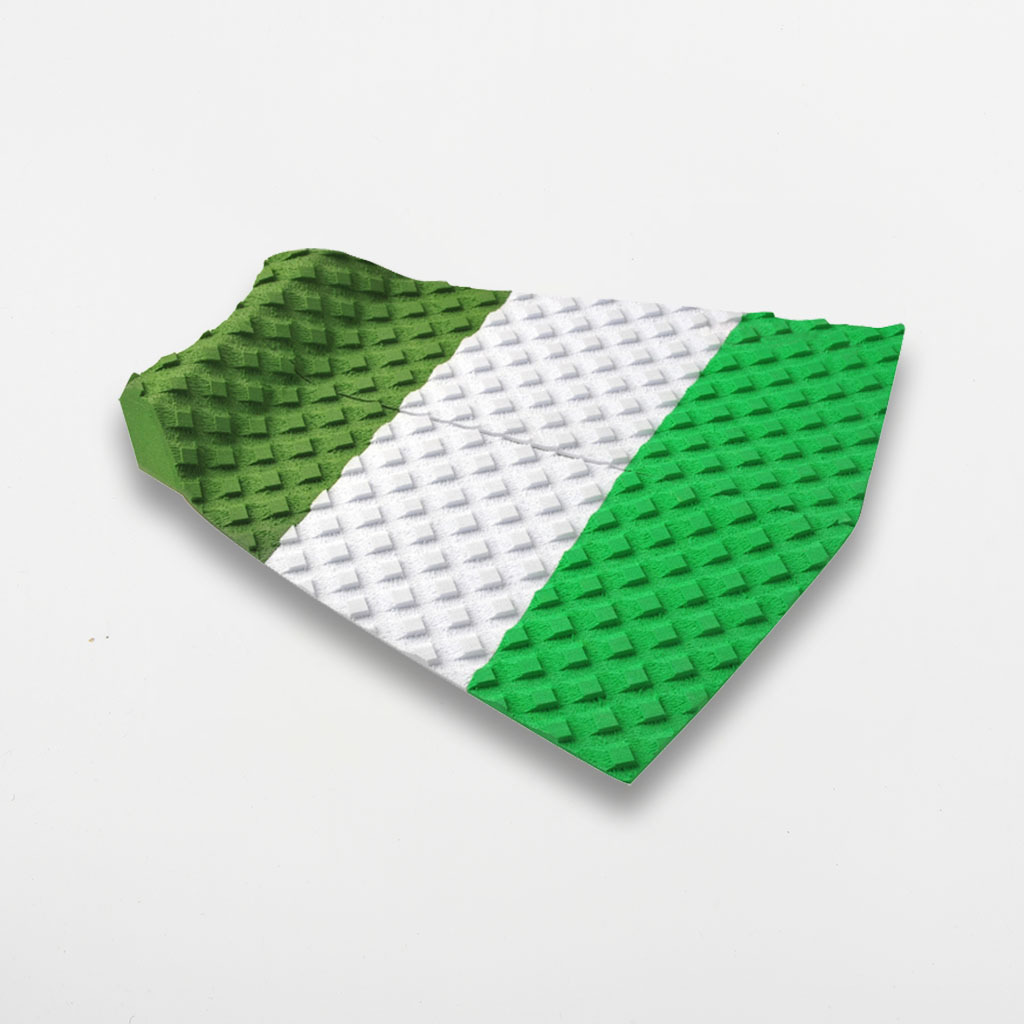
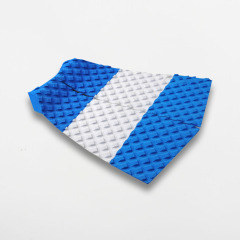
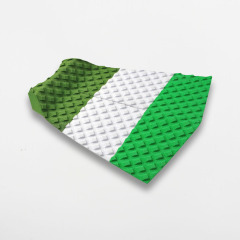
- Square pattern, predictable underfoot. This surfboard traction pad is cut as a square waffle — a grid of raised blocks with channels running between them. Water moves into the channels instead of sitting as a film under the foot, which is the difference between grip that holds on a wet take-off and a surface that feels slick. - Raised waffle texture. The blocks lift the sole slightly clear of the flat deck, so the foot presses onto edges rather than sliding across a plane. Fitters notice it most when a rider steps back for a cutback and the heel lands hard. - Wax-free grip on the tail. The texture does the job wax does on the tail, without the weekly scrape-and-reapply routine. That suits rental fleets and school boards, where staff need the same grip on every board with no maintenance between sessions. - A flexible sheet that follows the tail. The pad is a flexible foam-like sheet rather than a rigid plate, so it bends with the tail's curve instead of standing off at the edges. That is what keeps a longboard traction pad flat across a wide tail, and a pad that sits flat to the deck is a pad that stays stuck. - Colour-blocked top. The samples shown are blue and white and green and white, with the white traction pad panels set against the brighter block for a two-tone look on the deck. - Matte finish. The surface is matte rather than polished, so it does not glare in the sun and does not show smears the way a gloss top does.
Care & Pad Life
Salt is what ages a grip surface fastest, and fresh water is most of the answer. A quick rinse after a session clears the salt film out of the waffle and keeps the blocks feeling sharp underfoot; it takes a fraction of the time a wax scrape does, and on a white traction pad the salt line shows plainly enough to tell you when it is due.
Keep harsh chemistry away from the pad. Solvent-based cleaners, acetone and adhesive removers attack both the foam and the bond, and once an edge lifts, water works its way underneath and the pad starts peeling from the tail end. Mild soap and water is enough for anything that accumulates on the deck.
Heat is the other common cause of failure. A board left in a hot car or standing in direct sun softens the adhesive, and that is usually the moment an edge starts to curl. Storing boards out of the sun costs nothing and adds seasons to a surfboard traction pad.
Run a thumb along the edges every few sessions. Any lift can be pressed back down while the adhesive is still sound; left alone, it collects sand and stops re-bonding. When the raised blocks have worn flat and the surface feels smooth under a wet foot, the pad has done its work and it is time for a new one.
A longboard traction pad generally takes more punishment than a shortboard tail, because the rider's feet move up and down the deck between trim and turns. Check the rear edges on those boards more often.
Fitting & Installation
- Clean the tail deck first. Strip old wax, peel away any previous pad and wipe off adhesive residue, then let the tail dry completely. If a pad lifts, the adhesive is rarely the culprit—a surfboard traction pad will only bond properly to a clean, dry, dust-free surface.
- Mark the centreline. Run a light line down the stringer from the tail so both halves share one centreline and the finished pad looks straight from the water.
- Dry-fit the traction pad for surfboard tails before peeling anything. Lay both pieces on the deck, check the width against the board's edges, and make sure the pad clears the leash plug and any tail kick.
- Place one piece at a time. Peel the backing from one half, set it against the centreline, and work outward from the middle of the piece with the flat of your hand.
- Chase the air out. Press from the centre towards the edges so trapped air is pushed ahead of the adhesive rather than sealed underneath. Run a thumb firmly along every edge, especially the tail end where water sits longest.
- Repeat on the second piece, then sight down the tail to confirm both halves line up and the gap between them is even.
- Let it settle before the board goes in the water. Give the adhesive time to bond, then check the edges after the first session and press down anything that has started to lift.
Matching Gear Across the Range
- One supplier for the accessory wall. As surf board manufacturers we build pads alongside fins, leashes, covers and racks, so a shop can put a season's accessory order together in one pass instead of splitting it across suppliers.
- Leashes. Hypalon strap leashes run from 6 ft 6 mm for small to medium waves and 7 ft 7 mm for all-around conditions, up to 8 ft 7 mm for medium to large waves and longer boards, and 9 ft 8 mm for longboards and bigger surf. Match length to board length and thickness to the conditions the rider meets.
- Fins. Honeycomb fins in single tab and double tab. Confirm which system the board's fin boxes take before ordering, because the mounting is not interchangeable between them.
- The rest of the traction family. Tail pads like this one, centre pads, skimboard pads and waxless pads. A surf front traction pad covers the front foot, while the tail piece covers the back, so a board built from scratch usually needs both.
- Covers. Basic bag, regular bag, stretch cover and bodyboard bag — the everyday protection a shop sells alongside a board and the first thing a new owner asks for.
- Racks. Travel rax and tie-downs, storage racks, display racks and bike racks. Display racks are what shops use to merchandise pads and fins where customers can see the patterns side by side.
Specifications
| Product type | Surf traction tail pad |
| Model | T27026 |
| Pieces per set | 2 |
| Pattern | Square |
| Grip surface | Raised waffle texture |
| Sheet construction | Flexible sheet cut to the tail outline |
| Adhesive | 3M backing |
| Fitting position | Tail deck |
| Deck coverage | Tail section |
| Fixing method | Peel-and-stick application |
| Surface finish | Matte |
| Tail shapes | Squash, pin and rounded tails |
| Packing | Bulk cartons or prepacked sets agreed per order |
Ordering & Delivery
- Send the buy list. Model, colourway, quantity per product and any packing or labelling requirement, so the order can be quoted in one pass.
- Approve the pattern and colourway on a physical sample before a production run starts. Ask your sales contact about sample availability and timing for the season you are buying for.
- Decide how it ships. Bulk cartons suit a distributor; if your chain needs shelf-ready packing and barcodes, say so on the buy list so it can be quoted in.
- Confirm the commercial terms with your sales contact. Lead time, shipping terms and payment terms depend on quantity, packing and season, and are agreed per order rather than fixed on this product.
- Split the quantities if the order serves two purposes. If you need a traction pad for surfboard repairs and for new-board builds in the same shipment, say which quantity is for which, so packing can be planned around both.
- Keep the approved sample on file. Repeat orders are matched against it, so next season's batch lines up with the one you signed off.
- Combine pads with fins, leashes, covers and racks on one order and one shipment, which is how most shops buy the accessory range.
Scale & Supply Capability
CIMI is a factory-based supplier with 16 years in surf and watersports hardgoods, manufacturing at our own facility rather than sourcing through traders. Chain stores, supermarkets and surf-brand stores buy from us because one supplier covers a full accessory assortment, so a season's order and its reorders can be planned together. We take on OEM and private-label work, adapting designs, colourways and branding to your programme, and we schedule production against your agreed range plan. Send us your buy list and target dates, and we will confirm what we can make and when.
FAQ
Does this pad cover the whole deck or only the tail?
Only the tail. The two pieces sit under the back foot, from behind the rear fin cluster to the tail end of the board. Front-foot grip is a separate item — a centre pad or surf front traction pad. If you are setting up a bare board, order the surfboard tail pad and a centre pad together.
Why is the pad supplied in two pieces?
Two pieces let a fitter set each half separately, check it against the centreline and the tail's edge, and only then commit the adhesive. A squash, swallow or narrow pin tail has no single-sheet shape that lines up cleanly on every board, and the split also means one pad code covers a wider spread of tail shapes for a shop carrying replacements.
Do I need glue or resin to fit it?
No. The pad is backed with 3M adhesive and goes straight onto a clean, dry deck. The work is all in the preparation: strip the old wax, remove adhesive residue from a previous pad, and let the deck dry completely before anything is peeled. A surfboard traction pad fitted onto a damp or waxy surface will lift at the edges, whatever adhesive is behind it.
How does the square pattern feel underfoot once the board is wet?
The raised blocks are what make the grip work. Water runs into the channels between them instead of sitting as a film under the sole, so the foot finds an edge rather than sliding across a flat surface. That is also why this surf traction pad is fitted without wax — the texture provides what the wax would otherwise supply.
Which colours can I order?
The samples shown are blue and white and green and white, both built around white traction pad panels with a brighter block. Colourways are agreed per order, so confirm the exact combination on a physical sample before the production run and keep that sample as the reference for repeats.
Will it work on a longboard?
A longboard traction pad usually covers the tail in the same way, though longboard riders often wax most of the deck and use the pad only where the back foot lands. Check your tail width against the pad before ordering — on a wide longboard tail the two pieces leave more deck showing at the rails than they do on a shortboard.
Can I trim the pad to fit a narrower tail?
Trimming is possible on a foam-backed pad, but dry-fit it first and mark the line before you cut, because once the shape is changed there is no going back. If you are unsure how the two pieces will sit on a particular board, send us the tail width and we will tell you whether this pad or another in the range is the better match.