Product Overview
T27034 is a grip set for the tail of a surfboard. It is the part of the board a rider's back foot works against — the pad that keeps the foot steady through a bottom turn, off the top, or on a late drop when the tail is loaded and the deck is already wet.
Board builders and surf board manufacturers fit it during assembly, so a new board leaves the rack with grip on the tail. Shops, distributors and surf schools buy it as a replacement part for boards whose original pad has gone smooth, lifted at a corner or lost its pattern after a season. Either way the job is the same: put dependable grip back where the rider's weight actually goes.
The backing is a pressure-sensitive adhesive, so fitting happens on the bench with a clean deck and firm hand pressure — no resin, no clamps, no workshop curing. A shop can fit a set between customers; a builder can fit it as the last step before the board is bagged.
For anyone putting together a grip wall or a board programme, this is the anchor item: a clean square grid that suits shortboards and longboards alike, a black surface that sits with any graphic, and a surf traction pad a customer understands at a glance without a member of staff explaining it.
Grip & Surface Feel
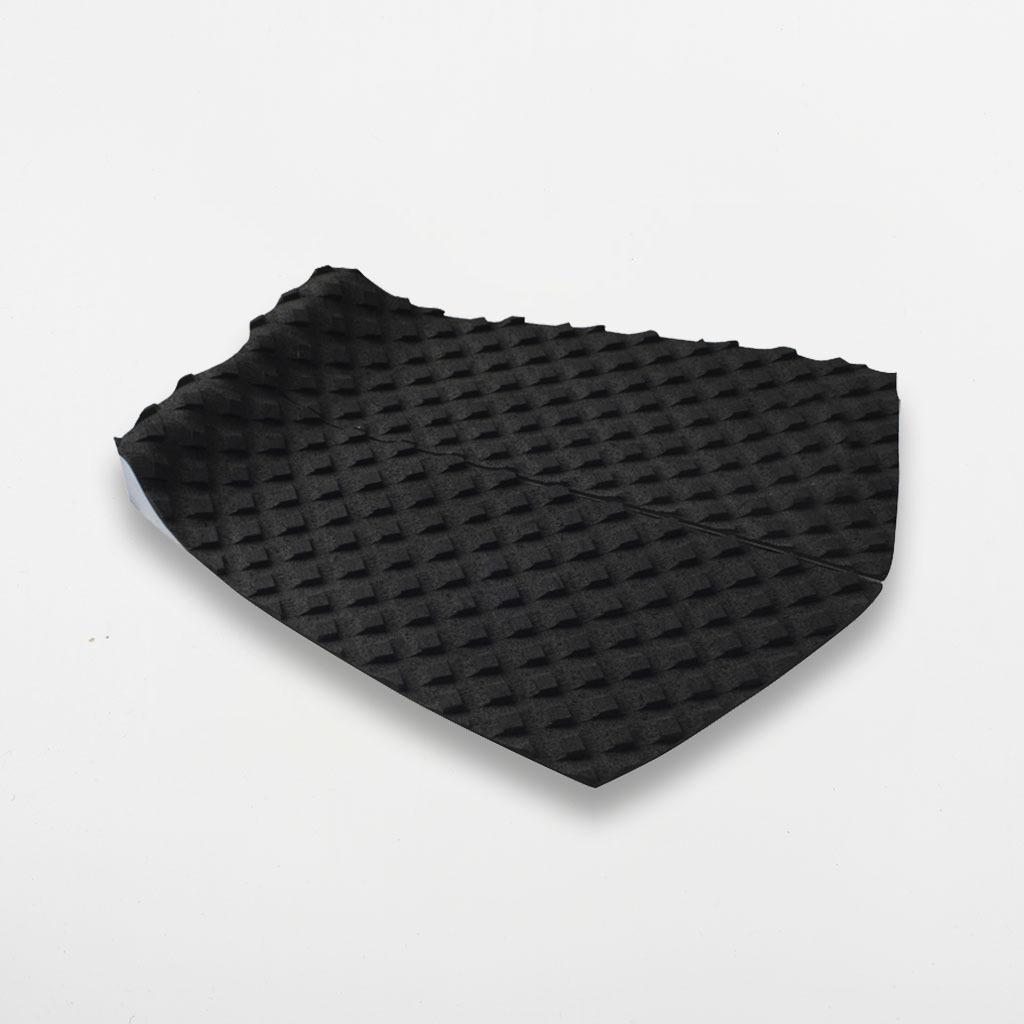
- Raised square grid. Small squares stand proud of the base, giving the foot a row of edges to press against. Riders feel where the back foot has landed without looking down, which matters most when the tail is buried in a turn.
- Matte surface. Low sheen rather than gloss, so it does not throw glare back at the rider in bright sun and does not show handling marks the way a polished deck pad does.
- Contoured outline. The pad is cut to a curved shape instead of a plain rectangle, so the edges follow the tail line rather than overhanging the rail.
- Diagonal centre seam. The halves meet on a diagonal, which lets each piece sit flat on a tapering tail — a straight seam would leave one side bridging a hollow in the deck.
- Moderate relief. Deep enough to bite under a bare foot, shallow enough that it does not bruise through a long paddle. That balance matters most on a longboard traction pad, where the foot rests on the tail for long stretches.
- Deck-side fit. As a surfboard traction pad, it adds only the height of the pattern to the tail, so the board still sits the same underfoot and still slides into its bag.
- Wax-free tail. Once the set is down, the tail needs no wax; the grip comes from the pattern, and the deck stays cleaner between sessions — an obvious gain for a school or rental fleet.
Fitting & Placement
- Strip the old pad and all wax from the tail, then wipe the deck until it is dry and free of dust or oil. Adhesive only performs on a bare surface.
- Set both pieces in place without peeling anything. Line the seam up with the centre of the board and check that the outline sits inside the rail edges.
- Mark the corners with tape so the pieces can go back in the same spot after peeling.
- Work in a warm room. Board and pad both need to be at room temperature for the adhesive to wet out — a cold workshop is the usual reason a pad lifts in its first week.
- Peel the backing from one piece, starting at a corner, and press from the middle of the pad outward. Repeat with the second piece so the seam closes cleanly.
- Roll the pad with a hard roller or press it firmly with the heel of the hand, working from the centre to the edges to push out trapped air.
- Leave the board to stand for a few hours before it goes in the water, so the adhesive can build its full bond.
- Check the edges after the first session.
Tail Shape & Selection
Tail shape decides most of the fit on a surfboard tail pad. A squash or rounded pin gives this set a straightforward footprint, and the pieces can be set with the seam on the centre line. A wide swallow tail usually wants the halves spread further apart, which the split layout allows. On a very narrow tail, dry-fit first — the pad may need to sit further back than a rider expects.
Board length changes the job the pad does. On a shortboard it is the pivot point, the place the back foot drives from through every turn, so most riders want full coverage over the tail. As a longboard traction pad, the same set has to cover a wider, flatter tail, and the two halves are usually spread a little further apart to do it.
For a shop the decision is about the grip wall rather than one board. Choosing which surfing traction pad sits next to which texture gives customers a visible choice, and because the pad is black it works beside almost any board on the rack. Build a range around the patterns you intend to repeat rather than a scatter of one-offs — the repeat pattern is what a customer comes back for.
Board builders and surf board manufacturers usually buy this set in line with the boards being finished, matching the pad to the tail template rather than to a colour card, then holding that reference for the next production run.
Buyers choosing a surfboard traction pad for the first time tend to settle it on three things: how much of the tail the pad covers, how coarse the pattern feels underfoot, and whether the outline suits the tails their customers actually ride. This set sits in the middle on all three, which is why it works as a stock line rather than a specialist item.
Specifications
| Model | T27034 |
|---|
| Set contents | 2 pieces |
| Pattern | Raised square grid |
| Surface finish | Matte |
| Adhesive | 3M pressure-sensitive |
| Colour | Black |
| Placement | Tail deck |
| Outline | Contoured to the tail line |
| Centre join | Diagonal seam |
| Relief | Moderate |
| Wax on pad area | Not required |
| Use | Replacement part or new-board fit-out |
| Board type | Surfboards with a clear tail deck area |
| Mounting | Peel-and-stick |
Care & Maintenance
- Rinse after every session. Fresh water lifts salt and sand out of the grid; salt left to dry in the pattern dulls the edges over a season.
- Mild soap, never solvent. Wax remover and acetone belong on the deck before fitting, not on the surfing traction pad afterwards — they soften the adhesive at the edges.
- Keep the board out of a hot car. Heat is the usual reason a pressure-sensitive pad lets go, and a board left in a closed car will find the corner that lifts first.
- Scrape wax with plastic. A plastic scraper or the edge of a wax comb clears the pattern without cutting into the ridges.
- Deal with lifted corners early. Press a corner back down while the adhesive underneath is still clean; once sand gets under it, it will not hold again.
- Keep sunscreen and wax off the surface. Both leave a film that fills the pattern, and a filled pattern is a slippery one.
- Store without load on the tail. Flat on a rack or standing in a board bag, with a surf leash hung loose rather than pulling across the pad.
Related Accessories
| Surf leash | Hypalon construction, several lengths and diameters, fitted at the tail beside the pad |
| Surfboard fins | Honeycomb, honeycomb carbon, timber and G10 glass in single tab, double tab and box systems |
| Centre pads | Mid-deck grip, chosen with a tail pad when a longboard deck needs full coverage |
| Skimboard pads | Flat grip panels for skimboards and similar decks |
| Waxless deck pads | Patterned deck grip that replaces wax across the board |
| Board bags and covers | Basic and regular bags plus stretch covers for storage and travel |
| Racks | Travel, storage, display and bike racks for shops, schools and home storage |
Ordering & Delivery
- Send the pattern, colour and set reference you want, with quantities per line, so a surf traction pad order can be quoted exactly as you intend to stock it.
- Confirm the pack format — whether sets are supplied bare or with a header card or hangtag for shelf display.
- Ask about sample availability and current lead time before committing to a season window; both are confirmed per order rather than held as a standing figure.
- If your own label goes on the pad or the packaging, share the artwork with your sales contact so it is planned alongside production.
- List everything that ships together — surfboard fins, covers or racks — on the same sheet, so packing and shipping are worked out once.
- Confirm payment terms, shipping terms and the destination port with your sales contact before production starts.
- Reorder against the same reference. Keeping the pattern and colour code on file is what keeps a repeat batch matching the first one.
Scale & Supply Capability
CIMI is a factory-based supplier with 16 years in surf and watersports hardgoods, manufacturing at our own facility rather than sourcing through traders. Chain stores, supermarkets and surf-brand stores buy from us because one supplier covers a full accessory assortment, so a season's order and its reorders can be planned together. We take on OEM and private-label work, adapting designs, colourways and branding to your programme, and we schedule production against your agreed range plan. Send us your buy list and target dates, and we will confirm what we can make and when.
FAQ
How much of the tail should the pad cover?
A surfboard tail pad should cover where the back foot actually lands, and no more. On most boards that means the set sits over the last section of the tail, with the outline inside the rail edges and the front edge behind the point where the heel comes down. Dry-fit before peeling: if the pad reaches forward past your natural stance, it is further forward than it needs to be.
Will this set work on a longboard?
Yes. A longboard traction pad does the same job as a shortboard one, but the tail is usually wider and flatter, which suits the split layout — the halves spread to cover the width while each piece follows the curve. On a longboard the deck forward of the tail pad is usually covered by a separate mid-deck pad, so the two are chosen together when the whole deck needs grip.
Does the pad interfere with the leash plug?
No, as long as it is positioned around the plug before the backing is peeled. A surf leash pulls from that point every time the board is ridden, so a pad edge sitting over the plug is the first thing to lift. If the plug sits further forward than expected, adjust the seam between the two pieces rather than crowding it.
Will a tail pad change how the board turns?
The pad does not touch the fin boxes, so it does not change how a set of surfboard fins behaves. What changes is the input above them: with grip on the tail the back foot can push harder without sliding, and the fin response feels more direct because the turn starts from a planted foot. If the board feels different after fitting, check the pad position first — a pad set too far forward moves where the foot naturally lands.
How is a tail pad different from a centre pad?
Both are surfboard traction pads, but they cover different parts of the deck. A tail pad sits over the back foot and is shaped around turning: the pattern, the outline and the split layout all follow a tail. A centre pad covers the middle of the deck, usually on a longboard or a board that gets walked, where the job is grip under a moving foot rather than a planted one. Skimboard pads and waxless deck pads follow the same idea for their own boards.
How much does the pattern change the feel underfoot?
More than most riders expect. A raised square grid like this one gives a firm, positive feel: the edges are easy to find with a bare foot and the grip stays consistent when the deck is wet. A finer or flatter surfing traction pad feels smoother underfoot but gives less feedback. Riders who spend long stretches on the tail, or who surf in boots, tend to prefer more relief; riders who want a smooth deck under the hand prefer less.