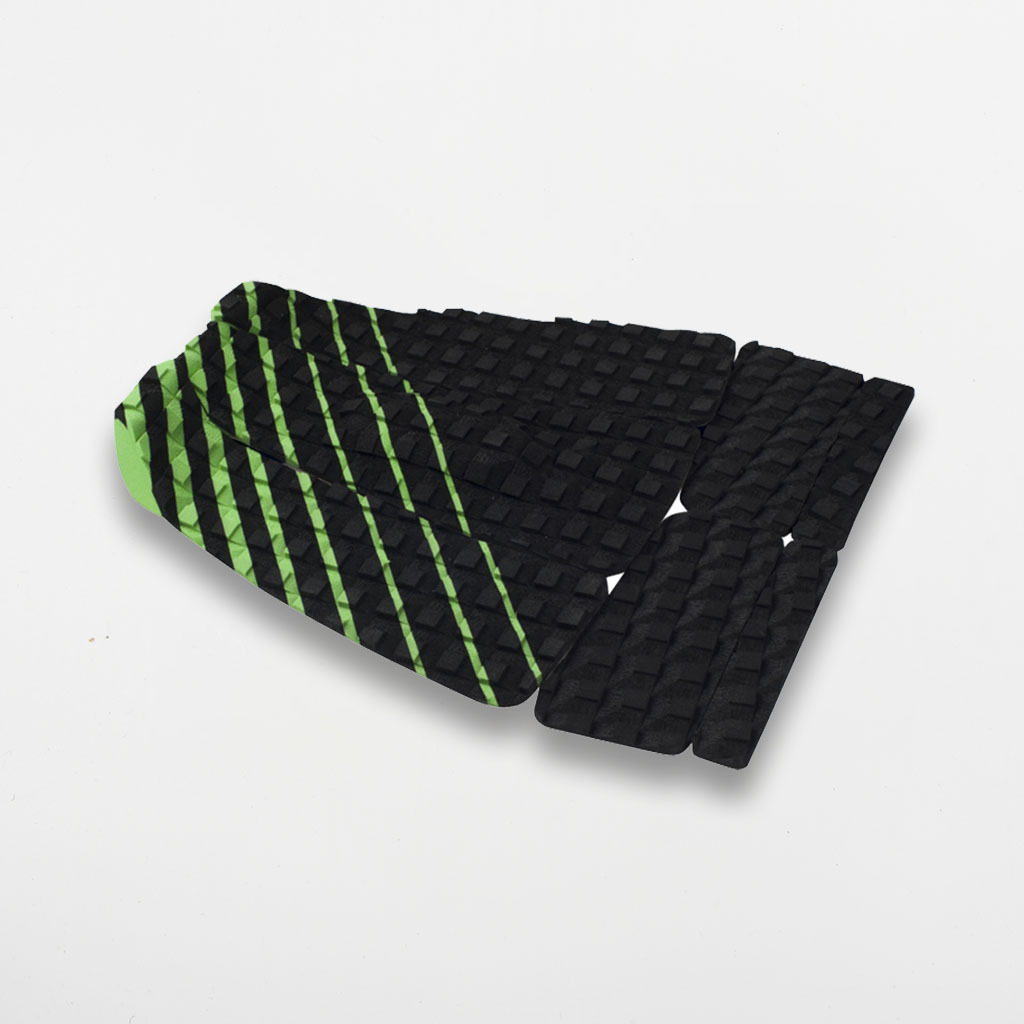
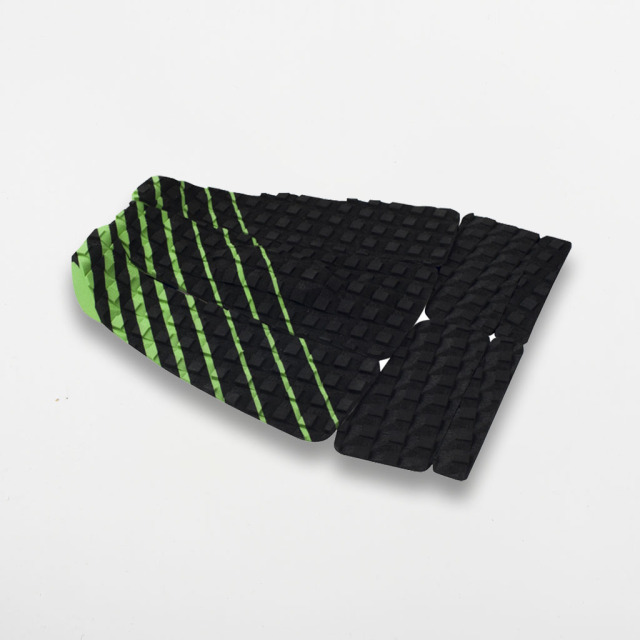
This surf traction pad forms the rear grip section of a surfboard deck and arrives as a seven-piece set with adhesive already applied to the back of every piece. Each segment carries a square block pattern and a diamond-textured top, so the pad goes down as a series of blocks that follow the curve of the tail instead of one stiff sheet that has to be forced into place. Board builders fit it while a new board is going together. Shops fit it when a customer walks in with a used board and a worn or missing pad. Surf schools and rental operators fit them in batches along a surfboard rack, where the same layout has to work across a fleet of similar boards. Because the set arrives as separate pieces, you can spread or close the gaps slightly to suit the width of the tail in front of you, which is the main reason a fitter reaches for a segmented pad rather than a single cut sheet. Nothing is trimmed in the workshop and nothing is mixed from a pot. The liner is peeled and the pad is pressed, so a fit is a bench job measured in minutes rather than an afternoon of clamping and cleaning up glue.
A traction pad for surfboard use has one real job: sit flat on the deck behind the back foot without lifting at an edge. That section changes shape from board to board — squash, rounded pin, wide fish, swallow — and the seven-piece layout is what lets one set cover all of them. On a narrow shortboard tail the pieces sit close together. On a wider tail you open the spacing so the coverage follows the outline instead of bunching in a block in the middle, and the same set works in a longboard traction pad position behind the fin area.
Before ordering, measure the tail width roughly a hand's length up from the tail tip and compare it with the spread of the set in the photos. If there is an old pad on the deck, strip it and clean the area first. Adhesive will not bond to wax, salt or old residue, and that is the most common reason a new pad lifts early.
Two checks are worth doing on the bench. Look for a deep double concave or a steep kick in the tail, because the segmented pieces have to sit down into it rather than bridge across it. Then make sure the deck is dry before anything is peeled. If your tail is unusually wide, narrow or heavily shaped, send us the board model and the tail width and we will tell you how the set sits before you commit to a run.
A board does not leave the workshop with a tail pad alone, and buying the rest of the hardware from the same source saves a container's worth of paperwork. Alongside this pad we make the parts that sit around it: a surf leash in regular, non-slip strap and Hypalon strap versions, plus bodyboard and SUP leashes; surf fins in honeycomb, timber, G10 glass and nylon, with the fin accessories that go with them; centre pads, skimboard pads and waxless decks in the traction line; covers running from a basic bag through a regular bag to a stretch cover and a bodyboard bag; and a rack line covering travel rax and tie-downs, storage racks, display racks and bike racks.
For surf board manufacturers building complete boards, that means one purchase order can carry the pad, the leash and the fins that belong to the model, in a single colour story. For a shop or a distributor it means one supplier to chase when a season runs late, and one set of contact details when a customer asks for a part that is not on the shelf.
Ask for the current accessory list alongside your pad order. Ranges move, and the list we send you should be the one that matches what is actually in production.
| Property | Value |
|---|---|
| Product code | T27036B |
| Product type | Surf traction tail pad |
| Family | Traction tail pads |
| Pieces per set | 7 |
| Layout | Segmented multi-piece |
| Pattern | Square blocks |
| Grip surface | Diamond texture |
| Adhesive | 3M |
| Mounting | Self-adhesive, peel-and-stick |
| Board position | Tail / rear deck |
| Set coverage | Rear deck grip zone behind the back foot |
| Range companions | Leash, surf fins, cover, rack |
A surfboard tail pad is one of the few parts of a board a customer actually looks at before buying, and the black-and-green finish on this set is made to be seen. The dark body settles against a white or clear deck while the bright green diagonal stripe gives the tail a graphic that reads from across a shop floor.
For a range, the practical question is consistency. Keep one code per finish and reorder against that code, because a pad that drifts from bright green to a duller tone between batches is exactly the kind of difference a regular customer spots. If the pad has to sit inside a board range's graphics, share the reference with your sales contact early so the finish can be checked against your sample before production is booked.
The two-tone block does a merchandising job as well: it lets you photograph a complete tail setup — pad, leash and fins — with every part distinguishable. Shops carrying this pad tend to keep it alongside plainer options rather than instead of them, so a customer who wants a quiet deck and one who wants a graphic both leave with something.
Every surfboard traction pad line is ordered by code and finish, so the first thing we need on an enquiry is the code you want and the quantity per code rather than a single total figure. Minimum order quantities, lead times and packing are set per line and per season, so confirm the current terms with your sales contact before you commit to a delivery date, particularly on a pre-season build.
Packing is worth settling early. Bulk packing suits a distributor who re-packs in store, while a board brand or a chain usually wants the pad labelled for store display with the code visible on the outside. Tell us which you need and the quotation will follow.
Payment terms, shipping method and the delivery schedule are agreed on the order rather than set out here, and they vary with destination and programme size. We supply surf board manufacturers, shops, distributors and schools on repeat programmes, so if this is a first order, say so and we will walk you through what gets decided at each stage. If you need to check the finish against your own range before committing, ask your sales contact about sample availability and current terms.
CIMI is a factory-based supplier with 16 years in surf and watersports hardgoods, manufacturing at our own facility rather than sourcing through traders. Chain stores, supermarkets and surf-brand stores buy from us because one supplier covers a full accessory assortment, so a season's order and its reorders can be planned together. We take on OEM and private-label work, adapting designs, colourways and branding to your programme, and we schedule production against your agreed range plan. Send us your buy list and target dates, and we will confirm what we can make and when.