Product Overview
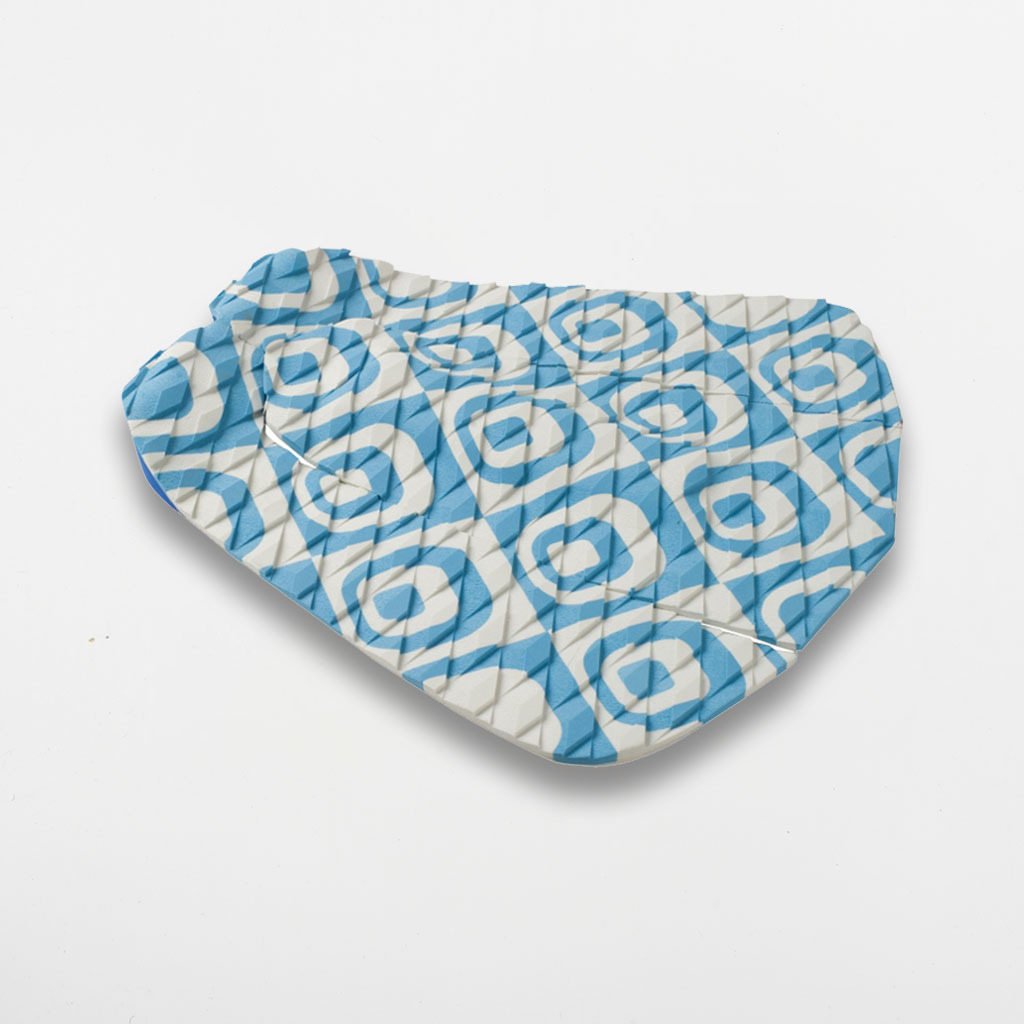
T27042 is a surf traction pad set for the rear of the deck, the section behind the back foot where a rider shifts weight through a turn and where a plain glassed deck gives nothing to push against. The face is laid out in a diamond tread and supplied as three separate pieces, so grip can be spread across the tail instead of being locked into one fixed footprint.
Two kinds of order bring these in. A deck has gone smooth and needs grip again, or a new board is being finished before it goes on the shelf. The layout is fitted differently depending on the shape underneath: on a shortboard the pieces sit close to the tail block, while a wider tail opens them into a longboard traction pad with a narrow channel running between them.
As one of the surf board manufacturers working with wholesale distributors and surf brands, we build this set in-house and hold the pattern from one batch to the next, which matters more than it sounds when a shop reorders the same pad a season later and expects the board on the wall to look familiar. This is the tail section only; a board that wants grip along the full deck adds a centre pad separately.
Grip Face & Build
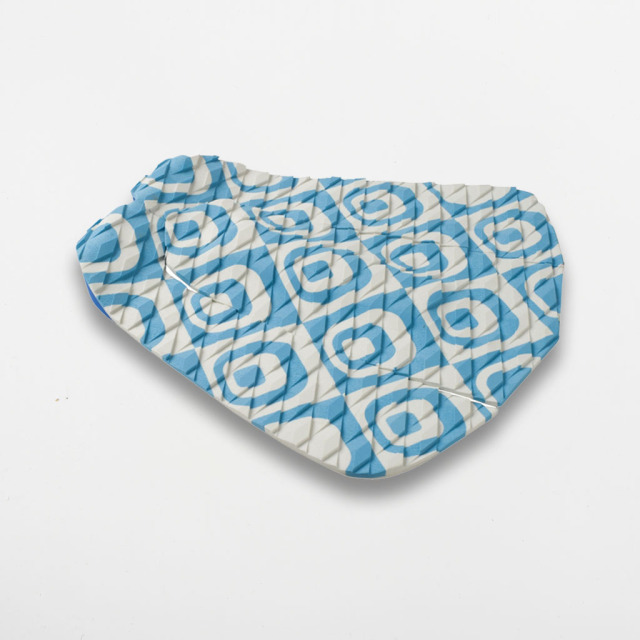
- Diamond tread: The face repeats a diamond pattern across its width, which puts an edge under the heel, the ball of the foot and the toes at every angle, rather than the single direction of grip a plain sheet gives. - Thin, flexible sheet: Each piece is a thin flexible sheet rather than a rigid block, so it follows the deck as it rolls toward the rail and sits down over tail rocker without standing proud at the corners. A surfboard traction pad of this type is used bare, which means no wax on the rear deck, no melted wax on a hot day and no re-waxing between sessions. - 3M adhesive backing: The pieces are peel-and-stick on a 3M adhesive. - Three shaped pieces: The pieces are shaped rather than rectangular, so the set can follow a squash, swallow or rounded pin tail, and the spacing you choose shapes the finished look more than the pad itself does. - Printed face: Each piece carries a blue-and-white graphic across the tread, which lets a shop show the set as one design instead of three blank shapes. - Repeatable pattern: Tread and adhesive stay the same from batch to batch, so a reorder matches the pad already fitted rather than coming close to it.
Fitting & Tail Matching
- Look at the tail before anything else, because shape decides the layout. Squash, swallow and rounded pin tails all take the same three pieces, and a traction pad for surfboard decks is spaced differently on each: narrow tails want the pieces close, wide tails want them opened up.
- Strip the old wax and clean the deck. Scrape, wipe with a degreaser or isopropyl, and let the surface dry completely, since adhesive bonds to a clean, dry deck and fails on a wax film.
- Dry-fit the surfboard tail pad with the backing still on. Centre the lead piece on the stringer and keep the gap to each rail even.
- Set the gaps. On a shortboard, run the pieces close with a narrow channel between them; on a wide tail, open the spacing so the set behaves more like a longboard traction pad and covers more deck.
- Mark the outline lightly with pencil or tape so each piece goes down in the same place twice.
- Peel and place from the centre outward, pressing firmly as you go and working air toward the edges.
- Leave the board flat and out of direct sun while the adhesive settles, and do not ride it until it has had time to bond.
- Check the edges after the first session. A corner that has lifted once can be pressed back; a corner that lifts again is better replaced than patched.
Matching Accessories
- Leashes: Hypalon ankle leashes in 6 ft 6 mm, 7 ft 7 mm, 8 ft 7 mm and 9 ft 8 mm, so a board can leave the shop with its pad and a leash suited to its length and the waves it is meant for. - Fins: honeycomb fins in single tab, double tab and box, in the standard honeycomb layup and in carbon and timber versions, for boards that are sold complete rather than bare. - Traction: the surfing traction pad on this product, plus centre pads, waxless pads and skimboard pads, which lets a shop stock one deck-grip wall instead of one narrow line. - Covers: basic bags, regular bags, stretch covers and bodyboard bags, for boards that need protection the same day the pad goes on. - Racks: travel rax and tie-downs, storage racks, display racks and bike racks, for shops that need to show boards and for customers who need to move them.
Care & Replacement
Salt, sun and wax are what shorten the life of a surf traction pad. Rinse the deck with fresh water after a session and dry the board in the shade; a board left face-up in a hot car softens its own adhesive, and an edge that was flat in the morning can be standing up by the afternoon. Wax is the other problem. A comb dragged across the tread pushes grit into the texture, so keep the rear deck wax-free instead of scraping it out later. When the diamonds have gone shiny and the surface feels polished underfoot, the pad is doing less than it did, and that is the point to replace rather than repair, especially on a rental or school board where grip is the whole reason for a surfing traction pad in the first place. Removing an old pad is a slow job done properly. Warm the piece gently with sun or a hair dryer on low, peel from one corner instead of tearing, and lift the old adhesive with a soft scraper and a little citrus solvent. Store spare pieces flat and out of the sun so the backing stays intact.
Specifications
| Specification | Detail |
|---|
| Model | T27042 |
| Product type | Traction tail pad set |
| Set composition | Three separate shaped pieces |
| Tread pattern | Diamond |
| Adhesive | 3M |
| Mounting | Peel-and-stick |
| Placement | Rear deck, behind the back foot |
| Grip face | Textured, wax-free |
| Tail shape compatibility | Squash, swallow and rounded pin |
| Deck coverage | Tail section only |
| Centre deck pad | Ordered separately |
Tail Width & Trimming
- Measure across the deck at the rear edge of the set and compare it with the three pieces laid out at their normal spacing. On a very narrow tail the outer pieces will hang over the rail, and that is the point to change the layout, not the pad.
- A trimmed edge is a raw edge. Cut into a surf traction pad and the tread no longer wraps the core, the adhesive stops short of the new outline, and the cut face takes in salt water. That edge lifts first, and once it starts it keeps going.
- Try a tighter layout first. Close the gaps, shift the set slightly forward, or use two pieces instead of three on the narrowest tails. A surfboard tail pad that sits inside the rail line with whole pieces will outlast one trimmed to look neat.
- On a swallow tail, treat the two points as separate landing areas. Keep an outer piece on each point, let the channel run down over the notch, and do not bridge the gap with a cut section — an unsupported span is where a lift begins.
- If you must trim, cut once and cut clean. Use a fresh blade, mark the line on the backing rather than the tread, and make one continuous pass on a firm flat surface. A ragged or double-cut edge is worse than a slightly generous one, so leave a small margin rather than shaving to the pencil line.
- Seal what you cut. Ask us what we recommend for the cut face before you apply anything; a bare edge is the part that wicks water and curls. Press the new edge down firmly and keep the board flat while it bonds.
- For shops and rental fleets, keep a narrow-tail version in the range. Trimming every board makes each fit slightly different, so a replacement no longer matches the one beside it. A two-piece arrangement is often the cleaner answer for a very narrow pin or a deep swallow; ask us which set suits the tails you carry.
- Send the tail width and a photo of the tail from above if you are unsure. We will tell you whether the three pieces fit as supplied, whether they should be spaced differently, or whether a narrower set is the better order.
Ordering & Delivery
- Send your buy list by code and quantity: the diamond set, plus any leash, fin, cover or rack codes you want on the same order.
- Confirm the version going on your shelf. Pattern, piece count and finish of the surfboard traction pad have to match the sample you approved, so reorder by code rather than by description.
- Tell us how the pads should arrive, whether bulk, poly bag with hanger, barcode or custom labelling, so packing is agreed before production starts.
- Ask about sample availability and the current lead time for the quantity you have in mind; both depend on the season and on what else sits on the order.
- Agree the reorder pattern. Chains and school fleets usually take a first order across several codes and top up the fast-moving codes, so codes and schedule are set together the way surf board manufacturers usually plan a season.
- For a private-label line, send artwork and we will confirm which parts of the pad face and the packaging it can be applied to.
Scale & Supply Capability
CIMI is a factory-based supplier with 16 years in surf and watersports hardgoods, manufacturing at our own facility rather than sourcing through traders. Chain stores, supermarkets and surf-brand stores buy from us because one supplier covers a full accessory assortment, so a season's order and its reorders can be planned together. We take on OEM and private-label work, adapting designs, colourways and branding to your programme, and we schedule production against your agreed range plan. Send us your buy list and target dates, and we will confirm what we can make and when.
FAQ
How much of the tail does a three-piece surf traction pad actually cover?
Enough for the working area behind the back foot, and the spacing decides the rest. Fitted close, the three pieces cover a shortboard tail from rail to rail; opened up, they leave a clean channel down the middle. On a very wide tail, ask us for a layout before you commit, because the same set can be arranged two or three different ways.
Will this surfboard tail pad work on a longboard?
Yes. Spread wider, the same three pieces lay out as a longboard traction pad across the tail of a wider board, and you cover more deck without ordering a different pad. The pieces are shaped, so they follow a rounded or squared tail instead of fighting the curve.
Is this a full-deck pad or only the tail section?
Tail only. It is a surfboard traction pad for the rear deck, and boards that also want grip under the front foot use a separate centre pad. Shops usually carry both so a customer can buy one or the other, or take the pair.
Can I lift a piece and reposition it once it has been pressed down?
You can, but the adhesive does not come back to full strength after it has been peeled, so it is worth dry-fitting first. Mark the outline before you peel anything and press the whole face rather than just the middle. If a piece lands wrong, lift it slowly from one corner and reset it in a single movement, because a traction pad for surfboard tails is far easier to place with the backing still on.
Does the pad need wax, and when does the grip wear out?
No wax on the pad itself. The texture does the work, and wax on top of it only collects grit. Expect the tread to dull over a couple of seasons of regular use: a surfing traction pad is ready to be replaced once the diamonds have gone shiny and the surface feels smooth underfoot, which is cheaper than a slip on a rental board.