Product Overview
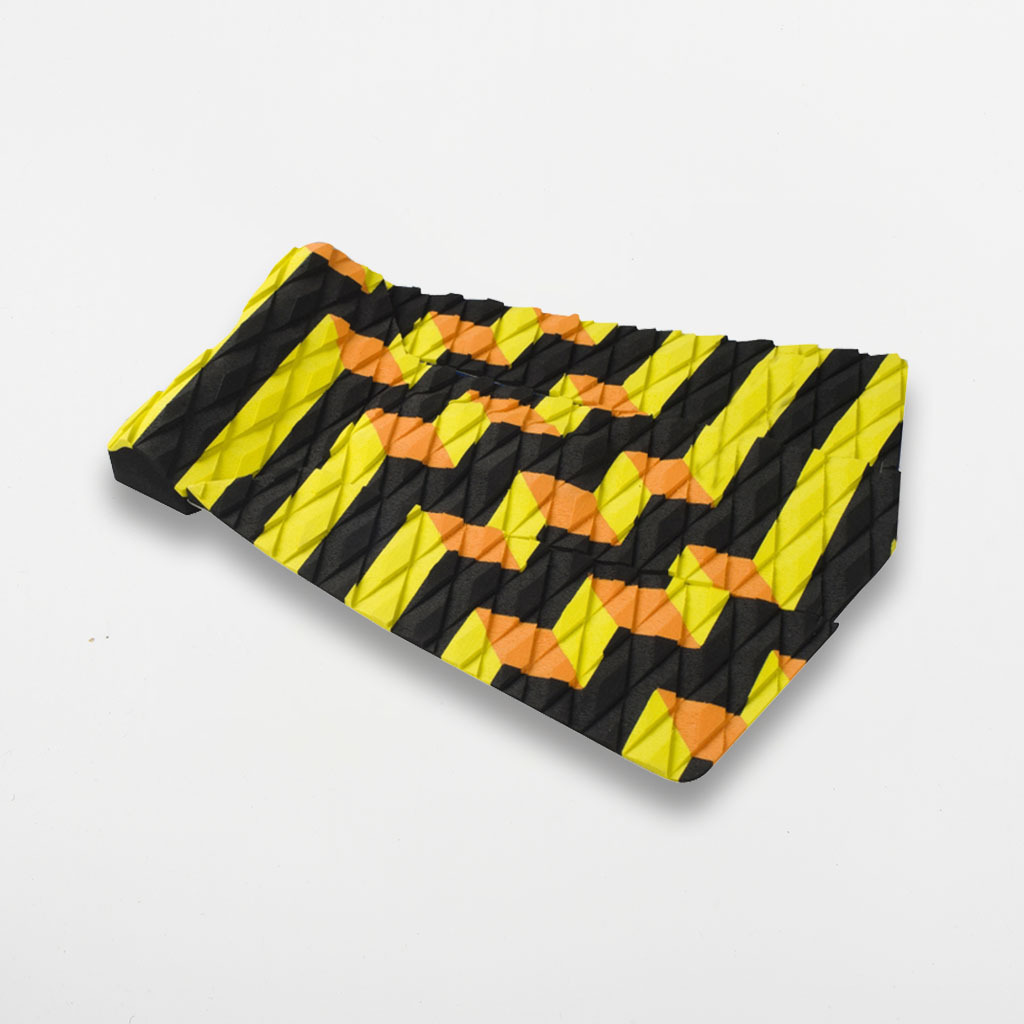
This three-piece surf traction pad covers the tail of a shortboard, the patch of deck your back foot works against on every turn. Splitting the pad into three pieces instead of one panel means the heel and toe sections can sit either side of the stringer while the rear piece lands where your foot naturally stops, so the grip follows the shape of the tail instead of sitting across it. It is the part of a deck that takes the most wear, and usually the first thing that makes an older board feel tired.
Shops fit it as a replacement surfboard tail pad once the original deck grip has polished smooth.
Surf board manufacturers fit it during assembly so a new board leaves the workshop ready to ride. It also suits rental and school fleets, where boards are used hard by riders who are still working out where to put their back foot, and a defined rear edge gives them something to aim at.
Grip Surface & Layout
- Diamond-cut deck: the top surface is cut into a raised diamond grid rather than left flat, so your back foot finds edges to push against when you drive off the tail. - Three-piece layout: heel and toe pieces sit either side of the stringer with a separate piece behind them, so the grip can run tight to the centre line or open up for rail clearance. - Black, yellow and orange chevron: a bold zigzag print runs across the pad, which makes the tail obvious on a shop wall and easy to pick out on a full board rack. - Thick foam slab: the pad stands proud of the deck, and that height is what gives the cut pattern its depth instead of letting it flatten into the board. - Pressed on, not screwed down: there is nothing to re-tension underfoot, which is what surf board manufacturers need on fleet boards that change hands every hour.
Specifications
| Model | T27044 |
|---|
| Product type | Three-piece surf traction tail pad |
| Pieces per set | 3 |
| Surface | Diamond-cut raised grip |
| Graphic | Black, yellow and orange chevron print |
| Adhesive | 3M peel-and-stick backing |
| Placement | Tail, under the back foot |
| Deck fit | Shortboard and hybrid tails, or the tail section of a longboard traction pad set-up |
| Profile | Flat foam slab with cut grip pattern |
| Mounting | Press-on, no hardware or re-tensioning |
| Set contents | 3 pad pieces |
Board-Side Pairings
A tail pad never works alone. Where the grip can sit depends on the boxes for your surfboard fins, because the rear edge has to clear them, and a cluster set well back pushes the whole pad forward. The surf leash plug sets the other limit. Leave enough clean deck around it that the cord can be tied and the rail saver can move without rubbing across the grip; if the plug sits close to the tail, the rear piece goes in front of it rather than around it. The rest of the deck can be built up from the same range. Centre pads add mid-deck grip when a longer board needs it, and a longboard traction pad set-up usually pairs this tail piece with a centre section and a nose piece so the grip runs the length of the board. Off the water, a board cover keeps wax and sand out of the diamond pattern, and a rack that holds boards by the tail keeps weight off the pad between sessions.
Fitting & Alignment
- Dry-fit before you peel anything. Lay the three pieces on the deck, find the stringer, and check that the layout clears the rear boxes for your surfboard fins and the leash plug.
- Mark the centre line. Run a strip of tape down the stringer and another across the back of the tail, so the pieces go back in the same place if you have to lift one.
- Clean the deck properly. Take off old wax and residue, wipe the area down and let it dry completely; adhesive will not hold on a waxy or damp surface.
- Set the side pieces first. Peel a short section of liner, line each piece up against the tape, and press outward from the centre so no air is trapped underneath.
- Place the rear piece square. Align it with the centre line, then press hard along its back edge, which is where your foot pushes hardest.
- Work over the whole surfboard tail pad. Press across the full surface with the heel of your hand, then leave the board flat and out of direct sun while the adhesive settles.
- Check the clearances. Run a thumb along both rails and around the surf leash plug; a pad that overhangs an edge will lift on the first session, so surf board manufacturers check this before a board leaves the workshop.
Care & Replacement
- Rinse after every session. Fresh water lifts sand and salt out of the diamond pattern; dry the board out of direct sun before it goes back in the bag.
- Keep wax off the grip. Wax fills the cut pattern and turns a textured surfboard traction pad into a smooth one, so scrape around the pad rather than across it.
- Skip solvent-heavy cleaners. Harsh cleaners soften the adhesive at the edges; mild soap and water is enough for a traction pad for surfboard decks that see weekly use.
- Catch lifted edges early. A corner that has lifted can be cleaned, dried and pressed back down before sand works underneath and the whole edge lets go.
- Replace when the diamonds round off. Once the raised pattern has worn flat in the middle of the pad, the grip has gone even though the foam is still stuck down.
- Taking an old pad off. Warm it gently, work a plastic scraper under one corner and lift slowly, then clear the leftover adhesive before the new set goes on.
Ordering & Delivery
- Confirm the set. Tell your sales contact which pad code you want and how many three-piece sets you need, and ask for the current specification sheet if you are matching an existing line. 2. Send the whole list. Wholesale orders usually run across several tail pad designs plus centre pads and accessories; include the surfboard traction pad and leash lines in the same request so the whole order is quoted together. 3. Confirm packaging and labelling. Say whether the pads should ship shelf-ready for resale or bulk for your own packing, and what labelling your market requires. 4. Confirm artwork if the pad carries your brand. Send it for approval before production is scheduled. 5. Confirm the schedule in writing. Lead time, shipping terms and payment terms are agreed per order, so ask for them on the confirmation rather than assuming last season's figures. 6. 7. Check a sample first if you need to. Grip, colour and thickness are easier to judge in the hand, so ask your sales contact about sample availability and timing before the season's order is placed.
Scale & Supply Capability
CIMI is a factory-based supplier with 16 years in surf and watersports hardgoods, manufacturing at our own facility rather than sourcing through traders. Chain stores, supermarkets and surf-brand stores buy from us because one supplier covers a full accessory assortment, so a season's order and its reorders can be planned together. We take on OEM and private-label work, adapting designs, colourways and branding to your programme, and we schedule production against your agreed range plan. Send us your buy list and target dates, and we will confirm what we can make and when.
FAQ
Is this surfboard traction pad a single panel or a set?
It is a set of three pieces. That lets you run the grip either side of the stringer and set the rear piece where your back foot stops, instead of accepting the fixed outline of a one-piece panel.
Will this surf traction pad fit my board's tail?
Check three things against the pieces before you buy: the tail width, the position of the rear fin boxes and the position of the leash plug. The set is shaped for shortboard and hybrid tails, and if your board has a wide or square tail, send us a photo of the deck and we will confirm the layout for you.
Will the pad cover the boxes for my surfboard fins?
It should not. Dry-fit the pieces so the rear edge sits clear of the fin boxes. If the cluster is set far back, shift the whole pad forward rather than trimming the foam, because a cut edge loses its seal and lifts first.
Can I fit a traction pad for surfboard use straight over an old one?
No. A new pad needs a clean, flat deck to bond to, and foam on top of foam will lift at the edges. Take the old pad and its leftover adhesive off first, then fit the new set on the bare deck.
Can I use it as part of a longboard traction pad set-up?
Yes, as the tail section. A longer deck usually takes a centre piece and sometimes a nose piece as well, so the grip runs the length of the board instead of stopping at the back foot.
Where should the surf leash plug sit relative to the pad?
Leave clear deck around the plug so the cord can be tied without running across the grip. On most boards that means the rear piece stops short of the plug rather than wrapping around it.