Product Overview
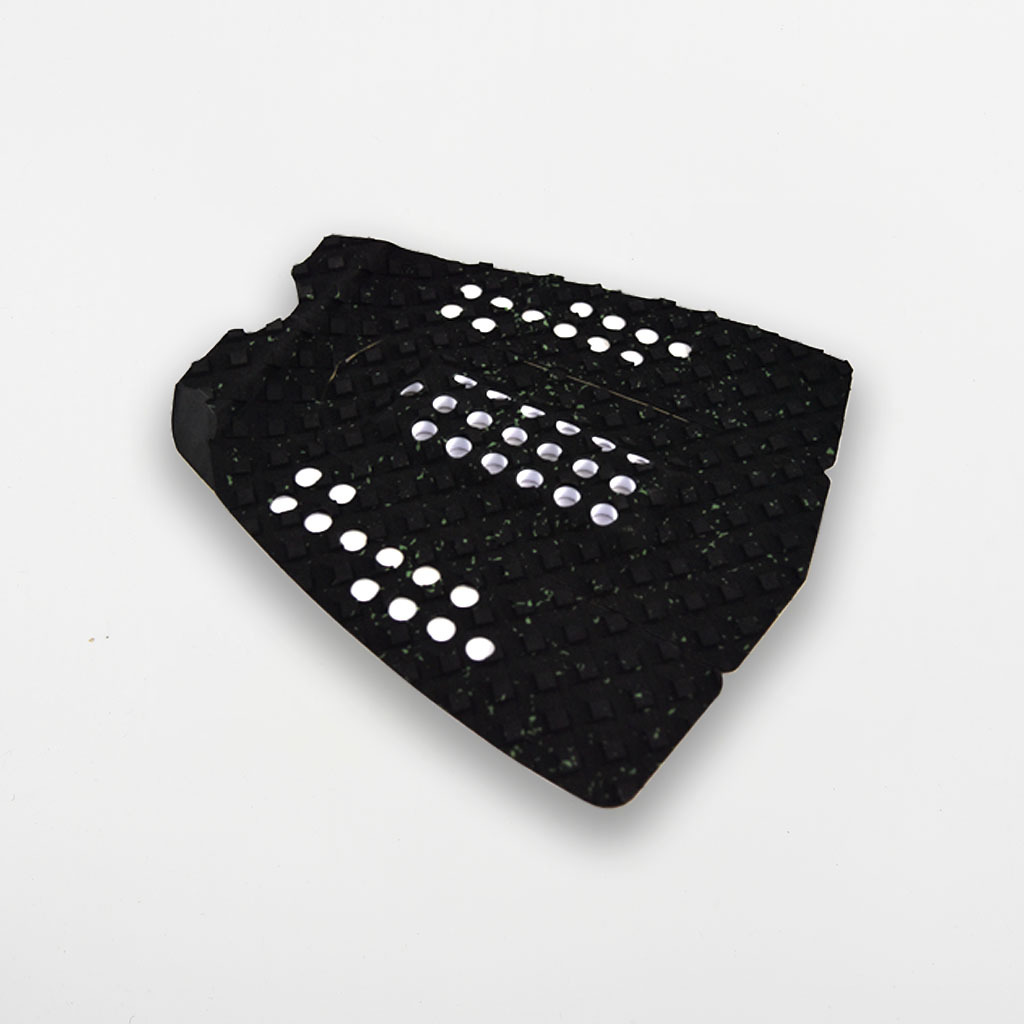
A raised diamond pattern runs across the deck face, broken up by groups of circular perforations, and the outline narrows toward the rear so the pad follows the tail instead of hanging over the rail. Most of these pads leave us as replacement stock. A shop refits a customer's board when the original grip has gone smooth, lifted at a corner or started peeling away from the deck. A rental fleet rotates pads through a season. A distributor keeps several designs on the shelf so a rider can change the look of a board without changing the board. That makes it a straightforward line to carry: a flat surf traction pad, no tools, no workshop, and a deck that is usually ready for it. Chain store groups buy it as a fast-moving small item beside the boards; private-label programmes take the same design and put their own branding on it.
Grip Pattern & Deck Feel
- Diamond pattern that bites underfoot. The raised diamond field gives the back foot a set of edges to push against, so the deck reads clearly through a turn instead of sliding away under a wet foot. The texture does the work, rather than a coat of wax that has to be refreshed before every session. - Perforations grouped, not scattered. The circular holes sit in clusters across the pad. They break up the flat field of grip and give water and sand somewhere to move, which keeps the surface from feeling sealed and slick when the board comes out of the water. - A tapered outline shaped for the tail. Cut to sit as a surfboard tail pad or a longboard traction pad, it narrows toward the rear so the rail line stays clear and the outline follows the board rather than fighting it. - Firm rather than spongy. The sheet sits flat against the deck with a matte face. - One flat piece, no stepped edge. Because the pad goes down as a single flat sheet, there is no raised lip under the arch and nothing for a toe to catch when the foot slides back to the tail. - Quiet on the deck. The black matte face reads as a plain deck detail, so it sits comfortably on a white board, a tinted resin board or one with a full graphic.
Fitting on the Board
- Take the old grip off first. Warm the worn pad with a hairdryer or leave the board in the sun, lift a corner and work along the deck with a plastic scraper. Remove the adhesive residue, then let the deck dry completely before anything else happens.
- Test the position without sticking. Lay the new surfboard traction pad in place with its backing still on. Check it against the stringer, the rail curve and the leash plug, and sight down the board from the tail — a pad that looks square from above can sit off-centre from behind.
- Clean and degrease the deck. Wipe the tail area with alcohol or a wax remover and let it flash off. Wax, sunscreen, sand and dust are what cause a traction pad for surfboard decks to lift at the edges later.
- Mask the outline. Run a strip of tape along each side of the pad's footprint so you can drop it back into the same place once the backing comes off.
- Peel and anchor one end. Take off a short section of backing, press that end down against the tape line and check the alignment again before you commit the rest.
- Work forward from the centre. Press the pad down a little at a time, pushing from the middle outward so trapped air escapes at the edges instead of sitting under the middle.
- Press the edges and let it settle. Run a thumb or a roller along the whole perimeter, then leave the board flat and out of direct sun before the first session.
Traction Range & Assortment
- Tail pads carry the range. The back foot takes more punishment than any other part of the deck, so the tail line needs more than one pattern. This design sits alongside the rest of our surfboard tail pad line, which lets a buyer put several looks on the shelf and let the rider choose the deck detail.
- Centre pads for the middle of the deck. A centre pad sits forward of the tail pad and adds grip where a rider widens the stance or moves the feet between turns.
- Skimboard pads. Flat-deck coverage cut for skimboards, where the whole standing area needs grip rather than just the tail.
- Waxless pads. Full-deck grip for riders who would rather not wax at all — the same idea as a surf traction pad, applied across the whole standing area.
- HEXA all-over grip. A hex-pattern grip that covers the deck instead of sitting on the tail, for a buyer who wants one consistent surface across the board.
- Longboards need a different balance. A longboard traction pad gives the back foot its patch, but a rider who cross-steps will usually want a centre pad as well, so it is worth mentioning when a customer is choosing.
- One order across the shelf. As surf board manufacturers we cut across the traction line and supply the matching leash, fin, cover and rack ranges, so a buyer can build an accessory shelf and a single reorder list. Shops generally display traction beside the surf fins and leashes, because the three are bought together.
Companion Accessories
| Surfboard leash | Hypalon ankle leashes in 6 ft, 7 ft, 8 ft and 9 ft lengths |
| Leash matching | Shorter, lighter cords for small to medium surf; longer, thicker cords for longboards and bigger days |
| Surf fins | Honeycomb fins with single tab or double tab bases |
| Fin build | Resin transfer moulded honeycomb, light and usable across a range of conditions |
| Board covers | Basic bags, regular bags, stretch covers and bodyboard bags |
| Racks | Travel rax and tie-downs, storage racks, display racks and bike racks |
Care & Surface Life
Deck grip ages from three things: salt left to dry on it, sun, and the wax and sand that collect around its edges. Rinse the deck in fresh water after a session and let it dry out of direct sun. A soft brush and mild soap are enough for the texture; a stiff brush rounds off the diamond edges that give the grip its bite, and acetone or paint thinner attacks the adhesive at the perimeter faster than anything else that comes near the board.
Heat is the slower problem. A board left in a closed car or stacked flat against a hot wall softens its adhesive, and a pad that has started to lift at one corner keeps lifting once sand gets under it. If an edge does come up, press it back while the board is cool and dry, not in the middle of a hot afternoon.
For a shop or a rental fleet, check pads at the start of a season rather than waiting for a customer to mention it. A surfboard traction pad has done its job when the diamond field has flattened to a smooth patch under the back foot, when the edges have curled, or when the sheet has hardened and no longer follows the deck. That is the point to replace it — the deck underneath is usually fine and the new pad goes straight on.
Specifications
| Specification | Detail |
|---|
| Model reference | T00532 |
| Product type | Surf traction tail pad |
| Range | Surf traction pad line |
| Outline | Tapered, narrowing toward the rear |
| Grip pattern | Raised diamond field across the deck face |
| Perforations | Circular holes arranged in clusters |
| Surface finish | Matte, textured |
| Form | Flat one-piece sheet |
| Adhesive | Peel-and-stick backing with a peel-away release liner |
| Placement | Tail of the deck, under the back foot |
| Board type | Surfboards and longboards |
Ordering & Delivery
- Start from the design reference. Send the model reference or a clear photo of the pad you want, along with the quantity you need per design. If you are matching a pad already on a shelf, say so and we will confirm the match before production.
- Tell us what the order is for. A consumer pack, a rental fleet top-up and a private-label launch are packed and labelled differently, so tell us which one you are buying for.
- Raise branding early. OEM and private-label work is part of what we do. Send your artwork, colour direction and packing requirements, and we will confirm what can be applied to this product.
- Agree packing and carton marks. Tell us how the pads should be packed, how many go in an inner pack and what should be printed on the carton.
- Confirm the commercial terms in writing. Quantity, price, payment terms, lead time and shipment are agreed per order. As surf board manufacturers we quote against the design, quantity and season you give us, so ask your sales contact for the terms that apply before you commit a plan.
- Combine the accessories. If the order also carries a surfboard leash, covers or racks, list everything together so it leaves as one consignment.
- Give the tab type with any fin order. Where the same delivery includes surf fins, tell us the tab type and the board range they are going on, so the right base is picked.
- Reorder by the same reference. Order against the same model reference next time and the design stays consistent across a shelf, a rental fleet or a repeated season.
Scale & Supply Capability
CIMI is a factory-based supplier with 16 years in surf and watersports hardgoods, manufacturing at our own facility rather than sourcing through traders. Chain stores, supermarkets and surf-brand stores buy from us because one supplier covers a full accessory assortment, so a season's order and its reorders can be planned together. We take on OEM and private-label work, adapting designs, colourways and branding to your programme, and we schedule production against your agreed range plan. Send us your buy list and target dates, and we will confirm what we can make and when.
FAQ
Where on the tail should this pad sit?
Directly under the back foot, between the tail end of the board and the point where the foot lands when you drive off the bottom. Set the board flat, drop the pad in place with the backing still on and look down the deck from the tail: it should run parallel to the stringer and sit clear of both rails, with the tapered end toward the tail. As a surfboard tail pad it is meant to be a defined patch the foot finds without looking, so the time spent checking the position is worth more than any amount of pressing afterwards.
How long does the diamond texture stay grippy?
It depends on how often the board is used and how it is looked after. On a well-used shortboard the diamond field under the back foot flattens first, then the edges begin to curl. Rinse the deck after salt water, keep the board out of a hot car, and the surface keeps its definition much longer. When the pattern feels smooth to the touch or the sheet has hardened, it is time for a new one — a surf traction pad is a wear item, and replacing it costs far less than the deck underneath.
How do I check the pad will fit my tail width?
Measure across the tail where the pad will sit and compare it with the pad's outline before you commit. The tapered shape leaves a margin on most shortboard tails; on a very wide or very narrow tail the fit changes. Send us a photo taken from directly above the deck with a ruler laid across the tail, and we will confirm whether this traction pad for surfboard tails is the right shape for that board.
Can the pad be taken off later without damaging the deck?
Yes, if you work slowly. Warm the pad with a hairdryer, lift one corner and ease a plastic scraper under it, following the adhesive rather than levering at the laminate. Clean the residue with a wax remover or alcohol, then let the deck dry before anything new goes on. Skip the metal blade and skip aggressive solvents. Handled this way, a surfboard traction pad comes off cleanly and the deck underneath can be prepared for a replacement.
Can I fit this on a longboard?
Yes. As a longboard traction pad it goes over the tail in the same way, giving the back foot a defined patch for cutbacks and for the last steps of a noseride. A rider who cross-steps a lot usually adds a centre pad so the middle of the deck has grip too — the tail pad alone leaves the waxed section forward of it untouched.
Will the pad cover the leash plug?
Only if the plug sits inside the pad's outline. Check the plug and its slot before anything is stuck down, and shift the pad forward or adjust the outline if it would sit over them. Send us the plug position on your deck together with your surfboard leash setup — plug on the stringer, offset, or through a rail saver — and we will confirm how the pad should be positioned for that board.