Product Overview
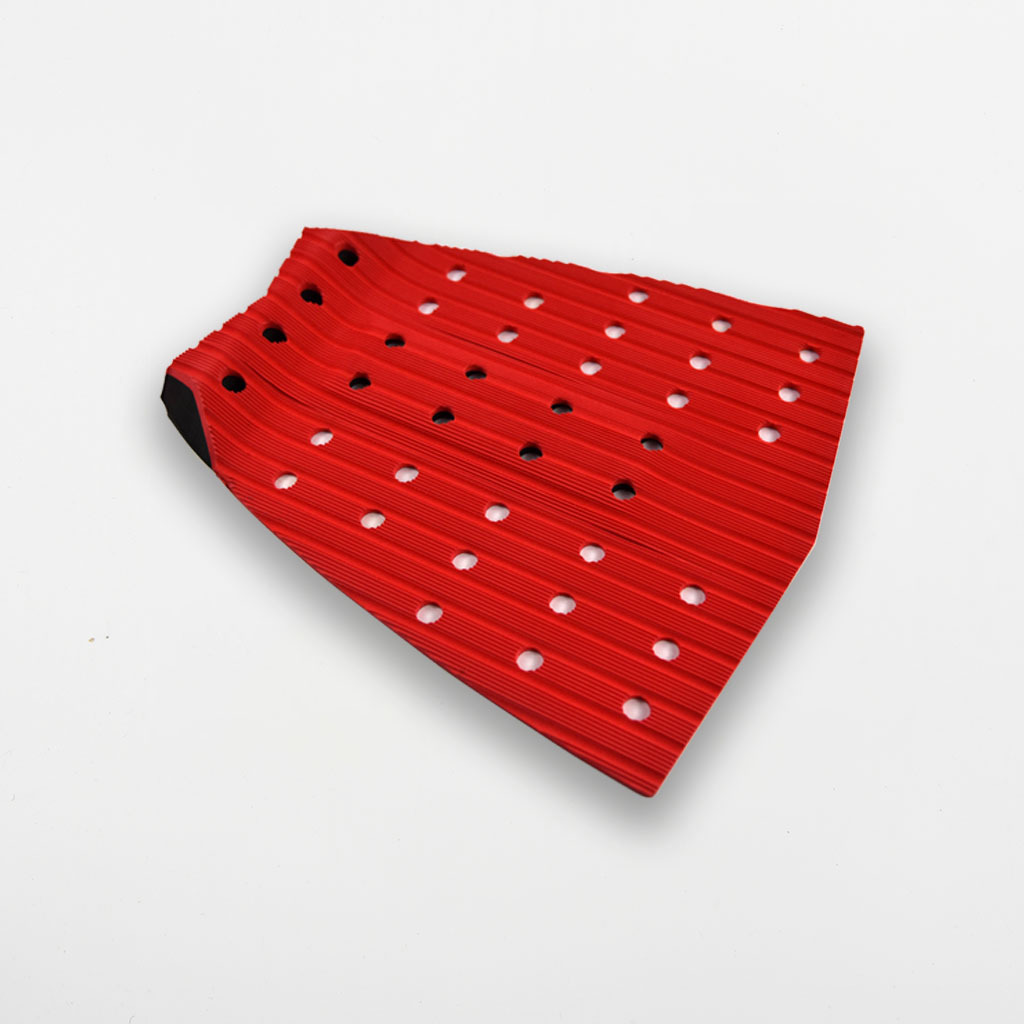
T00533 is a surf traction pad made for the tail of the deck, the part of a board that takes the heaviest pressure from a back foot. The top surface is ribbed and broken up by a field of circular perforations, and the outline is curved and tapered so it follows the shape of a tail instead of sitting on it as a plain rectangle. Underfoot the pattern gives the back foot edges to push against; on a shop wall it gives the range a look that is clearly its own. That matters more than it sounds. A tail pad is the accessory a customer picks up, flexes and presses a thumb into before deciding, and a row of near-identical pads gives them nothing to choose between. This one is shaped enough to look deliberate and restrained enough to sit on a wide spread of boards, from a first foam board through to a shortboard that gets ridden hard. It is also the practical fix for a board whose grip has worn smooth, gone shiny under the wax or started lifting at the corners. Because the pad applies peel-and-stick, a shop can refit a customer's board in a single visit rather than sending it away, and a rental fleet can keep boards in service through a busy season.
Perforated Grip Pattern
- Circular perforations. Round holes are cut in a regular field across the face of the pad. They give water and sand somewhere to go instead of letting both sit under the foot, and they separate this pattern at a glance from the waffle and hex surfaces beside it on a shelf.
- Ribbed raised surface. Raised ribs run across the pad in line with the board. The ball and heel of the back foot get a defined ridge to lock against when you rotate through a turn, which is exactly the moment a worn flat grip starts to feel vague.
- Curved, tapered outline. The pad narrows towards the tail rather than ending square. That shape keeps the corners inside the rail line on a narrow tail, gives a wider tail fuller coverage, and reduces the chance of an edge catching on a board bag or a wetsuit.
- Matte top with a black backing edge. The face is a flat matte red and the black adhesive backing shows as a thin rim around the pad. Once fitted, that rim reads as a clean outline against the deck, which is the detail that makes a refit look professional rather than improvised.
- Cushion without deadness. The pad is deep enough to take the sting out of a hard landing on the tail and firm enough that the foot does not sink into it. You keep feel through the board while still putting a barrier between your heel and the deck.
- One pattern, two board classes. Nothing about the design is specific to a single board type, so it works as a longboard traction pad on a bigger tail just as well as on a performance shortboard — useful when shops and surf board manufacturers want one look across a mixed wall of boards.
Installation Steps
- Strip the old grip. Lift a corner of the worn pad and work it back slowly, warming it with your hand rather than a flame. Scrape off the leftover adhesive with a plastic scraper — a metal blade will gouge the deck.
- Clean and dry the deck. Take off wax and residue with a suitable cleaner, then let the surface dry completely. Adhesive will not bond to a waxy, damp or dusty deck, and that is the most common reason a new surfboard tail pad lifts at the edge.
- Dry-fit before you peel. Set the pad on the tail, centre it on the stringer and check it sits clear of the leash plug and both rail edges. Mark the outline with tape if it helps you place it straight.
- Peel and press from the centre. Lay the pad down and work outwards with your thumbs, pushing air ahead of you and pressing firmly around every rib and every hole in the pattern.
- Work the rim. Run a thumb around the whole edge, then press again. Any corner standing proud should be pressed while the adhesive is still fresh.
- Let it settle. Keep the board out of the water and out of a hot car while the adhesive beds down, then refit the surf leash once the deck is dry and the pad is fully seated.
- Check the underside is untouched. The pad is fitted to the deck, so the fin boxes and the surf fins underneath are exactly as they were. No drilling, no cutting into the board, no clamps.
Care & Longevity
Salt, sun and wax are what shorten the life of any surfboard tail pad, and all three are manageable with a little routine.
Rinse with fresh water after a session. Salt left in the perforations dries into a crust that dulls the surface and works at the bond over time, and a quick rinse and shake-out is enough — there is no need to scrub the pad.
Clear wax out of the holes with a wax comb rather than a blade or a solvent. Wax builds up in a perforated surface faster than on a flat one, and a comb lifts it out without tearing the ribs. Keep acetone, thinners and aggressive household cleaners away from the pad; they soften the adhesive and strip the matte finish off the top surface.
Heat is the other enemy. A board left in a hot car or standing in direct sun all day will soften the bond and let the edges curl. Store it on a surfboard rack in the shade rather than leaning it against a wall, where the tail carries the weight and the pad takes the pressure.
Look at the edges at the end of a season. A pad that has gone smooth and shiny under the back foot, has grit trapped permanently under a lifted corner, or no longer shows its rib profile is finished. Replacing it takes minutes and costs far less than riding a board that feels vague under the back foot.
For shops holding stock, keep pads flat and out of sunlight. The backing film stays reliable for much longer when it has not been cooked on a shelf.
Companion Accessories
- Surf leash. Hypalon regular leashes run from a lightweight 6 ft model for small to medium waves up to a 9 ft 8 mm longboard leash for bigger days, with 7 ft and 8 ft versions between them. A shop fitting a new pad can hand the customer the right leash in the same visit.
- Surf fins. Honeycomb fins made by resin transfer moulding are the light, versatile choice and come with single tab or double tab bases; timber, G10 glass and nylon fins cover the rest of the range, along with fin accessories for the small parts that always go missing.
- Traction. Beyond this pad the range carries centre pads for coverage further up the deck, skimboard pads, waxless pads and a full-deck hex grip for buyers who want one continuous surface rather than a longboard traction pad at the tail.
- Covers. Basic bags, regular bags, stretch covers and bodyboard bags — the item a customer buys on the same trip as a pad, because the two live in the same corner of the store.
- Surfboard rack. Travel rax and tie-downs, storage racks, display racks and bike racks, so a shop can merchandise boards on the floor and a customer can get one home safely.
- Wax inserts and paddles. Small add-ons that fill the gaps in a traction and accessories display and lift the average basket without asking for extra shelf space.
Specifications
| Product type | Surfboard traction pad |
| Model | T00533 |
| Placement | Tail of the deck, under the back foot |
| Surface pattern | Ribbed surface with circular perforations |
| Outline | Curved and tapered |
| Finish | Matte |
| Backing | Black peel-and-stick adhesive |
| Boards | Surfboards, from longboard tails to shortboards |
| Range | Tail pads, centre pads, skimboard pads, waxless pads |
| Customisation | OEM and private-label production |
Ordering & Delivery
- Send your design list and quantities. Tell us which designs in the surfboard traction pad range you are working with and how many of each you need, and we will come back with availability for the season you are planning.
- Ask for the terms that apply to your order. We are surf board manufacturers rather than a trading company, so price, lead time, packing and shipping are quoted against the actual production run; your sales contact will confirm the figures before you commit.
- Approve a sample of the exact design. If you are adding this pad to a range you already stock, check a sample against the pad on your shelf before the run. Ask your sales contact about sample availability and timing.
- Settle branding and packing if the order carries your own label. Artwork, label placement and packing format all need agreeing before production starts, and any change after that point affects the schedule.
- Keep the model code on file for reorders. Repeat orders move faster when the code, the design and the packing are already on record, especially in a range where several pads look similar.
- Build a mixed shipment if it helps. Leashes, fins, covers and surfboard rack stock can be scheduled alongside the pads so one delivery covers a season's accessories instead of several.
Scale & Supply Capability
CIMI is a factory-based supplier with 16 years in surf and watersports hardgoods, manufacturing at our own facility rather than sourcing through traders. Chain stores, supermarkets and surf-brand stores buy from us because one supplier covers a full accessory assortment, so a season's order and its reorders can be planned together. We take on OEM and private-label work, adapting designs, colourways and branding to your programme, and we schedule production against your agreed range plan. Send us your buy list and target dates, and we will confirm what we can make and when.
FAQ
Which boards does this tail pad suit?
It is cut for the tail of a surfboard, so it works as a surfboard tail pad on anything from a longboard to a shortboard. The tapered outline keeps the pad inside the rail line on a narrow tail and gives a wider tail fuller coverage. If a board has an unusually square or very wide tail, dry-fit the pad first and trim the tail edge rather than forcing the shape.
Can the design be produced in our own colours and branding?
Yes. We produce surfboard traction pad designs to order, including colourways, branding and packing for private-label programmes. Send the design reference and the look you are after, and we will confirm what can be matched and what a run involves.
Is there a version for longboards?
The same pattern works as a longboard traction pad where the tail is wider, and the range includes larger pads and centre pads for decks that need coverage further forward. Tell us the board classes you are stocking and we will point you to the outlines that suit them.
Which leash pairs with this pad?
Any of our Hypalon regular leashes sits with this pad: the 6 ft for small to medium waves, the 7 ft for all-around conditions, and the 8 ft and 9 ft 8 mm versions for longer boards and bigger days. Match the surf leash to the board and the conditions the customer rides rather than to the pad itself.
Does the pad interfere with the fins or the leash plug?
The pad is fitted to the deck, so the fin boxes and your surf fins underneath stay exactly as they are. Position the pad so the leash plug stays clear — dry-fit it first and shift it slightly forward if the plug sits close to the tail.
Does the pad need wax?
No. The pad replaces wax on the tail: the ribs and perforations give the back foot grip on their own. Waxing over the top fills the holes, traps sand and makes a surf traction pad slicker rather than stickier, so keep wax forward of the pad.