Product Overview
This is a peel-and-stick surf traction pad that bonds to the tail of a surfboard deck, giving the back foot a textured, cushioned patch to drive against. Position does most of the work. A surfboard tail pad sits behind the back-foot stance, over the curve where the tail narrows, so the rear foot lands on grip instead of bare glass when weight shifts back through a turn. The pad also stands slightly proud of the deck, which is the difference riders notice first on a board that was previously wax only. We supply this design to multi-store chains, distributors and shops that refit customer boards, and it goes into private-label programmes as well. It is one look inside a broad tail pad range rather than a stand-alone item, which is what lets a buyer build a section with several graphics instead of stacking near-identical pads.
Grip, Wear & Care
- Grip where the back foot lands. The textured top gives the rear foot a defined patch to push against, in the exact spot a surfboard tail pad is meant to cover, and that area is ridden without wax.
- Cushioning on landings. The pad puts a layer between foot and deck, which takes some of the sting out of aerials and late off-the-lip landings and keeps the tail feeling solid underfoot.
- Edge control through turns. The outline follows the tail curve so the outside edge of the foot stays on grip through a cutback instead of sliding onto bare deck.
- How it wears. A surfboard traction pad rarely fails all at once: the surface polishes first, then the edges lift, then a corner peels back. Once the texture reads shiny and flat under the thumb, the pad is doing far less than it did on day one.
- Cleaning. Fresh water after every session, a soft brush and mild soap for wax smears and sunscreen, then air dry out of direct sun. Keep solvents, acetone, wax remover and silicone polish away from it — those are the usual cause of a lifted edge.
- Storage between sessions. Lay the board flat or set it on a surfboard rack rather than leaning it against a warm wall, and do not stack heavy bags on the deck. Heat and load are what shorten a pad's life.
- If an edge lifts. Clean under the lifted section, let it dry properly, press it back down and weight it overnight. If it lifts again the pad has had its run — replace it rather than gluing it back.
Fitting & Placement
- Offer the pad up to the tail before you peel anything. Check the outline against the tail width and the deck curve, and reposition rather than forcing an overhang into place.
- Take off the old pad and strip the wax back to the deck, working gently around the tail so you do not lift glass or dent foam.
- Clean the area and let it dry completely. A surfboard traction pad only holds as well as the surface under it, so any wax film, dust or polish left behind is where the adhesive will fail first.
- Mark the centreline with a strip of tape, and a second strip where the rear edge of the pad should sit.
- Peel a short section of backing at the front of the pad, tack it on the centreline, then peel the rest as you work the pad down from the middle outward.
- Press firmly along the tail curve and both rear corners, then run a thumb around the entire edge to seat it.
- Fit the surf leash to the plug as you normally would once the pad is down, and keep the board out of the water until the pad sits flat with no lifted edges.
Deck Design & Assortment
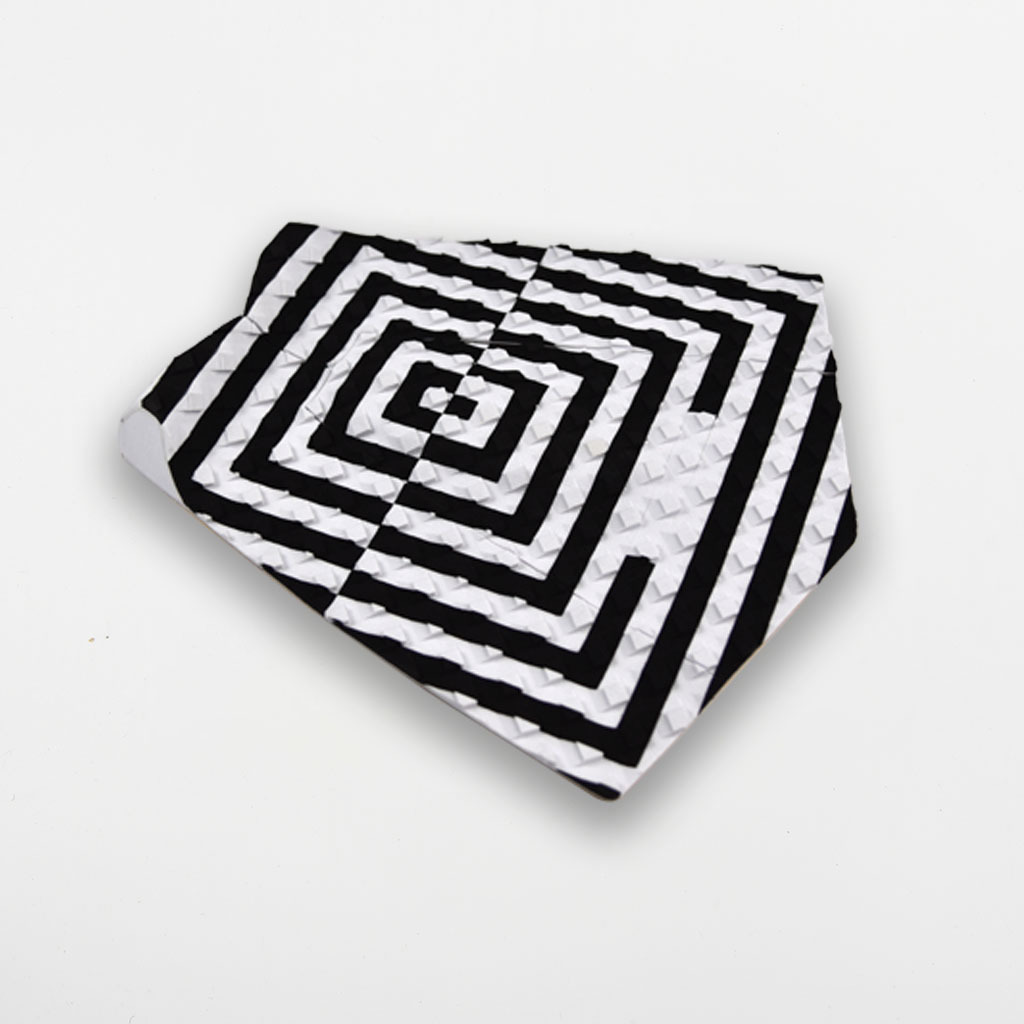
The design here is a black-and-white geometric print. It reads as strong contrast against a plain deck, and the pattern carries a board that would otherwise look blank behind the tail.
A surfboard tail pad is one of the few accessories a customer actually sees on the finished board — surfboard fins are the other — so the print does merchandising work that a plain grey patch cannot. Fitted to a shop display board it sells the idea of an upgrade; hanging flat on a hook it has to look distinct from the pad beside it.
That is the argument for stocking the range as a set rather than one design at a time. Several graphics on the same shelf let a customer pick a look, and they make the section read as a range rather than a row of duplicates. The trap is stocking designs that all resolve to the same grey grid from two metres away — choose contrasting graphics and let the colour of the deck do the rest.
On a longboard the same design works at the tail and is normally paired with a centre pad further forward, so the walking area gets grip too. A longboard traction pad at the rear plus a centre pad ahead of it covers the two places a foot actually lands.
Specifications
| Product type | Surf traction pad — tail placement |
| Model reference | T00534 |
| Placement | Tail of the deck, under the back foot |
| Fixing | Peel-and-stick adhesive backing; no glue needed |
| Top surface | Textured grip with a black-and-white geometric print |
| Range position | One of several tail pad designs, alongside centre pads and waxless pads |
| Board types | Tail pad position suits shortboards, funboards and longboards |
| Manufacturer | Ningbo Cimi Sports Co., Ltd. |
Companion Accessories
- Surf leash. Hypalon ankle leashes in the featured line run from a 6 ft 6 mm lightweight up to a 9 ft 8 mm regular longboard leash, with 7 ft 7 mm and 8 ft 7 mm in between. Match the leash to board length and the waves the board is built for.
- Surfboard fins. Honeycomb fins are listed with single tab and double tab bases, made by resin transfer moulding — light, and usable across a range of conditions. A pad order is a sensible moment to confirm which fin base a customer's board takes.
- Traction. Beyond the tail pads, the traction line covers centre pads, waxless pads and a skimboard pad, so a shop can grip the whole deck rather than the tail alone.
- Covers. Basic bags, regular bags, stretch covers and bodyboard bags — the item that turns a board purchase into a board-and-bag purchase.
- Surfboard rack. Travel rax and tie-downs, storage racks, display racks and bike racks. A display rack lets a shop show a pad fitted to a board instead of hanging it flat, which is the way this graphic merchandises most effectively.
Ordering & Delivery
- Send the design list and quantities you want on the shelf, and we will confirm which designs are in production for your season. 2. Build the order as a set — if a longboard traction pad is going onto a longboard, add the centre pads for the same board so the grip matches. 3. Add surfboard fins and covers where the board needs them. 4. Add a surfboard rack where the buyer wants pads shown on a board rather than hung flat. 5. Private label: as surf board manufacturers we run this through our own production — send artwork, colourway and packaging direction, and we confirm what can be matched before production starts. 6. 7. Confirm quantities, pricing, lead time, payment and shipping terms with your sales contact for each order; availability and dates move with the season. 8. Ask your sales contact about sample availability and how samples are supplied before committing to a full range.
Scale & Supply Capability
CIMI is a factory-based supplier with 16 years in surf and watersports hardgoods, manufacturing at our own facility rather than sourcing through traders. Chain stores, supermarkets and surf-brand stores buy from us because one supplier covers a full accessory assortment, so a season's order and its reorders can be planned together. We take on OEM and private-label work, adapting designs, colourways and branding to your programme, and we schedule production against your agreed range plan. Send us your buy list and target dates, and we will confirm what we can make and when.
FAQ
Is this a tail pad or a full-deck grip?
It is a tail pad. This surf traction pad covers the tail area under the back foot, not the whole deck. For grip from nose to tail, the Hexa traction board grip in the same range is the full-deck option, and plenty of boards end up with a centre or full-deck pad forward and a tail pad behind.
Which boards does it suit?
Shortboards, funboards and longboards all take a pad in the same position behind the back-foot stance. On a longboard, a longboard traction pad at the tail is usually paired with a centre pad further forward so the front foot has grip when you walk the board. Check your tail width against the outline before ordering, since a very narrow or very wide tail can want a different shape.
Does it need glue, wax or tools?
No. The backing is peel-and-stick, so a clean, dry deck is the only thing it needs. A surfboard traction pad holds on its own adhesive, and adding glue usually makes the next replacement harder rather than easier. Wax goes on the rest of the deck, not on the pad.
Does the pad sit clear of the leash plug?
Yes. The pad runs along the deck ahead of the plug, and the surf leash is fitted to the plug as usual once the pad is down. If your plug sits unusually far forward, hold the pad outline against it before peeling anything.
Can we run this design under our own brand?
Yes. Private-label traction work is part of what we do as surf board manufacturers, and it runs through our own production rather than a third party. Send the artwork, the colourway you want and the packaging direction, and we will confirm what can be matched and what has to change before anything goes into production.
Is it a practical choice for rental fleets and school boards?
It is. The pad takes the wear that wax and bare deck would otherwise take, and when the grip finally goes flat the pad is swapped rather than the deck being re-waxed after every session. Keeping one design across a fleet also keeps the boards looking consistent and makes the next replacement order simple.