Product Overview
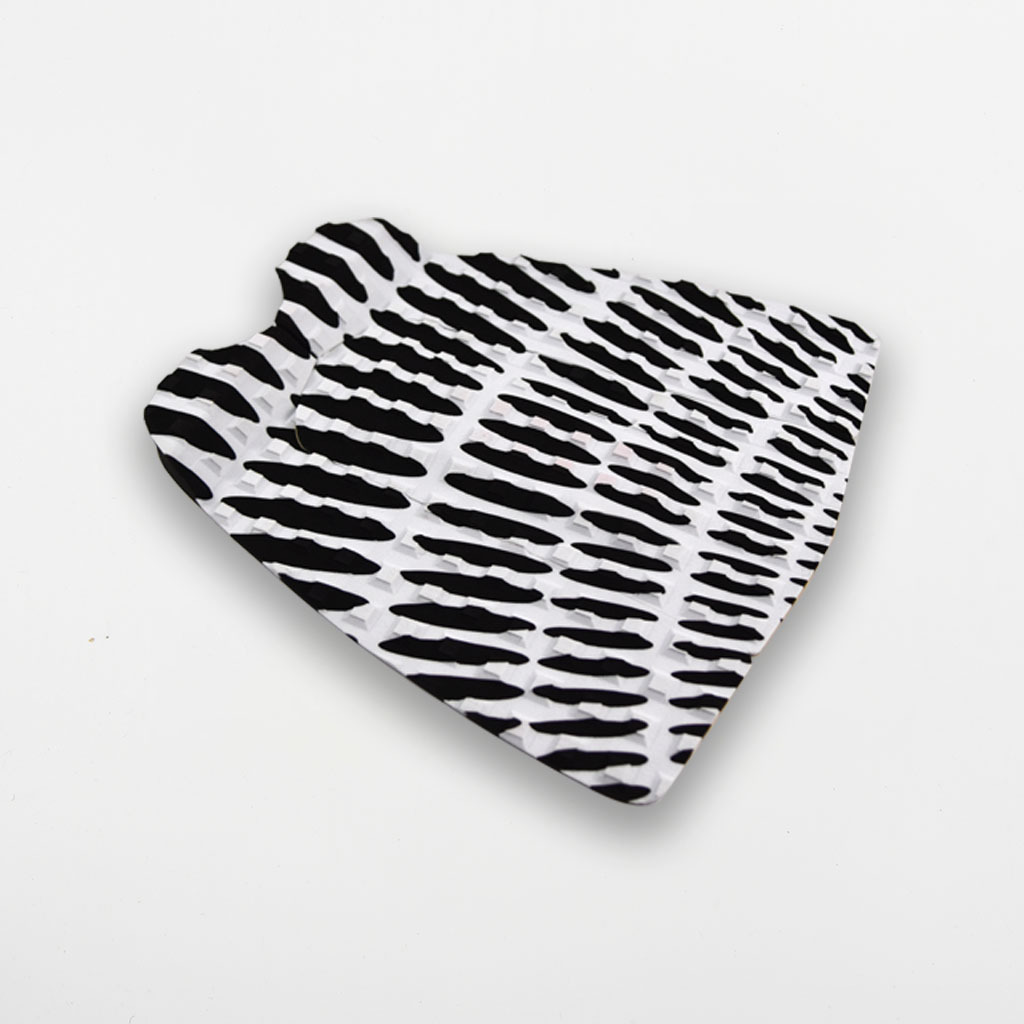
The T00535 is a surfboard tail pad: a flat, peel-and-stick traction pad that sits under the back foot at the tail of the deck, where a rider drives off the bottom and locks a turn in. It is the zebra-print design in our tail-pad range — black bars across a light ground, a raised textured surface and edges that follow the outline of the board instead of sitting on it as a rectangle. Most of these pads go on as a replacement. A pad comes off a board because the old one has gone smooth underfoot, lifted at a corner or peeled away after a season of sun and salt, and the fix is a fresh pad on a properly cleaned deck. Shops fit them for customers, rental and school fleets refit whole racks of boards before a season, and trade buyers stock them as a fast-moving accessory that sells next to boards, leashes and fins.
Surface & Grip Texture
- Raised texture across the deck: the pattern stands proud of the surface, so the back foot has something to bite against when the deck is wet, and the grip does not disappear the moment wax and salt build up.
- Matte finish: the surface reads flat rather than glossy, which keeps the graphic legible on a wall rack and stops the pad looking worn as soon as it picks up wax.
- Contoured edges and rounded corners: corners are where pads usually start to lift, so the outline tapers into the deck rather than ending in a sharp point that catches a toe, a leash or a board bag.
- Notched tail end: the notch lets the pad sit around the stringer and follow a rounded squash tail or a pointed pin without creasing or bunching at the tip, which is what a surfboard tail pad usually fails on.
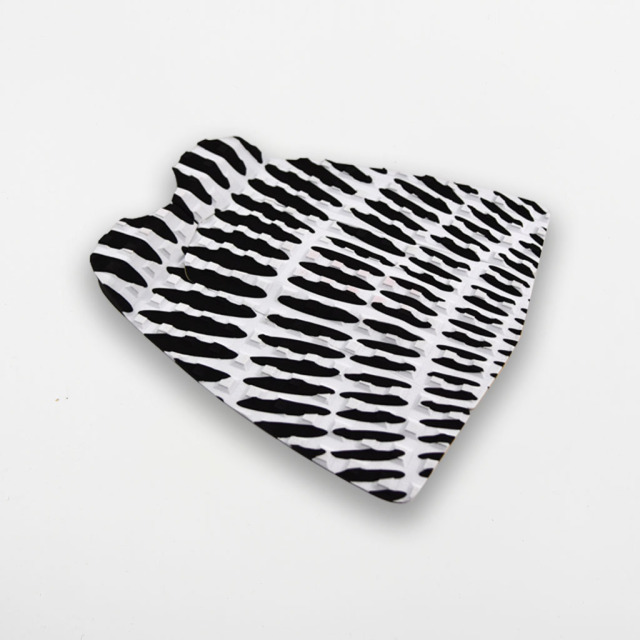
- Black and white zebra print: bold black bars over a light ground. On a white deck the print reads as a white traction pad with black stripes laid across it; on a clear or coloured board it becomes the graphic that identifies the setup on the rack.
- Low, flat profile: the pad sits tight against the deck instead of standing proud of it, so it does not change how the tail feels underfoot or catch the rail when the board goes on edge.
Placement & Fitting
- Strip the old pad properly. Warm the surface with a hairdryer or a few minutes in the sun, lift a corner with a plastic scraper and work it back slowly. Pulling a cold pad tears it and leaves a skin of adhesive behind, which is the usual reason a new surf traction pad lifts again within a week.
- Clear every trace of the old adhesive. A citrus-based remover or isopropyl alcohol on a cloth lifts the residue; wipe the deck with fresh water afterwards and let it dry completely. Wax or oil left in the pores sits between the deck and the new backing.
- Dry-fit before you peel anything. Set the pad on the tail, stand the board up and put your back foot on it. A traction pad is only as good as where the foot actually lands — set a longboard traction pad too far forward and the back foot lands behind it on bare deck — so check that the arch of the foot sits on the texture, the notched end reaches the back of the tail and a clean margin of deck is left along both rails.
- Look hard at the deck surface. If the tail has been ding-repaired, filled or sanded, run your hand across it — the pad only sits flat on a level surface, so sand the fill smooth and let it cure fully first. A repaired tail that still has a hollow in it will pull the backing away as the deck flexes.
- Mark a centreline. A strip of tape along the stringer, or a light pencil line, keeps the pad symmetrical and gives you something to align to when the backing is half off and the adhesive is already tacky.
- Set it from the tail end. Peel back a short section of backing, line the notch up with the tail, press that end down, then peel the rest as you work forward. Press from the centre out with your thumbs so the air is pushed to the edges instead of being trapped underneath.
- Let it settle before it goes in the water. Run a thumb along the contoured edge, leave the board flat at room temperature for a few hours, and check the corners after the first session — that is when a pad that was not pressed down evenly shows itself.
Wear & Care
Salt comes off with fresh water. Rinse the deck after a session and the raised texture keeps its bite; leave salt and dried wax on it and the pattern slowly fills in, which is what makes a pad feel smooth long before anything has actually worn through. A soft brush and a little mild soap will lift the rest. Keep solvent-based cleaners and acetone away from it — they attack both the surface and the print.
Wax belongs on the deck, not on the grip. Wax worked into the pattern fills the low points of the texture, and the light ground of a white traction pad shows every fingerprint of it. Riders who wax the whole deck out of habit are the ones who end up replacing pads first.
Heat is the other thing that shortens the life of a surfboard tail pad. A board left in a hot car or standing in the sun all afternoon softens the adhesive and lets the edges creep. Once a corner lifts, water and sand get underneath and the rest of the pad follows. If a board lives outside, keep it covered or under shade.
Check the edges every few weeks, particularly along the tail block where the foot pivots. A small lift can be pressed back down while the backing is still tacky; once grit is under it, the pad has to come off.
When the texture has gone flat and the deck starts to feel slippery again, that is the signal to refit rather than to add another layer of wax. A fresh pad on a clean, dry deck gives a shop years of service for half an hour of work.
Companion Accessories
- Leash: Hypalon leashes in 6 ft 6 mm, 7 ft 7 mm, 8 ft 7 mm and 9 ft 8 mm, so the cord can be matched to the board and the conditions — a short light one for a shortboard, the longer and thicker cord for a longboard or bigger surf.
- Fins: honeycomb fins made by resin transfer molding, supplied with single tab and double tab bases. Light and versatile, and the usual second item on the counter when a customer is setting up a new board.
- Traction: the wider deck-grip range — tail pads, centre pads, skimboard pads and waxless pads — so a shop can carry a whole grip section rather than a single design, whether that is a shortboard tail pad or a longboard traction pad.
- Cover: basic bags, regular bags, stretch covers and bodyboard bags for boards going into storage, onto a roof or into the back of a van.
- Rack: travel rax and tie-downs, storage racks, display racks and bike racks, for shops putting stock on the wall and for riders moving a board.
- Board builders and surf board manufacturers often take fins and a surfboard traction pad in the same order, since a new board leaves the workshop needing both anyway.
Specifications
| Item | Detail |
|---|
| Reference | T00535 |
| Product type | Surf traction tail pad |
| Placement | Tail of the deck, under the back foot |
| Pattern | Black and white zebra print |
| Surface | Raised texture, matte finish |
| Outline | Flat pad, contoured edges, rounded corners, notched tail end |
| Fixing | Peel-and-stick adhesive backing |
| Board type | Surfboards, including longboards and fun shapes |
| Pad outline and deck size | Confirmed against your board drawing before production |
| Packaging | Confirmed with your sales contact |
Ordering & Delivery
- Send the design and the quantity per design. Quote the code T00535 for this white traction pad, and list each code separately on a mixed order of surfboard traction pads so the right designs are packed and nothing is substituted.
- Confirm the outline against the boards you sell most. A traction pad for the surfboard market has to suit more than one tail shape, so send a board drawing, a template or a photo of the tail with a tape measure across it and we will tell you how this outline sits on it.
- Agree the packaging before the run. Poly bag, header card, hang tag or shelf-ready label — tell us how the pads will be merchandised on the shelf or hanger and we will quote and pack to that format.
- Fix the carton quantity, the pallet layout and the delivery window. If your season starts on a set date, give us the date the stock has to land and we will confirm what the production schedule allows.
- Ask about sample availability, artwork approval and current lead time. Where the pad will carry your own branding, the artwork and print colour are signed off against a physical proof before production starts.
- Payment terms, shipping method and delivery terms for your order are set out on the quotation and confirmed in writing before we begin. Size, packaging and any branding change the cost, so raise them at enquiry rather than after the order is placed.
Scale & Supply Capability
CIMI is a factory-based supplier with 16 years in surf and watersports hardgoods, manufacturing at our own facility rather than sourcing through traders. Chain stores, supermarkets and surf-brand stores buy from us because one supplier covers a full accessory assortment, so a season's order and its reorders can be planned together. We take on OEM and private-label work, adapting designs, colourways and branding to your programme, and we schedule production against your agreed range plan. Send us your buy list and target dates, and we will confirm what we can make and when.
FAQ
Do I still need wax once the pad is on?
No — the surf traction pad takes the place of wax on the tail. Wax still belongs on the rest of the deck, from the middle of the board forward, because that is where the front foot and chest need grip. Keeping wax off the pad itself is what preserves the raised texture: worked-in wax fills the low points of the pattern and the grip goes flat long before the pad wears out.
Will the pad suit a longboard or a wider fun shape?
Where the tail is wide enough to take the full outline, yes. Riders looking for a longboard traction pad usually fit it together with a centre pad, so the deck has grip under the back foot and through the middle of the board instead of two separate islands of texture. On a very narrow pin tail the pad may need trimming at the rear corners — check the fit on the board before the backing comes off, and send us the tail width if you want us to confirm it against this outline.
Can I fit the new pad straight over the old one?
No. A surfboard traction pad has to bond to the deck, not to another pad. Fitting over the top leaves two layers and a stepped edge that catches a toe, water works its way between them, and the new pad lifts with the old one still attached. Strip back to bare deck, clear the adhesive and let the surface dry — a clean, dry deck is the single biggest factor in how long the new pad stays down.
Can I trim the pad to fit a narrower tail?
Yes, and plenty of shops do. Cut from the backing side with a sharp blade, take small amounts off each side rather than one big cut, and check the fit on the board between passes. A traction pad for surfboard use is trimmed most often at the two rear corners, where a wide outline overhangs a narrow tail. Keep the cut edges clean and press them down firmly along the whole length afterwards.
Will the pad bond to a soft-top or foam deck?
Tell us the board construction before you order. Soft-tops and moulded foam decks hold adhesive differently from a glassed deck, and the backing that suits a PU or epoxy board is not automatically the right one for a foam board. Give us the deck type and we will confirm the backing that suits it before the pads are produced.
Will it hold up on rental and school boards?
It is the kind of item rental operators refit at the start of a season. Boards in daily use go through pads quickly — sun, salt and constant traffic soften the adhesive at the edges first, so fleets tend to check corners every few weeks and press them back down while the backing is still tacky. A light-ground design like this one shows wax and dirt sooner than a dark pad, which matters if you want hire boards looking tidy; keep a spare set on the shelf and order by code so replacements match the pads already on the boards.