Product Overview
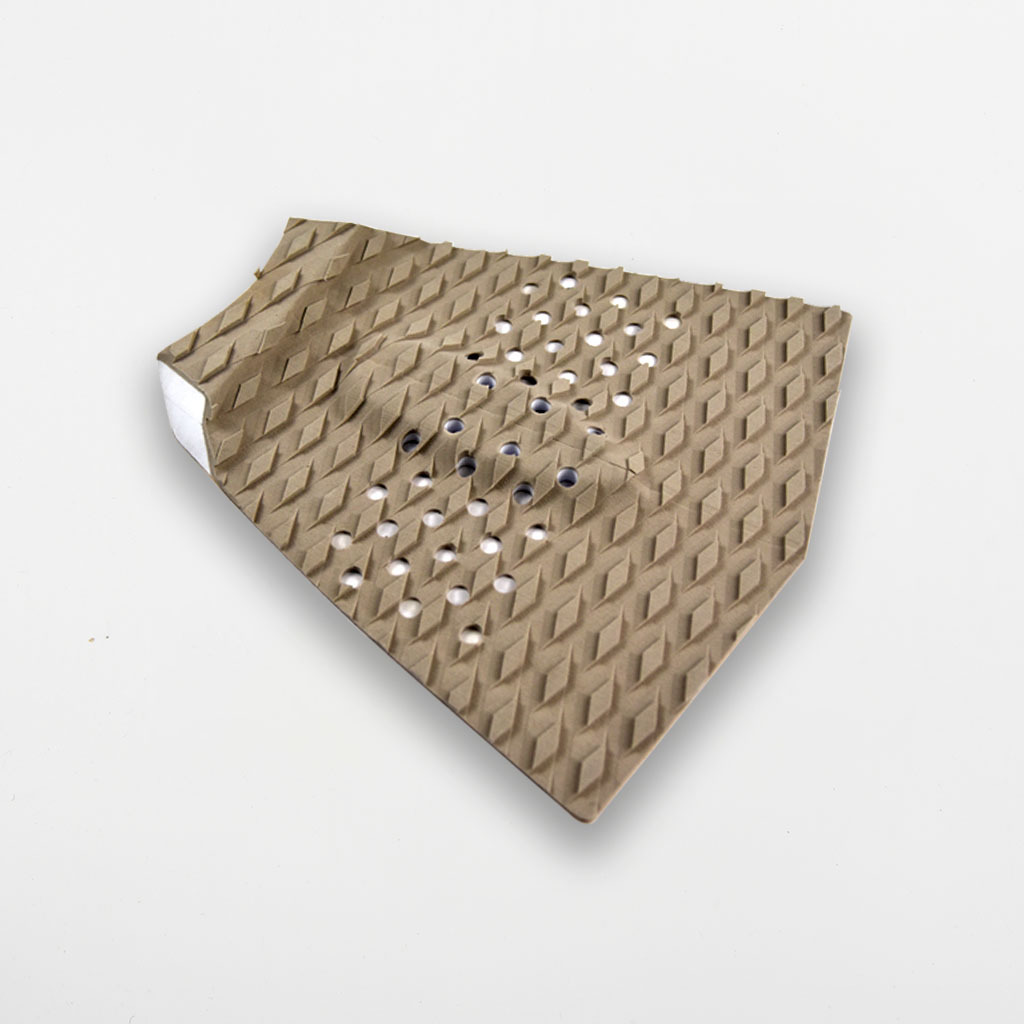
T00537 is a surf traction tail pad: a flat, peel-and-stick grip panel that sits on the tail of the board, right where the back foot lands. It goes down on a clean, sound deck with nothing more than a liner to peel and firm hand pressure behind it, and it stays put through the riding, carrying and stacking a board gets between sessions.
What it changes is the tail itself. Wax gives grip but no shape — nothing to push against, nothing to tell you where the foot is. This pad puts a raised, textured panel there instead, so the back foot meets grip rather than a smooth sheet, and the outline of the pad becomes a marker you can find with your foot alone. On a shortboard that means the foot is already in place when the section stands up; on a wider, softer tail it means the foot stops sliding out halfway through a cutback.
The pad arrives flat and flexible, so it follows the curve of the tail as it is pressed into place. It is built to be ridden rather than protected: salt water, wax and sand are part of its working life, and it cleans up without the edges coming away.
Grip Feel & Control
- Grip where a turn starts: the raised diamond pattern sits directly under the back foot, so the pressure that drives a turn has something to bite against instead of skating over wax.
- A flat surf traction pad, not a platform: the pad stays low to the deck, so the tail still talks to your foot and the board keeps its feel through the whole turn.
- A foot position you can find again: the outline marks where the back foot belongs, so you can reset after a wipeout without looking down at the deck.
- Wet grip from a raised pattern: the texture stands out of the surface rather than being printed on it, so water and wax have somewhere to move instead of sitting between foot and deck.
- Feedback through the rail: with no soft layer between foot and board, you feel the rail load as the turn comes on, which is what lets a rider hold a line rather than guess at it.
- Grip that does not depend on the wax: a surfboard traction pad keeps working through cold water and long sessions, where a waxed tail starts to slick over and needs re-waxing to come back.
Build & Surface
Start with the surface, because that is the part that wears. The pattern on this surfboard tail pad is embossed into the foam rather than printed or laminated on top, so the texture is the material itself — there is no upper layer to polish smooth and start sliding on.
The pad is cut flat with a matte finish and a warm tan tone, plain rather than graphic, so it sits under a board logo instead of competing with it. A run of perforations through the centre breaks the surface and gives a clean centre line to line the pad up on the deck. The edges are cut square and finished flat, so a heel that rolls onto the edge meets the pad rather than a lip of loose material waiting to catch.
Underneath sits a pressure-sensitive adhesive under a peel-off liner. The pad is supplied flat, which keeps both the shape and the adhesive intact in storage, and it flexes to the tail curve at the moment it is fitted.
Three things are worth checking when a carton arrives: that the liner is unbroken, that the edges are clean, and that the pattern is evenly pressed across the whole pad. Between them they catch almost everything that would otherwise surface later on a customer's board.
Fitting the Pad
- Clear the old grip first. Take the old pad off with a plastic scraper and lift the wax residue with it, then wipe the tail down with a cloth and a solvent that flashes off completely — isopropyl alcohol is the usual choice in a shop. Surf traction tail pads only hold as well as the surface under them.
- Check the tail is sound. A repaired or re-glassed section needs to be fully cured, flat and clean before anything goes down on it.
- Dry-fit before you peel. Set the surfboard tail pad in place and sight along the stringer: the pad should sit square on the tail with the pattern running with the board, not across it.
- Keep the leash plug clear. Mark the plug with tape and keep the pad and its edge off the plug and its channel, so a surf leash can be fitted and changed without lifting the corner of the pad.
- Tape the outline. Two strips of tape at the front edge give marks to drop the pad back onto once the liner is off.
- Peel and press from the centre out. Take the liner off in one movement, set the pad down on the marks and work outwards with the flat of your hand, pushing air ahead of you to the edges.
- Go round the edge with a thumb, then press it again a little later. That second pass on the edges is what stops a corner lifting in the first week.
- Let it set before it gets wet. Keep the board out of the water, and out of a hot car, until the adhesive has had the time it needs to settle.
Rider, Shop & Fleet Use
- Surf shops fitting at the counter: a pad goes on in minutes while the customer waits, which turns a worn tail into a sale on the same visit instead of an order for next week.
- Rental fleets and surf schools: every board that comes off the surfboard rack at the start of a season can be brought back to the same standard, so renters meet the same grip whichever board they are handed.
- Surf board manufacturers fitting out production boards: pads go on before the board is packed, so the deck arrives ready to ride rather than needing work at the shop.
- Longboard and mid-length riders: a longboard traction pad is fitted at the tail as a turning platform while the rest of the deck stays waxed for cross-stepping, which is how most longboards are actually set up.
- Riders kitting out a board in one visit: a pad and a surf leash are the two parts that wear out first on a board in regular use, so shops tend to fit both at the same time.
- A rider moving off a plain waxed tail: the first pad on a board is usually the point where the back foot stops wandering between waves.
Care & Longevity
Salt is the main thing to deal with, and it is easy. Rinse the deck with fresh water after a session, use a soft brush and a little mild soap on the pattern when wax builds up in it, and let the board dry out of direct sun. Keep solvents, wax removers and acetone away from the pad: they attack the foam and the adhesive at the same time, and an edge softened that way will lift.
Heat is the other thing to watch. A board left in a hot car or lying flat in the sun all afternoon will lift at the pad edges long before the pattern wears out, and once an edge curls, sand and salt get underneath and the pad is finished. Store the board out of the sun and it will outlast the wax around it.
A longboard traction pad takes more foot traffic than a shortboard's simply because there is more deck underfoot and more moving about on it, so check its edges once a season. If an edge does lift, resist trimming it back — clean and reseat it properly, or have a shop that fits pads do it. Replace the pad when the pattern has gone smooth and shiny across the middle, not when it merely looks dirty.
Companion Range
- Surf leash: Hypalon leashes spanning 6 ft to 9 ft and 6 mm to 8 mm, so a shortboard, a mid-length and a longboard can all be kitted from the same family.
- Fins: honeycomb fins in single tab and double tab, made by resin transfer moulding, for shops that want to sell a fin set with the board.
- Traction: the fuller surfboard traction pad range covers tail pads, centre pads, skimboard pads and waxless pads, so a deck can be set up the way the rider wants it.
- Covers: basic bags, regular bags, stretch covers and bodyboard bags for the board that leaves the shop.
- Surfboard rack and storage products: travel rax and tie-downs, storage racks, display racks and bike racks, for the shop floor and for the customer's garage.
- Why they belong together: these are the categories a board buyer usually takes as well, and holding them in one range keeps a shelf consistent without four separate supplier relationships.
Ordering & Delivery
- Send the list: the design codes you want and the quantities for each. The code on the pad shown here is T00537, and it stays the same on every reorder.
- Say what the order is for. A shop-floor display, a rental fleet and a private-label programme are quoted differently, and knowing which one it is saves a round of questions.
- Confirm the programme. We produce deck hardware under private label for surfboard manufacturers, multi-store chains and distributors; tell us what you want changed on this pad and our team will confirm what can be adapted.
- Ask about samples. If you need to see the pattern and the edge finish before committing, ask your sales contact about sample availability and what a sample would cover.
- Confirm packing and marking. Tell us how the pads should be packed and whether the cartons need your own labels.
- Confirm lead time and shipping terms against your season. Peak-season dates are worth raising early, and your sales contact will confirm what is achievable.
- Confirm payment terms before the order is placed, so the paperwork matches what your finance team expects.
- Ask whether the order can be consolidated with the rest of the accessory catalogue, including surfboard rack and storage products, so the whole buy is planned together.
Scale & Supply Capability
CIMI is a factory-based supplier with 16 years in surf and watersports hardgoods, manufacturing at our own facility rather than sourcing through traders. Chain stores, supermarkets and surf-brand stores buy from us because one supplier covers a full accessory assortment, so a season's order and its reorders can be planned together. We take on OEM and private-label work, adapting designs, colourways and branding to your programme, and we schedule production against your agreed range plan. Send us your buy list and target dates, and we will confirm what we can make and when.
FAQ
Will the pad hold on a board that has been repaired or re-glassed?
Provided the repair has fully cured and the surface is flat, yes. Wipe off every trace of wax and dust before the surf traction pad goes down, and do not fit it the same day a ding was filled — a repair that is still moving underneath will take the pad with it. If the repair left a ridge or a hollow, flatten or fill it first, because the adhesive follows the surface rather than bridging over it.
Can I replace just the tail pad and leave the rest of the deck alone?
That is what these surf traction tail pads are made for. If the rest of the deck is sound, remove the old tail pad, clean the area back to the board and fit the new one; there is no need to strip a centre pad or a full deck grip that is still doing its job. If the old pad comes away in pieces, work it off with a plastic scraper and let the solvent lift the residue rather than digging at the glass.
Which boards is this shape suited to?
It is a tail pad, so it belongs on the area behind the back foot — shortboards, fish, step-ups and mid-lengths all take one. What matters more than the board label is the deck it goes on: the pad wants a flat or lightly domed tail section with enough clean surface to take the full outline. On a heavily domed or deeply channelled tail, check the dry fit of the surfboard tail pad before the liner comes off.
Do longboards and mid-lengths need a different pad?
Most longboards carry a smaller pad at the tail rather than grip across the whole deck, because the rest of the board is waxed for cross-stepping. A longboard traction pad is there to give the back foot a platform for turns, and it sits on a flatter tail section than a shortboard pad does. If the tail is rounded or the deck is domed, tell us the board and we will say whether this outline will seat properly.
How do I take an old pad off without damaging the deck?
Warm it gently and work slowly. A hair dryer on a low setting, kept moving, softens the adhesive without cooking the foam; a heat gun is far too much for this job. Peel from a corner while you slide a plastic scraper under the pad, and never lever against the glass with a metal tool. Residue comes off with the same solvent you would use to clean the deck before a new surfboard traction pad goes down.
Can the pad be produced in our own branding?
Yes. We produce customised deck hardware under private label for surf board manufacturers, reseller chains and distributors. Patterns, colours and branding can all be adapted to a programme — send us the artwork and the design direction, and our team will confirm what can be made and what needs to change to suit production.