Product Overview
Riders stand on the back third of a board far more than most of them realise, and that is the area this pad is built for. It is a peel-and-stick surf traction pad shaped to sit on the tail of a surfboard, directly under the back foot, so the foot has a defined surface to push against through a turn instead of sliding on bare glass. It is also the part of a board that wears first: wax flattens, the old grip goes slick, the edges curl and water works its way underneath.
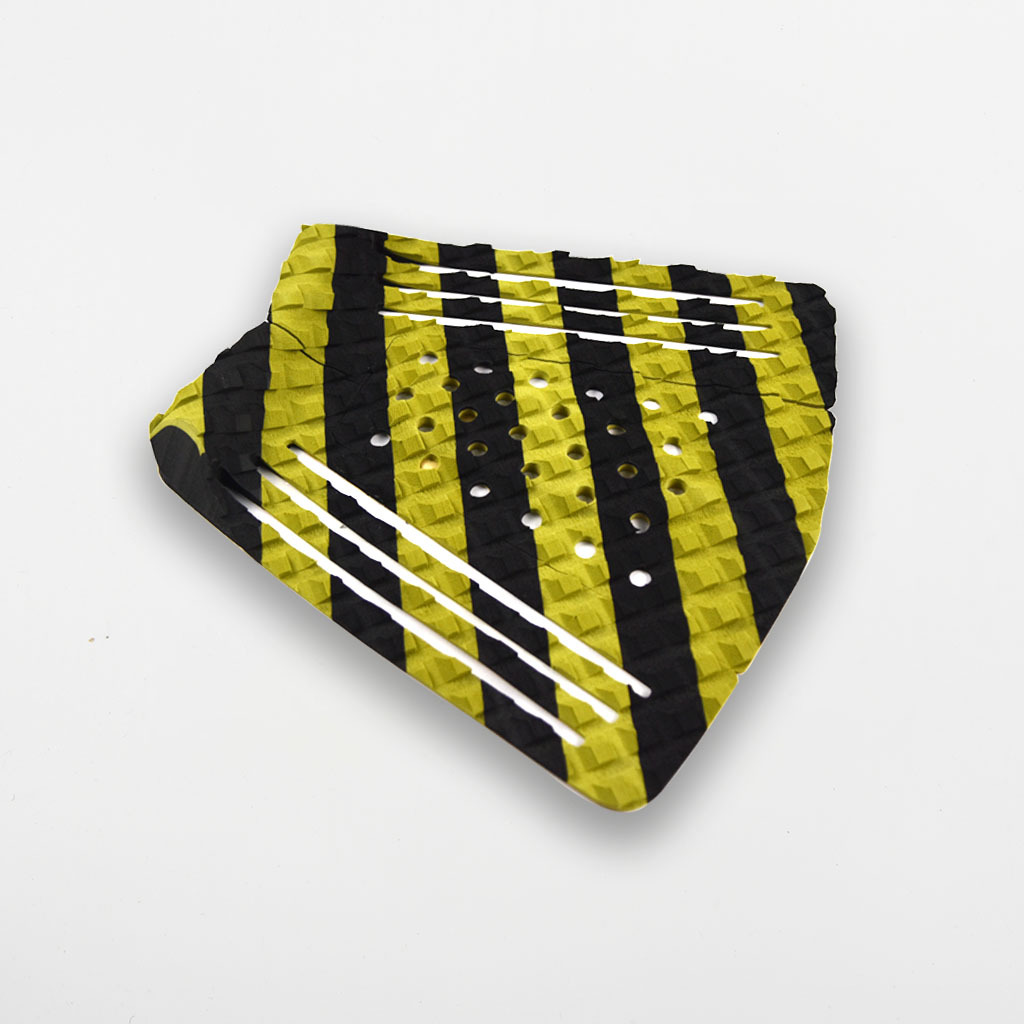
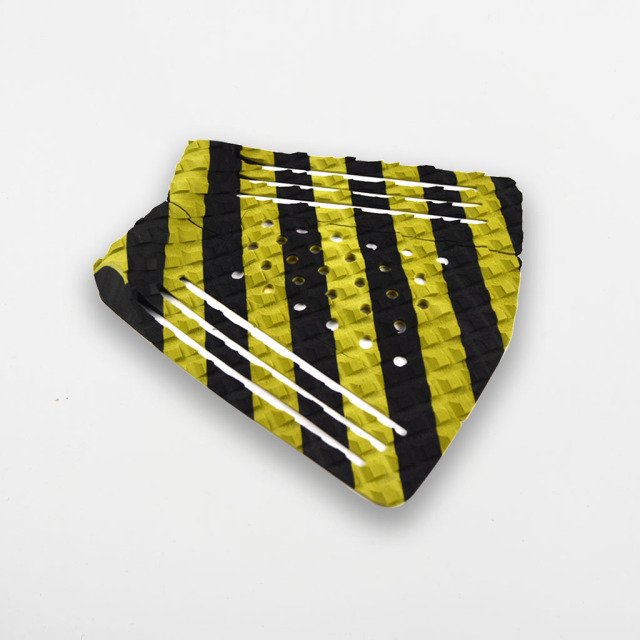
The design shown here is a two-tone pad with a black and yellow split, a pebbled grip surface across the standing area and a centred perforated detail that marks the middle of the pad when you line it up on the deck. The surface is cushioned rather than hard, which takes some of the sting out of a heavy landing and gives the back foot a softer bed on long sessions.
We build these for shops, rental fleets and private-label programmes as well as for riders replacing their own grip, and each pad arrives with its adhesive backing already applied, so it can be fitted without resin, clamps or workshop time. Whether you are filling a shelf, keeping a school's boards serviceable through the season or simply retiring a pad that has gone smooth, this one is a straightforward swap.
- Pebbled grip surface. The standing area carries a raised, textured finish rather than a flat sheet, so there is something for a wet foot to bite against and something for wax to key into on the drop. - Centred perforated detail. The middle of the pad is broken up with a perforation pattern, which gives a clear centre line to align on the stringer and stops the pad reading as one flat slab underfoot. - Cushioned standing area. The surface has some give to it, which softens the landing after an air or a heavy bottom turn and keeps the back foot comfortable through a long session. - Peel-and-stick backing. The adhesive is already applied. A pad can be fitted on the beach wall, in the shop or in a rental bay with no resin, no clamps and no cure time to plan around. - Tail-following outline. The shape follows the taper of the tail, so the surfboard tail pad sits inside the rail line rather than overhanging the edge, where it would catch water and lift. - Two-tone finish. The black and yellow split reads clearly at a distance, which helps a customer pick the same design off a wall or a screen a second time.
Fitting a Tail Pad
- Take the old grip off. Stand the board in a surfboard rack or against a wall, warm the old pad briefly with a hair dryer or a hot water bottle, lift a corner with a plastic scraper and work it back slowly. Never use a metal blade — a gouge in the deck is worse than a worn pad.
- Clear the residue. Scrape off old adhesive and wax with a plastic scraper and a wax remover or warm soapy water, then wipe the area with fresh water and let it dry completely. Adhesive will not bond to a damp or waxy deck, and that is the most common reason a new pad lifts.
- Dry-fit the surfboard tail pad. Set it on the board before any backing comes off: find the stringer, centre the pad's middle detail on it, and look along both rails to check the outline sits inside the edge.
- Tape a fence. Two strips of masking tape at the nose end and along one side give a stop to drop the pad back against. On a longer deck the same method works for a longboard traction pad, where the tail is further from your eye and a small misalignment is harder to spot.
- Peel and anchor. Peel a short section of backing at the nose end, set the pad against the tape and press that end down firmly.
- Work towards the tail. Peel and press in short sections, pushing air out from the centre to the edges with your thumbs as you go, rather than laying the whole pad down in one movement.
- Finish the edges. Run firm pressure across the whole outline and then along the edges last, because that is where lifting starts.
- Let it settle. Keep the board out of the water long enough for the adhesive to settle before waxing over the join.
Shop, School and Home Refits
- Shop bench work. A surfboard tail pad change is one of the quickest jobs a shop can take on for a customer: the board comes in with a slick or lifting tail and goes out with a defined surface under the back foot. Shops that fit pads while the customer waits usually keep two or three designs on the wall, so there is a choice of look rather than one plain pad.
- Rental fleets and surf schools. School boards take more feet per season than any private board, and the tail is where it shows first: grip worn smooth, edges curled, water under the pad. Replacing pads across a fleet in one pass before the season keeps every board feeling the same underfoot, which matters when beginners are swapping boards between lessons.
- Longboard and mid-length refits. Longer boards are ridden further forward, so the back foot does not always land in the same place. If you are sourcing a longboard traction pad rather than a shortboard cut, say so — a wider standing area usually suits that position better than a narrow tail pad.
- New-board finishing. Surf board manufacturers fit the pad as part of final assembly, before the surfboard fins go in and before the board is bagged. Doing it at that stage means a clean, unwaxed deck, which is the easiest surface to get a flat, well-seated pad onto.
- Pre-season servicing. Shops that service customer boards ahead of the season tend to replace grips in batches, alongside leashes and a check of the fin boxes. Ordering pads in that same run saves a second shipment later.
- Dealer and web listings. A pad with a clear two-tone design photographs well and is easy for a customer to recognise again. If a range is mostly plain black pads, one contrast design gives the shelf something to look at.
Specifications
| Property | Detail |
|---|
| Product type | Peel-and-stick surfboard traction pad, shaped for the tail of the deck |
| Model reference | T00539 |
| Fitting position | Tail of the deck, centred on the stringer under the back foot |
| Adhesive | Factory-applied pressure-sensitive backing; the bond builds over the hours after fitting |
| Deck preparation | Old wax, salt, dust and any previous adhesive removed; deck wiped and completely dry before the backing is peeled |
| Fitting conditions | Still air, out of direct sun, at a working temperature you would be comfortable in yourself |
| Board match | Shortboards, funboards and longboards whose tail carries the pad without crossing the rail edge; check the tail width before ordering |
| Wax compatibility | Basecoat wax keys into the texture; strip the old wax before fitting, not after |
| Drainage | Perforations through the centre section give water an escape route instead of letting it sit under the back foot |
| Cleaning | Fresh water and a soft brush; no solvents and no abrasive pads |
| Storage before fitting | Flat, backing paper intact, out of direct sun and away from heaters |
| Reorder reference | Quote model T00539 to repeat the same design |
Grip, Wear and Care
- Rinse after salt water. A quick rinse with fresh water after a session keeps salt and sand out of the texture. Salt crystals left in a textured surface blunt the grip over months of use.
- Keep wax where it belongs. Wax goes forward of the pad, not on it. Wax worked into the pebbled surface clogs the texture, and the fix is a plastic scraper and warm water, never a solvent that can attack the adhesive at the edges.
- Mind the heat. Do not leave a board in a closed car or flat in strong sun for long periods. Heat softens the adhesive under any pad, and a tail area that has been cooked is where lifting begins.
- Check the edges once a season. Press down along the outline with a thumb. A small lift can usually be pressed back with a warm hand; a lift that has collected sand needs the pad taken off and the deck cleaned before refitting.
- Store it off the tail. A surfboard rack keeps the board upright and its weight off the tail, rather than standing it in a corner on the very end the pad is bonded to.
- Look the board over while it is stripped. With the old pad off, check the tail for dings, look at the fin boxes where the surfboard fins seat, and check the rail saver area. A soft spot under a new pad will spread.
- Replace when the texture flattens. When the pebbles have worn down and the surface feels slick even when clean, that surfboard traction pad has done its work. Regripping early is cheaper than a slipped back foot.
Stocking This Design
A pattern only earns its shelf space if the same thing can be ordered back next season. Every pad we make is held under a fixed code, so a reorder is quoted by code rather than by photograph — photos drift, screens render colour differently, and a buyer who joined after the last purchase has nothing else to match against. For a multi-store programme that means one code per facing: the same pad in every branch, instead of three near-matching designs that confuse the customer and complicate the stock count. As surf board manufacturers we run the design through our own line, so a question about a pattern, an outline or a colourway goes to the people who actually make it. If a design is being changed or retired, raise it before the next buy goes in rather than after the shipment lands. A mid-season substitution is what turns a tidy shelf into a mixed one, and it is far easier to plan the change into a range review than to explain it to a store manager.
Leash, Fins, Covers and Racks
- Leash. A board that leaves the shop with a new pad also needs a leash on it. Our range covers a 6ft 6 mm Hypalon for small to medium surf, a 7ft 7 mm for all-round conditions, an 8ft 7 mm for medium to large waves and longer boards, and a 9ft 8 mm regular longboard ankle leash for bigger days. Stocking the surf leash beside the pads means a customer can finish the whole setup in one stop.
- Fins. Honeycomb fins in single tab and double tab are made by resin transfer moulding — light, versatile and usable across a range of conditions. If you already buy surfboard fins from us, the pad, leash and fins can be planned as one accessory buy rather than three.
- Traction. This pad is one design inside a wider traction range that also covers centre pads, skimboard pads and waxless pads. A shop that carries one tail pad usually wants two or three looks on the wall, plus a centre pad for riders who want grip further forward.
- Covers. Basic bags, regular bags, stretch covers and bodyboard bags protect the deck and the pad between sessions and in transit. A cover is the natural add-on when a customer is buying grip to look after the tail; a bag that fits the board properly keeps weight off the pad's edges.
- Racks. Travel rax and tie-downs, storage racks, display racks and bike racks all sit in the same catalogue. Whether a store is merchandising pads on a display wall or a school is storing boards between lessons, a surfboard rack is the piece that keeps boards off the floor and off their tails.
Ordering and Delivery
- 2. If you want a different colourway or your own branding on it, say so at this stage so the artwork and colour can be agreed before production is scheduled. 3. Say what else travels with the order. A surf leash, a set of covers or spare fins change the carton count and the packing plan, so flag them at quoting rather than adding them after the order is costed. 4. 5. Agree the packing. Tell us whether the pads should arrive loose for your own bagging or with a printed header card for hanging, and whether the cartons need your labels. 6. Ask about samples. If you need to check the surface and the adhesive before committing to a quantity, ask your sales contact about sample availability and what needs to accompany the request. 7. Check the calendar. Confirm the current lead time against your season and your store delivery windows before the order is placed, since the schedule changes through peak months. 8. Agree the commercial terms. Payment terms, shipping terms and the documents you need are settled with your sales contact when the order is confirmed. 9.
Scale & Supply Capability
CIMI is a factory-based supplier with 16 years in surf and watersports hardgoods, manufacturing at our own facility rather than sourcing through traders. Chain stores, supermarkets and surf-brand stores buy from us because one supplier covers a full accessory assortment, so a season's order and its reorders can be planned together. We take on OEM and private-label work, adapting designs, colourways and branding to your programme, and we schedule production against your agreed range plan. Send us your buy list and target dates, and we will confirm what we can make and when.
FAQ
Will this pad fit my surfboard?
Tail pads sit behind where the back foot lands, and this one is tapered to follow that shape. Before anything is peeled, set it on the board and look along both rails: the pad should sit inside the rail line with the centre detail lined up on the stringer. If your tail is unusually narrow, wide or heavily channeled, send us the outline and we will tell you whether this surf traction pad is the right fit or whether another design in the range suits the board better.
Can I trim it to shape?
Yes, and shops often do it on a narrow tail. Trim before the backing comes off, take a little at a time, and use a fresh blade so the cut edge stays clean rather than ragged. Check the fit against the board between cuts rather than taking one large slice. Keep it modest: a surfboard traction pad trimmed too far loses the outline that was designed to cover the back foot.
Can I use this pad on a longboard?
It will fit a longboard tail, though longboard riders often want more coverage than a shortboard outline gives. If you are after a longboard traction pad with a wider standing area, tell us your deck width and the position the rider stands in, and we will point you at the design in the range that suits. On a longer board the pad usually goes a little further forward to the riding position rather than hard against the tail.
What is the difference between a tail pad and a centre pad?
A tail pad, like this one, sits in the back foot's zone at the tail and is shaped to leave the rails clear. A centre pad sits further along the deck and is generally flatter and lower in profile, for grip where a rider shifts their stance mid-turn. Skimboard pads are a separate cut again, sized for a skim deck. All three belong to the same traction category but do different jobs, so a shop range usually carries a mix rather than one type.
Do I need a new surf leash when I change the pad?
Not as part of the job, but a pad change is the moment the board is stripped down and easy to inspect. Check the cord where it meets the rail saver, check the string where it passes through the plug, and replace anything that looks worn rather than waiting for it to fail in the water. A surf leash that has been on the board for several seasons is usually the next thing to go after the grip.