Product Overview
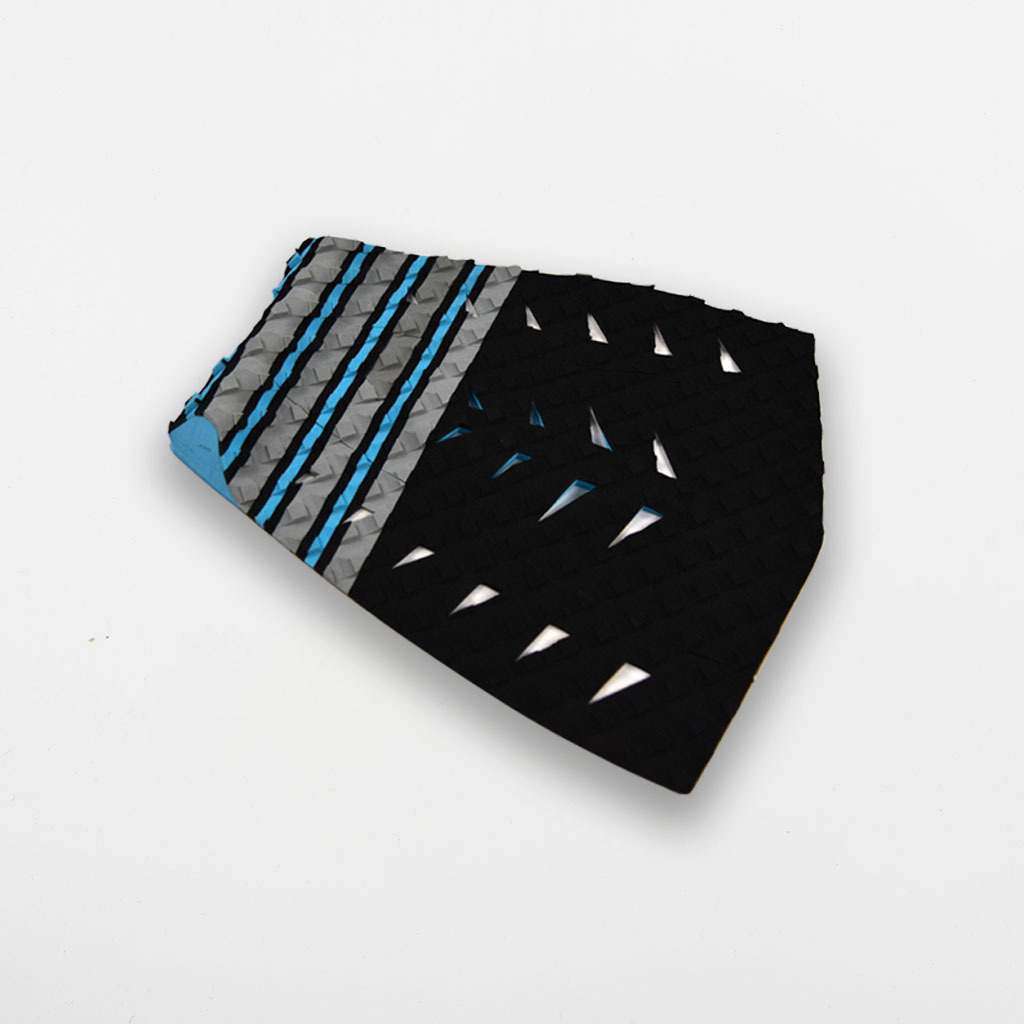
T00540 is a shaped grip pad for the tail of a surfboard — the patch of deck under the back foot that takes the most punishment in a turn, and the tail piece that sits behind a longboard traction pad. The backing is peel-and-stick, so fitting is a single job on a clean, dry deck. Most of these leave us as replacement parts. A deck grip that has gone smooth in the middle of the tail, lifted along an edge or worn through where the back foot pivots is the usual reason a shop or a rider orders one, and the fitting job is much the same whether the board is three months old or three seasons old. Board builders and surf board manufacturers buy the same design to finish new boards, and rental operators keep a few in stock for the fleet. The outline is already shaped — the angled edge and the cut-outs are part of the piece, so there is nothing to trim before it goes down and no trimming marks along the rail afterwards.
Design And Commercial Presentation
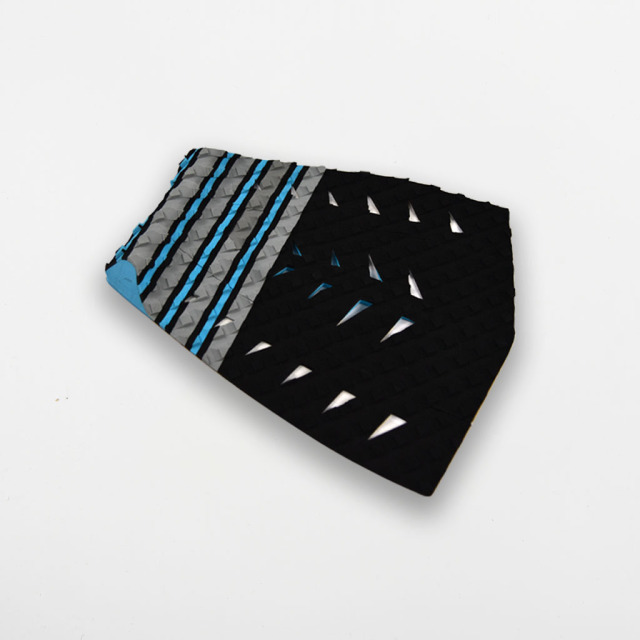
- Diamond-textured face. The raised diamond pattern covers the main body of the surfboard tail pad, giving the sole a set of edges to push against instead of a flat sheet. It is also the detail that reads first in a close-up product shot.
- Blue and grey stripe. A striped section runs across the pad and gives the design a colour cue — useful on a peg where every pad is black, and easy to describe to a customer over the phone.
- Triangular cut-outs. Cut-outs along the edge stop the outline reading as a plain rectangle beside the other designs in the range.
- Angled edge. One end is shaped on an angle so the pad follows the tail outline; that edge is also the line to position first when fitting.
- Hanger and shelf presence. The sheet lies flat on a hanger, and the striped section gives shop staff something to point at when a customer is choosing between designs; it also sits easily beside a surfboard leash on a counter display.
- Installed photography. The pad photographs clearly from low over the tail, with the stripe and the cut-outs set against the board's graphics — an installed shot, board steady on a surfboard rack, sells it better than the pad alone on a white background.
- Plain and graphic decks. A black base with a cool blue and grey stripe sits well over white, grey and blue board finishes and stays visible on a bright deck.
Grip And Control
A surfboard traction pad earns its place through the back foot, and this one is shaped around that. The diamond pattern gives the sole something to lock into: the raised edges catch the ball and heel, so the rider is driving against the pad rather than sliding across a waxed deck. Under the arch the sheet adds a layer between foot and board, which takes the hard edge off the tail through a turn. The pad doubles as a position marker. Once it is down, the back foot has a defined place to return to after every paddle — an advantage that shows most on a board ridden by several people, or in a rental fleet where stance drifts from session to session. In a shop, the surface is the part of the sale a customer can actually touch. Handing over the pad so they can press a thumb into the pattern says more about grip than a photograph, and the colour break makes it easy to talk through the difference between this design and the one next to it, with surfboard fins often displayed on the same wall. Riders coming off bare wax notice the change immediately — the tail stops feeling slippery when the foot is wet, and there is no wax to top up in that spot. Riders already running a pad tend to replace like with like, because the outline and the position on the tail are already familiar.
Fitting A Tail Pad
- Strip the old grip. Warm the old pad gently, lift a corner with a plastic scraper and work it back slowly, keeping the scraper flat so it does not gouge the deck. Work slower and with less heat on painted or timber decks.
- Clear every trace of adhesive. Lift the residue with a suitable solvent on a cloth, then wipe the whole tail with clean alcohol and let it dry completely. Wax, dust or oil left on the deck is exactly what makes a traction pad for surfboard use lift at the edge later.
- Dry-fit before you peel. Set the surfboard tail pad on the tail without removing the backing and check the outline against the rail line and the stringer; with the surfboard fins out, the board sits flat on the bench. Mark the tail end with two strips of masking tape so the pad returns to the same spot.
- Start at the tail. Peel the backing from the tail end first, sit the angled edge against the tape line and press that end down.
- Work forward and out. Peel the rest of the backing a little at a time and press from the centre outwards, pushing air ahead of your hand instead of trapping it.
- Roll the whole pad. Press firmly with the heel of your hand or a roller, working from the middle out to both rails and finishing along the edge; a board held steady on a surfboard rack makes this easier.
- Let it settle. Give the adhesive time to settle before the board is waxed or ridden, and loop the surfboard leash away from the tail so it does not pull across the fresh edge; keep the board out of a hot car in the meantime.
Traction Range And Companion Gear
- Tail pads across the range. This surf traction pad is one of a long run of tail designs we make. Stocking three or four outlines gives a peg that reads as a range and lets a customer compare patterns instead of taking the only option on the hook.
- Centre pads and waxless pads. Forward of the tail, a centre pad or waxless pad covers the standing area; a tail pad plus a centre pad is the usual pairing for a rider who wants the whole deck covered without wax.
- Longer boards. On a longboard, a longboard traction pad over the standing area plus a tail pad behind it covers the deck a rider actually uses.
- Full-deck grip. For buyers who want one continuous surface rather than a tail-only pad, the HEXA traction board grip covers the deck in a single pattern.
- Surfboard leash. Hypalon leashes in 6 ft 6 mm, 7 ft 7 mm, 8 ft 7 mm and 9 ft 8 mm — the item most often bought in the same basket as a replacement pad.
- Surfboard fins. Honeycomb fins in single tab and double tab, for the same board a customer is refitting at the counter.
- Covers and boards storage. Board covers for transport, plus storage, display and bike racks and travel tie-downs for the surfboard rack side of the range.
- Skimboard pads. For shops serving skimboard customers, the same traction family covers skimboard decks.
Specifications
| Property | Detail |
|---|
| Product type | Surf traction tail pad |
| Model reference | T00540 |
| Surface pattern | Raised diamond texture |
| Colourway | Black with a blue and grey striped section |
| Outline | Flat sheet with an angled edge and triangular cut-outs |
| Fixing | Peel-and-stick adhesive backing |
| Deck position | Tail area, under the back foot |
| Board type | Surfboards |
| Brand | CIMI |
Ordering And Delivery
- Send your list. Design references, quantities per design and anything else you need from the range, so the whole order is quoted together. 2. Confirm the pad and the pack. Check the design, the colourway and how each surfboard traction pad is bagged, labelled and boxed for your shelf, so it arrives ready to hang rather than needing repacking. 3. Look at a sample before a full run. Ask your sales contact about sample availability so the grip, the colour and the outline can be judged in the hand before the production order is placed. 4. Agree the production slot. Lead time is confirmed per order and per season — raise your peak-season dates early so the slot is held against them. 5. Settle the trading terms. Payment terms, incoterms, port of loading and the shipping documents are confirmed in writing on the order. 6. Reorder on the same reference. Keep the code and a signed-off sample on file, and the next run repeats the same traction pad for surfboard specification, colour and packing without a fresh round of approvals.
Scale & Supply Capability
CIMI is a factory-based supplier with 16 years in surf and watersports hardgoods, manufacturing at our own facility rather than sourcing through traders. Chain stores, supermarkets and surf-brand stores buy from us because one supplier covers a full accessory assortment, so a season's order and its reorders can be planned together. We take on OEM and private-label work, adapting designs, colourways and branding to your programme, and we schedule production against your agreed range plan. Send us your buy list and target dates, and we will confirm what we can make and when.
FAQ
How do I check the pad will fit my board's tail?
Lay the pad on the tail before you peel anything and look at three things: whether the width sits inside the rail line, whether the angled edge follows the tail outline, and whether the back of the pad reaches the part of the deck your back foot actually uses. A surf traction pad that overhangs the rail will lift there first. If you are ordering for a shop or a fleet, ask us for the pad's measurements and compare them against the tails you stock before the order goes in.
What does the diamond pattern feel like underfoot?
Firm, with a distinct set of edges. The diamonds are shallow enough that the foot sits close to the board — you feel the deck through the pad rather than standing on a soft cushion — but the raised edges give the sole something to push against when the tail is loaded in a turn. Riders who wear booties in cold water notice the pattern more than barefoot riders, because the texture bites into the sole rather than the skin. This surfboard tail pad suits riders who want feedback from the board.
Can I fit the new pad over an old one?
No — take the old one off first. A traction pad for surfboard use only holds as well as the surface underneath it, and a pad laid over an existing one sits on a soft, uneven base that lifts at the edges within a few sessions. Remove the old grip, clear every trace of adhesive, wipe the tail down and let it dry fully before the new pad goes on.
How do I keep the grip working?
Rinse the pad with fresh water after a session and let the board dry out of direct sun. Salt and sand work into a surfboard traction pad and dull the surface, so a soft brush and mild soap every few weeks is enough to bring the texture back. Keep solvent away from the grip face, and do not leave the board in a hot car — heat is what softens adhesive and lets an edge start to lift.
Does the range cover longboards as well?
A tail pad is the back-foot piece on any board. On a longboard, a longboard traction pad across the standing area usually comes first, with a tail pad behind it for the turns. If you are stocking for longboard riders, take the two together rather than a tail pad alone, and the deck is covered where the rider actually stands.
Can this design be made in our own colours and branding?
Yes. We build traction pads for private-label programmes as well as for our own range, and colourways, pattern details and branding are adapted to the programme. We already supply surf board manufacturers, distribution chains and distributors, so packing and labelling can be set up around your shelf. Send the design direction and the quantities you have in mind and our team will come back on what is possible for your order.