Product Overview
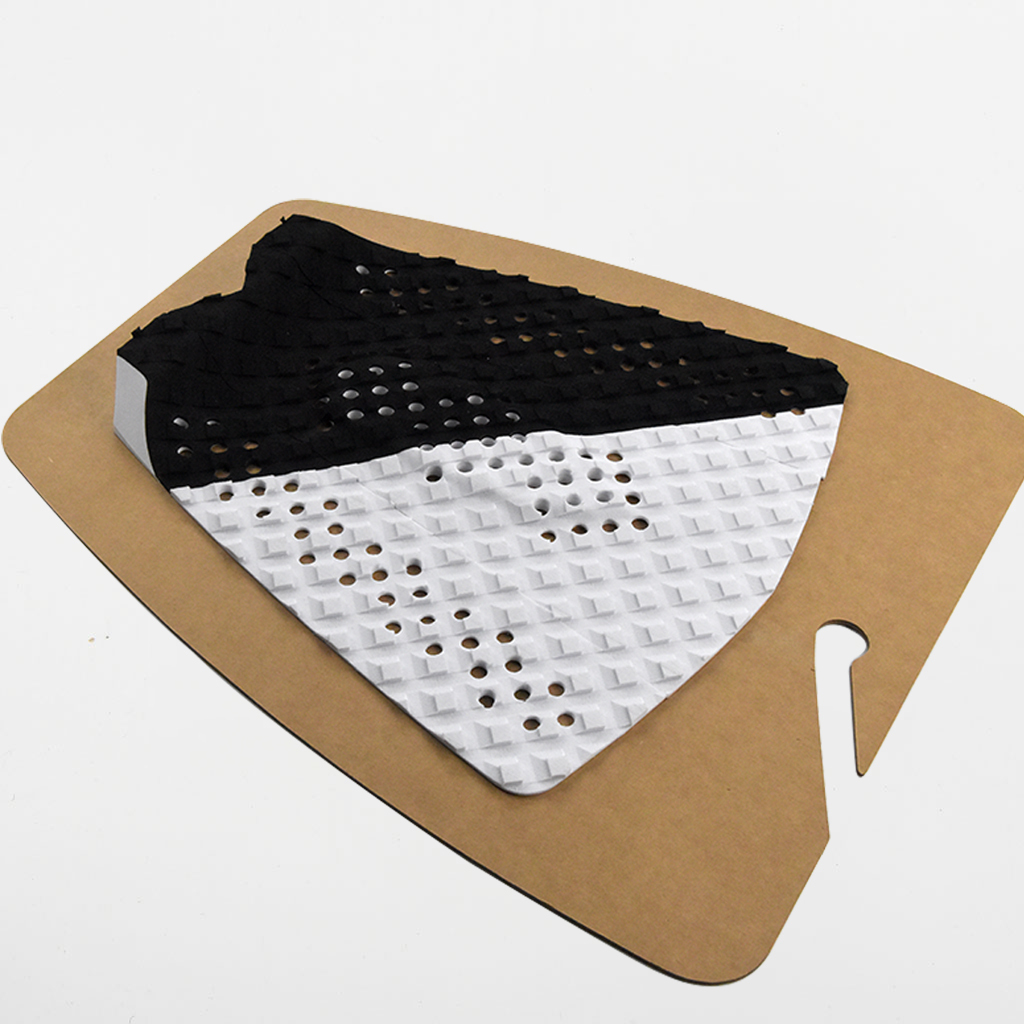
This surf traction pad is a single tapered deck pad for the tail of a surfboard, shaped to sit under the back foot and finished with a raised, perforated surface that reads clearly on a board and across a shop floor. It is a replacement and upgrade part rather than a full-deck covering: a rider takes off a flattened or lifting pad, cleans the tail down, seats this one in its place, and the board goes back in the water with a fresh grip surface. The pattern is the point of the design — a textured grid broken up by punched holes, drawn to hold its shape at a distance and to feel distinct underfoot when the back leg drives through a turn. Shops stock it as a fast-moving accessory that a customer buys with a board or after a season of wear; riders fit it when the tail has gone smooth and slippery.
The pad carries the reference No. 00547, so a design that sells through can be asked for by number instead of described over the phone. Surf board manufacturers and board-brand chains order it alongside deck grips and centre pads to keep one surface across a range of boards.
Deck Pattern & Surface
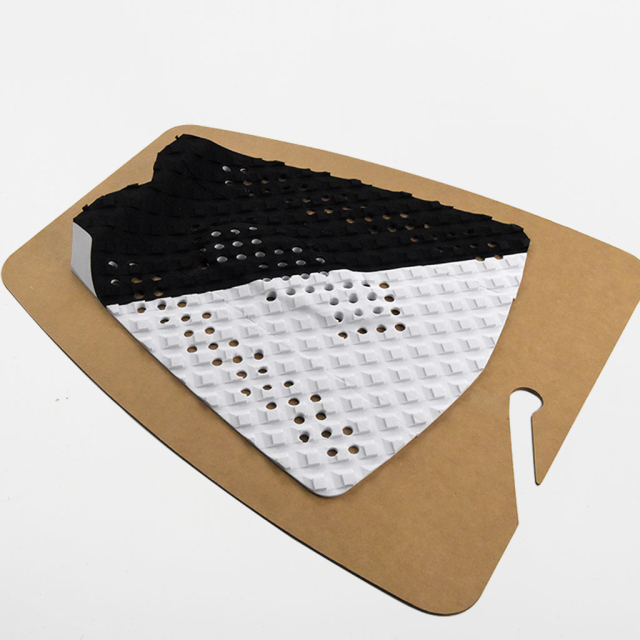
- Raised grid texture: the surface is built up in a fine raised grid rather than laid flat, so the foot meets something to push against when the back leg drives through a turn instead of skating across a smooth sheet.
- Punched perforations: small holes are cut through the pattern across the pad; they give the graphic its character and give water somewhere to go rather than letting it sit on top of the grip.
- Tapered tail outline: the pad narrows towards the back to follow the shape of a tail, so the edges sit inside the board's outline. That matters most on a surfboard tail pad, where an overhanging corner catches on a rail saver or a board bag.
- Matte finish: the pad is non-reflective, which keeps the design legible in photographs and stops it looking glossy under shop lighting.
- High-contrast graphic: the pattern is drawn to read from a few steps away, which is what makes it work on a shelf where nobody can reach out and feel the texture first.
- One surface across the range: every traction pad for surfboard in this family uses the same raised treatment, so a shop can stack two or three patterns without customers noticing a difference in feel between them.
Placement & Tail Fit
The pad belongs on the tail, over the back fin area, where the rear foot lands when a board is driven through a turn. Set it so the taper follows the board's own tail outline and the front edge sits just behind the natural stance — too far forward and the foot rides off the grip, too far back and the pad overhangs the tail and catches on bags and rail savers. On a surfboard tail pad, that front edge is the line that decides how the whole thing feels: it is what the ball of the back foot pushes against when the board comes round.
Boards differ enough that the fit is never universal. A shortboard tail is narrow and pulled in, so the pad covers most of its width; a wider fish or funboard tail leaves a strip of bare deck either side, which is normal and changes nothing underfoot. Dry-fit the outline before anything is peeled — check the tail width at the point where the surfboard fins are fitted, since that is usually where a tail narrows fastest, and remember the deck domes along the stringer as well as across it.
Most boards carry the leash plug just behind the tail, so check the rear edge of the pad clears it. A surfboard leash needs a clean run out of the plug, and a pad laid across it will have to come off again — better to adjust the position at the dry-fit stage than to refit a pad that has already bonded.
Replacing Worn Deck Grip
- When the grip is finished: the surface goes shiny and flat where the back foot sits, the edges lift, or water starts getting under the pad. Once it is smooth under a wet foot, nothing you put on the rest of the deck brings the tail back.
- A straight swap, not a repair: a surf traction pad of this shape is made to be replaced in one piece, so a worn deck gets a new surface in a single sitting rather than a patch that lifts again in a month.
- Rental fleets and surf schools: these boards take the same load every week, so pads wear through faster than on a privately owned board. Holding one spare surfboard traction pad per common board size lets staff put a board back out the same day instead of pulling it off the line.
- What a refit needs: a clean, dry, grease-free deck, a warm room, and a flat place to leave the board while the adhesive settles.
- Fleets that standardise: when every board on a surfboard rack wears the same pad, staff learn one fitting routine and one removal routine, and the fleet looks consistent to the customer who rents it.
- An upgrade as well as a repair: a rider moving off a plain waxed deck can add a pad to mark foot position and get a defined edge to push against from the first session.
- Why shops keep two or three: pads sell at the counter as an add-on and in the workshop as a repair item, so a small depth of stock covers both without tying up much space.
Fitting Steps
- Start from a bare deck. The new pad bonds to the board, not to an old pad or old adhesive, so anything still on the tail comes off and the residue is cleared before fitting begins.
- Clean and dry the area. Wipe the tail down and let it dry completely, then keep fingers off the surface — dust and skin oil are the usual reason a fresh pad lifts at one corner.
- Dry-fit the outline. Set the pad down with the backing still on: taper following the tail, front edge where the back foot lands, leash plug clear.
- Mark the centre line. A strip of tape along the stringer gives a straight line to work to. On a longboard traction pad, take the extra minute here — a wide tail shows a crooked fit far more than a narrow one does.
- Peel and press. Take the backing off, set the pad down along the centre line, and press from the middle outwards with the heel of your hand so air is pushed to the edges rather than trapped underneath.
- Work the edges. Run a thumb firmly around the outline, then lay the board flat rather than standing it on its tail — standing puts load on the rear edge before the adhesive has taken.
- Check it after the first session. A traction pad for surfboard that has bonded properly looks the same wet as dry; a corner that lifts after a session can be pressed back down before sand gets under it.
Care & Storage
Fresh water is the only cleaner this pad needs. Rinse the board after a session and let it dry in the shade, because salt and sand collect in the perforations and dull the texture if they are left sitting there. Skip solvent-based cleaners, which attack the surface, and keep the board out of a closed car in summer — heat softens adhesive and turns a flat pad into a lifting one. A longboard traction pad takes more punishment than a shortboard's, because the rider walks the deck and drags the back foot across it; check the front edge every few months on a board that gets used that way.
Storage decides how long a pad lasts as much as anything else. A board kept on a surfboard rack, upright or on its side, holds its shape and keeps weight off the tail; a board leaning against a wall in a hot garage lets the tail take the load and the pad edge take the strain. Let a freshly fitted pad see a few normal sessions before the board is packed for travel, so the adhesive has been through a proper wet-and-dry cycle at home first.
Product Specifications
| Product type | Tapered deck pad for the tail area |
| Surface | Raised grid texture with punched perforations |
| Outline | Tapered tail shape |
| Finish | Matte, non-reflective |
| Colour | Black pattern with white detail |
| Mounting | Self-adhesive backing, peel-and-stick |
| Placement | Tail of the deck, under the back foot |
| Packaging | Single pad on a cardboard hang tag |
| Design reference | No. 00547 |
| Typical use | Replacement or upgrade surfboard traction pad |
Companion Accessories
- Leashes: a surfboard leash in this range runs from 6 ft to 9 ft in Hypalon, with lighter 6 mm and 7 mm cords for everyday waves and an 8 mm cord on the 9 ft model for a longboard or bigger surf, so the leash can be matched to the board the pad goes on.
- Fins: honeycomb construction in single tab and double tab fitments, made by resin transfer moulding — light, versatile and usable across a range of conditions. A shop fitting a board for a customer can supply the pad and the surfboard fins on the same order.
- Traction: centre pads, skimboard pads and full-deck grips sit in the same family, so a rider who likes this pattern but wants more coverage has a next step, and a buyer can build a complete traction set from one place.
- Covers: basic bags, regular bags and stretch covers keep a freshly fitted pad out of the sun and protect the deck travelling between home and the beach.
- Racks: travel rax and tie-downs, storage racks, display racks and bike racks — a shop that wants boards merchandised upright can fit out the floor with a surfboard rack from the same supplier rather than a separate order.
- Wax and inserts: riders who still wax the rest of the deck will find wax and inserts in the same catalogue, which keeps the accessory wall consistent under one supply.
Display Presentation & Assortment
For a wholesale buyer, the useful thing about this surfboard traction pad is that the pattern can be read from a metre away. The graphic is the reason a customer picks it up; the texture is what brings them back for a second one. Because the pad is mounted on a cardboard hang tag, it sits on a hook or a small shelf without extra packaging, and the flat card holds the pattern facing out rather than curling in a basket.
Build the shelf as a set rather than a single item: two or three patterns from this family, a centre pad for riders who want more coverage, and a surfboard leash on the next hook. Where a chain runs several stores, keep the reference numbers on the reorder list — quoting the number is faster than describing a pattern over the phone, and it keeps the look consistent from one season to the next.
Ordering & Confirmation
- Send your design list and quantity, including how you want the pads split across patterns if you are building a shelf set.
- Tell us the packing you need — the standard cardboard hang tag or private-label labelling for your own stores.
- Ask about sample availability for the patterns you are considering, so the texture and the print can be checked before a volume order.
- Confirm the current production and delivery schedule for your quantity and mix before you fix a launch date.
- Agree the delivery terms, port and paperwork with your sales contact when the order is placed.
- Confirm what inspection and packing checks your order will go through, and who signs off the pattern before production starts.
Scale & Supply Capability
CIMI is a factory-based supplier with 16 years in surf and watersports hardgoods, manufacturing at our own facility rather than sourcing through traders. Chain stores, supermarkets and surf-brand stores buy from us because one supplier covers a full accessory assortment, so a season's order and its reorders can be planned together. We take on OEM and private-label work, adapting designs, colourways and branding to your programme, and we schedule production against your agreed range plan. Send us your buy list and target dates, and we will confirm what we can make and when.
FAQ
Will this tail pad work on a longboard?
It will, with one adjustment in expectation. The tapered outline is drawn for a pulled-in tail, so on a wide longboard tail the pad covers the centre of the tail rather than the full width, and the bare deck either side is normal. Fit it centred on the stringer, just behind where your back foot lands — a longboard traction pad earns its keep when you are trimming from the tail, not when you are walking the middle of the deck. If you want grip along the whole deck, add a centre pad to the same set-up.
Does the pattern still grip when the deck is wet?
That is what the raised surface and the punched holes are for. Water moves through the perforations instead of pooling on a flat sheet, and the raised grid gives a wet foot something to press into rather than sliding over. A surf traction pad will not feel like dry wax on the very first step — nothing does — but it holds the same feel through a whole session instead of degrading the way wax does. Rinse it after use and the texture stays sharp for longer.
How soon can the board go back in the water after fitting?
Wait until the adhesive has fully taken, and take the temperature where you are fitting into account — a warm room cures faster than a cold garage. The practical test is the edge: press a corner and if it lifts or creeps, the pad needs longer. Skipping this step is the most common reason a traction pad for surfboard starts peeling within a few weeks of being fitted.
What is the difference between a tail pad and a centre pad?
A tail pad sits over the area where the surfboard fins are fitted and gives the rear foot a defined platform to drive against; a centre pad covers the middle of the deck, where the front foot lands and, on a longboard, where the rider walks. Some riders run both, which is why the two sit in the same traction family. On a shortboard the tail pad is the one that changes how the board feels under the back foot; the centre pad changes how it feels under the front one.
Can I change the design later without damaging the deck?
Yes, with patience. Warm the pad and work a corner up slowly rather than pulling it off in one rip, then clear the old adhesive off the deck before anything new goes down. A surfboard tail pad that comes away cleanly leaves a deck ready for the next one; one that is torn off in a hurry can take laminate with it, and that turns a swap into a repair. On a glassed board, work in the shade rather than in direct sun.