Product Overview
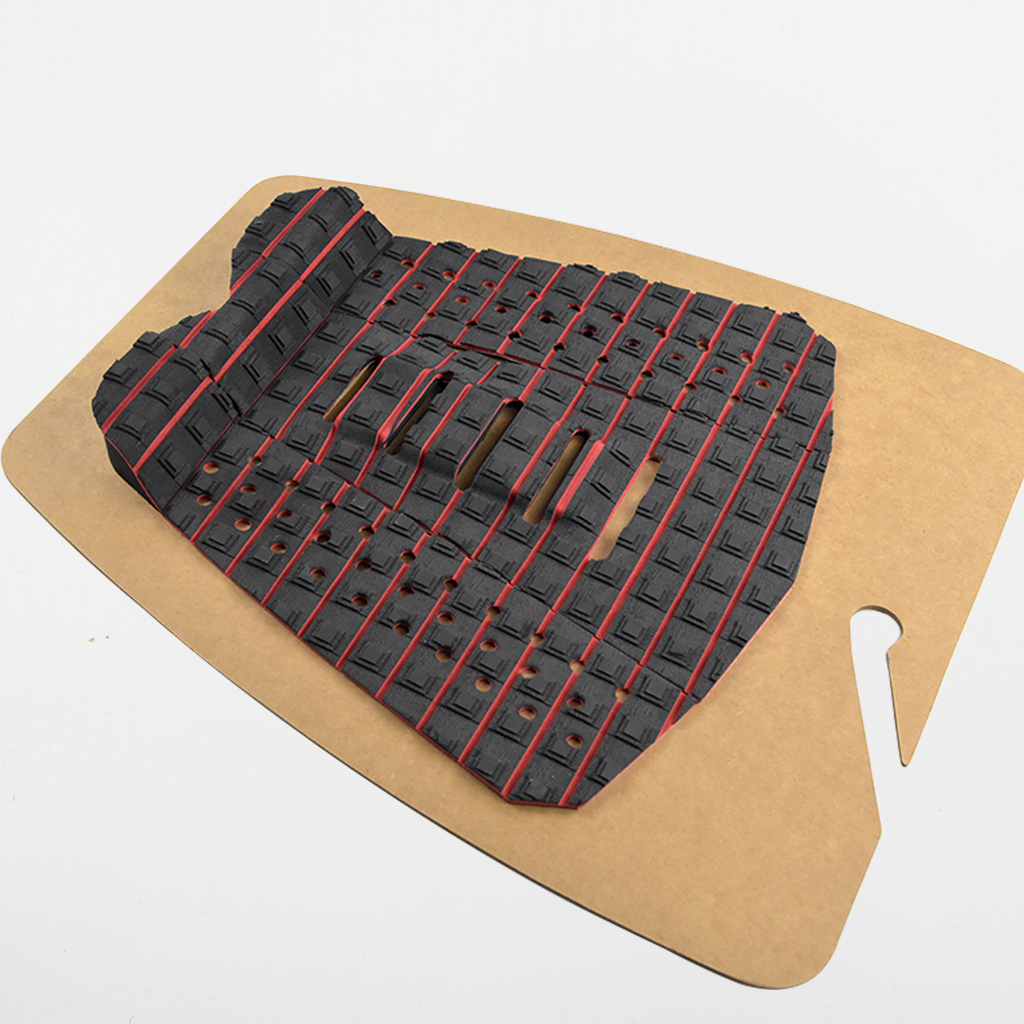
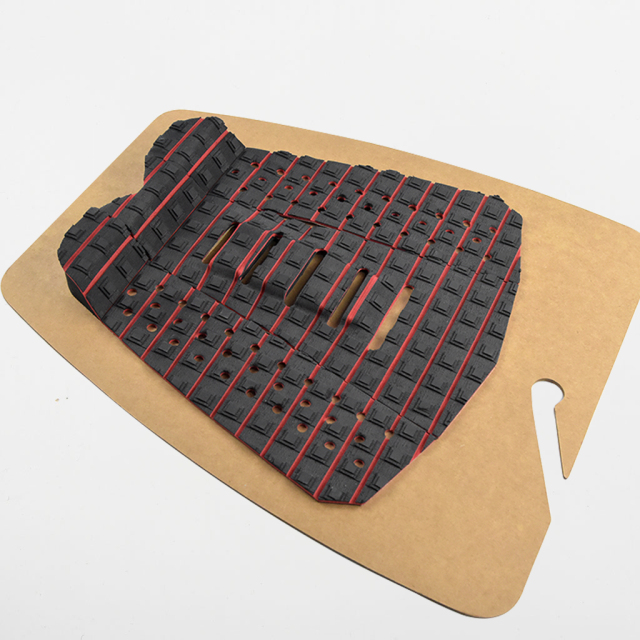
These tail pads are a multi-piece deck grip for the back of a surfboard, shaped to sit under the back foot where a rider actually drives through a turn. The set is die-cut into separate pieces rather than cut as one sheet, which is what lets it follow a shaped tail instead of standing off it. The top surface is a raised square texture in matte black, traced with red accent lines that pick out the piece edges and give the pattern a clear direction on the board. As a surf traction pad it does the job wax cannot hold for long. The raised squares keep an edge under the back foot through a season of salt water, sand and sun, so the rider gets the same push point every session without combing wax back into the tail. This design is one entry in a wide tail pad line, and the designs share a common card format and a common look on the shelf. For surf board manufacturers building out a traction fixture, consistency matters more than any single pattern: the peg layout stays the same between designs, the range reads as one family rather than a pile of oddments, and reordering is a matter of quoting design references instead of describing a shape down the phone.
Shops often place it beside the surfboard rack and the leash wall, where somebody who has just chosen a board is already looking for the parts to finish it.
Board Matching
- Squash and rounded squash tails. The side pieces follow a wide, curved outline without lifting at the corners, so the pattern reads as part of the tail rather than a strip laid across it.
- Swallow and winged swallow tails. The slotted centre lets the halves sit either side of the stringer and stop short of the swallow cut, leaving both tail tips clear.
- Diamond and pintail shapes. On a pulled-in outline the pieces can be set closer to the stringer, or the outer edge trimmed back to the rail line, because the texture runs right to the border.
- Wide hybrids and mid-lengths. A broader deck gives more room to spread the pieces, and a surfboard traction pad spread across a wide tail gives the back foot a bigger landing area on a board ridden more from the middle.
- Longboards kept clear for cross-stepping. A longboard traction pad belongs at the very back of the deck, behind the strip a rider walks along; leave the middle of the board bare so the feet can move freely.
- Round-pin and retro outlines. The centre section can be set slightly forward on a narrow, curved tail, which keeps the pattern centred on the board instead of crowding the tail tip.
Grip and Control
The reason to fit one is the feel underfoot. The raised squares give the back foot an edge in every direction — forward as the rider steps into a turn, sideways when the board goes on rail, backwards as the weight shifts to the tail. It matters most in the half-second when a turn starts: the foot either holds or it slides, and a textured grid holds.
The slotted centre is doing real work as well. Splitting the pad lets each piece follow the tail curve and any kick in the last few inches of the deck, so the grip sits flush. A surfboard tail pad that bridges will lift at the edges long before the material itself wears out; one that follows the deck stays put.
Because the surface is meant to be ridden dry, the back foot sits on texture rather than wax — no soft layer squashing flat, no grit, no re-wax before a session. On a surfboard traction pad of this kind, most riders notice it within the first few waves: the foot stops hunting for grip and the board feels more direct through the back foot. There is plenty of range in who it suits, too. A newer rider gets a clear, obvious platform at the back of the board, which makes the tail easier to find after a pop-up; an experienced rider gets a surface that behaves the same in every session.
Installation Steps
- Clear the old grip. Take off the worn pad or the wax, scrape back any adhesive residue and wipe the area down until the deck is flat, dry and free of oil. A surf traction pad bonds to the deck itself, not to old wax.
- Dry-fit before you peel anything. Set the pieces in place, check the gap to the tail edge and the clearance around the leash plug, so the surf leash still loops through cleanly, then sight down the board from nose to tail to see whether the pad sits on the centreline.
- Mark the position. A strip of masking tape along the stringer and another across the back edge gives you something to line up against once the backing is off and the adhesive is exposed.
- Peel and place from the centre out. Expose a little of the backing, set the centre piece first, then work outward to the side pieces so the gaps between them stay even.
- Press from the middle to the edges. Run a thumb or a soft roller from the centre of each piece out to the border so trapped air has somewhere to go.
- Let it settle before the board goes in the water. Give the adhesive time to key to the deck in a dry, room-temperature spot; a board that goes straight into the surf puts load on a bond that has not settled yet.
Care and Replacement
- Rinse it after every session. Fresh water and a soft brush lift salt and sand out of the squares; leave the board to air dry out of direct sun afterwards.
- Keep the deck out of direct heat. A board left in a hot car or propped against a wall in full sun softens the adhesive under the pad, and that is the usual reason a grip starts to creep at the edges.
- Watch the edges, not the middle. A surfboard tail pad almost always fails at the border, where sand works under a lifted corner. Re-press a lifting edge early and you usually save the whole piece.
- Store it off the ground. A surfboard rack holds the board on its rail and keeps the tail clear of hot concrete, standing water and grit between sessions.
- Replace it when the squares go flat. Once the raised pattern has worn smooth in the middle of the pad, the grip has gone even though the sheet is still attached, and a refit is quicker than fighting a slick tail.
- Wide tails take more punishment. A longboard traction pad covers more deck area, so it sees more sun, more sand and more foot traffic; check the border more often on those boards.
Specifications
| Structure | Multi-piece die-cut set |
| Surface pattern | Raised square texture |
| Centre detail | Slotted cutouts |
| Placement | Tail of the board, under the back foot |
| Fitting | Peel-and-stick adhesive backing |
| Set contents | Slotted centre section plus side pieces |
| Mounting card | Printed backing card with hang hole |
| Adhesive release | Peel-off backing paper |
| Edge finish | Die-cut edges follow the pattern outline |
| Pack format | One complete set per printed card |
| Display compatibility | Hang hole suits standard peg hooks |
Ordering Notes
- Quote the design you want. This one is design No.00548; if you are matching a pad already on your shelf, send a photo of the card and we will confirm whether it is the same outline.
- Tell us what it will be fitted to. Board type and tail shape help us confirm the outline suits your range before anything is cut.
- Agree quantity, carton and card artwork. The backing card, hang hole and carton format are set per order, so changes are simpler to make before a run than after it.
- Settle branding early. For surf board manufacturers and private-label programmes we need artwork and sign-off in hand before production is scheduled.
- Confirm the commercial side with your sales contact. Lead time, payment terms and shipping arrangements are confirmed per order, because all three depend on destination and volume.
- Ask about sample availability. Grip and appearance are easier to judge in the hand than on a screen, so ask your sales contact what can be arranged before a large commitment.
- Add the rest of the fit-out. A surfboard rack, a board cover or leashes ordered alongside the pads can be planned together so one fit-out does not arrive in two parts.
- Line up the fins at the same time. If the order also covers fins, confirm the fin system and the sizes your boards run so both lines arrive ready to fit.
- Leash | Surf leash builds from 6 ft to 9 ft, including regular, Hypalon, non-slip strap, SUP and bodyboard models Fins | Honeycomb, timber, G10 glass and nylon surfboard fins, plus fin accessories Traction | Tail pads, centre pads, skimboard pads and waxless pads across the traction line Covers | Basic bags, regular bags, stretch covers and bodyboard bags Racks | Travel rax and tie-downs, storage racks, display racks and bike racks Wax & inserts | Wax and deck inserts for board prep OEM supply | Custom and private-label work for surf board manufacturers and distribution chains
Scale & Supply Capability
CIMI is a factory-based supplier with 16 years in surf and watersports hardgoods, manufacturing at our own facility rather than sourcing through traders. Chain stores, supermarkets and surf-brand stores buy from us because one supplier covers a full accessory assortment, from tail pads and surfboard fins to bags and covers, so a season's order and its reorders can be planned together. We take on OEM and private-label work, adapting designs, colourways and branding to your programme, and we schedule production against your agreed range plan. Send us your buy list and target dates, and we will confirm what we can make and when.
FAQ
Will this pad suit my board's tail?
The outline is built around the shapes most boards use — squash and rounded squash, swallow and winged swallow, diamond, pintail, and the wider tails of hybrids and mid-lengths. Because the pieces are separate, a fitter can set them either side of the stringer and trim the outer edge on a pulled-in tail. If the tail is unusual — very narrow, very square or asymmetric — send a photo of it with a tape across the width and we will tell you whether a surfboard tail pad in this layout will sit flat.
Does the pad need wax?
No. A surf traction pad of this kind is ridden dry: the raised squares give the back foot grip on their own, and wax on top would only fill the texture and hold sand. Keep the pad clean and free of wax and it behaves the same all season.
Can I fit it over the old pad?
No — strip the old grip first. A new surfboard traction pad needs a flat, clean deck to bond to, and adhesive laid over an old pad or a wax layer will lift at the edges within a few sessions. Remove the old pad, scrape back the residue, wipe the deck down and let it dry completely before fitting.
Is a longboard set up differently?
Only in where the pad goes. A longboard traction pad belongs at the very back of the deck, behind the strip a rider walks when cross-stepping, so the middle of the board stays clear. A wide tail takes the same multi-piece layout with the pieces set a little further apart.
Does the pad interfere with the leash?
Not if you plan the position before peeling. Set the pad so it clears the leash plug and the rail saver, and check that a surf leash can still be looped through the plug without rubbing on the pad edge. On most boards the pad sits forward of the plug; dry-fit it first and the two never meet.
Which fins suit a board with this pad?
Fins are matched to the board and the conditions, not to the pad. For a standard set, the honeycomb and nylon surfboard fins in our line cover the usual shortboard and hybrid setups, and the fin accessories cover plugs and screws. Confirm the fin system your boards are routed for before pairing the two lines.