Product Overview
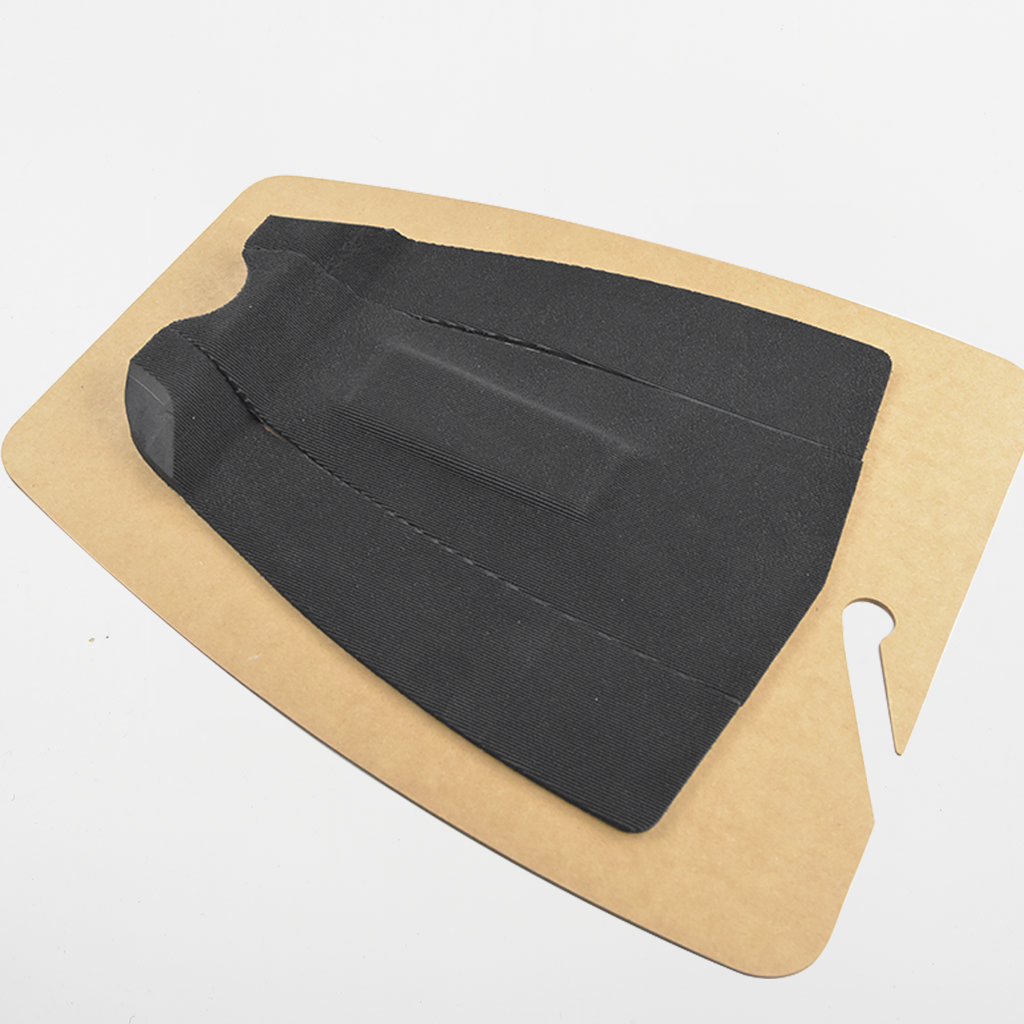
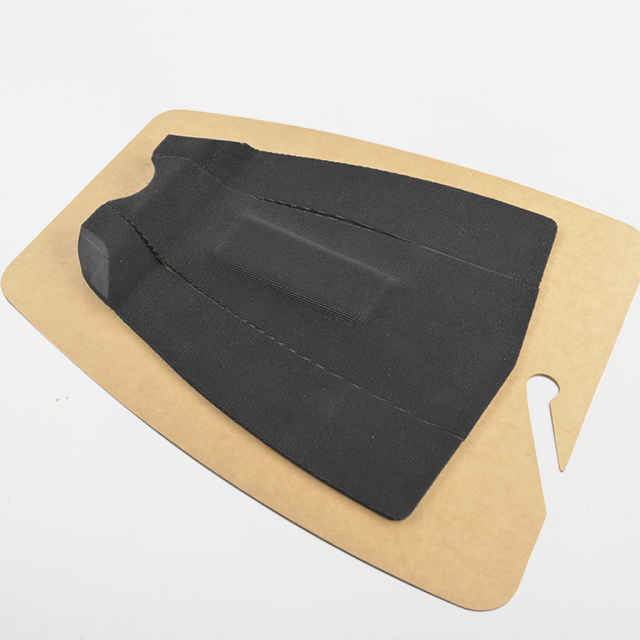
This is a deck grip that sits on the last stretch of the board, under the back foot. The surface is patterned rather than smooth, so the foot has something to push against when you drive off the bottom or come around a section, and a raised ridge runs through the centre to give you a consistent place to plant your stance. The outline tapers towards the tail so the pad follows the shape of the board instead of sitting on it like a rectangle. We make this pad for distributors, stockists and surf board manufacturers who fit deck grip to their own board lines.
Surface & Design
- Patterned deck surface: the raised pattern breaks up an otherwise flat deck, so the back foot bites against the board through a turn instead of sliding over it.
- Raised centre ridge: a spine down the middle of the pad gives you a landmark underfoot, which is what makes a stance repeatable when you pop up in a hurry.
- Tapered outline: the pad narrows towards the tail, so it tracks the board's own curve rather than squaring off across the deck.
- Flat, low body: the pad stays close to the deck so the board still feels like a board underfoot — grip without a platform under your heel.
- Matte, textured finish: it reads as deck grip rather than a glossy sticker, and it keeps that look through a season on a shelf and in the water.
- Edge line that finishes clean: a surf traction pad only works while it is flat on the deck, so the outline is cut to sit flush and the edges are finished so a corner is less likely to catch and start lifting.
Board Fit & Rider Levels
A surfboard tail pad belongs over the part of the deck the back foot works across — roughly the last third of a shortboard, further forward on a wider or longer board. Put it there and the ridge and pattern line up with the part of your foot that actually drives the turn. Put it too far back and you spend the session reaching for it, which is the most common fitting mistake we see from shops.
On a longboard the picture changes, because the rider moves. A longboard traction pad is usually set further up the deck than a shortboard pad, so it sits under the foot at the point where you turn rather than right at the tail end. Riders who cross-step will still spend most of their time off the pad, so what matters is covering the turn zone cleanly rather than covering as much deck as possible.
The same design covers a wide range of riders. On a first board it replaces wax over the tail and gives a new surfer a stable place to stand while they learn to pop up. On a more experienced rider's board it is the surface they push against out of a turn, and the ridge helps them find the same stance at speed. Shops that fit pads for customers can hold one design on the bench and cover most of the boards that come through the door, trimming only where a tail shape demands it.
Fitting & Aftercare
- Strip the old grip first. Take off the old pad or wax, scrape the deck back to clean glass or foam, wipe it down and let it dry completely — adhesive will not hold on a damp or waxy surface.
- Dry-fit before you stick. Lay the surfboard traction pad on the tail with its backing still on, stand on it in your normal stance and check that the ridge sits where your foot actually lands.
- Mark the outline. Run a line of tape or a soft pencil mark around the pad so it can go back in exactly the same place once the backing comes off.
- Set it for the board in front of you. The same method covers a shortboard pad and a longboard traction pad, but the position changes: on a longboard the pad belongs under the turn zone, further forward than on a shortboard.
- Check the leash plug. Note where the surfboard leash plug sits relative to the outline, so the pad does not cover it or crowd the cord.
- Leave the fins alone. Fitting a pad is a deck job — the surfboard fins do not need to come out, and leaving them in avoids knocking a fin box on the bench.
- Peel and press from the middle out. Lay the pad down along your marked line, press from the centre towards the edges and work any trapped air out to the sides with your thumb.
- Work the edges down last. On a rounded tail or a board with channels, spend the extra minute pressing the outline down firmly — that is where a pad starts to lift if it is going to.
- Let it set, then keep it clean. Follow the adhesive's own guidance before the board goes back in the water, keep it out of direct sun until then, and from then on rinse with fresh water after salt water and avoid solvent cleaners and long spells in a hot car.
Specifications
| Product type | Surfboard tail pad |
| Reference | No.00549 |
| Placement | Tail section of the deck |
| Surface | Textured, matte |
| Profile | Flat body with a raised centre ridge |
| Outline | Tapered towards the tail |
| Fixing | Peel-and-stick adhesive backing |
| Board types | Shortboard, funboard, longboard |
| Rider level | Beginner to experienced |
| Packaging | Hang card with a die-cut hole |
Companion Accessories
- Surfboard leash: the item a rider most often picks up at the same time as a board or a refit, so it sits naturally beside the pads on the same fixture.
- Surfboard fins: bought alongside deck grip whenever a rider reworks a board, and stocked in the same size conversation as the boards you carry.
- Surfboard rack: what turns a stack of boards into a display — floor, wall and travel versions cover the shop floor, the store room and the van.
- Covers and bags: protection for a board between sessions, which is the purchase a rider makes right after spending on grip.
- The wider traction range: other surfboard traction pad designs plus centre pads and skimboard pads, so a shelf does not depend on a single pattern.
- Small add-ons: wax inserts and fin accessories that fill the last of a carton and give the counter something to sell at the till.
Ordering & Delivery
- Send the design reference and the quantities you need for the season, so we can match the pattern and plan the run.
- Tell us how it should be packed — hang card or bulk — and whose label goes on it.
- Confirm whether the programme runs under your own brand: we produce private-label pads for surf board manufacturers and distribution chains, and the branding has to be agreed before the run starts.
- Decide what else travels with it. Covers, a surfboard rack or other accessory lines can be consolidated into the same order rather than arriving as separate deliveries.
- Confirm quantity breaks, lead time, payment terms and the shipping route with your sales contact before your season cut-off — these are set per order and we would rather agree them up front than surprise you later.
- Ask your sales contact about sample availability and about which designs in the range are open for your programme, so you are not building a range sheet around a pattern we cannot run for you.
Scale & Supply Capability
CIMI is a factory-based supplier with 16 years in surf and watersports hardgoods, manufacturing at our own facility rather than sourcing through traders. Chain stores, supermarkets and surf-brand stores buy from us because one supplier covers a full accessory assortment, so a season's order and its reorders can be planned together. We take on OEM and private-label work, adapting designs, colourways and branding to your programme, and we schedule production against your agreed range plan. Send us your buy list and target dates, and we will confirm what we can make and when.
FAQ
I am buying my first board — is this pad suitable, or is it aimed at better riders?
It works for both, which is why we keep one design rather than splitting the range by level. On a first board the pad replaces wax over the tail and gives a new surfer a stable, repeatable place to stand while they learn to pop up, which is the period when most deck damage happens. On a more experienced rider's board it is the surface they push against out of a turn, and the centre ridge helps them find the same stance at speed. A surfboard tail pad does not need to be rider-specific; it needs to be in the right place and pressed down properly.
How do I check that the pad will fit my tail before I order a quantity?
Measure the flat area you actually stand on, not the full width of the board, then allow for the outline to follow the board's curve rather than sit square across it. The most useful check is a dry fit: set the surf traction pad on the tail with the backing still on, take your normal stance and see whether the ridge and pattern sit under the ball and heel of your back foot. If the outline overhangs a channel, a wing or a sharply narrowing tail, that is the point to trim rather than to force it down.
Can the pad be trimmed to match a shape it does not quite follow?
Yes, and shops do it routinely. Dry-fit first, mark the line you want, then cut from the top side with a sharp blade in a single pass so the edge stays square rather than feathered. Bear in mind that a trimmed surfboard traction pad no longer matches the original outline, so trim before the backing comes off and keep the offcut if you want a record of the shape. Once it is down, leave it — lifting a pad to re-cut it weakens the adhesive.
Will this work as a longboard traction pad?
Yes, with the position moved forward. On a longboard the rider walks, so a longboard traction pad is set where the turn actually happens rather than at the very end of the tail — that is usually further up the deck than a shortboard rider would place the same pad. Cross-stepping still takes the foot off the pad for much of the ride, so think of it as covering the turn zone rather than the whole deck. On a board with a polished finish, make sure the deck is clean and completely dry before the backing comes off.
Will a new pad interfere with my leash plug?
It should not, as long as you look before you stick. Note where the surfboard leash plug sits in relation to your planned outline during the dry fit. If the pad would sit on top of the plug or crowd the cord where it exits, shift the pad forward slightly or trim the tail end of the outline to clear it. The plug itself is not affected by fitting a pad — this is purely about keeping the cord free to move.
Do I need to take the surfboard fins out to fit a pad?
No. Fitting a pad is a deck job and the surfboard fins stay where they are. Leaving them in is usually the safer choice: the board sits stable on the bench, and you avoid knocking a fin box or a fin edge while you work. The only reason to remove them is if you are servicing the fins at the same time, in which case do that job after the pad is down and set.
Can a board with a newly fitted pad go straight back on a rack?
Once the adhesive has set, yes — a surfboard rack is a normal place for a board to live and puts no unusual load on the pad. While it is still curing, keep the board off anything that presses on the fresh surface: do not stack another board on the tail, and do not stand it nose-up against a wall so the full weight rests on the new grip. After that, rack storage is fine and is how most shops and rental fleets keep their boards.