Product Overview
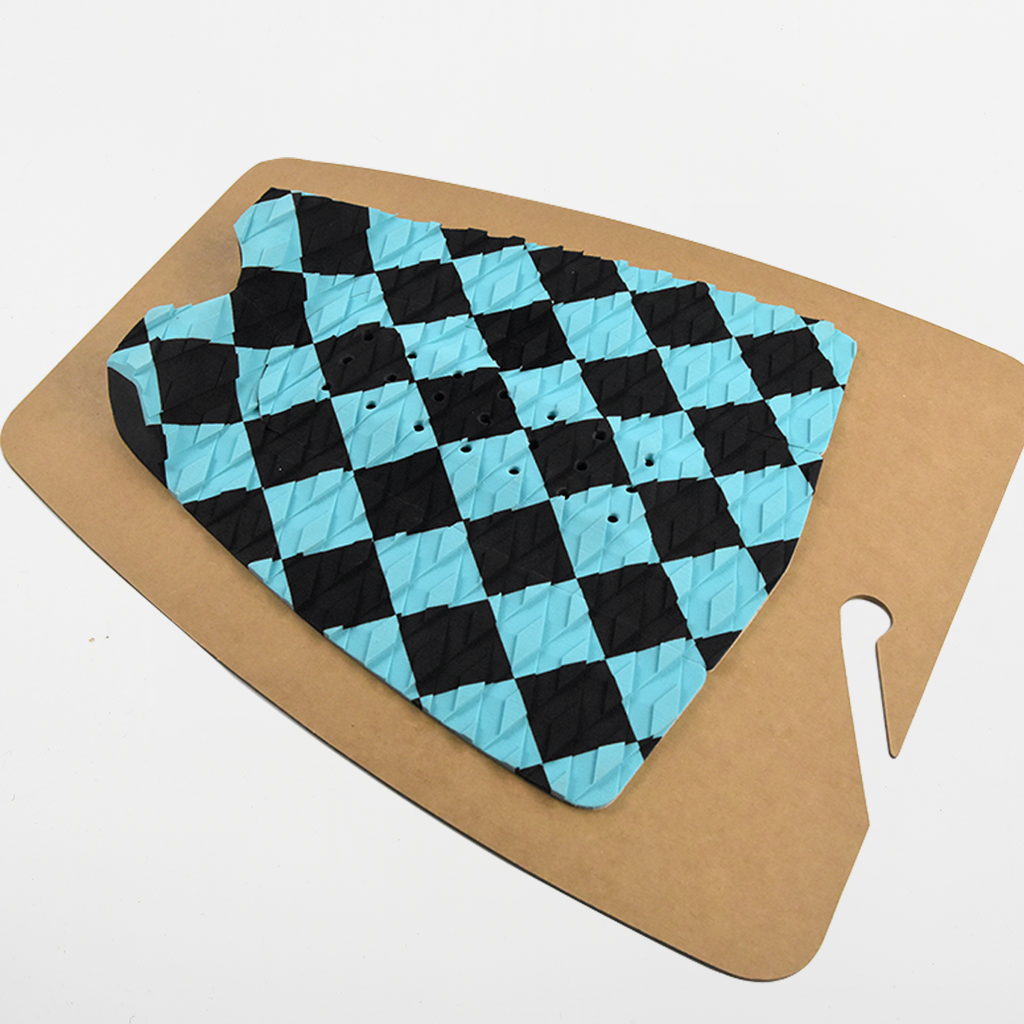
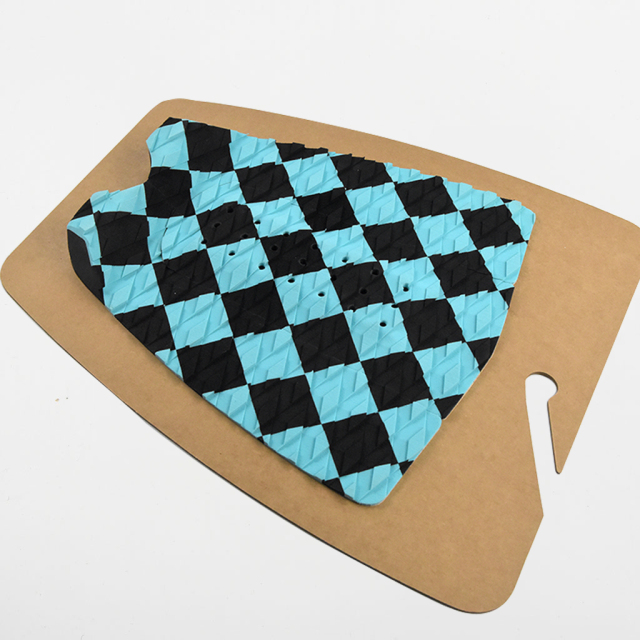
Grip under the back foot is the first thing to go on a board that gets used hard. This surf traction pad is the replacement for that job: a die-cut tail piece in a black and turquoise checker with an embossed diamond surface, made to sit flat on the rear deck and hold the back foot steady through a turn.
It is one design inside a deep tail pad range rather than a standalone item. That matters if you buy for a shop or a fleet — several patterns can sit on the same shelf and go on the same order, and the one that sells can be reordered without changing supplier. For a board builder, the same pad gives a consistent look across a run of boards.
Nothing on the pad needs tools to fit, and nothing about it is tied to one level of rider: the same surfboard tail pad works on a first board and on a shop's demo fleet, so a shop does not have to carry separate stock for beginners and for experienced customers.
If you fit pads for other people, this is the design that stays within reach on the bench: quick to seat, easy to describe to a customer, and patterned enough to look like a considered choice rather than a default.
A surf traction pad is a grip product, and the whole of its job is grip underfoot on a board. It sits on the rear deck of a surfboard so the back foot has an edge to push against through a turn. It is not a safety product: it is not an anti-slip surface for walkways, steps, pool surrounds, changing rooms, gym floors or workshop floors, it is not flotation, and it is not rated to carry a load or protect a person. It carries no safety certification, and a buyer sourcing slip resistance for somewhere people walk or stand should look elsewhere in the catalogue rather than make this part fit that brief. On the board, the pad asks for very little. Keep wax forward of the tail, where feet slide, and out of the embossed diamonds — wax packed into the pattern is the quickest way to make a surfboard tail pad feel slick. Rinse the deck with fresh water after salt water and let it dry before the board goes back in the bag or on the rack, and lift out any sand that has worked into the texture with a soft brush rather than a scraper. Solvents, thinners and heavy degreasers attack both the surface and the adhesive, and a pressure washer held at the rim will lift an edge that was otherwise sound. Most failures start at fitting time rather than in the water. A deck that still carries wax, old adhesive or dampness under a new surfboard traction pad is the usual reason a corner creeps up within a week, and a lifted corner pressed back down with contact adhesive rarely stays. Store boards upright or flat rather than tail-down against a wall, keep them out of a closed car in summer, and avoid stacking one board's tail onto another's pad, which flattens the pattern exactly where the back foot needs it. Make the pad part of the same check a shop already runs over a board — the surf leash, the fin boxes, the rail saver. When the outline lifts, or the diamond face has gone smooth underfoot, the pad has finished its life and a replacement is the clean answer. Treated that way, tail grip holds its texture through a season of shop or fleet use and stays what it was sold as: a grip part for a surfboard deck.
Pattern, Texture and Build
- Checkered colour block. Black and turquoise run in a checker across the full pad, so the tail of the board reads as a deliberate look rather than a plain grey deck. - Vent holes through the pad. Small holes punched across the surface let trapped air travel out while the pad is pressed down, and give water somewhere to clear instead of sitting on the deck. - Cushion underfoot. There is some give in the pad, which softens the landing of a turn on the tail and stops the deck feeling like bare glass under the back foot. - Consistent construction. The same build runs through the range, which lets a shop stock several patterns and describe any surfboard traction pad in the family to a customer in a single sentence.
Fitting Steps
- Strip the old surfboard tail pad first. Warm it gently, lift a corner with a plastic scraper rather than a metal blade, and work it off in one piece so the deck underneath stays sound.
- Take off every trace of old adhesive and wax. The new backing only grips a clean, dry surface, and a smear of wax left behind is where a pad starts to lift at the edge.
- Dry-fit the new pad before you peel anything. Set it on the tail, look at the outline against the tail shape and the leash plug, and move or trim it while the backing is still in place.
- Lay two strips of tape along the edges as a guide, so the pad goes down square the first time instead of after two attempts.
- Peel a short section of backing, set the front edge on your tape line, and press from the middle outward so air travels toward the rails and the tail instead of being trapped under the centre.
- Press the whole pad down, edges included, then run a thumb around the rim to seat it, and check that the outline has not crept out of position.
- Let the board sit before it goes back in the water. If you are fitting several boards in one session, do them in the same order and leave the last one resting the longest.
- Use the time on the bench to look over the rest of the tail — the leash plug, the rail saver and the surf leash are all easier to check now than after the customer has left.
The Traction Range
Traction on a board is not one product. This pad is the tail piece: the shaped grip that sits under the back foot, where a rider's weight drives through turns and where a deck wears first.
The rest of the range covers the other parts of the deck. Centre pads fill the section between the feet on a longer board. Waxless pads take the place of wax over a larger area. Skimboard pads are cut for skimboard decks rather than surfboards. Alongside them runs the HEXA full-deck grip, a hexagon-patterned surfboard traction pad that covers the whole deck instead of the tail alone.
What a board carries follows how it is ridden. A shortboard usually runs a tail pad with wax forward of it. A longboard often takes a tail pad plus a covered or waxless section further up, because the rider moves along the deck as the board trims. A full-deck grip suits a board that should look uniform from nose to tail, and it is the version a brand is most likely to build into its own line.
Typical Uses
- Shops refitting customer boards. A shop that fits pads for customers goes through the same job again and again, so a design that seats cleanly and looks right on most boards keeps its place within reach of the bench.
- Rental fleets and surf schools. Tail grip on a rental takes a beating from riders who are still learning where to put their back foot, and replacing the tail piece is the quickest way to keep a fleet feeling solid.
- Board builders fitting at build. Surf board manufacturers fit pads before a board is packed and leaves the workshop, and a design that goes on flat and stays flat saves handling at the end of the line.
- Dealer peg and shop floor. The pad hangs on a peg beside leashes and fins, and a board sitting on a surfboard rack in the window shows customers what the pattern looks like once it is fitted.
- Season prep. Before a season starts, a shop can work through its demo and rental boards in one pass instead of replacing pads one at a time as they fail.
- Home repair. A rider replacing a worn pad on their own board gets the same part a shop fits, with no special tools involved.
Specifications
| Item code | No.00550 |
| Product type | Surf traction pad, tail placement |
| Position on board | Rear deck, under the back foot |
| Design | Black and turquoise checkered block |
| Surface | Embossed diamond texture |
| Venting | Small vent holes across the pad |
| Form | Flat die-cut pad with a rounded outline |
| Fixing | Peel-and-stick adhesive backing |
| Packaging | Kraft hanger card with a hanging slot |
| Range position | One design in the CIMI tail pad range |
| Colour and branding | Confirm options with our sales team |
Leashes and Fins
- Hypalon leashes by length. The range runs L00570H 6ft 6 mm as a light leash for small to medium waves, L00572H 7ft 7 mm for all-round conditions, L00573H 8ft 7 mm, and L00575H 9ft 8 mm as a longboard ankle leash for bigger waves or a longer board.
- Strap styles to match the board. Regular, non-slip strap, Hypalon strap, bodyboard and SUP leashes sit side by side, so the strap is matched to the board a customer is buying rather than to whatever is left in the drawer.
- Honeycomb surf fins. F00543 to F00546 are honeycomb fins in single tab and double tab, made by resin transfer moulding; the material is light and works across a spread of conditions.
- Other fin builds. Timber, G10 glass and nylon fins, plus fin accessories, fill out the rest of the fin range, which helps when a customer wants one look across a quiver.
- One order for the same board. A tail pad, a surf leash and a set of fins for one board can go on one order list, so the accessory wall stays matched by look and by brand.
Covers and Racks
- Basic, regular and stretch covers. The cover range moves from a basic bag through a regular bag to a stretch cover, plus a bodyboard bag, so a shop can offer a protection level at each price point on the shelf.
- Covers that fit around a fin set. Check with your sales contact that the cover you choose takes your usual surf fins fitted, because a taller set changes what a bag will swallow.
- Storage racks. For a back room, a fleet cupboard or a garage, a storage rack keeps boards off the floor and off each other, which is easier on a freshly fitted pad than a stack.
- Display racks. A surfboard rack on the shop floor shows the pattern on a fitted board and lets a customer see how the checker sits against a deck instead of guessing from the pad alone.
- Tie-down and travel racks. A travel rax and tie-down set is the version that goes in or on a vehicle, for shops moving demo boards or customers taking a quiver on the road.
- Bike racks. A bike rack keeps hands free on the way to the water and holds the board clear of the frame.
Ordering Notes
- Send the item codes and the pattern mix you want. If you are matching a pad that is already on a board, a photo of the pattern is the quickest way for us to confirm which one it is.
- Tell us what the order is for — surf board manufacturers fitting pads into new boards, shops restocking a peg, or distributors filling an accessory programme — so the details come back in the shape you need.
- Confirm quantity, price and lead time with your sales contact before the order is placed; they depend on the mix and on the season rather than being fixed on a list.
- Ask your sales contact about sample availability if you need to feel the texture and see the pattern before committing to a range.
- For private-label work, send artwork and any colour direction early and allow time for approval before production starts.
- Agree packing and carton marking with your order if the pads need to arrive shelf-ready for your own warehouse or stores.
- Reorder by item code. Keeping the code on your purchase order is what holds the pattern consistent from one delivery to the next.
Scale & Supply Capability
CIMI is a factory-based supplier with 16 years in surf and watersports hardgoods, manufacturing at our own facility rather than sourcing through traders. Chain stores, supermarkets and surf-brand stores buy from us because one supplier covers a full accessory assortment, so a season's order and its reorders can be planned together. We take on OEM and private-label work, adapting designs, colourways and branding to your programme, and we schedule production against your agreed range plan. Send us your buy list and target dates, and we will confirm what we can make and when.
FAQ
How do I know when a surf traction pad needs replacing?
When the embossed diamond pattern has flattened where the back foot sits, when an edge has lifted enough to catch a fingernail, or when the surface feels slick underfoot once it is wet, the pad has done its work. Replacing the whole pad is cleaner than re-sticking a lifted corner, because a corner that has lifted once usually lifts again.
Will this surfboard tail pad suit a rounded or squash tail?
Dry-fit it first. The pad is a flat die-cut piece with a rounded outline, so it sits comfortably on most tail shapes; on a narrower tail you may want to trim the rim slightly so it follows the shape instead of overhanging. Trim before the backing comes off, and take a little at a time.
Does a surfboard traction pad replace wax?
Under the back foot, yes. The pad gives grip exactly where the rider's weight drives through turns, so that area no longer needs wax. Forward of the pad most riders still use wax, a centre pad or a waxless section, depending on the board and how far they move along the deck.
Should I fit the pad before or after the surf fins go in?
Fit the pad first. With the board flat on the bench and no surf fins in the boxes, the deck is easy to clean, easy to press down on, and the board will not rock while you work the edges. The fins go in afterwards, once the pad is seated.
Where should the pad sit in relation to the surf leash plug?
Set the pad down dry and look at where the plug sits before you commit. Most riders want the rear edge of the pad close to the tail with the plug clear, or just at the edge of the pad; if the outline covers the plug, shift the pad forward or trim it so the leash still runs cleanly.
What keeps the grip in good shape between sessions?
Store the board on a surfboard rack out of direct sun where you can, and rinse the pad with fresh water after salt-water sessions. Heat and sunlight are hard on any adhesive-backed grip, and sand worked into the texture is what wears the pattern down early.