Product Overview
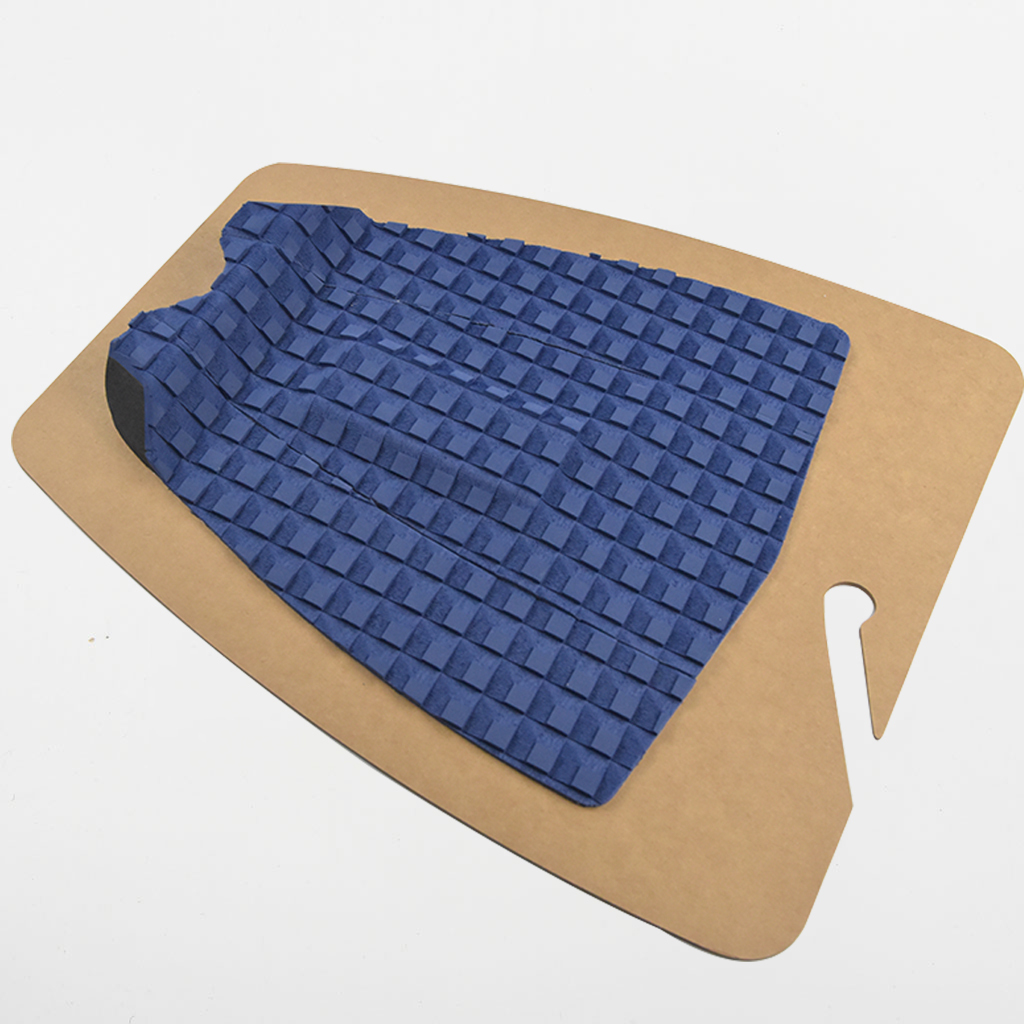
A surfboard tail pad earns its place under the back foot, and this one is shaped for that job alone. The outline is contoured to follow the tail rather than sitting as a plain rectangle, and the face is moulded into a raised square grid so the ball and heel of the foot press against edges instead of sliding across a flat sheet. It goes down where the old grip sat on a used board, or onto a fresh deck before the board is packed and shipped.
Who buys it: shops refitting a customer's board, board builders and surf board manufacturers fitting grip at build stage, and chains or distributors stocking a traction line. The pattern is geometric rather than printed, so the look survives wear and does not date with one season. That makes it the design to add when a shelf needs a new face but the supply relationship should stay where it is — same family, same reorder list, one more look on the wall.
Key Features
- Raised square grid. Small moulded blocks across the face give the foot edges to load against, so grip keeps working as the surface scuffs instead of going slick the way a flat surf traction pad does.
- Contoured outline. The pad is cut for the tail, so it sits inside the board's outline rather than overhanging a rail or lifting at a corner — a surfboard traction pad that reads as fitted rather than cut down.
- Cushion where it counts. The face is textured but not hard: enough give to take the sting out of a long session, still firm enough to feel the board respond through the back foot.
- Peel-and-stick backing. Fitting needs no glassing, no resin and no workshop time — clean the deck, align the pad, peel and press.
- One outline, several boards. It sits at the tail of a shortboard, and on a longer deck it works as a longboard traction pad with wax kept forward of the grip.
- New build or replacement. Board builders fit it on a fresh deck; shops fit it as a replacement traction pad for surfboard repairs, which lets one part number do two jobs on the shelf.
Placement & Fitting
- Take the old pad off first. Work a plastic scraper under a corner of the worn surfboard tail pad and lift it slowly; soften stubborn adhesive with gentle heat from a hairdryer rather than a flame.
- Clear every trace of old glue. Wipe the deck back to clean foam or glass with a soft cloth and a little mineral spirits, then let it dry completely — a pad bonds to the deck, not to old adhesive.
- Dry-fit before you peel. Set the pad down with its backing still on, centre it on the stringer, keep the back edge inside the tail curve, then sight along both rails to check it sits square.
- Mark the outline with two strips of tape so the pad cannot shift as you set it down.
- Peel and set from the back edge. Fold the backing away a few centimetres at a time and press the pad down working forward, pushing air out from the centre as you go — the standard way to land a traction pad for surfboard tails without trapping a bubble.
- Press the edges firmly with the heel of your hand, then leave the board flat until the adhesive has taken hold. Keep it out of direct sun and out of a hot car while it settles.
Companion Ranges
- Leashes. Regular Hypalon leashes run from 6 ft to 9 ft through the range, so a shortboard and a longboard can be covered on one buy list — a surf leash sells with the board, not after it.
- Fins. Honeycomb, timber, G10 glass and nylon sets, plus fin accessories: the surfboard fins line is what turns a pad order into a complete tail-end order for a shop.
- Traction. Centre pads, skimboard pads and waxless pads sit in the same family as this surfboard traction pad, so a shelf can carry one grip story across three or four items instead of a single hook.
- Covers. Basic bags, regular bags, stretch covers and bodyboard bags — a cover protects both the deck and the pad once a board leaves the shop.
- Racks. Travel rax and tie-downs, storage racks, display racks and bike racks. Display racks matter commercially: a board standing on a rack shows the grip that is fitted to it.
- One supplier for the whole list. Chains and surf board manufacturers buy pads beside leashes, fins, covers and racks so the assortment, the reorder list and the shipping schedule stay in one place.
Specifications
| Product type | Surf traction pad |
| Range | Traction - tail pads |
| Face pattern | Raised square grid |
| Surface | Textured, matte |
| Outline | Contoured, cut to a tail shape |
| Construction | One-piece pad with a peel-and-stick adhesive backing |
| Deck placement | Tail area, under the back foot |
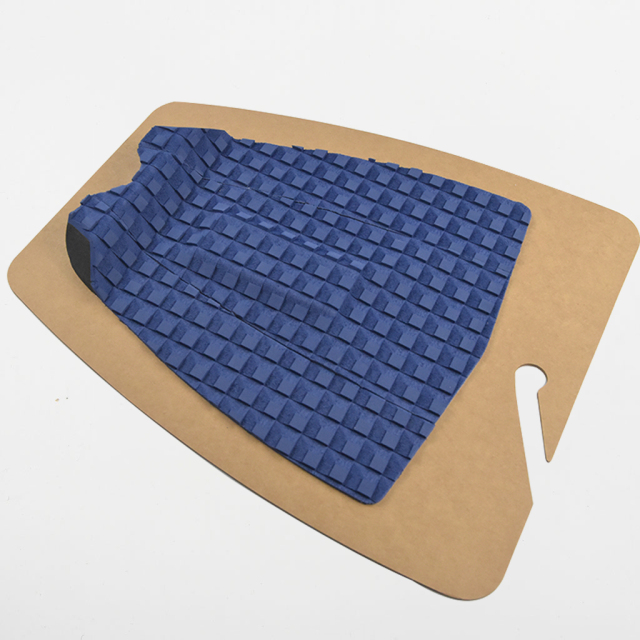
| Sample shown | Deep blue pad on a printed backing card with a hang hole |
| Companion ranges | Leashes, fins, traction, covers, racks |
| Item code | No.00553 |
Care & Longevity
Salt is what kills deck grip, and the answer is a rinse rather than a scrub. Fresh water after a session takes the salt out of the raised blocks; a stiff brush or a solvent takes the edge off the texture instead. Wax that drifts back from the deck lifts more easily while it is cold — scrape it off the pad rather than melting it in with heat. Keep the board out of a closed car in summer, because heat is what softens an adhesive edge and lets a pad start to lift. If a corner does come up, clean underneath it, warm it briefly and press it back down, trimming away any stretched adhesive rather than trapping grit under the pad. The routine is the same whether the deck carries a shortboard pad or a longboard traction pad: rinse, dry flat or on a rack, and store out of the sun.
Ordering & Delivery
- Quote the item reference.
- Say what the pad is for. Replacement grip for a shop, grip at build stage for a board builder, or a shelf position in a chain are three different orders and are packed and scheduled differently.
- Confirm the design and finish you want for the run, and whether the pads should ship on their printed backing card with the hang hole for peg display.
- Raise branding early. Private-label programmes are set up case by case, and your sales contact will confirm what can be labelled or printed for your range.
- Check packing and carton quantities, and ask whether a surf leash line can travel in the same shipment.
- If fins are on the same order, confirm the surfboard fins system and the sizes you need alongside the pads.
- Agree lead time, payment terms and the delivery date you are working towards with your sales contact. These are set per order, and asking early keeps a seasonal range on schedule.
Scale & Supply Capability
CIMI is a factory-based supplier with 16 years in surf and watersports hardgoods, manufacturing at our own facility rather than sourcing through traders. Chain stores, supermarkets and surf-brand stores buy from us because one supplier covers a full accessory assortment, so a season's order and its reorders can be planned together. We take on OEM and private-label work, adapting designs, colourways and branding to your programme, and we schedule production against your agreed range plan. Send us your buy list and target dates, and we will confirm what we can make and when.
FAQ
Does the grid face need wax on top?
No. A surf traction pad grips through its texture, so wax on the pad only fills the gaps between the raised blocks and dulls the hold. Wax the deck forward of the pad and leave the pad itself clean.
Will one surfboard tail pad suit different board lengths?
The outline follows the shape of the tail rather than the length of the board, so the same pad goes onto a shortboard and a step-up without changing. What changes is the position: on a longer board the pad stays at the tail and the waxed area in front of it gets longer.
Is a surfboard traction pad comfortable underfoot, or does the texture feel hard?
The grid is small enough to stand on barefoot and there is cushioning behind the face, so the sting of a long session is reduced. It stays firm rather than soft, because the point of the pad is to feel what the tail is doing through your back foot.
Where does a longboard traction pad sit if I still wax the nose?
Keep it at the tail, where you turn from. A longboard traction pad placed at the back lets you wax and cross-step the forward deck as normal; running grip the full length turns the board into a waxless deck, which is a different product decision.
Can I trim a traction pad for surfboard tails that is slightly too wide?
Yes, and it is normal practice on a narrow tail. Cut before the backing is peeled, work from the edge inward along a straight line, and keep the trim outside the outermost row of blocks so the border stays even and the pad keeps its shape.
Will the pad cover the leash plug?
It should not, and the dry-fit is where you check it: set the pad down with the backing on and look for the plug before you commit. If the outline sits over it, move the pad back or trim the rear edge so your surf leash still threads cleanly.
Should the pad go on before or after surfboard fins are fitted?
Do the dusty work first. Fin work, repairs and sanding are better finished before the pad goes down, so the deck is clean and dry when you press it. Surfboard fins themselves can go in at any point after that — fitting the pad last simply keeps debris out from under the adhesive.