Product Overview
The back foot is the steering wheel of a surfboard, and it needs somewhere to sit. This surfboard tail pad is shaped for exactly that spot on the rear deck — the patch a rider's heel and toes find without looking, on the bottom turn, through the pocket and on the way out of a cutback.
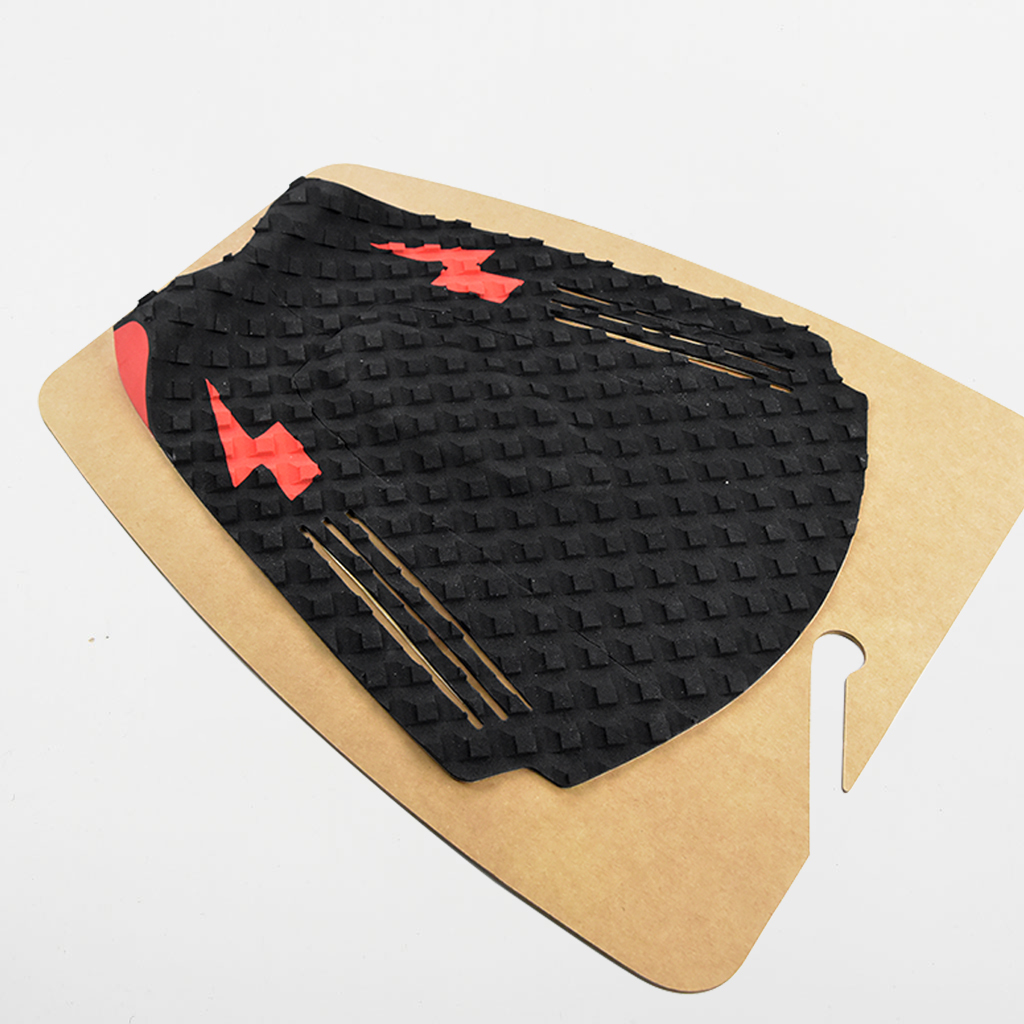
The pad is a single contoured piece with a matte black surface and small red logo accents. It does one job: stand between the bare foot and the deck, hold the foot steady when the board is wet, and take the wear that would otherwise go into the board itself. Once it is down there is nothing to tune or adjust.
Surf board manufacturers and board builders fit pads like this to finish a deck before it leaves the workshop. Shops, rental fleets and distributors fit them later, usually as a replacement, when the original grip has gone smooth in the middle, lifted along an edge, or collected so much old wax that it no longer holds a wet foot.
As a surfboard traction pad, the useful measure is not a number on a sheet. It is whether the surface still reads clearly under a bare foot after a season of salt water and sun, whether the edges stay flat against the deck, and whether the pad feels the same in the tenth session as it did in the first.
Surface & Pattern
- Textured grip face — the working surface of a surfboard traction pad is moulded with a raised pattern rather than left flat, so a wet foot has something to bite on instead of skating across a smooth sheet.
- Matte black body — the finish is matte rather than glossy, so it does not throw glare back at the rider on a bright day and does not show every fingerprint the moment it goes on a hanger.
- Red logo accents — a small red mark against the black gives this design a fixed identity. On a board photo, on a shelf or beside a neighbouring pad, it is the detail that tells this one apart.
- Die-cut slot detail — the pad carries die-cut slots through the face, which breaks up the flat expanse and lets the grip follow the curve of the tail instead of sitting on it like a solid slab.
- Contoured outline — the edge line follows a shaped outline rather than a plain rectangle, so once fitted it reads as part of the board rather than a sheet trimmed down to size.
- A pattern that stays legible — the rear section of a longboard traction pad takes more foot traffic than any other part of the deck, and it is the raised pattern, not colour, that keeps that section readable after the wax has been walked off.
Fitting the Pad
- Clear the old grip: lift the worn pad with a plastic scraper and a little warmth, then take the old adhesive off with a suitable cleaner rather than a metal blade.
- Wax off, dust off: scrape and wipe the tail until the deck is clean and dry. A surfboard tail pad bonds to the deck, not to a layer of old wax.
- Dry-fit first: set the pad in place with the backing still on, stand back, and check that it sits square on the stringer with room behind the back foot.
- Mark the centreline: a strip of masking tape down the stringer gives a reference so the pad goes on straight the first time.
- Peel and place: lift the backing from the front edge, set that edge down first, then peel the rest away and lay the pad from front to back.
- Press from the middle out: work the palm from the centre towards the edges to push trapped air out, then run a thumb firmly around the whole outline.
- Let it settle: keep the board out of the water for a while after fitting so the adhesive can take a proper hold, and check the edges once more before the first session.
Care & Replacement
Rinse the board with fresh water after a session and the pad will look after itself. Salt, sand and old wax are what fill a grip pattern and make a surfboard traction pad feel slick; a soft brush and a little mild soap lift them out, and a thorough rinse takes the rest. Skip solvents, acetone and harsh degreasers — they attack the surface and the adhesive under it. Leaving a board in a hot car or in direct sun for hours softens the bond and is the usual reason a pad starts to lift at a corner.
Replace the pad when the middle of the surface has gone polished and smooth, when an edge no longer sits down, or when the deck under it has started to take water. On a rental fleet that is a seasonal job; on a private board it is usually every few years. Between fittings, store the board on a surfboard rack or in a cover rather than leaning it against a wall, so the tail takes no pressure and the edges stay flat.
Leash & Fin Pairings
- Hypalon surf leash, 6 ft with a 6 mm strap — the light option for small to medium waves and shorter boards, where a heavier leash only adds drag.
- 7 ft and 8 ft, both with a 7 mm strap — the all-round lengths for medium waves and mixed conditions, and the two sizes most shops keep on the shelf.
- 9 ft with an 8 mm strap — the longboard length. A longboard traction pad and a long leash usually end up on the same board, so they are worth ordering together.
- Honeycomb surfboard fins in single tab and double tab — resin transfer moulded, light for their size, and usable across a spread of conditions rather than one narrow window.
- One fin line, several setups — single tab and double tab cover the common fin systems, so a shop can stock a single fin range and still fit most boards that come through the door.
- Leash as the first add-on — grip and leash tend to wear out on the same schedule, so a pad display with a leash rack beside it sells both without a second conversation.
Specifications
| Product type | Surf traction tail pad |
| Surface | Textured grip face, matte finish |
| Colour | Black body with red logo accents |
| Outline | Contoured tail pad shape |
| Detail | Die-cut slot pattern through the face |
| Mounting | Peel-and-stick adhesive backing |
| Presentation | Supplied on a printed cardboard backing card |
| Placement | Rear deck of a surfboard, under the back foot |
| Intended use | Replacement grip and finishing a new deck |
| Family | Tail pads, centre pads, skimboard pads and waxless pads |
| Companion lines | Leash, fins, covers and surfboard racks |
Ordering & Confirmation
- Confirm the design: quote reference No.00562 so the pad you receive matches the one already on your shelf or on your sample board.
- Confirm the presentation: pads are supplied on a printed backing card, and the card format, hanger style and carton arrangement are worth settling before the run starts.
- Confirm branding: surf board manufacturers and brand owners usually want their own logo or colourway on the pad or the card, so agree artwork and approval steps early.
- Confirm quantity and date: give your sales contact the target quantity, the delivery window, and whether the order ships alongside covers, leash or surfboard rack lines.
- Confirm the terms: payment, lead time, packing and freight are quoted per order, so ask for them in writing with the confirmation.
- Ask about samples: if you need to check grip, pattern and colour against your own deck, ask your sales contact about sample availability before the production run.
- Traction range | Tail pads, centre pads, skimboard pads and waxless pads Tail pads | Rear-deck grip in a range of designs Centre pads | Mid-deck grip placed between the tail pad and the nose Skimboard pads | Grip shaped for skimboard decks Waxless pads | Full-deck coverage for riders who skip wax Leash | Hypalon surf leash range in four lengths Fins | Surfboard fins and fin accessories Covers | Basic bag, regular bag, stretch cover and bodyboard bag Racks | Travel rax and tie-down, storage racks, display racks, bike racks and wall surfboard rack options Wax | Wax and wax inserts for deck preparation
Scale & Supply Capability
CIMI is a factory-based supplier with 16 years in surf and watersports hardgoods, manufacturing at our own facility rather than sourcing through traders. Chain stores, supermarkets and surf-brand stores buy from us because one supplier covers a full accessory assortment, so a season's order and its reorders can be planned together. We take on OEM and private-label work, adapting designs, colourways and branding to your programme, and we schedule production against your agreed range plan. Send us your buy list and target dates, and we will confirm what we can make and when.
FAQ
Where exactly does this pad sit on the board?
It is a surfboard tail pad, so it goes on the rear deck, behind the point where the back foot lands in a normal stance, squared to the stringer. Moving it slightly further back leaves room for the foot to slide into the tail on a turn; moving it forward crowds the stance. Dry-fit it with the backing still on before you commit.
Will the adhesive hold on a soft-top or a moulded-texture deck?
The peel-and-stick backing is made for a clean, rigid surface — a glassed or epoxy deck that has been stripped of wax and wiped dry. Soft-tops and moulded-texture decks behave differently, so check the surface with your sales contact before fitting, and if you are unsure, try a small offcut first.
Can I trim the pad to fit a narrow tail?
Yes. A surf traction pad can be trimmed along its outer edge with a sharp blade to follow a narrow or pulled-in tail. Mask the deck first so the blade cannot mark it, cut a little at a time, and check the fit against the board rather than against a measurement.
Does this pad work on a longboard?
It does, with a note on coverage. A longboard traction pad is usually backed up by a centre pad or wax further forward, because the rider walks the deck; this pad covers the tail section where the back foot turns the board. If most of your boards are longboards, order it together with the centre pad.
How is this design different from the other tail pads in the range?
Other pads in the range use different outlines and surface patterns. This one is the matte black design with a red logo accent and the die-cut slot pattern running across the face. If you are choosing between designs for a shelf, put them side by side — the difference is easier to see in the hand than in a photograph.
What else should go on the board alongside the pad?
A surf leash is the usual pairing, since grip and leash wear out on a similar schedule. Fins are the other half of the setup: the honeycomb surfboard fins in the range cover single tab and double tab systems, and the fin accessories fill in the small parts.