Product Overview
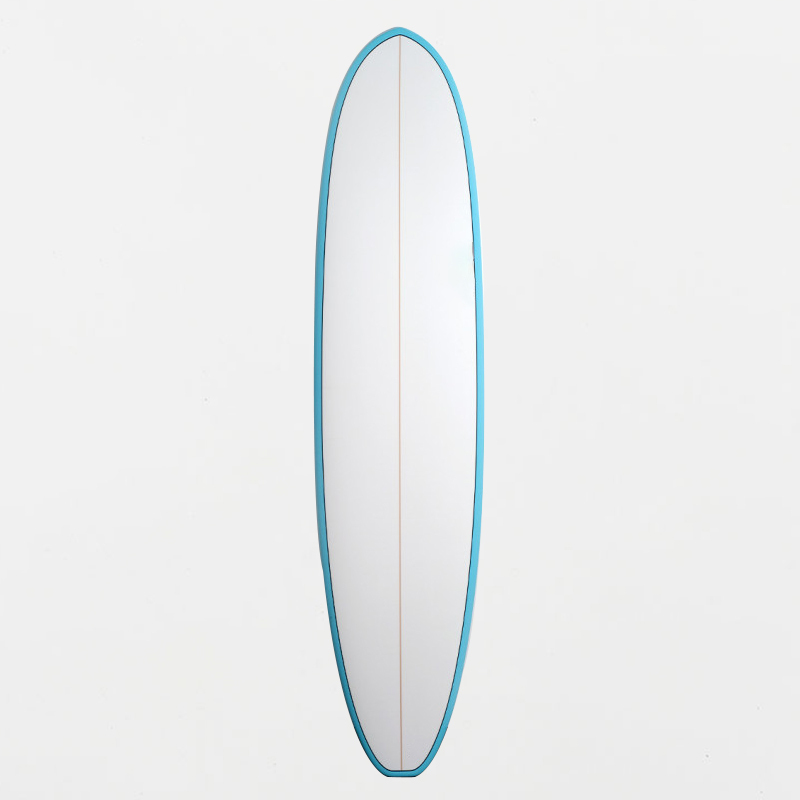
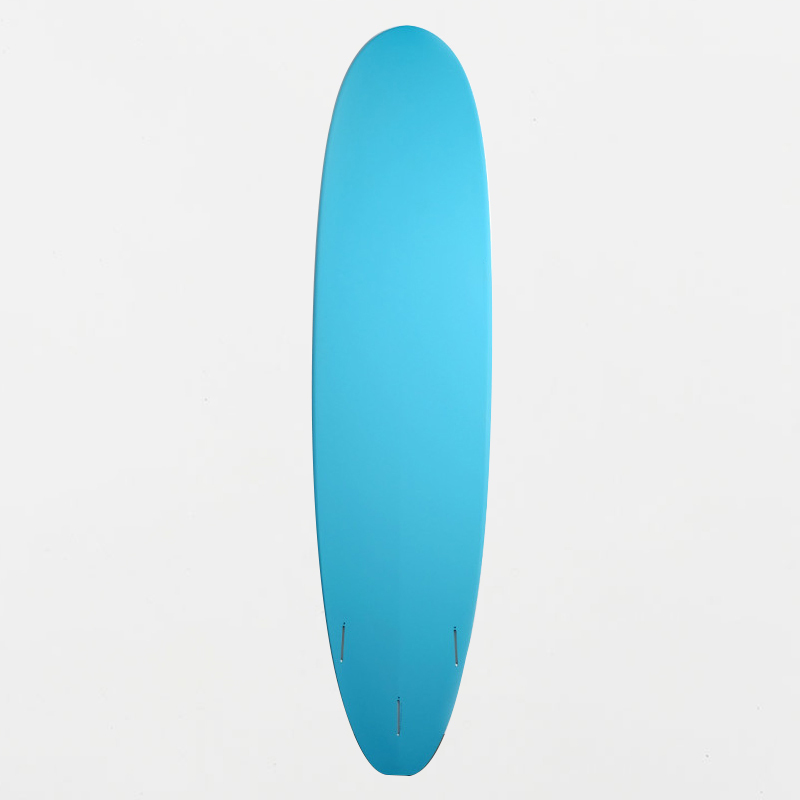
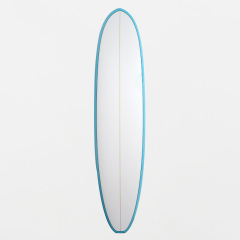
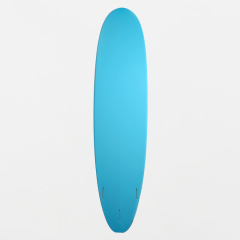
This is a big, stable eps epoxy surfboard built to be used hard: 8ft2 long, with the volume of a mini-longboard and a laminate meant for daily handling rather than occasional weekends. The deck is white, the rails and the whole underside are blue, and a wooden stringer runs down the centreline. It reads cleanly on a store wall and stays easy to pick out from the beach when a dozen boards are out at once. We build it for buyers who need one length to cover most of their customers: rental operators handing the same board to a light teenager in the morning and a heavy adult after lunch, shops filling the gap between their shortboards and their full-length logs, and distributors who want a dependable volume shape in stock rather than a specialist one. This board is a stock shape we run continuously, not a one-off commission.
Construction & Laminate
- EPS core. The blank is expanded polystyrene rather than polyurethane, which is what makes this an eps epoxy surfboard rather than a traditional glass-over-poly build. It is lighter for the same volume, so a board of this length stays manageable to lift and carry.
- Fibreglass and epoxy resin. The core is glassed on deck, bottom and rails with epoxy resin. Epoxy bonds more aggressively to both the foam and the cloth, which is why this construction resists the pressure dents and star cracks that finish a poly board early.
- A wooden stringer down the centreline. The timber stringer you can see in the deck photograph stiffens the board nose to tail and helps it hold its rocker, so the curve is still there after a season of being stacked, strapped and stood on end.
- Rails that take the knocks. Rails meet other boards in a rack, the sand, the car park and the inside of a van. Rail cracks are what put a fleet board out of service first, so the rail laminate is the part of the build to look at before you commit to a quantity.
- A deck built for standing on. Heels and knees land in the same two patches of deck all day in a school or rental setting. That is where pressure either becomes a soft spot or stays cosmetic.
- Built for the second season. Fleet buyers retire boards when the tail softens and the rails crack, not when the graphic fades. The EPS, glass and epoxy combination is specified for that second and third season, which is what a wholesale epoxy surfboards order is really paying for.
- Made under one roof. As an epoxy surfboard manufacturer we control the blank, the lamination, the sanding and the gloss in one facility, so the boards that arrive in March are built the same way as the ones that arrived last August.
- A ding is a maintenance item, not a write-off — provided it is dealt with while it is still small. Put the two outcomes side by side and the arithmetic is straightforward: a patch of glass and epoxy on a rail costs a fraction of a replacement board, while the same break left open through a wet week can soften the foam under the standing area and turn a small repair into a cut-out and re-laminate, or into a board that no longer justifies the labour. On top of that sits the cost that never appears on an invoice — hire days lost on an 8ft epoxy surfboard in the middle of the season. What is worth repairing Rail cracks, nose chips, heel dents that have not yet gone soft and hairline cracks around a fin box are all routine jobs that put the board straight back into service. A deck skin that has lifted across a wide area, a stringer that has snapped, or a core that has taken water over a long stretch are the opposite: the hours exceed the value of the finished board, and the right call is to retire it and replace it from the next production run. Same-day sealing, booked-in repair Split the job in two. Staff seal anything that has broken through the gloss the same day — epoxy putty, a scrap of glass, sandpaper and tape kept in the workshop — so the core stops taking water and the board keeps earning. The proper patch then goes to a repair shop in the quiet week after the swell drops. Tell whoever does the work that the core is EPS, so the repair is laid up in epoxy resin; epoxy bonds to the blank and to the surrounding laminate, where a polyester patch sits on the surface and lifts. Local repair turnaround Find out who will handle your repairs locally and ask what turnaround they can give on rail work before you actually need it. A shop that already knows your boards will turn a patch around in a day or two; a shop meeting them for the first time will want them booked in. Agree the rate for fleet work at the same time, so a month with ten dings in it does not turn into a negotiation. Spares that keep boards in service A missing fin, a rounded screw or a leash that has stiffened with salt keeps a board on the shelf just as effectively as a crack in the rail. Order fin sets, spare screws and plates, and leashes in the same shipment as the boards — fleets that buy wholesale epoxy surfboards in one length usually take the matching parts at the same time and rig them on arrival. When to retire a board A rail rebuilt twice in the same spot, a deck gone soft across the whole standing area, or a board that comes back damaged in the same place every month is telling you something, about how it is racked, stacked or carried as much as about the board itself. Price replacement on a cycle instead of waiting for failure, and a fleet avoids the season where half its boards are in the workshop at once. Keep a repair log One line per board: date, area, what was done. Over a season it shows which models and which lengths come back most often, which is useful when the next order is being put together, and it stops a slow problem in the fleet going unnoticed until the board is beyond saving.
Fins & Fin Boxes
The board is photographed with its fin boxes set into the tail, moulded into the laminate rather than bolted onto a plate. That matters at this size: an 8ft epoxy surfboard takes a lot of load through the tail when a rider leans back to turn or when a wave picks the board up on the inside, and every bit of that load goes into the boxes.
Check the box type before you commit to a fin inventory. Across the range more than one fin interface is used, so confirm which boxes are fitted to the boards you are buying and match your fin stock to it. A single-tab fin and a double-tab fin are not interchangeable, and a box that has been forced will crack at the corner.
As a custom epoxy surfboard supplier we also stock honeycomb fins in single-tab and double-tab variants, made by resin transfer moulding: light, stiff and consistent from set to set. For a fleet, buy fin sets with the boards and keep a few spares on the shelf, because a lost fin is the most common reason a hire board sits out a session.
Standardise the fixing as well. If every board in the fleet uses the same key or screw size, the rental desk is not hunting through a drawer every time a customer wants to change a fin before they go out.
Sizing & Wave Conditions
Eight foot two is a deliberate middle ground. It is long enough to paddle onto a wave a stroke or two earlier than a shortboard, and short enough that a rider can still pivot it from the tail instead of only trimming along the face. Foam is carried through the middle and under the chest, so this eps epoxy surfboard floats a heavy adult without the rail sinking, and it feels steady rather than twitchy under a lighter rider.
Where it works: small to average beach breaks, soft reef days and long rolling whitewater — the conditions most rental fleets and mixed-ability groups actually get. Where it stops: steep, fast, hollow surf, where the length gets in the way and an experienced rider will want something shorter and looser.
There is more glide here than a mid-length and more turn than a full log. In the way it carries speed it is closer to an epoxy longboard surfboard than to a shortboard, without the awkward length of one.
For a buyer assembling a range, that makes it the length that serves the widest middle. If your programme needs maximum float for absolute first-timers, go longer; if it needs quick direction changes for improvers, go shorter. One length that suits most of the group is usually worth more to a rental desk than two specialist lengths nobody quite fits.
Specifications
| Model | B70136 |
|---|
| Length | 8ft2 |
| Board type | High-volume mini-longboard |
| Construction | EPS core, fibreglass, epoxy resin |
| Stringer | Central wooden stringer |
| Deck | White |
| Rails and underside | Blue |
| Finish | Gloss |
| Tail | Fin boxes fitted at the tail; fin system confirmed per order |
| Supplied as | Board only; fins, leash, traction pad, cover and rack are separate items |
Deck, Rails & Colour
- White deck, blue rails. The contrast is not only cosmetic: a white deck stays cooler lying on the sand, and it makes cracks, dings and old wax easy to see during a pre-hire check. - Solid blue underside. From the beach or the patrol tower, a blue underside on a tipped-up board is easier to identify than a white one, especially in flat light. - Built to be spotted. Colour is a working part of a rental board. When six boards are out with six riders, a distinct colourway saves the time staff spend counting and gives customers an easy way to describe which board they had. - Shelf presence. On a rental display floor the white-and-blue finish separates this board from the plain white boards around it, which is the same reason colour-led models sell well next to neutral ones. - A gloss finish you can wipe down. Salt, sunscreen and sand come off this epoxy longboard surfboard with fresh water and a soft cloth at the end of the day, and the shine holds far longer than a matte finish does. - Colour to your palette. Blue and white is the stock colourway.
Leash, Traction, Cover & Rack
- Match the leash to the board. Board length sets leash length: an 8ft epoxy surfboard like this one pairs with an 8ft or 9ft leash, so the cord has room to stretch without loading the rail. Our Hypalon leashes run from 6ft to 9ft, with the cord stepping up in thickness as the length increases.
- Choose the cuff for the whole fleet, not one rider. Hypalon cuffs are light on the ankle and stay comfortable over a long session, which matters when the same leash goes out with a different customer every hour.
- Fit the traction pad before the board gets waxed. Lay the pad on the tail of the epoxy surfboard where the back foot actually lands, mark the outline with tape, peel from one corner and press from the centre outwards. Pads fitted in a hurry usually sit too far forward and end up under the arch of the foot.
- Bag it or cover it. A basic bag protects a board in storage and in the back of a van. A stretch cover is the faster option for an operation pulling boards in and out of a rack several times a day.
- Rack it properly. A storage rack should take the board at two points with the weight spread, a display rack should hold it clear of the floor, and travel rax and tie-downs are for moving several boards at once. Keep racked boards out of direct sun, because heat is what turns a gloss finish yellow over a few seasons.
- Order the accessories with the boards. Fleets that buy wholesale epoxy surfboards in one length usually take the leash, pad and cover on the same order, so the boards arrive rigged and go straight onto the wall instead of sitting in a store room waiting for parts.
Custom Colour & Branding
Stock colourways cover most of the range, but a good share of what we build is specified by the buyer: a house colour on the rails, a deck graphic, a logo at the nose, or a finish that matches the rest of a store fit-out. Most custom epoxy surfboard supplier programmes start from a shape we already cut — this 8ft2 outline included — and change the finish rather than the engineering.
The sequence is straightforward. Send your artwork or a colour reference, we come back with a deck sample or a colour chip, you approve it, and production is scheduled against that approval. Artwork is easiest to work from as vector files, with the print size and placement marked on a deck outline.
What does not change is the build: core, laminate and stringer stay as specified, because the board's service life depends on them. Colour and graphics are the variables; the structure is not.
If your range needs something closer to a classic epoxy longboard surfboard, or a shorter shape under the same colourway, that is a separate conversation about the template. Raise it early, because a new template takes longer than a colour change.
Ordering & Delivery
- Send the mix, not just the model. Lengths, colourway, whether the order includes fins, pads, leashes or covers, and where the boards are going. The more of that we have at quote stage, the fewer assumptions end up in the packing list.
- Confirm the commercial terms per order. Minimum order quantity, lead time, payment terms, incoterms and freight are set for each order and destination, so ask your sales contact for current figures against your quantity rather than working from an older quote.
- Ask about samples. If you need to handle the shape and the finish before committing to a season, ask your sales contact about sample availability and how a sample would be shipped to you.
- Agree the packing before it ships. Boards normally travel sleeved, with extra foam or bubble protection at the nose and tail, then crated or cartoned in multiples. Confirm the packing method for your route and your handling equipment when you place the order.
- Changes go through the factory. Because we are the epoxy surfboard manufacturer, a late change to a deck graphic or a colourway stops at our own production planning instead of being relayed to a third party and lost.
- Custom work runs to its own schedule. If the order carries logos or a house colour, treat it as a custom epoxy surfboard supplier programme and fix the date after artwork approval, not before it.
- Flag reorders as reorders. Tell us when an order is a repeat wholesale epoxy surfboards shipment, and we build it to the same schedule as the run before.
Scale & Supply Capability
CIMI is an epoxy surfboard manufacturer with 16 years in surf and watersports hardgoods, building at our own facility rather than sourcing through traders. Chain stores, supermarkets and surf-brand stores buy from us because one supplier covers a full accessory assortment, so a season's order and its reorders can be planned together. We take on OEM and private-label work, adapting designs, colourways and branding to your programme, and we schedule production against your agreed range plan. Send us your buy list and target dates, and we will confirm what we can make and when.
FAQ
Does the deck need wax or a traction pad?
Either, depending on who is riding. The deck is gloss with no texture and no pad fitted, so the board needs wax or a stick-on pad before it goes in the water. A rental or school board usually gets a waxless pad, because it does not need re-waxing between riders and does not soften in a hot van; a private rider on an epoxy surfboard of this size often prefers wax for feel. Whichever you choose, clean and dry the deck first, because anything applied over dust or old wax will lift.
Can a ding be repaired, and how urgent is it?
A ding through the glass needs drying out and a patch of glass and epoxy, and a crushed rail is the same job with a little more shaping. Fix it promptly: the EPS core does not draw water along the length of the board the way some foams do, but a ding left open through a wet week will still soften the foam around it, and a soft patch under the heel is a much bigger repair than a sealed crack. Most coastal repair shops work on epoxy boards, and a fleet should keep a small kit on site so anything through the gloss is sealed before the board goes back out.
Is 8ft2 too much board for a lighter rider?
In the water, no. The volume is what makes it stable, and a light rider will find it easy to paddle and stand up on. On land it is a different story: an 8ft epoxy surfboard is awkward through a doorway, on a narrow stair and on a small car roof, and it takes more commitment to turn than a shortboard. For a school or a rental desk that trade is usually worth it, because one length covers the widest range of people in the group.
Does the EPS core change how the board feels?
It changes the feel more than the outline does. The core is lighter for the same volume, so the board picks up speed quickly under paddle and feels lively rather than damped on the wave. Riders moving off a poly board usually notice the weight first and the stiffness second; riders coming off a soft-top notice the hard, responsive deck straight away.
What should we check on a fleet board at the start of a season?
Work from nose to tail. Run a thumb along both rails for cracks, press the deck where heels land for soft spots, look closely around the fin boxes for hairline cracks in the laminate, and check the stringer line on deck and bottom for any change of colour that suggests water has got in. Leashes and pads are usually the first items to fail on a hire board, so inspect them at the same time and replace anything that has stiffened, stretched or lifted. Anything that has gone through the gloss should be sealed before the board goes back on the water.