Product Overview
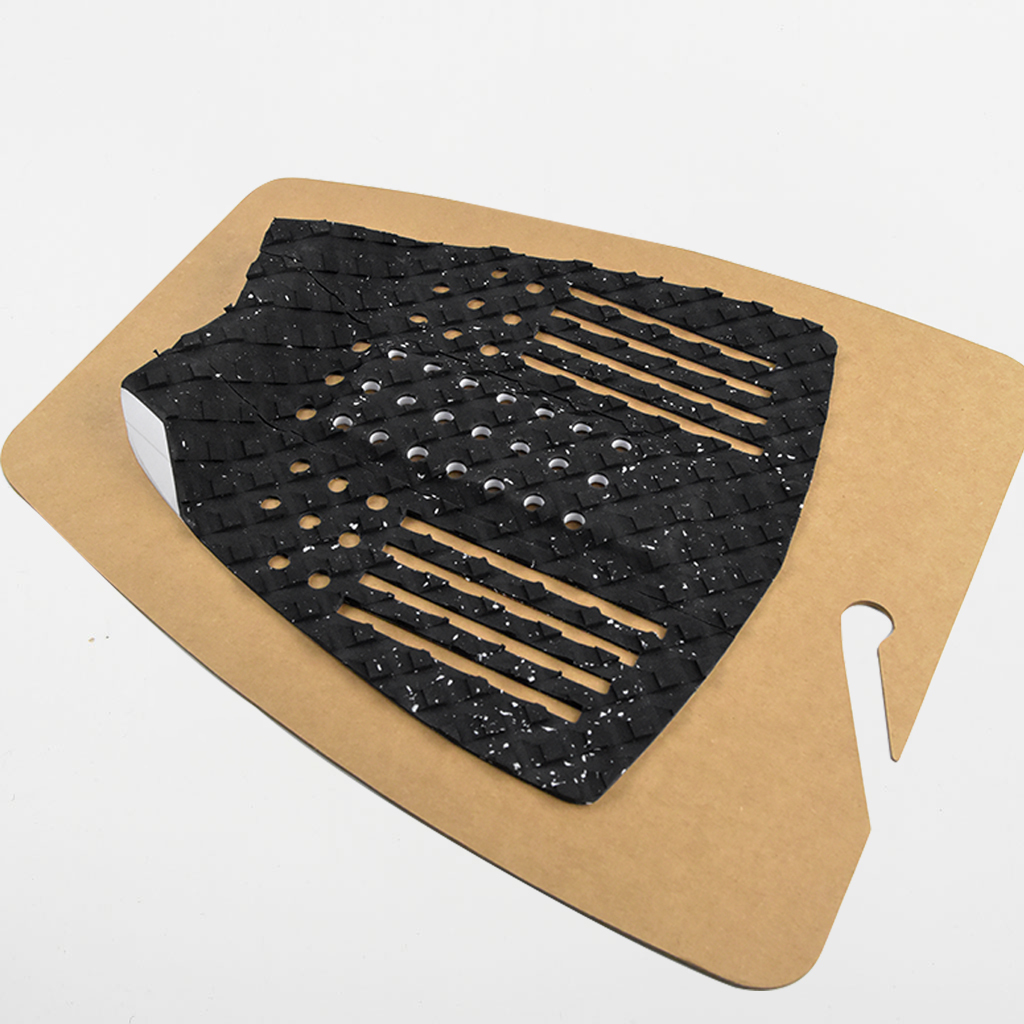
This surf traction pad sits on the tail of a surfboard deck, right where the back foot lands and where wax wears through first. The outline follows the tail curve, which is what keeps the corners down flat rather than curling up where a heel catches them, and the black surface is flecked with light speckles that break up wax smear and sand between cleans. Most of these pads are bought as replacement parts. A board comes in with grip that has gone smooth, lifted at one edge or peeled back to bare deck; the old pad comes off, the deck is cleaned, and the new one goes down over the same footprint. Shops fitting pads for customers, rental fleets refreshing a set of boards before the season and buyers building a traction line for a shop all work from the same product, which is why it is supplied as a straightforward peel-and-stick pad rather than a kit. Because this is a tail pad and not a full-deck grip, the front half of the board stays free for wax, which is still what most shortboard riders want. On a longer board it covers the area behind the back foot and stops there, so the waxed walkway forward of it is untouched. CIMI has been building surf hardware since 2007 as one of the surf board manufacturers supplying shops, chains and private-label programmes, and this pad sits in a range that runs from tail pads through centre pads to waxless decks.
Grip Surface & Deck Feel
- Raised grip blocks: the surface stands up in small moulded blocks rather than lying flat, so the ball of your back foot bites into it when you drive through a turn instead of skating over a smooth sheet.
- Perforated holes: the pierced pattern lets water and air move across the deck instead of trapping a film under the foot, and it gives wax somewhere to settle so the pad does not turn into one slick patch.
- Horizontal slots: these run across the pad and work as a brace — slide your back foot rearwards and it stops against an edge rather than slipping off the tail.
- Contoured outline: the shape is cut to follow the tail curve, which is what keeps a surfboard traction pad sitting flat at the corners through a full season of use.
- Cushioned underfoot feel: there is enough give to take the sting out of a hard landing off a section without turning the tail soft and vague when you push against it.
- Speckled black surface: the light flecks hide wax smear and sand, so a working board still looks presentable when it goes back on the shop rack.
- Consistent across a fleet: fitting the same traction pad across a rental or school set means every board feels the same underfoot, which is why surf board manufacturers and fleet operators standardise on one design for a whole quiver.
Fitting the Pad
- Strip the old grip back to bare deck. Take off the worn pad or the built-up wax, scrape away old adhesive and wipe the area dry — the new pad bonds to the deck, not to wax, sand or glue residue.
- Dry-fit before any backing comes off. Set the surfboard tail pad in place, square to the stringer and hard against the tail. Check that the surfboard leash plug stays completely clear.
- Mark the outline with two strips of tape. Lift the pad, slide the tape under the edges as a guide, then drop it back down — this is the step that saves you from a crooked pad.
- Let the board and the pad come to room temperature. On a cold day, bring both indoors first; adhesive grabs far better on a warm, dry deck than on a cold, damp one.
- Peel a few centimetres of backing and anchor the tail end first. Work forward from there, pressing from the centre of the pad out towards the edges as you go.
- Press the whole surface down firmly. Run a thumb along the outline to seal the edge, then go back over the blocks and slots so every part of the pad is in contact with the deck.
- Leave the board flat before it goes back in the water. Give the adhesive time to settle, then check the edges after the first few sessions and press down anything that has started to lift. On a longboard traction pad the outline is longer, so line it up twice before you peel.
Care & Longevity
Salt, sun and wax do most of the damage to deck grip, and all three are easy to manage. Rinse the board with fresh water after a session and let it dry out of direct sunlight — a pad that stays hot in a car or against a wall for hours softens and loses its edge sooner than one that dries indoors.
Wax is the other slow killer. Rather than scraping hard at the surface, soften it with warm water and lift it off with a soft cloth or brush, working with the pattern rather than across it. Solvents and aggressive cleaners are not worth the risk on a textured surface.
Sand and grit trapped in the holes and slots do more harm than they look like they do, because they grind the texture smooth every time a foot lands on them. A quick rinse and a soft brush after a beach session keeps the pattern open. Check the outline every few weeks as well; the first sign of a pad going is usually a corner lifting, and pressing it back while the board is clean and dry is far easier than trying to re-bond it later.
Storage matters more than most riders expect. Stand the board on a surfboard rack or lay it flat rather than leaning it tail-down against a wall, which puts constant pressure on one edge of the pad. If you run a rental or school set, expect a longboard traction pad to take more traffic than a shortboard pad simply because more people stand on that part of the deck, so build a quick edge check into the turnaround between sessions.
Leash, Fins, Traction, Cover & Rack
- Leash: the pad is cut to leave the plug clear, so the surfboard leash you already run goes straight back on once the pad is down, with no re-drilling and no change to the rail saver.
- Fins: honeycomb fins in single tab and double tab fitments, made with a resin transfer process, so a board can be re-finned in the same order as the grip.
- Traction: this is one design in a deep traction range — other tail pads, centre pads, skimboard pads and waxless decks, which is how a shop builds a full surfboard traction pad wall rather than one hook of the same look.
- Covers: basic bags, regular bags, stretch covers and bodyboard bags, for the customer who buys a board and wants to protect the new grip on the way home.
- Racks: travel rax and tie-downs, storage racks, display racks and bike racks — useful when the board is going back on a surfboard rack in a shop, a garage or on a car.
Specifications
| Property |
Value |
| Product type |
Surf traction pad |
| Reference |
No.00551 |
| Design |
Black pad with a light speckle |
| Grip surface |
Raised blocks, perforated holes, horizontal slots |
| Outline |
Contoured tail shape |
| Fitting position |
Tail of the deck, under the back foot (surfboard tail pad) |
| Fixing |
Self-adhesive backing, peel-and-stick |
| Board types |
Surfboards, longboards and hybrid shapes |
| Finish |
Textured, non-gloss |
| Construction |
Moulded grip surface on a flexible base |
Ordering & Confirmation
- Send the reference if you are reordering, or a photo of the surfboard tail pad you are replacing — No.00551 identifies this design, and a picture settles it faster than a description.
- Tell us the boards it is going on. Shortboard, longboard or hybrid changes the traction pad for surfboard fit, because tail width and how much deck sits behind the back foot both affect which outline works.
- Ask for the current design list before you commit a shelf. The range is deep, and checking the other tail pads first stops you stocking two designs that look the same from a metre away.
- Ask your sales contact about sample availability, so you can judge the grip texture and the finish in your own hands before placing a run.
- Raise branding early if the pad is going out under your own label — as surf board manufacturers we take on private-label work, and the earlier artwork and packing are agreed, the smoother the run goes.
- Confirm packing and presentation for your shelf, including whether the pad is merchandised on a hanger or bagged with the rest of your traction set.
- Confirm lead time and terms with your sales contact, and mention any mixed order at the same time — pads, leashes, fins, covers and racks all come out of the same factory.
Scale & Supply Capability
CIMI is a factory-based supplier with 16 years in surf and watersports hardgoods, manufacturing at our own facility rather than sourcing through traders. Chain stores, supermarkets and surf-brand stores buy from us because one supplier covers a full accessory assortment, so a season's order and its reorders can be planned together. We take on OEM and private-label work, adapting designs, colourways and branding to your programme, and we schedule production against your agreed range plan. Send us your buy list and target dates, and we will confirm what we can make and when.
FAQ
Will this surf traction pad fit my board?
It covers the area under the back foot and stops before the waxed front half, which is the shape most shortboards and hybrid decks take. Wide-tailed fish shapes and longboards carry more deck behind the back foot, so hold the outline against your board before the backing comes off. A photo of the tail is usually enough for us to tell you whether it is the right fit.
Is it worth fitting on a longboard?
Yes — a longboard traction pad takes the wax top-up out of the area that gets the most foot traffic and keeps the deck consistent when different riders use the board. It still only covers the tail, so the walkway forward of your back foot stays waxed for trimming and nose riding. Longer outlines need more care when lining up, so check the shape against the board first.
What makes a surfboard traction pad lift at the edges?
Almost always preparation. The adhesive bonds to the deck itself, so wax, sand or old glue left under the outline will let go, usually at a corner first. Clean back to bare, dry board, press from the centre outwards, seal the outline with your thumb and leave the board flat before the first session. If a corner lifts later, press it back while the board is clean and dry rather than waiting for it to curl.
Can I trim it for an unusual tail shape?
Trim before the backing comes off, and keep the outer band of the outline intact so the edge still seals. A traction pad for surfboard tails that are much wider or much narrower than a standard shortboard is usually better matched to another design than cut down, so send the tail shape and we will point you at the closest option.
Do I need to take the surfboard leash off to fit it?
Unclip it and move the cord clear so it does not drag across the deck while you work. The plug stays where it is — the pad goes around it, not over it, which keeps the leash easy to thread and replace later. Check that clearance at the dry-fit stage, because shifting a pad after it has bonded is far more work than shifting tape.
Can the board be stored on a rack with the pad fitted?
Yes. A surfboard rack holds the board by the rails or the deck, and the pad only covers the tail, so the contact points are unaffected. Rinse and dry the board before it goes back on the rack, and keep it out of direct sun — grip that stays hot for hours softens and dulls sooner.